


Landing in Las Vegas with plans to explore more than the casino floor often means renting a car at Harry Reid International Airport. The city’s huge consolidated Rent-A-Car Center, 24 hour shuttles, and sprawling resort garages make driving relatively straightforward, but the details on deposits, insurance, and Strip parking fees can surprise first time visitors. This guide walks you through how the airport rental system works, what to expect at the counter, and when a car actually makes sense for a Las Vegas trip.
Get the latest updates straight to your inbox!
How the Harry Reid Rent-A-Car Center Works
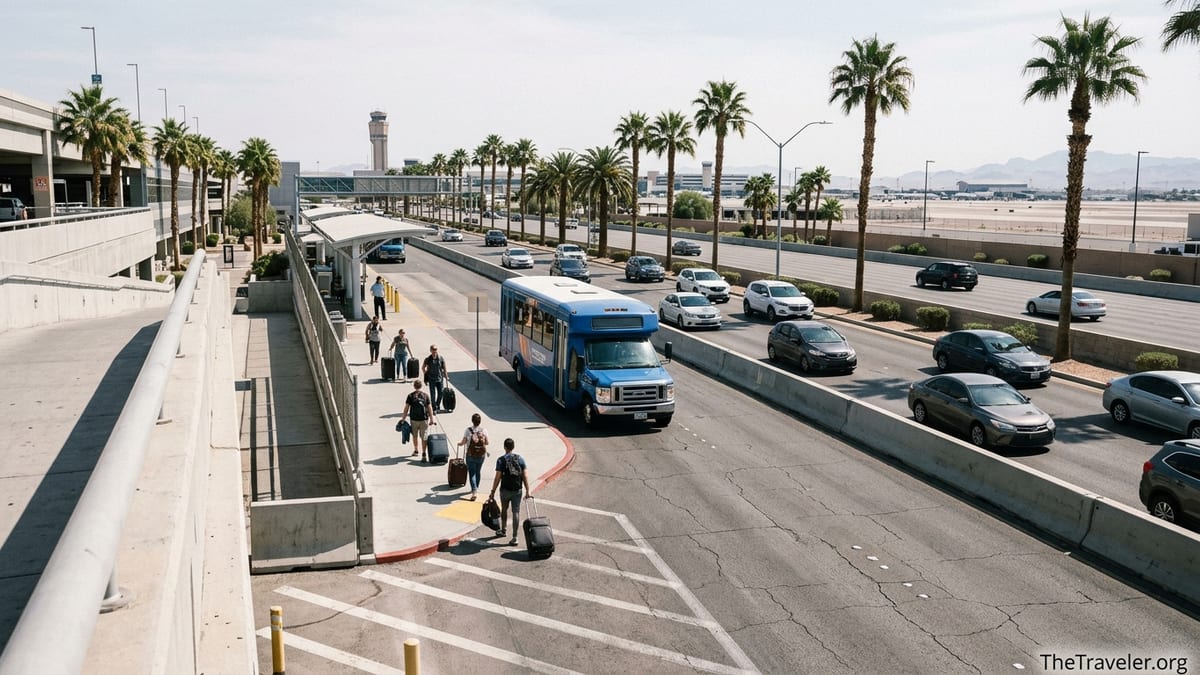
Harry Reid International Airport uses a consolidated Rent-A-Car Center located about three miles south of the passenger terminals at 7135 Gilespie Street. The facility houses the major brands most visitors recognize, including Alamo, Avis, Budget, Dollar, Enterprise, Hertz, National, Payless, Sixt and Thrifty, along with several smaller operators. It operates 24 hours a day and is connected to the terminals by a dedicated shuttle system, so you will not pick up a car directly outside baggage claim.
After you land, follow signs for “Rental Car Shuttle” rather than trying to find individual company buses. At Terminal 1, shuttle stops are outside doors 10 and 11 on the baggage claim level. At Terminal 3, you head to Level 0 on the west end of the building, following ground transportation signs. Buses are clearly marked and circulate continuously, typically every 10 to 15 minutes depending on the time of day, and the ride to the Rent-A-Car Center usually takes less than 10 minutes in light traffic.
Once you arrive at the Rent-A-Car Center, you will find all the rental counters lined up on the main floor, with parking decks behind the building. Many companies now offer expedited pickup through loyalty programs such as Hertz Gold Plus, National Emerald Club or Avis Preferred, allowing you to bypass the main counter and go straight to the garage to choose a car from a dedicated aisle. This can easily save 20 to 30 minutes during busy periods like major conventions or big fight weekends.
When you return your car, you drive back to the same Rent-A-Car Center address, follow signs for your company’s return lane, then walk or take a short escalator ride to the shuttle boarding area. Shuttles then take you back to Terminal 1 or Terminal 3. If you have an early morning flight, the 24 hour operation is a real plus; travelers regularly drop cars at 3 or 4 a.m. and still find the return process staffed and shuttles running.
Free Airport Shuttles, Timing and First Day Logistics
The rental car shuttles at Harry Reid are free and run on a continuous loop between the terminals and the Rent-A-Car Center. You do not need a ticket to board; you simply line up at the clearly signed stops. Most visitors wait under 10 minutes for a bus outside peak surges, though on Sunday afternoons and during conventions you may see a full bus depart and need to wait for the next one.
From wheels-down to driving out of the garage, plan for at least 45 to 60 minutes if you are checking bags. A typical sequence looks like this: 15 minutes to deplane and reach baggage claim, 10 to 15 minutes to wait for and ride the shuttle, and another 15 to 30 minutes to complete the paperwork and walk to the car. Travelers arriving late at night sometimes move faster, especially if they used online check-in and are part of a loyalty program that allows them to head straight to the garage.
On departure day, give yourself a buffer for returning the vehicle, especially during morning peak hours. From a mid Strip resort like Bellagio or Paris, the drive to the Rent-A-Car Center via the airport connector tunnel can take as little as 10 minutes in light traffic, but 25 to 30 minutes is safer when Las Vegas Boulevard or Tropicana Avenue are congested. Add 20 to 30 minutes for the return process and shuttle back to your terminal, plus the time you need for check in and security. For a domestic flight, many visitors aim to leave their hotel roughly three hours before departure when returning a car.
If you prefer to simplify arrival, one strategy is to take a taxi or rideshare to your hotel on day one and pick up a rental later in your stay from an in town location operated by the same brands. Many companies have Strip or off Strip neighborhood offices with shorter lines than the airport. This can make sense if you only need a car for a couple of day trips rather than your full stay.
Deposits, Credit Cards and Debit Card Rules
One of the most confusing aspects of renting at Harry Reid is the security deposit and how different companies treat credit and debit cards. In practical terms, every major rental company will place a hold on your card that combines your estimated rental charges with an additional security amount. At Las Vegas airport locations, visitors commonly see holds in the range of 200 to 500 dollars on top of the base rental estimate, though the exact figure varies by company, vehicle type and whether you use a credit or debit card.
Credit cards are the path of least resistance. If you present a major credit card from Visa, Mastercard, American Express or Discover, most airport counters simply authorize the required amount and release the remaining credit line. You will not see any cash actually leave your account; the extra funds are just frozen until you return the car undamaged and the final bill posts. For a one week midsize rental quoted at 400 dollars, it is common to see an authorization of about 600 to 800 dollars.
Debit cards are accepted at several Harry Reid airport brands but usually under stricter conditions. Enterprise and Avis, for example, note that at airport locations you must present a debit card with enough available funds plus proof of a return airline ticket that matches your rental dates. Vehicle options may be limited to certain classes when using a debit card, and the deposit hold can be larger than for credit cards. Local renters without a return flight may find that some counters refuse debit cards entirely or require a credit card instead.
Because policies change often and can differ slightly by location, it is crucial to read the “Renter Requirements” section on your chosen company’s Las Vegas airport page before you travel and to arrive with a back up card if possible. If you only have a debit card and limited funds, consider whether a shorter rental or a smaller vehicle will lower the hold, and check your bank’s daily limit so the authorization does not trigger a fraud alert that could delay your pickup.
Insurance, Fuel Policies and Avoiding Costly Surprises
At the counter, agents will usually offer a menu of optional protections with names like “loss damage waiver,” “supplemental liability,” and “personal accident insurance.” In the United States these add on coverages can easily double the daily rate of a basic rental. A compact booked for 40 dollars a day can climb to 80 dollars or more once waivers and extras are accepted, so it pays to understand what you already have before you arrive in Las Vegas.
If you own a car at home, many standard U.S. auto insurance policies extend collision and liability coverage to rental cars of similar type within the country, though deductibles and limits still apply. Certain premium credit cards also provide secondary or even primary rental car coverage when you pay for the rental with that card and decline the company’s collision damage waiver. Because rules are detailed and card benefits vary, travelers should confirm with their insurer or card issuer in advance rather than relying on brief explanations at the counter.
Visitors from abroad or those without personal auto insurance are often better served by purchasing some form of coverage offered by the rental company or a reputable third party. Without any coverage, you could be responsible for the full value of the car if it is damaged or stolen, plus “loss of use” fees while it is out of service. As a simple example, scratching the side of a midrange SUV in a tight Strip parking garage could generate a repair bill in the thousands of dollars if you are completely uninsured.
Fuel policies also deserve attention. Harry Reid locations typically offer three choices: prepay a full tank at a fixed price per gallon, return the car full and avoid fuel charges, or return it partially empty and pay a premium per gallon for the company to refill it. Because gas stations are plentiful near the airport and along Tropicana, Flamingo and Tropicana East, most cost conscious travelers choose to refuel themselves. A practical tactic is to top up at a station on the way to the Rent-A-Car Center, keep the receipt, and photograph the full fuel gauge just before you park.
Driving in Las Vegas and When a Rental Car Is Worth It
Driving in and around Las Vegas is more straightforward than many first timers expect. Streets are laid out on a grid, signage to the airport and major resorts is clear, and the Harry Reid Airport Connector provides a direct tunnel route between the freeway and Tropicana Avenue near the University of Nevada, Las Vegas campus. The main stress points are heavy weekend traffic on Las Vegas Boulevard and long red lights at major Strip intersections, which can make a short distance drive feel slow.
A rental car makes the most sense if you plan to explore beyond the Strip. Popular day trips include Red Rock Canyon National Conservation Area roughly 30 minutes west, Hoover Dam and Lake Mead about 45 minutes to an hour southeast, and Valley of Fire State Park about an hour northeast. Families who want to visit off Strip attractions such as the Pinball Hall of Fame, local restaurants in Chinatown, or outlet shopping centers on both sides of town also find a car valuable.
If most of your time will be spent at a single or adjacent Strip resorts, you might not need a car at all. The Strip is walkable in segments, and taxis, rideshares, and the Las Vegas Monorail cover many common routes. For example, a couple staying three nights at Paris and mainly planning to visit neighboring resorts like Bellagio and Planet Hollywood will likely spend less on occasional rideshares than on a three day rental plus parking and fuel.
Costs provide a useful decision point. A basic rental car from Harry Reid often starts in the range of 40 to 70 dollars per day before taxes and fees, depending on season and demand, while daily self parking on the Strip can add 18 to 30 dollars at many resorts. For a solo traveler who only needs to reach the convention center and back each day, those combined costs may outweigh the convenience of having a personal vehicle compared with taxis or the monorail. For a family of four making several off Strip trips over a week, the flexibility of a car usually justifies the expense.
Strip Parking: What to Expect and How to Keep Costs Down
Most major Strip resorts now charge for self parking, particularly along the central corridor. MGM Resorts properties such as Bellagio, Aria, MGM Grand and Mandalay Bay, and Caesars Entertainment properties like Caesars Palace typically use a tiered pricing system based on how long you stay in the garage, with the first hour often free or low cost, followed by daily maximums that commonly land in the high teens to upper twenties for standard weekday stays and higher event rates on peak nights.
There are still some bright spots for budget conscious drivers. As of mid 2026, several properties toward the north and south ends of the Strip, such as Treasure Island and Circus Circus, generally offer free self parking for hotel guests and visitors, though policies can change and special events may trigger different rules. Many off Strip hotels and local casinos a short drive away also provide free or cheaper parking, though you will trade savings for time spent walking or riding back to the main Strip.
Loyalty programs and credit cards can significantly reduce or eliminate parking fees. MGM Rewards members at Pearl tier and above, or holders of certain co branded MGM credit cards, often receive complimentary self parking at all MGM resorts. Similar benefits exist within the Caesars Rewards program for mid and upper tier members or affiliated credit card holders. Frequent visitors sometimes focus their play or stays with one group to unlock these parking perks, which can easily save more than 100 dollars across a multi day trip.
To avoid surprises, always check the latest parking policy for your specific hotel in the weeks before you travel, and be cautious about event days when garages may shift to flat “event pricing” that is higher than standard daily rates. When pulling into a garage, take note of signs at the entrance that list current rates, maximums and validation rules. If you plan to hop between several resorts in a single evening, it can be cheaper and less stressful to park once at a central property and walk rather than paying multiple garages or getting stuck in late night Strip traffic.
Practical Tips for Smooth Pickups, Returns and Strip Driving
A few simple habits can make renting and driving from Harry Reid much smoother. Before you leave the Rent-A-Car Center, walk around your vehicle with the rental agent or take your own photos of each side, including any existing dings, wheel scrapes or windshield chips, plus a picture of the fuel gauge and odometer. Las Vegas rentals see heavy use from visitors and convention traffic, so it is not unusual to find minor cosmetic wear. Documenting it upfront helps avoid disputes later.
Plan your first driving route before you land. Many visitors head straight from the airport to key Strip intersections like Tropicana and Las Vegas Boulevard or Flamingo and Las Vegas Boulevard. Setting your phone’s navigation to your hotel while you are still on airport Wi Fi, then starting driving directions again once you leave the Rent-A-Car Center, reduces fumbling with maps in unfamiliar traffic. If your rental includes built in navigation, confirm that maps are up to date; otherwise, rely on a smartphone app you already know.
In Strip garages, park thoughtfully. Choose well lit areas near elevators and remember that upper levels often have more available spaces. Take a quick photo of your level and section marker, as garages at large resorts such as MGM Grand or Caesars Palace can be sprawling and visually similar. At night, allow extra time to exit garages after popular events; a concert at T Mobile Arena, for example, can cause long lines of cars exiting nearby resorts and backing up onto Tropicana or the surrounding streets.
On your last day, refill fuel in advance rather than searching near the Rent-A-Car Center under time pressure. Gas prices closer to the Strip are often slightly higher than in suburban neighborhoods, but the difference across a single tank is usually modest, while the convenience of a straightforward return can be significant. Once back at the Rent-A-Car Center, remove all belongings, check the trunk, and wait for the agent’s confirmation or receipt. You can then head directly to the airport shuttle area without returning to the rental counter unless instructed otherwise.
The Takeaway
Renting a car at Harry Reid International Airport is generally efficient thanks to the consolidated Rent-A-Car Center and free 24 hour shuttles linking it to both terminals. For travelers planning day trips to Red Rock Canyon, Hoover Dam or Valley of Fire, or those staying off Strip, having a car makes Las Vegas far easier to navigate on your own schedule.
The key is to walk into the process informed. Understand how deposits work with your credit or debit card, decide in advance whether you will rely on personal or credit card insurance or buy coverage from the rental company, and factor Strip parking fees into your overall budget. Balance the costs of daily rental and parking against alternatives such as rideshares, taxis and the monorail, especially if your plans center on a small portion of the Strip.
With realistic expectations and a bit of preparation, driving in Las Vegas usually feels more like navigating a large, modern suburban city than a chaotic resort zone. Follow the signs, give yourself time buffers around arrivals and departures, and use simple strategies like documenting the vehicle and planning your routes ahead. The result is a trip where the car enhances your experience rather than becoming a source of stress.
FAQ
Q1. Where do I catch the rental car shuttle at Harry Reid Airport?
At Terminal 1, follow signs to the Rental Car Shuttle stops outside doors 10 and 11. At Terminal 3, go to Level 0 on the west end and look for ground transportation signs to the rental car shuttles.
Q2. How long does it take to get from my flight to driving a rental car?
In normal conditions, expect 45 to 60 minutes from landing to driving out of the garage, including time to reach baggage claim, ride the shuttle, complete paperwork and find your car.
Q3. How much is the typical deposit for a rental car at Harry Reid?
Deposits are usually handled as card holds and commonly range from about 200 to 500 dollars above the estimated rental charges, with exact amounts varying by company, vehicle and payment type.
Q4. Can I use a debit card to rent a car at the Las Vegas airport?
Several major brands do accept debit cards at Harry Reid, but often require proof of a return airline ticket, may restrict vehicle types and sometimes apply higher deposit holds than for credit cards.
Q5. Do I really need to buy the rental company’s insurance?
If you have U.S. auto insurance or a credit card that includes rental coverage, you may already be protected, but you should confirm specifics in advance. Travelers without such coverage are usually wise to purchase some form of protection.
Q6. Is a rental car worth it if I am staying mostly on the Strip?
If you plan to remain around one or two central resorts and make only short trips, rideshares, taxis and the monorail can be cheaper and simpler than paying for a car plus daily parking.
Q7. How expensive is self parking at Strip hotels?
Many central Strip resorts now charge roughly 18 to 30 dollars per day for standard self parking, with higher event rates on busy nights. Some outlying or independent properties still offer free or cheaper parking.
Q8. Are there any hotels on the Strip with free parking?
As of mid 2026, a few properties toward the north and south ends of the Strip, along with several off Strip casinos, generally offer free self parking, though policies can change, especially during major events.
Q9. How early should I leave my hotel to return a rental car before a flight?
For a domestic flight, many travelers leave their Strip hotel about three hours before departure when returning a car, allowing time for traffic, car return, the shuttle ride back to the terminal, check in and security.
Q10. Is driving in Las Vegas difficult for first time visitors?
Most visitors find driving manageable thanks to the city’s grid layout and clear signage. The main challenges are heavy traffic and long lights on the Strip, so planning routes and allowing extra time helps significantly.