


Choosing between Lecce and Bari as a base is one of the most important decisions when planning a Puglia trip. Lecce sits at the southern tip of the Salento peninsula with a baroque historic center and easy seasonal bus links to golden beaches. Bari is further north, a busy waterfront city with the region’s largest airport, major railway junction and fast trains right across central and northern Puglia. The better base depends on whether you care more about Salento’s beaches or having quick transport connections in all directions.
Get the latest updates straight to your inbox!
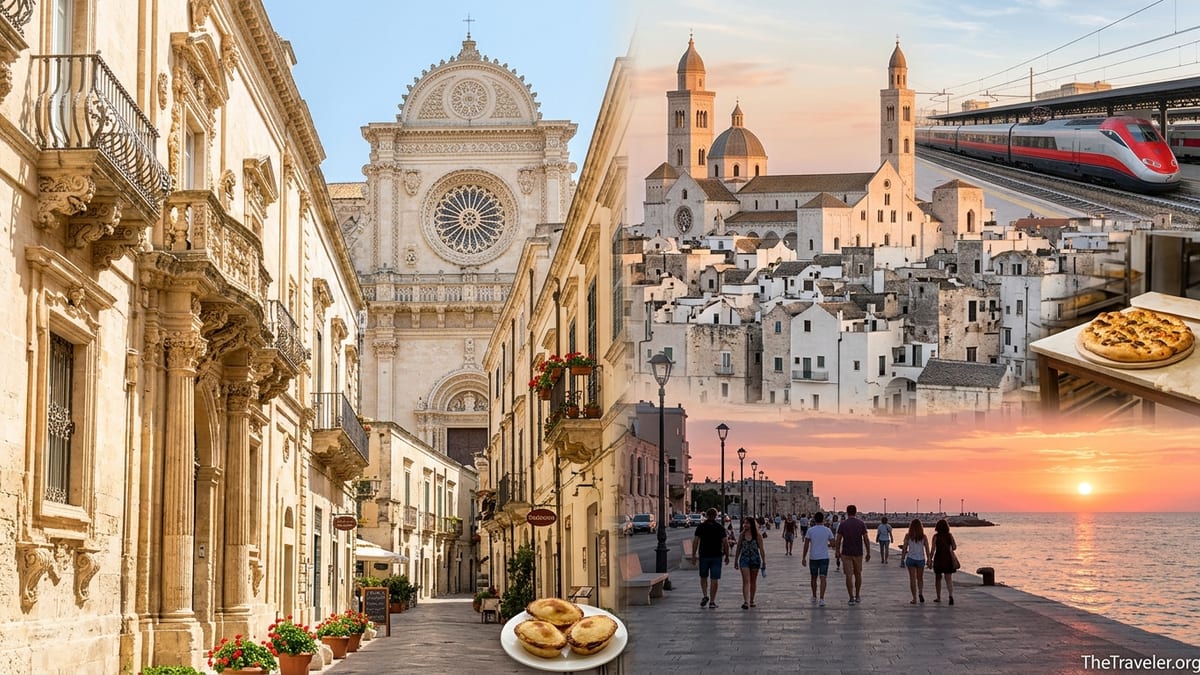
Lecce and Bari at a glance
Lecce is often called the Florence of the South for its dense baroque historic center carved from pale local stone. Within a compact area you walk from the ornate façade of the Basilica di Santa Croce to the elegant Piazza Duomo and Roman amphitheatre in just a few minutes, with palazzi, wine bars and trattorie in between. The city sits in the far south of Puglia, making it ideal for exploring the Salento coasts on the Adriatic and Ionian seas but a longer haul for day trips north.
Bari is a very different experience. It is Puglia’s largest city and main transport hub, with Bari Centrale station handling high speed Frecciarossa and Intercity trains up the Adriatic as well as regional services across the region. Just beyond the tracks lies Bari Vecchia, a tight medieval quarter facing a long seafront promenade where residents gather in the evenings. The atmosphere is more urban and everyday than Lecce, with port traffic, commuters and students alongside visitors.
If your priority is easy access to beaches such as Torre dell’Orso, Porto Cesareo or the coves near Otranto, Lecce’s location in Salento and its summer beach bus network are a major advantage. If you mostly want to string together towns like Polignano a Mare, Monopoli, Trani and even an inland UNESCO site like Alberobello, Bari’s central position and rail connections save a lot of time changing trains and buses.
Neither city’s historic core is directly on a major beach. In Bari you can walk to the small city beach of Pane e Pomodoro along the lungomare in around 25 to 30 minutes from Bari Vecchia, while from Lecce the nearest coasts are at least 20 to 30 kilometers away. In both places, even beach-focused travelers should expect to use public transport or a rented car for actual swimming and sunbathing days.
Airport access and first arrival logistics
Bari Karol Wojtyla Airport lies about 10 kilometers northwest of the city and has its own station inside the terminal. Trains operated by Ferrotramviaria run to Bari Centrale in roughly 17 to 20 minutes, and recent information indicates a typical one way fare around 5 to 6 euros. There is also the Tempesta shuttle bus which usually costs about 5 euros and takes close to 30 minutes depending on traffic, plus standard taxis and app based transfers. For most travelers arriving in Bari, reaching the city center is fast and straightforward, even with luggage.
Brindisi Salento Airport is the closest airport to Lecce. A dedicated coach known locally as the airport shuttle or Pugliairbus connects the terminal with Lecce’s City Terminal near the center in roughly 35 to 40 minutes, with recent prices around 7 to 8 euros one way. Alternatively, you can take a short city bus or taxi from the airport to Brindisi Centrale station and then a regional train to Lecce which typically takes about 30 minutes. Door to door, both options usually come in under 90 minutes, which is still competitive with flying into Bari and then taking a southbound train.
From Bari Airport you can also reach Lecce without entering the city. One common pattern is airport train or shuttle to Bari Centrale, then a Regionale Veloce or Frecciarossa to Lecce. Factoring in connections, that usually means about 2.5 to 3 hours from landing to Lecce station on a smooth day. From Brindisi Airport to Bari, the route reverses: shuttle or local bus into Brindisi, then a Trenitalia service north. That journey tends to be slightly longer overall than going straight into Lecce.
In practice, travelers who want a Bari base often choose Bari Airport for the fast direct rail link and short time into town. Those planning to stay in Lecce or focus on Salento beaches usually find Brindisi Airport more convenient, though price and timing of flights from home can outweigh the ground transport differences.
Trains, regional lines and Salento in Bus
The railway line between Bari Centrale and Lecce is one of Puglia’s main north south axes. On a sample weekday timetable in late 2026 there are well over twenty direct Trenitalia departures per day. Regionale Veloce and Regionale services typically take around 1 hour 41 to 1 hour 45 minutes, with many priced about 13 to 15 euros when booked at the base fare. Faster Frecciarossa high speed trains cover the distance in roughly 1 hour 21 to 1 hour 28 minutes, with recent second class fares starting near the mid 20 euro range, sometimes higher at busy times.
This frequent link means that even if you choose one city as a base, a day trip to the other remains realistic. For example, a couple staying in Bari could board an 8:02 Regionale Veloce, reach Lecce before 10:00, spend the day exploring Santa Croce, Piazza Duomo and museums, then return on a 19:02 or 20:40 departure. Similarly, Lecce based travelers can be in Bari mid morning to explore Bari Vecchia and the seafront and still be back before dinner.
Besides Trenitalia, Puglia is served by several regional rail companies, the most important for this comparison being Ferrovie del Sud Est, or FSE. FSE lines radiate from Lecce and Bari into smaller inland and coastal towns that Trenitalia does not reach directly. Services are slower and trains more basic, but they are invaluable for reaching villages and less touristic beaches. For example, FSE tracks help connect Lecce with Otranto and Gallipoli via inland routes, though in many cases travelers now prefer faster buses or road transfers.
Crucial for beach lovers is the Salento in Bus network. This is a seasonal system of bus routes coordinated by the Province of Lecce that runs each summer, usually from mid June through early or mid September. Lines link Lecce with Otranto, Gallipoli, Santa Maria di Leuca, Porto Cesareo, Torre dell’Orso and many smaller beach communities. In high summer frequencies can be roughly hourly on main routes, while in shoulder months such as early June or late September some lines reduce frequency or do not operate at all. Travelers visiting outside the core season should check carefully, as the lack of these buses can make a rental car almost essential for daily beach visits.
Architecture, neighborhoods and food
In Lecce, most visitors choose between staying inside the historic center or just outside near the station. The old town is a tight web of lanes packed with churches and palazzi in the distinctive Lecce stone. Highlights include the Basilica di Santa Croce with its exuberant sculptures and rose window and the enclosed Piazza Duomo framed by the cathedral and its bell tower. Wandering here in the evening is one of Puglia’s great pleasures, though streets can be lively and sometimes noisy in high summer.
Lecce’s food scene reflects its role as capital of Salento. Traditional dishes to look for include ciceri e tria, a chickpea and pasta stew with pieces of fried dough, and pezzetti di cavallo, small cubes of horse meat stewed in tomato and spices. Aperitivo bars pour local Primitivo and Negroamaro wines by the glass, while bakeries sell rustici leccesi, flaky pastries filled with tomato and mozzarella, and pasticciotti, custard filled tarts typically eaten at breakfast. Around Piazza Sant’Oronzo and the adjacent streets you find a mix of family run trattorie and more contemporary bistros.
Bari offers a contrasting urban texture. Bari Vecchia is the oldest part of the city, a knot of alleys between the port and the grand 19th century Murat district. Here you find the Basilica di San Nicola, an important pilgrimage site for both Catholics and Orthodox Christians, and the cathedral of San Sabino. Along the seafront, the wide promenade stretches for several kilometers, popular for evening passeggiate with sea views and occasional street food stalls.
Culinary traditions in Bari are anchored in wheat and the sea. In Bari Vecchia women still shape fresh orecchiette pasta at ground floor doorways, often serving it with cime di rapa or tomato sauces in nearby trattorie. One of the city’s emblematic bites is focaccia barese, a thick, airy bread topped with tomatoes, olives and plenty of olive oil, sold in panifici throughout the center for a few euros a slice. Compared with Lecce, Bari has more raw fish options, from simple plates of octopus to panini stuffed with seafood near the port, alongside a growing number of modern wine and cocktail bars around Piazza del Ferrarese and the Murat grid.
Day trips without a car
From Bari, independent day trips by train are particularly straightforward. Polignano a Mare lies less than 40 minutes south by Trenitalia regional train, with several departures per hour on many days. From the station, a short walk brings you to clifftop viewpoints over its famous cove and a compact historic center. Just one stop further south sits Monopoli, with a pretty port, low key beaches and a maze of whitewashed streets around its cathedral. Trani lies to the north, typically around 35 to 40 minutes away, prized for its Romanesque cathedral that rises almost directly from the sea and a relaxed harbor lined with bars.
Alberobello, inland and known for its trulli houses, is more complex but still manageable from Bari. Travelers generally take a regional train or FSE service to Alberobello or nearby stations, with a journey time often between 1 hour 15 minutes and 1 hour 45 minutes depending on line and changes. This makes Bari an efficient base for stitching together several of Puglia’s headline sights in consecutive day trips without driving, returning each evening to familiar restaurants in Bari Vecchia.
From Lecce, the focus of day trips naturally shifts to Salento. Trains and buses reach Otranto on the Adriatic coast in a little over an hour in many cases, rewarding you with a walled old town, waterfront promenade and access to nearby coves. Gallipoli on the Ionian side is reachable in around 1 hour 15 minutes to 1 hour 30 minutes by train or coach, with its island historic center connected by bridge and long beaches stretching both north and south.
Porto Cesareo and Torre dell’Orso, both known for fine sand and clear water, are more challenging but still possible without a car during the Salento in Bus season. For instance, you might take a summer bus from Lecce’s city terminal to Torre dell’Orso in about one hour, walk down to the beach and return on an afternoon departure. In late September or early October, when many Salento in Bus routes stop, these same excursions can require a combination of infrequent local buses and taxis that quickly become time consuming or expensive.
Where to stay, rough costs and tourist taxes
In Lecce, charming guesthouses and boutique hotels cluster in the historic center inside the old gates. Recent spot checks for a couple in June or September show many mid range properties in the 90 to 150 euros per night range, with simpler B&Bs sometimes between 70 and 100 euros. Parking is limited inside the old town and much of it falls in restricted traffic zones, so drivers often choose accommodations just outside the walls or near Lecce station, where several modern hotels and B&Bs can include on site or nearby paid parking.
Lecce applies a tourist tax collected by accommodations. Current guidance suggests a per person per night charge that varies by category and season, with reported upper rates around 5 euros per person per night for high season stays in upscale properties from April 2026 onward. Lower categories and off season periods pay less. For a couple spending two nights in a mid range hotel in June, budgeting roughly 8 to 12 euros in total city tax is a reasonable planning figure, but travelers should always confirm the exact amount at booking.
In Bari, the main choice is between Bari Vecchia and the more modern grid around Bari Centrale and the Murat district. Inside Bari Vecchia, accommodations tend toward small B&Bs and apartments in converted family homes, where double rooms in shoulder seasons often range from about 80 to 140 euros per night depending on comfort level and view. Around Bari Centrale, mid range business style hotels and apartment rentals are common, with doubles frequently in the 70 to 130 euro bracket. This area is convenient for early trains but feels less atmospheric than the old quarter.
Bari also levies a tourist tax, again per person per night and scaled by hotel category and duration of stay. For a short two night stay in a 3 or 4 star hotel, a couple might expect a total of roughly 6 to 10 euros in local tax, though amounts can change and are best confirmed directly with the property. Parking in Bari’s historic center is limited and street spaces fill quickly; travelers with cars often prefer hotels a bit away from Bari Vecchia that offer garage options at daily rates, which recent checks place roughly in the 15 to 25 euro per day band.
Sample three day itineraries and budgets
For a couple relying entirely on public transport and choosing Bari as a base, a three day, two night itinerary might look like this. Day one: arrive at Bari Airport, take the airport train to Bari Centrale and check into a B&B in Bari Vecchia. Spend the afternoon exploring the Basilica di San Nicola, cathedral and waterfront, and enjoy an evening stroll and focaccia. Day two: catch a morning regional train to Polignano a Mare, walk the cliffs and historic center, then continue by train to Monopoli for a late lunch and a couple of hours at a nearby city beach before returning to Bari. Day three: take another regional train north to Trani, visiting the seafront cathedral and harbor before heading back for your departure.
For such a Bari based stay in late spring, a reasonable rough budget for two nights could include 200 to 260 euros for a characterful double room in Bari Vecchia, 40 to 60 euros for airport transfers and regional train tickets for all listed day trips, and around 160 to 220 euros for food and drinks depending on dining style. Adding tourist tax and small extras, a couple might look at an overall spend near 450 to 550 euros for the accommodation, local transport and meals portion of a two night, three day visit, excluding long haul flights.
In Lecce, a parallel three day plan might run as follows. Day one: arrive at Brindisi Airport, take the direct shuttle to Lecce, check into a B&B inside the old town, then spend the evening visiting Piazza Duomo and enjoying aperitivo under the baroque façades. Day two: use Salento in Bus or a regional connection to reach Otranto, exploring its cathedral mosaics, harbor and a nearby beach before heading back to Lecce for dinner. Day three: take a bus or train to Gallipoli for a few hours in the historic island center and possibly a dip at a town beach before returning to Lecce and on to the airport the next day.
For a similar June or September window, two nights in a mid range Lecce old town B&B might cost approximately 180 to 260 euros, airport shuttle tickets and local bus or train fares for the Otranto and Gallipoli excursions could total around 60 to 80 euros for two, and food might again sit in the 160 to 220 euro range for three days of breakfasts, lunches and dinners. With tourist tax and small museum entries, the practical budget ends up broadly comparable to Bari for many couples, with differences driven more by specific hotel and restaurant choices than by the city itself.
When to rent a car, seasons and accessibility
For travelers fixated on reaching remote coves, quiet stretches of sand or inland villages with little public transport, renting a car can be worthwhile from either Lecce or Bari. In Salento, a car opens up smaller beaches between Santa Cesarea Terme and Castro, lesser known spots beyond Porto Cesareo, and interior wine villages on flexible day loops. From Bari, driving simplifies visits to the Valle d’Itria countryside between Locorotondo, Cisternino and Martina Franca, or allows quick detours to castles and rural masserie that trains do not reach.
However, urban driving and parking can be stressful. Both Bari and Lecce have restricted traffic zones in their historic centers, enforced by cameras, and streets are narrow. Many visitors choose to base in the city car free and rent a vehicle only for specific days, picking it up at the edge of town or from the airport. This strategy works particularly well if you want a few days of cultural sightseeing by train and bus followed by a focused stretch of beach hopping with more independence.
Summer in Puglia is hot, especially in July and August, when daytime highs often rise above 30 degrees Celsius and nights can remain warm and humid. In this period, Lecce’s baroque stone streets can feel baking at midday and both cities see higher visitor numbers. The trade off is that this is exactly when the Salento in Bus network and many coastal services run at their fullest, making a car less essential for beach access. In shoulder seasons such as May, early June, late September and October, temperatures are more comfortable for city walking but some beach buses and smaller coastal businesses reduce hours or close.
Accessibility considerations differ slightly. Bari Centrale and Bari Airport’s rail link provide step free access and modern trains, and the city’s seafront promenade is mostly flat, making it relatively easy for travelers with limited mobility to enjoy long, level walks. In Lecce, much of the old town is also flat, but cobbled surfaces and occasional uneven pavements can be challenging for some. Many historic buildings, including small guesthouses in centuries old palazzi, have stairs and no lifts, so anyone with mobility concerns should check accommodation details carefully and consider staying closer to the station zone where modern hotels are more common.
So which base wins?
For beaches, Lecce comes out ahead. Its southern position and access to both Adriatic and Ionian coasts, combined with the summer Salento in Bus network, make it the better choice if your priority is spending multiple days by the sea around Otranto, Gallipoli, Porto Cesareo or Torre dell’Orso without constantly changing hotels. Just remember that outside the main summer timetable, reaching those beaches without a car becomes more complicated.
For transport, Bari is the stronger hub. Bari Centrale’s role as a major railway junction with frequent regionals and long distance Frecce trains means you can day trip efficiently to Polignano a Mare, Monopoli, Trani, Barletta, Foggia or even farther afield. Combined with the fast airport rail link, this makes Bari particularly appealing for shorter trips where you want to see several different towns in three or four days.
In terms of food, both cities are rewarding, but many travelers who love seafood and street life lean toward Bari for its fresh focaccia, raw and cooked seafood by the port and numerous casual spots in and around Bari Vecchia. Those who prefer wine bars, rich baroque backdrops and Salento specialties might favor Lecce, where pasticciotti, rustici and robust Negroamaro reds punctuate an evening passeggiata.
Architecture and atmosphere tilt in Lecce’s favor if you love ornate baroque detail and a cohesive historic core, while Bari shines for its mix of medieval lanes and 19th century boulevards on the waterfront. For airport convenience, Bari is best for Bari city stays and northern itineraries, while Brindisi Airport aligns naturally with a Lecce and Salento plan. For first time visitors to Puglia who want an overview using only trains and buses, Bari is often the more forgiving starting point. For those returning to the region or already sure they want to focus on southern beaches and slower evenings in a baroque town, Lecce is the more evocative base.