


More news on this day
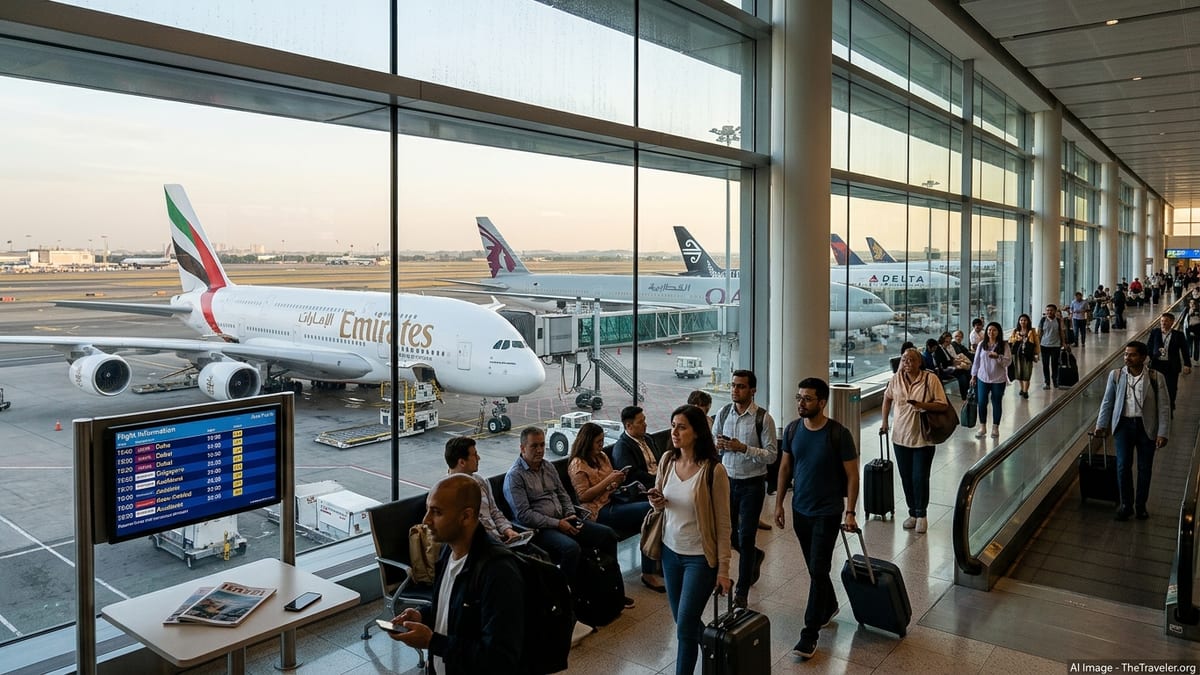
Emirates has been named the overall winner in TIME magazine’s inaugural “World’s Best Airlines 2027” ranking, released on 19 November 2026 with research partner Statista, in a top 10 that notably excludes every European carrier.
Get the latest news straight to your inbox!
How TIME and Statista ranked the “World’s Best Airlines 2027”
The TIME and Statista project is a new global airline benchmark built around two main pillars: passenger satisfaction and operational reliability. According to Statista’s methodology description, the ranking combines large-scale traveler evaluations, drawn from surveys and verified online reviews, with performance indicators such as punctuality and flight cancellations. Rather than simply rewarding size, the framework is designed so that a big network cannot compensate for weak satisfaction or reliability metrics, while smaller airlines with consistently strong results can still place highly.
The result is a forward-looking table labeled “World’s Best Airlines 2027,” even though it relies on data gathered in the period leading up to publication on 19 November 2026. TIME positions the list as guidance for travelers planning trips in 2027, not as a lifetime achievement award or a measure of historical prestige. Importantly for readers comparing rankings, TIME’s system is separate from longer-running awards such as Skytrax’s World Airline Awards and other specialist indices, each of which uses its own survey base and scoring model.
Travelers should also be aware that price plays no direct role in the TIME/Statista composite score. A carrier can appear high on the list because it blends strong customer feedback with reliable operations, regardless of whether its fares are typically low, mid-range or premium. For anyone using the list to plan journeys, “best” in this context means a blend of satisfaction and performance, not cheapest or most luxurious.
Emirates leads a top 10 dominated by Gulf and Asia-Pacific airlines
In the overall ranking, Dubai-based Emirates takes first place, ahead of Qatar Airways in second and Air New Zealand in third. Singapore Airlines, which has topped multiple Skytrax global rankings in recent years, appears just behind this leading trio. Coverage of the new table also indicates that the top 10 features a mix of Gulf, Asia-Pacific, African and North American airlines, including at least two major U.S. carriers: Delta Air Lines and American Airlines. Reports from aviation and travel outlets further point to South African Airways, China Southern and Air China as among the non-European names rounding out the top tier.
For Emirates, TIME’s verdict adds another high-profile trophy to an already crowded cabinet. The airline has previously collected “best airline” titles from Skytrax, AirlineRatings and other award schemes, often recognized for its long-haul product, extensive entertainment system and premium cabins. Those earlier accolades were based largely on passenger surveys and product assessments; the TIME/Statista result extends that narrative into a framework that explicitly blends traveler opinion with reliability data, aligning perceived quality with measured performance.
Network design also works in Emirates’ favor under a methodology that does not reward sheer scale for its own sake but does capture how passengers rate their end-to-end experience. The Dubai hub supports a dense web of long-haul and connecting flights across Europe, Asia, Africa, the Americas and Oceania, meaning many travelers encounter the carrier on complex multi-leg itineraries. Strong feedback on comfort, service and consistency across that global network likely contributed to Emirates’ ability to edge out Qatar Airways and Air New Zealand in the final scores published by TIME and Statista.
Why Europe is missing from the TIME/Statista top 10
One of the most striking findings for European travelers is that no European airline appears in TIME’s top 10 for 2027. Turkish Airlines is the highest-ranked European carrier in the TIME/Statista table, reportedly in 14th place, with Finnish flag carrier Finnair appearing further down the list. That means long-established European brands such as Lufthansa, British Airways, Air France-KLM, Iberia, Swiss and others are absent from the very top of this particular global benchmark.
TIME and Statista have not singled out Europe in their published methodology, so the continent’s absence from the top 10 should be read as an outcome of the scoring rather than a targeted judgment. The composite approach, which fuses satisfaction data with punctuality and disruption metrics, can particularly reward airlines and regions that have managed to keep cancellations and severe delays relatively contained while maintaining strong cabin and service reputations. In recent years, European hubs have periodically struggled with congestion, staffing constraints and operational upheaval, factors that can weigh on reliability scores even when onboard service remains competitive.
Crucially, this result does not mean that European airlines have collapsed in quality or are absent from other high-level rankings. In the 2026 Skytrax World Airline Awards, which are built primarily on a large passenger survey rather than a combined survey-and-operations dataset, Singapore Airlines was named World’s Best Airline, with Qatar Airways second and Cathay Pacific third, but several European carriers still featured in or near the global top 20 and collected regional titles. Turkish Airlines, for example, was again recognized by Skytrax as Best Airline in Europe, while airlines such as Iberia and Vueling improved their positions in the Skytrax top 100 list. TIME’s list therefore reflects one methodology and one snapshot in time, not a definitive verdict on Europe’s aviation sector.
What the ranking means for travelers planning 2027 trips
For passengers, the TIME/Statista World’s Best Airlines 2027 table is best used as a directional tool rather than a sole decision-maker. A high position indicates that, across many routes and thousands of data points, an airline has combined strong satisfaction scores with solid on-time performance and relatively low cancellation rates. That can be reassuring if you are booking a complex long-haul journey through hubs such as Dubai, Doha, Auckland or Singapore. However, travelers will still need to weigh fare levels, schedule convenience, alliance partnerships, frequent-flyer benefits and local airport access, none of which are captured directly by the ranking’s headline score.
European travelers in particular may notice a gap between TIME’s 2027 results and their own loyalty patterns. Many will continue to choose local or regional carriers for direct flights, corporate contracts or frequent-flyer reasons even if those airlines sit outside TIME’s global top 10. Where it may be most useful is for discretionary long-haul travel, such as choosing between Gulf or Asia-Pacific carriers for trips to Africa, Asia or Australasia, or understanding how major U.S. airlines such as Delta and American currently compare on a global stage for reliability and satisfaction.
The TIME/Statista list is expected to be updated periodically, although no fixed cycle has been announced. Before booking significant itineraries for 2027 and beyond, travelers should check the latest version of the ranking on TIME’s website alongside other references such as Skytrax awards, national consumer-protection statistics and recent reviews on booking platforms. That combination of independent rankings, hard reliability data and up-to-date traveler feedback will offer the clearest picture of how Emirates, its Gulf and Asia-Pacific competitors and Europe’s major flag carriers are actually performing when it is time to fly.