


Lemmenjoki National Park in Finnish Lapland is one of Europe’s largest roadless wilderness areas and a dream destination for hikers who love big landscapes and very few people. To enjoy it safely, you need to understand how the trail system works, where to find reliable maps, and what kind of services actually exist on the ground. This guide brings together the latest practical information to help you plan a realistic visit, whether you are day hiking from Njurgalahti or heading deep into the gold prospector valleys for a week.
Get the latest updates straight to your inbox!
Understanding Lemmenjoki: Scale, Remoteness and What “Trails” Mean
Lemmenjoki National Park covers roughly 2,850 square kilometers in northern Lapland, making it the largest national park in Finland and one of the biggest protected wilderness areas in Europe. In practice this means that trailheads, signposted routes and services are concentrated in one corner of the park, mainly around the small village of Njurgalahti and the Lemmenjoki river valley. Once you leave these managed areas, you are mostly in pathless tundra and forest where navigation skills and proper maps are essential.
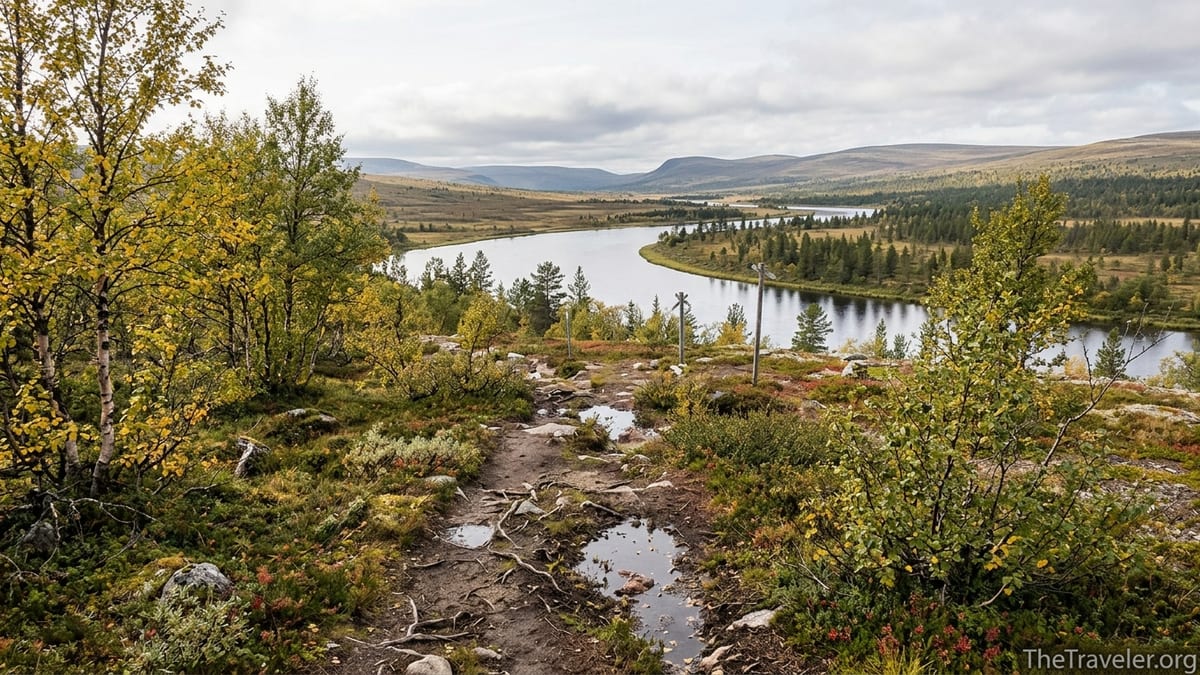
Unlike densely waymarked national parks near Helsinki, Lemmenjoki feels more like true wilderness. Well marked trails exist, but they are relatively few, and many routes are traditional reindeer herding tracks or old gold prospector paths that may not be obvious under snow or wet vegetation. In popular areas you will usually find brown-and-white national park signs, wooden direction posts with distances in kilometers, and duckboard sections across bogs. Farther out, only occasional cairns or trampled ground hint at the route.
This difference in infrastructure is crucial for planning. A first time visitor often expects a web of short, well groomed loops. In Lemmenjoki, you more likely choose between two or three marked day routes plus a small number of demanding multi day circuits that require carrying full gear. Understanding that context helps you pick a route that matches your experience, time and fitness before you even start looking at detailed maps.
Where to Get Reliable Lemmenjoki Trail Maps
The most reliable and detailed official information for Lemmenjoki’s trails and facilities is provided by Metsähallitus, the Finnish state body that manages all national parks. Their outdoor information is published under the Parks & Wildlife Finland service, which maintains up to date descriptions of marked routes, open wilderness huts, campfire sites and restrictions. Before your trip, check the Lemmenjoki section for current trail conditions, any bridge repairs, early spring snow or autumn flood warnings, and seasonal notices about reindeer herding or gold panning areas.
For on the ground navigation, most hikers combine an official topographic hiking map with a phone based map app. Finnish topographic sheets for Lemmenjoki typically use a 1:50,000 scale, showing contour lines, marshes, streams, huts and unmarked paths. These maps are sold in major outdoor shops in Finland and in Inari or Ivalo bookshops at prices that are usually in the range of 12 to 18 euros per sheet. In practice, one or two sheets cover the areas most visitors hike, including the Lemmenjoki river valley, Njurgalahti and the Ravadas falls area.
Digital tools are widely used in Finland and work well in Lemmenjoki as long as you carry a power bank. Many locals rely on the national map service and the Retkikartta outdoor map, both of which show official trails, lean to shelters and campfire sites on a topographic base. International visitors often download offline map sections in apps such as Gaia GPS, AllTrails, Outdooractive or Mapy.cz, then cross check their routes with the official Finnish sources. This layered approach gives you both the Finnish official point of view and the more social, crowd-sourced track logs that can help you follow less distinct routes.
Key Trailheads and Classic Marked Routes
Njurgalahti, on the southern shore of Lake Lemmenjoki, is the main gateway village to the park. Most visitors arrive here by car from Inari or Ivalo and use the large parking area close to the river. From this hub, a short access path leads to several marked hiking trails and to the riverboat jetties used in summer. Boards at the trailhead show a general map of the park, basic safety advice and the locations of official campfire sites and huts within a reasonable day’s walk.
One of the most popular short walks is the loop trail from Njurgalahti to an old reindeer round up area and back. Depending on the exact variant, it typically takes 2 to 3 hours and offers a first taste of Lapland pine forests, low fells and bog sections on duckboards. Another classic day option is to combine a riverboat ride up the Lemmenjoki to Lemmenjokilaakso with a hike to the Ravadas waterfall. In high summer a return boat trip for an adult may cost in the region of 40 to 60 euros, depending on the operator and whether you disembark to hike a section on foot. Hikers often take the boat upstream and then walk back to Njurgalahti, turning the outing into a full one day adventure.
More experienced backpackers are drawn to multi day circuits such as the Lemmenjoki river valley routes and connections deeper into the gold prospector areas. A typical three to five day trek might link Njurgalahti with open wilderness huts like Morgamojan Kultala, Sallivaaran poroerotuspaikka and Kultahamina, using established but at times faint paths along ridges and rivers. In these areas the terrain is mostly low tundra hills, mires and birch forest, and river crossings can become serious obstacles during snowmelt or heavy rain, so plans need to be flexible and conservative.
Understanding Lemmenjoki’s Wilderness Huts and Services
One of the distinctive features of Finnish national parks is the network of open wilderness huts and reservable huts maintained by Metsähallitus. Lemmenjoki has several of these simple cabins scattered along popular routes. Open huts are usually free to use for one night at a time, on a first come, first served basis, and they provide basic shelter with bunks, a table, wood stove and log supply. Reservable huts require pre booking and a fee that is often in the range of 40 to 80 euros per night for the whole hut, which is cost effective for small groups.
For example, on the Lemmenjoki river valley route, hikers may plan their nights around open huts such as Morgamojan Kultala, once used by gold prospectors, or around reservable cabins closer to Njurgalahti. In practice, it is wise to carry a lightweight tent even if you intend to use huts because the park’s popularity is slowly increasing and beds can fill up in July and early August. Simple lean to shelters, known locally as laavu, complement the huts and are often located at official campfire sites along marked trails.
Other services are limited but significant for planning. In Njurgalahti, small seasonal businesses may offer riverboat excursions, accommodation in cabins or rooms and light meals, but there is no large supermarket. Most visitors shop for food and gas canisters in larger towns such as Ivalo or Inari, where outdoor stores and supermarkets stock freeze dried meals, gas cartridges compatible with standard hiking stoves and warm clothing suitable for Arctic conditions. There is no public transport stop directly at Njurgalahti, so visitors without a car must either arrange a taxi from Inari or Ivalo or join a tour that includes transfers.
Seasonal Trail Conditions and When to Hike
Lemmenjoki sits above the Arctic Circle, and the hiking season is tightly defined by snow and daylight. Most summer hiking typically happens from late June to early September, with July and early August offering the most reliable snow free conditions on higher ground. Even then, expect lingering wet patches, boggy sections and cool nights that can dip close to freezing. In June, trails can still be partially snow covered, streams are high with snowmelt and mosquitoes can be intense in warm, calm weather.
By September, the park transforms into ruska, the Lapland autumn color season. Birch trees turn vivid yellow, dwarf birch and groundcover shift to deep reds, and the light becomes lower and softer. This is a superb time for experienced hikers, as mosquitoes disappear and crowds thin, but nights grow long and frosts are common. Some riverboat services wind down as visitor numbers drop, so anyone planning a Ravadas falls hike with a boat segment should confirm schedules directly with operators in advance.
Winter and spring bring very different opportunities, with ski touring routes instead of hiking trails. Marked winter trails may not follow the same lines as summer paths and are often laid out across frozen lakes and mires. Temperatures can fall well below minus 20 degrees Celsius, and daylight is very limited in December and January. For most visitors planning their first Lemmenjoki trip, a summer or early autumn visit is more realistic, with winter expeditions best left to those who already have Arctic cold weather experience and the gear to match.
Navigation, Safety and Local Rules
Because Lemmenjoki is so large and sparsely marked, navigation and safety deserve serious attention. Even on marked routes, fog, heavy rain or early snow can obscure waymarks and make path lines hard to see, particularly above the treeline on low fells. A common approach is to navigate primarily with a map and compass, using a GPS device or phone app as a backup rather than the sole tool. Many experienced Finnish hikers save their planned route as a track in an app and also carry a paper map sealed in a waterproof sleeve.
The concept of everyman’s rights in Finland generally allows free roaming, camping and berry picking on most uncultivated land, but national parks have specific rules designed to protect nature and ensure safety. In Lemmenjoki, camping is usually allowed near open wilderness huts, at marked campfire sites and within designated zones along marked routes. Making open fires is managed according to seasonal forest fire warnings; when the warning is in force, campfires are generally prohibited even at many constructed fire sites. Visitors should always check the current warning status before lighting any fire.
Wildlife encounters are usually limited to reindeer, birds and small mammals. Large predators such as bears, wolverines and wolves exist but are rarely seen. The more immediate safety issues are related to cold, wet conditions, sudden weather changes and long distances between shelter points. Mobile phone coverage can be patchy once you move deeper into the park, especially in valleys, so you should be prepared to manage minor issues independently. Carrying extra food for at least one additional day, a spare warm layer, proper rain gear and a means of water purification is standard practice.
Planning a Realistic Itinerary: Example Trips
For many visitors, a straightforward two or three day itinerary around Njurgalahti provides a satisfying introduction to Lemmenjoki without committing to a full wilderness expedition. One practical option is to arrive in Inari by bus from Rovaniemi or Ivalo, pick up a rental car or taxi to Njurgalahti, and spend the first afternoon on a short local trail, such as the reindeer round up loop. The next day, you might take a morning riverboat up Lemmenjoki, disembark near the Ravadas falls trail, and hike back downstream along the marked path, returning to Njurgalahti in the evening for a cabin night.
A more ambitious five day hike could start and end in Njurgalahti but loop through wilderness huts deeper along the Lemmenjoki valley. A typical plan uses a boat transfer on day one to position you further upriver, followed by three days of trekking between huts like Morgamojan Kultala and other shelters, with one contingency day in case of bad weather or swollen streams. On the final day, you walk back to Njurgalahti. This kind of trip works well for experienced backpackers comfortable carrying 15 to 20 kilograms of gear and food and covering 15 to 20 kilometers per day in uneven terrain.
Travelers with more time sometimes combine Lemmenjoki with a visit to another northern park such as Urho Kekkonen or Pallas Ylläs. In practice, this often involves renting a car for a week or more from Ivalo, driving first to Lemmenjoki for a shorter hike, then continuing to a better served park with easier public transport links for additional day hikes. This hybrid approach balances the wild, remote feel of Lemmenjoki with the convenience and infrastructure of more frequented Lapland destinations.
The Takeaway
Lemmenjoki National Park rewards careful planners with broad horizons, quiet valleys and a genuine sense of Arctic remoteness. Its trail system is less dense and polished than many other European parks, but with the right maps, realistic itineraries and an understanding of Finnish outdoor infrastructure, it is accessible to experienced hikers and adventurous first timers willing to respect the conditions. Treat it not as a park of casual strolls but as a light wilderness expedition destination, and your expectations will better match the reality on the ground.
Before traveling, obtain current information from official Finnish sources and check seasonal details such as riverboat timetables, forest fire warnings and hut availability. Combine that knowledge with solid navigation tools and conservative routing and you will be well placed to enjoy one of Finland’s most remarkable protected landscapes. In Lemmenjoki, the reward for that extra effort is the chance to walk for hours along tundra ridges or silent river bends with nothing but reindeer and the wind for company.
FAQ
Q1. Do I need a special permit to hike in Lemmenjoki National Park?
For regular hiking on marked trails and staying in open wilderness huts or at basic campsites, no special permit is required. You only need reservations for specific reservable huts or guided activities such as commercial riverboat tours.
Q2. What is the best time of year to visit Lemmenjoki for hiking?
The main hiking season typically runs from late June to early September, with July and early August offering the most stable snow free conditions. September is excellent for autumn colors but colder and darker.
Q3. How do I get to the main trailhead at Njurgalahti without a car?
There is no direct public bus to Njurgalahti, so most visitors travel by bus to Inari or Ivalo and then arrange a taxi transfer or join a tour that includes transport to the trailhead.
Q4. Are the trails suitable for beginners or families with children?
Short marked routes around Njurgalahti, including the local loop trails and easy sections near the river, can work for beginners and families. Multi day routes deeper into the park are better suited to experienced hikers comfortable with remote terrain.
Q5. Can I rely only on my phone for navigation?
Phone based maps are very useful, but coverage and battery life are not guaranteed in remote valleys. It is strongly recommended to carry a paper topographic map and compass as a backup and know how to use them.
Q6. Is wild camping allowed anywhere in the park?
Wild camping is generally allowed in designated areas near huts and marked campfire sites, in line with national park rules. Avoid camping directly on fragile vegetation and always check local guidance on restricted zones.
Q7. What kind of wildlife might I see on the trails?
Most visitors see reindeer, various Arctic birds and small mammals. Large predators such as bears and wolves are present in the wider region but are very rarely encountered by hikers.
Q8. Do I need to carry all my drinking water?
Many hikers drink surface water from streams and lakes after basic treatment such as filtering or boiling. In dry periods some smaller streams may run low, so it is wise to carry a bottle or two and refill whenever good sources are available.
Q9. Are there guided hikes or tours available in Lemmenjoki?
In high season, local operators around Njurgalahti and Inari often offer guided day hikes, riverboat excursions and cultural tours that include information on Sámi heritage and gold prospector history in the park.
Q10. What should I do in an emergency inside the park?
In a serious emergency, call the Finnish emergency number 112 if you have coverage, provide your location from your map or GPS and follow rescue instructions. Because help can take time to arrive, carry adequate clothing, shelter and food to cope with delays.