


More news on this day
Central European rail operator Leo Express is expanding its new Frankfurt–Prague–Przemyśl corridor with the introduction of couchette cars, strengthening overnight links between Germany, Czechia and southeastern Poland.
Get the latest news straight to your inbox!
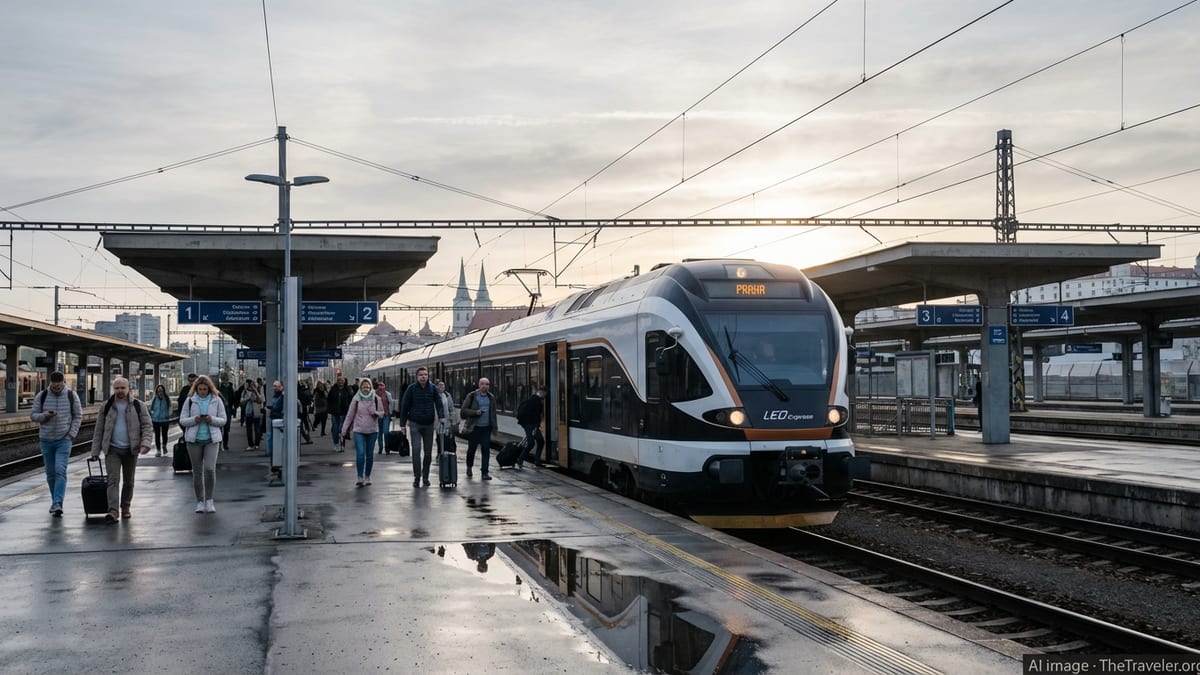
New night option on one of Europe’s longest routes
The Frankfurt–Prague–Przemyśl line entered service in late June as a through connection spanning more than 1,300 kilometers, linking Frankfurt Airport with major hubs including Dresden, Prague and Ostrava before continuing toward the Polish city of Przemyśl near the Ukrainian border. The route has been described in European media coverage as one of the continent’s longest direct passenger rail services.
Reports indicate that Leo Express initially launched the corridor as a mixed operation, with trains running between Frankfurt and Bohumín in Czechia and a connecting bus onward to Przemyśl while approvals for full rail operation in Poland were finalized. Recent industry updates show that the through service is now being reinforced with additional rolling stock specifically configured for overnight travel.
According to information shared by the company on professional and social channels, the new couchette cars will be deployed from the end of July, turning the existing overnight timetable into a more traditional night train product. The service is scheduled once daily in each direction, with an evening departure from Frankfurt and a morning arrival in Przemyśl, and the reverse pattern east to west.
Alongside the new sleeping capacity, Leo Express has highlighted onboard amenities such as air conditioning, Wi‑Fi and refreshments, aiming to position the train as a practical alternative to overnight coach or short‑haul air travel on this busy east–west corridor.
Timings designed around Frankfurt Airport and Polish border
Publicly available timetable details show that the westbound train departs Przemyśl just after midday and travels via Ostrava and Prague, reaching Dresden in the early hours before arriving at Frankfurt Airport around 7:20 in the morning. The eastbound working leaves Frankfurt in mid‑afternoon, calling at Dresden late in the evening, Prague shortly after midnight and Ostrava before continuing across the Polish border to Przemyśl late the following morning.
This schedule is intended to create overnight segments between the main cities served, particularly Dresden, Prague and Frankfurt, where travelers can board in the evening and arrive early the next day. With the introduction of couchette cars, passengers will be able to reserve berths rather than rely solely on reclining seats through the night hours.
For air travelers, the early morning arrival at Frankfurt Airport is being presented as an important feature. Coverage in European travel media notes that the timing allows onward connections to a wide range of European and intercontinental flights, while the mid‑afternoon departure in the opposite direction offers a rail option after daytime arrivals in Frankfurt.
On the eastern section, the service brings a direct overnight connection from Germany and Czechia to the vicinity of the Ukrainian border. Travel outlets in Poland have pointed to the potential for onward bus and rail links from Przemyśl toward Lviv and other destinations in western Ukraine, extending the route’s catchment area beyond the European Union.
Couchette rollout follows rolling stock expansion
The decision to introduce couchette cars comes as Leo Express continues to expand and modernize its long‑distance fleet. Railway industry publications have previously reported on the operator’s acquisition of additional coaches from Germany for use on the Przemyśl–Prague–Frankfurt service, along with the planned deployment of Talgo trainsets on other international routes.
Company communications indicate that the couchette vehicles are part of this wider rolling stock program, with interiors adapted for overnight use while retaining standard comforts such as power outlets and internet connectivity. The new cars are being attached to existing train formations on the Frankfurt–Prague–Przemyśl line rather than forming separate dedicated night services.
Observers note that the move aligns the product more closely with established Central European night train offerings, which traditionally combine seated coaches with couchette and sleeper cars. For budget‑conscious travelers, couchettes are often seen as a mid‑range option between regular seats and more expensive private sleeping compartments, making overnight journeys more comfortable without a significant premium.
Railway news sites also point out that offering at least one couchette car on an overnight train can influence how the service is classified in some ticketing and discount systems, potentially improving its visibility to passengers searching for night train connections across borders.
Strengthening private competition in Central European rail
The Frankfurt–Prague–Przemyśl route marks a further step in the gradual expansion of private operators on international rail corridors in Central Europe. Leo Express, based in Prague, already runs long‑distance services within Czechia and cross‑border routes into Slovakia, Poland and Germany, positioning itself as a competitor to state incumbents.
According to coverage in specialist transport media, the new line has attracted attention not only for its length but also because of regulatory scrutiny in Poland, where the state operator’s contracts are protected by economic equilibrium rules. Reports state that, at launch, the final section into Poland was partly handled by buses while approvals were refined, illustrating the complexity of opening new cross‑border services.
Despite these challenges, the addition of couchette cars underscores the company’s ambition to capture a share of the growing night‑train market. Across Europe, several national and private operators have been reintroducing or expanding overnight services in response to renewed interest in lower‑carbon alternatives to flying, and the Frankfurt–Prague–Przemyśl connection fits within this broader trend.
Travel analysts suggest that if the service proves popular, it could encourage further investment in overnight rolling stock and possibly influence other private and public operators to consider similar long‑distance cross‑border routes, especially where airports and major urban centers can be linked in a single overnight journey.
New options for cross‑border leisure and migrant travel
The launch of couchette cars on the Frankfurt–Prague–Przemyśl service is also expected to appeal to several distinct passenger groups. Tourism outlets in Germany, Czechia and Poland have highlighted the line’s potential for city‑break itineraries linking destinations such as Frankfurt, Dresden, Prague, Kraków and Przemyśl, with overnight segments allowing travelers to maximize time on the ground.
In addition, the route serves regions with significant numbers of cross‑border workers and migrant communities who regularly travel between Germany, Czechia, Poland and Ukraine. For these passengers, a night train with couchettes can provide a more comfortable alternative to long‑distance coaches, especially during peak holiday periods when roads and border crossings can be congested.
By connecting directly to Frankfurt Airport, the service also opens rail access for passengers heading to and from long‑haul flights, including those visiting family in Central and Eastern Europe from destinations further afield. The relatively low starting fares reported by the company for advance bookings may further support take‑up among price‑sensitive travelers.
As the couchette cars enter regular operation from late July, attention will likely focus on reliability, comfort and ticket availability across the busy summer and autumn seasons. Performance on these fronts will help determine whether the Frankfurt–Prague–Przemyśl corridor becomes a lasting fixture of Europe’s overnight rail network or a niche experiment in long‑distance cross‑border service design.