


Lisbon Humberto Delgado Airport has a reputation for beautiful arrivals over the Tagus River, but also for long queues at security and passport control. For first-time visitors, especially those arriving from outside the Schengen Area, understanding how security, immigration, and customs work in practice can make the difference between a smooth landing and a stressful start. This guide walks you step by step through what to expect in 2026, using real examples and up-to-date information to help you prepare.
Get the latest updates straight to your inbox!
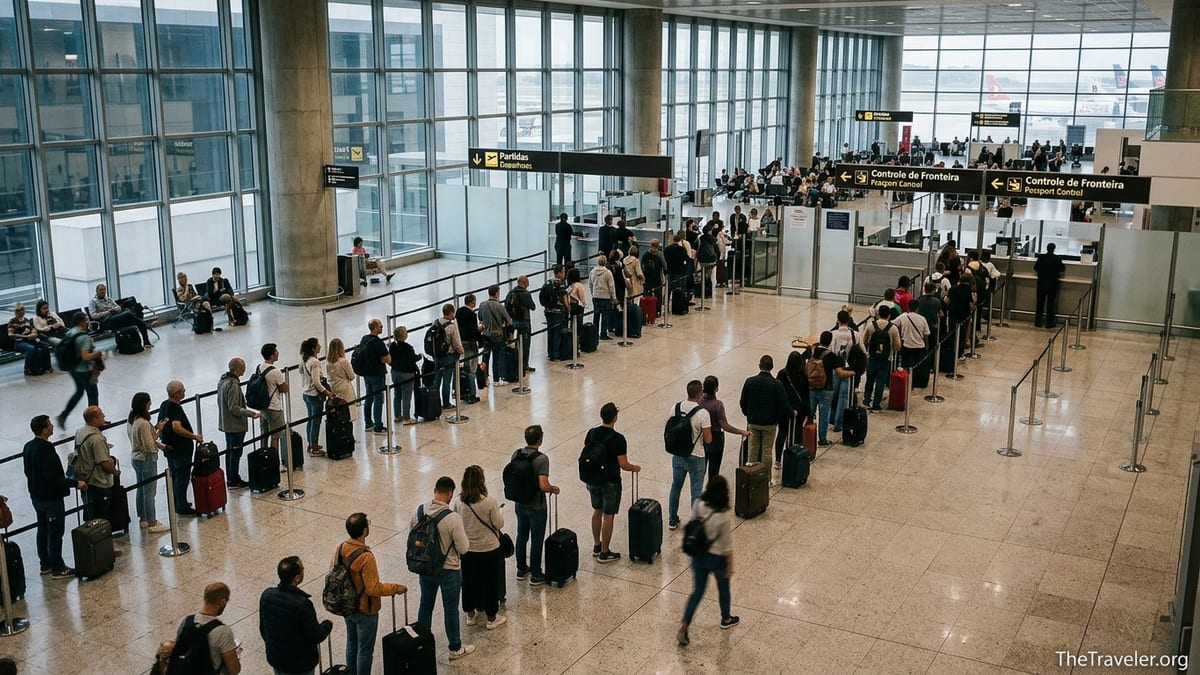
Understanding Lisbon Airport’s Layout and Why It Matters
Lisbon Humberto Delgado Airport has two terminals, but almost all international passengers will experience Terminal 1. Terminal 1 handles every arrival, plus most departures, including major airlines like TAP Air Portugal, Delta, United, American, Air Canada, British Airways, Lufthansa, Air France, KLM, Emirates, Qatar Airways, and many others. Terminal 2 is a smaller low-cost terminal used primarily by airlines such as Ryanair and easyJet for point-to-point Schengen flights, and it is connected to Terminal 1 by a shuttle bus. In practice, this means your first impressions of Lisbon, from passport queues to customs, will almost always happen in Terminal 1.
All arriving flights, whether you are coming from New York, Toronto, London, São Paulo, or Madrid, funnel into the same arrivals level in Terminal 1. From there, the route is clearly signposted: first immigration (passport control) if you are coming from a non-Schengen country, then baggage claim, then customs. Schengen arrivals, such as flights from Paris or Barcelona, usually walk straight to baggage claim without going through passport control. This shared infrastructure contributes to congestion at busy times, especially early in the morning when several long-haul flights land within the same hour.
On departure, Terminal 1 departures are split into two main flows: Schengen departures, which stay inside the common European border zone, and non-Schengen departures, which require an extra passport control check after security. For example, a Lisbon to Rome or Frankfurt flight is Schengen and will not require you to clear exit passport control, while a Lisbon to New York, London, or Toronto flight will. Many travelers are caught out by this second checkpoint, assuming that once they clear security they are at the gate. In reality, non-Schengen gates sit behind a separate passport control area where queues can easily add 30 to 90 minutes.
Because everything feeds through Terminal 1 and border control is a well-known bottleneck, the single most important planning decision for first-time visitors is timing. Arriving during the morning long-haul bank between roughly 6:00 and 10:00 can mean significantly longer immigration waits, especially for non-EU passports, compared with mid-afternoon or late evening arrivals when the hall is often much quieter.
Security Screening: What to Expect When Departing Lisbon
Security at Lisbon Airport broadly follows standard European rules. For passengers departing Lisbon, the main screening checkpoint sits just after check-in in Terminal 1. All carry-on bags go through X-ray, and passengers pass through a metal detector or body scanner. The airport follows the usual 100 milliliter liquid rule for hand baggage: liquids, gels, and aerosols must be in containers of 100 ml or less, all fitting comfortably in a single transparent resealable plastic bag of about 1 liter. This includes items such as toothpaste, face cream, perfume, and small bottles of olive oil or port wine you might have purchased in town.
Duty-free liquids bought after security, such as a one-liter bottle of Portuguese ginja liqueur or a vintage port, are allowed in larger sizes as long as they are sealed in a tamper-evident duty-free bag with the receipt visible inside. If you are connecting onward through another EU airport, keep these items sealed until you reach your final destination. Medical liquids and baby food are permitted in larger quantities, but you may be asked to show prescriptions or taste-test baby milk. Travelers with conditions like diabetes regularly travel through Lisbon with insulin or syringes, but should carry a doctor’s note and pack these in an easily accessible part of their bag to speed up inspection.
In terms of prohibited items, Lisbon enforces the familiar restrictions on sharp objects, tools, and sporting equipment. Small souvenir corkscrews with blades, for example, are often confiscated. If you are bringing local specialties such as canned sardines or ceramic dishes, these are usually fine in cabin baggage as long as they comply with size and weight rules, but heavy or bulky items are better placed in checked luggage to avoid manual inspection. Electronics like laptops, cameras, and tablets commonly need to be removed from bags and placed in separate trays, though staff sometimes relax this requirement for smaller devices depending on the lane setup.
Recent traveler reports suggest that pure security screening times at Lisbon are usually manageable compared with passport control. At quieter hours, some passengers clear security in 10 to 15 minutes, while at peak holiday periods or mid-morning on busy days, it can stretch closer to 30 minutes. The real risk lies in combining security queues with long waits at exit passport control for non-Schengen flights. As a rule of thumb in 2026, many experienced Lisbon travelers now arrive at least three hours before a transatlantic departure and at least two hours before most Schengen departures, especially during summer or on Fridays and Sundays.
Immigration on Arrival: Schengen, EES and Real Queue Times
For first-time visitors arriving from outside the Schengen Area, immigration at Lisbon can be the most unpredictable stage of the journey. The airport now operates under the EU Entry/Exit System (EES) for most non-EU/EEA/Swiss nationals. That means first-time EES travelers entering through Lisbon must have their fingerprints and facial image captured and their entry recorded electronically. This initial registration adds extra steps at the border, particularly during peak times when large numbers of passengers arrive from North America, Brazil, the United Kingdom, and North Africa.
On a typical morning, passengers stepping off a flight from Newark or Toronto will follow signs for passport control, then be split into different lanes: EU/EEA/Swiss citizens and Portuguese residents on one side, non-EU passports on the other. Non-EU passengers may first queue at self-service kiosks where they scan their passport and have biometrics taken for EES, then queue again for a border officer to finalize the entry stamp. On days when multiple long-haul flights arrive around 7:00 or 8:00, travelers have reported total waits of 1.5 to 2 hours from joining the queue to reaching the baggage hall. In late March 2026, Portuguese media reported peak morning arrival waiting times reaching about two hours for some flights during a particularly congested period.
At quieter times, the experience can be very different. Evening arrivals from North America or late-night flights from Brazil sometimes clear in 20 to 40 minutes door-to-door, especially if you walk briskly from the aircraft to passport control before the queue builds. Travelers with EU passports, including dual nationals who can use their European document, routinely report significantly shorter waits. When the automatic eGates are all operating and staffed effectively, EU holders often clear the border in 5 to 15 minutes even at moderately busy times, though this depends heavily on maintenance and staffing levels on the day.
Practically, first-time visitors should plan for a wide range of outcomes. If you are landing at 7:30 in the morning from New York or Boston in June or July, it is entirely possible that you will spend 60 to 90 minutes in the arrivals passport queue. If you are landing at 3:00 in the afternoon from London in October, you may find only a short line. It is wise to avoid tight onward connections by train or domestic flight from Lisbon on the day of arrival, especially in peak season. Booking a flexible ticket on the Alfa Pendular train to Porto or the intercity service to Faro with a departure at least three hours after scheduled landing gives you a safety margin if immigration is slow.
Have your documents ready before you approach the desk. Non-EU visitors may be asked to show proof of onward travel, evidence of accommodation, and sufficient funds for their stay, especially if they are entering as tourists for the first time. In practice, officers in Lisbon commonly ask short, direct questions: “How long are you staying?”, “Where are you staying in Portugal?”, “Do you have a return ticket?” Having a printed or easily accessible hotel confirmation, such as a booking in central Lisbon or in the Algarve, and a copy of your return e-ticket on your phone can help keep the interaction smooth and brief.
Departing Lisbon: Exit Passport Control and Time Planning
For non-Schengen flights departing Lisbon, exit passport control can be as significant a bottleneck as arrival immigration. The layout can be confusing for first-time visitors. After checking in your bags and passing through security in Terminal 1, you emerge into a large duty-free area and shopping concourse. Many travelers assume they are effectively at the gate and stop for coffee, pastel de nata, or shopping. In reality, non-Schengen gates for flights to destinations such as London, Dublin, New York, Toronto, Dubai, or Casablanca sit behind a dedicated border control zone, with its own queues that are not visible from the main concourse.
Recent first-hand accounts from spring 2026 illustrate how unpredictable timing can be. Some travelers leaving for North America in the late morning reported clearing security in about 15 minutes but then spending up to an hour or more in a line that snaked through the entire duty-free area to reach passport control. Others, departing at off-peak times, walked straight to the booths with only a few minutes’ wait. Airlines at Lisbon now routinely advise passengers on long-haul flights to head directly from security to passport control rather than lingering in shops, explaining that delays at the border have caused people to miss flights despite arriving at the airport three hours early.
Once at exit passport control, procedures are straightforward. EU/EEA/Swiss citizens typically use eGates or manual EU lanes, while non-EU travelers have their passports inspected and exit recorded in the EES system. Families with children, especially non-EU families, are often directed to manual booths, which can be slower. The officer may ask brief questions about your stay and verify that your entry stamp and length of stay are consistent. Overstays in the Schengen Area are taken seriously, though for most tourists on trips of a couple of weeks this is not an issue as long as they respect the standard 90-day-in-180-day rule.
For planning, a conservative approach works best. In 2026, frequent Lisbon flyers generally recommend arriving at the airport at least three hours before long-haul departures to North America, the Middle East, or Africa, and at least 2 to 2.5 hours before busy-season flights to the United Kingdom or Ireland. If your flight is at a peak departure time between roughly 9:00 and 13:00 or in the evening bank between 18:00 and 21:00, consider adding another 30 minutes. For early-morning flights, such as a 6:00 departure to Paris or Frankfurt, the airport and border control can be noticeably calmer, and two hours may be sufficient, but it is still safer to err on the side of arriving early than to risk a missed flight.
Customs in Portugal: Allowances, Declarations and Real Examples
Customs in Portugal is generally low drama for typical tourists, but it is important to understand the distinction between arriving from another EU country and arriving from outside the EU. When you land in Lisbon from a Schengen or EU destination such as Madrid, Paris, or Amsterdam, you move from the plane directly to baggage claim and then to the public arrivals hall. There is usually no formal customs check; officers may be present and can carry out spot inspections, but most passengers simply walk through the green channel for “Nothing to declare.”
Arrivals from outside the EU, such as flights from the United States, Canada, the United Kingdom, Brazil, or Morocco, are subject to EU-wide customs limits on what you can bring in duty free. Portugal follows the common EU framework for goods carried in personal baggage. In practice, this means that an adult traveler arriving from New York or Toronto can usually bring, for personal use, up to around one liter of spirits stronger than 22 percent alcohol or the equivalent in wine and beer, along with reasonable quantities of tobacco products, without paying duties. If you are arriving from another EU country, the thresholds for personal-use alcohol and tobacco are much higher, reflecting the lack of internal customs within the union, but carrying commercial quantities can still draw scrutiny.
Cash is a special case. If you enter or leave Portugal with 10,000 euros or more in cash or the equivalent in other currencies, you must declare it to customs. This also applies if you are only in transit through Lisbon. For example, if you are carrying 12,000 US dollars in cash while flying from New York to Cape Verde via Lisbon, you are legally required to complete a cash declaration when entering and when leaving the EU. Forms are available from customs at the airport. Failure to declare can result in fines and possible seizure of the funds, so anyone carrying large sums should factor the extra time needed at the customs desk into their arrival or departure plans.
Food and animal products deserve careful attention. The EU has strict rules on bringing meat, dairy, and some plant products from outside the union. A typical tourist arriving from Canada with vacuum-packed cheese or cured meat purchased at home might have these items confiscated if inspected, even if they are for personal consumption. On the other hand, bringing back sealed canned fish bought in Lisbon, such as local brands of sardines or tuna, to your home country is usually fine on the Portuguese side, though you will still need to respect import rules when you land in your own country. If in doubt, it is safer to buy local food gifts after you arrive in Portugal or in duty free on departure, where items are selected to meet EU rules.
At Lisbon, customs checks on arrival are generally light for tourists. After collecting your luggage, you pass signage with two options: green for “Nothing to declare” and red for “Goods to declare.” Most passengers use the green channel and walk straight into the arrivals hall. Officers sometimes monitor the flow and may stop selected travelers for questions or bag inspection, especially if their luggage appears unusually heavy or numerous, or if they are arriving from routes commonly associated with smuggling. For most first-time visitors bringing regular holiday items, the process is simply a matter of walking through.
Practical Tips to Reduce Stress and Delays
Given Lisbon Airport’s reputation for occasional long queues, there are several practical steps first-time visitors can take to make the experience smoother. The first is flight timing. If you have flexibility, choosing arrivals outside the morning long-haul wave can significantly reduce stress. A mid-afternoon arrival from North America, even with a connection in another European hub, often means shorter lines than a 7:00 landing when multiple wide-body flights arrive at once. Similarly, early morning departures before 8:00 can be calmer on the outbound side, with fewer passengers in both security and passport control.
Second, build a realistic time buffer into your onward travel. If you plan to take the metro or a pre-booked taxi from the airport into central Lisbon, factor in potential delays at immigration and baggage claim when choosing your transfer time. For example, if your flight from Boston is scheduled to land at 7:30, avoid booking a time-sensitive city tour or a train to Porto at 9:30. Instead, aim for something closer to 10:30 or 11:00, which leaves room for an hour at passport control and another 20 to 30 minutes for luggage and the walk to the public transport area.
Third, prepare your documents and baggage with Lisbon’s specific pinch points in mind. Have your passport, boarding pass, hotel address, and return ticket ready before you reach the front of the immigration line, rather than rummaging for them when the officer calls you forward. At security, pack liquids into a clear bag at your hotel and place laptops and large electronics at the top of your carry-on for easy removal. If you are returning home with fragile items such as bottles of port or olive oil from local shops in Bairro Alto or Belém, double-check that large bottles go into checked luggage or are purchased in duty free after security to comply with liquids rules.
Finally, listen closely to airline staff. Check-in agents at Lisbon have become accustomed to the airport’s pinch points and often give specific verbal advice based on live conditions, such as asking passengers on a midday Toronto flight to head straight to passport control after security or warning that exit queues are currently around 60 minutes. Treat these warnings seriously. Several travelers in 2026 reported missing flights despite arriving roughly two hours in advance, largely because they lingered in the shopping area before realizing how long the border queue had become.
The Takeaway
Lisbon Airport offers a memorable introduction to Portugal, from glimpses of red-tiled rooftops on final approach to the first taste of pastel de nata in the terminal. Yet its constrained layout and high passenger volumes mean that security, immigration, and customs can be more time-consuming than first-time visitors expect, especially during peak hours and seasons. The introduction of the EU Entry/Exit System for many non-EU travelers has increased unpredictability at passport control, and exit border checks for non-Schengen flights add another layer that can catch the unprepared by surprise.
With realistic expectations and a few simple strategies, however, most travelers can navigate Lisbon smoothly. Plan generous time buffers for both arrival and departure, pay close attention to whether your flight is Schengen or non-Schengen, organize your documents and luggage in line with EU security and customs rules, and heed on-the-day advice from airline staff. Accept that queue times may vary widely: one traveler may breeze through in 30 minutes while another, on a different day and flight, waits for nearly two hours. Building flexibility into your plans will help turn Lisbon’s airport from a source of anxiety into a manageable first step on a memorable trip through Portugal.
FAQ
Q1. How early should I arrive at Lisbon Airport before my departing flight?
For long-haul or non-Schengen flights, aim to arrive about three hours before departure, and even earlier in peak summer or for late-morning departures. For most Schengen flights, two hours is usually enough, but adding 30 minutes during busy holiday periods provides a useful buffer.
Q2. Is immigration at Lisbon really that bad for arrivals?
It depends heavily on time of day and your passport. Non-EU passengers arriving in the early morning long-haul wave can wait 60 to 120 minutes at passport control, especially during summer. At quieter times, and for EU passport holders using eGates, the wait may be closer to 15 to 30 minutes.
Q3. What is the EU Entry/Exit System and how does it affect me in Lisbon?
The EU Entry/Exit System is a biometric registration for many non-EU travelers entering the Schengen Area. In Lisbon, it usually means that first-time EES visitors must scan their passport and give fingerprints and a facial image before seeing a border officer, which can lengthen queues at busy times.
Q4. Do I have to go through passport control when departing Lisbon?
You go through exit passport control only if your flight is to a non-Schengen destination, such as the United States, Canada, the United Kingdom, Ireland, or many long-haul routes. Schengen flights, for example to France, Germany, Italy, or Spain, do not require exit border checks.
Q5. What are the rules on liquids at Lisbon Airport security?
Lisbon follows standard EU rules. Liquids in hand luggage must be in containers of 100 milliliters or less and fit in a one-liter transparent bag. Larger bottles, like wine or spirits, must go in checked luggage or be purchased duty free after security in sealed tamper-evident bags.
Q6. How does customs work when I arrive in Lisbon from outside the EU?
After baggage claim you choose between the green channel for “Nothing to declare” and the red channel for “Goods to declare.” Most tourists with normal personal belongings simply walk through the green channel. You must still respect EU limits on alcohol, tobacco, cash, and certain food products.
Q7. Do I need to declare cash when entering or leaving Portugal?
Yes, if you are entering or leaving the EU through Portugal with 10,000 euros or more in cash or the equivalent in other currencies, you must file a cash declaration with customs. This also applies to passengers in transit through Lisbon.
Q8. Can I bring food into Portugal for personal use?
Packaged snacks from within the EU are usually fine, but strict rules apply to meat, dairy, and some plant products from outside the EU. Items like homemade sausages or fresh cheese from a non-EU country may be confiscated if inspected, so it is safer to buy these products after you arrive in Portugal.
Q9. How long does it take to get from the plane to the city center after landing?
It varies with passport control and baggage. If immigration is quick and you have only carry-on, you might reach the metro or taxi rank within 30 to 45 minutes of landing. With longer queues and checked luggage, the process can easily stretch to 90 minutes or more before you reach central Lisbon.
Q10. What should I do if my queue is so long that I risk missing my flight?
If you are already at the airport and find yourself in an unusually long passport control or security queue, speak to airport or airline staff as soon as possible, showing your boarding pass and departure time. They can sometimes move passengers with imminent departures into priority lanes, though this is not guaranteed, so arriving early remains the best protection.