


Lisbon Humberto Delgado Airport is compact but can be confusing, especially if it is your first time navigating its two terminals. The biggest trap for visitors is assuming that Terminal 2 works like a normal full-service terminal. In reality, almost all the airport’s activity still runs through Terminal 1, with Terminal 2 acting as an overflow departures hall for low-cost airlines. Understanding how the two buildings share flights, and how to move between them, will save you stress, time and potentially even a missed flight.
Get the latest updates straight to your inbox!
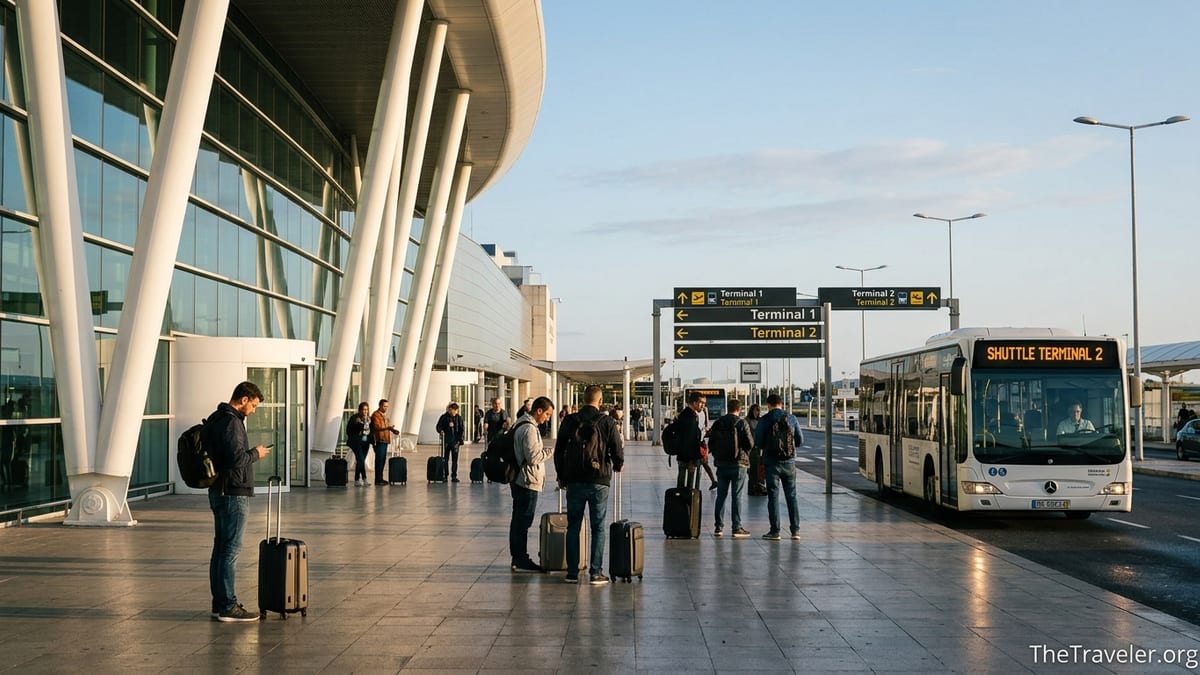
Lisbon Airport in a Nutshell: How the Terminals Work
Lisbon Airport, officially Humberto Delgado Airport, operates with two passenger terminals: Terminal 1 (T1) and Terminal 2 (T2). They sit on the same airfield but are separate buildings a few minutes apart by road. The key point to remember is that T1 is the main terminal, while T2 is a secondary departures-only facility used mostly by low-cost carriers flying within Europe.
Terminal 1 handles all arrivals into Lisbon, regardless of which airline you fly or which terminal you used for departure. A Ryanair or easyJet flight that checked in and boarded at T2, for example, will still disembark passengers into T1. This asymmetric setup often surprises travelers who expect to arrive into T2 if they departed from there, but it is simply how Lisbon Airport is organized.
T1 also manages the vast majority of international operations, including long-haul flights to North America, Brazil and Africa, as well as many European routes on full-service airlines. Here you will find the metro station, most airport buses, long-distance coach connections, and the main taxi and ride-hail ranks. T2 has more limited ground transport and facilities, which is why understanding where you need to be before you set off is so important.
From a passenger point of view, it helps to think of Lisbon as “one main terminal plus a low-cost annex” rather than two equal terminals. Your journey will almost always start or end in T1, even if you briefly pass through T2 on departure.
Which Airlines Use Terminal 1 and Terminal 2
Most full-service and flag carriers operate from Terminal 1. That includes TAP Air Portugal, Lufthansa, Air France, KLM, Iberia, British Airways, United Airlines, Delta Air Lines, Emirates and many others. If you are flying a long-haul route such as Lisbon to New York, Toronto, Rio de Janeiro or Luanda, or a European connection on a legacy carrier such as Lisbon to Frankfurt or Paris, your check-in, security and boarding will almost certainly take place in T1.
Terminal 2 is dedicated mainly to low-cost European carriers. In practice, this means that airlines such as Ryanair, easyJet, Transavia, Vueling, Wizz Air, Volotea and Eurowings are usually assigned to T2 for departures. A typical example is a Ryanair flight from Lisbon to Barcelona or Dublin. You will check in and go through security in T2, board your flight from a bus gate, but when you fly back to Lisbon a few days later you will arrive into T1.
There are occasional exceptions and seasonal changes, so it is important to verify your departure terminal on your booking confirmation and again 24 to 48 hours before travel. Airlines sometimes move flights between terminals as schedules change, and a route that previously departed from T1 can be shifted to T2 for the high summer season. For instance, a leisure carrier running extra summer flights to the Canary Islands might be moved to T2 to free space in T1.
A practical rule of thumb is this: if you booked with a low-cost airline that typically charges for extras like checked baggage and seat selection, expect to depart from T2. If you are flying with a national or global full-service carrier, expect to use T1. When in doubt, check your e-ticket or the airport’s flight information pages on the day of departure.
Arrivals: Why You Always End Up in Terminal 1
One of the most counterintuitive aspects of Lisbon Airport is that all passengers arrive through Terminal 1, no matter what airline they flew or which terminal handled their departure. Even if your boarding card and airport signage on departure said “Terminal 2,” your aircraft will be parked and processed in a way that channels you into the arrival facilities in T1.
When your plane lands, you may either disembark via a jet bridge or be taken by bus to a terminal entrance. In both cases, you will follow signs to passport control or directly to baggage claim depending on where you are coming from. If you are arriving from another Schengen Area country such as Spain, France or Germany, you will normally bypass passport control and head straight into the baggage carousel area in T1. If you are arriving from a non-Schengen destination such as the United Kingdom, United States or Brazil, you will go through passport control before reaching baggage claim.
This setup means that anyone waiting to meet you should always go to Terminal 1, regardless of the carrier. For example, if you fly Ryanair from London Stansted and tell your friend you are “on a Terminal 2 airline,” your friend still needs to wait in the arrivals hall of T1. Many first-time visitors make the mistake of going to T2 to meet arriving passengers and then realize, often too late, that all exit doors for arriving travelers are in T1.
Because all arrivals funnel through T1, the terminal can get busy at peak times, particularly in the morning when transatlantic and other long-haul flights land, and in the afternoon when many European flights arrive close together. Wait times at passport control can vary widely from about 20 minutes to well over an hour. It is wise to factor this variability into any same-day onward plans, such as a pre-booked train from Lisbon’s Oriente station or an intercity bus departure.
Departures: How to Make Sure You Go to the Right Terminal
The most important step in choosing the correct terminal is to confirm where your specific flight departs from. Start by checking the confirmation from your airline or booking site. Often the departure terminal is listed near the flight number. If it is not, log into your airline’s website or mobile app on the day of travel and look at the airport information for that flight. The airport’s real-time departures screens, available online and in the terminals, will also show “T1” or “T2” next to each flight.
If you are staying in Lisbon and taking public transport, you will almost always arrive first at Terminal 1. The Aeroporto metro station sits directly outside T1, and city buses and airport shuttles primarily serve this terminal. From there, you can either enter T1 for your departure if that is your terminal, or follow clearly marked signs outside to the free shuttle bus that takes you to T2. The shuttle stop is just beyond the main departures entrance at T1 and is signposted “Terminal 2 Shuttle.”
Travelers arriving by taxi or ride-hailing services such as Uber should tell the driver which terminal they need. Most drivers assume T1 by default, because it is the main terminal and serves more flights. If you are flying with a low-cost airline, it is worth checking your booking beforehand and explicitly asking for “Terminal 2 departures” to avoid being dropped at the wrong building and needing to backtrack by shuttle.
A simple real-world example illustrates why this matters. Imagine you have a 07:00 Ryanair flight to Milan on a busy summer Saturday. You schedule a taxi from your hotel at 04:45, expecting to be at the airport by 05:10. If the driver drops you at T1 because he assumes that is your terminal, you will still need to find the shuttle, wait for the next bus and ride over to T2, potentially adding 15 to 20 minutes at a time of day when check-in and security lines for low-cost carriers can already be long. That extra delay can make the difference between a calm boarding and a stressful sprint through the terminal.
Moving Between Terminal 1 and Terminal 2
Although Terminal 1 and Terminal 2 are part of the same airport, they are not connected by an internal walkway behind security. You can only move between them on the public side of the airport, outside the secure zone. The official way to transfer is via the free shuttle bus operated by the airport, which runs frequently during the day between the two terminals.
The shuttle usually runs every 10 minutes or so, with a journey time of approximately 3 minutes between T1 and T2 in light traffic. Buses are standard airport shuttles with space for luggage and standees, and many flights worth of passengers use them throughout the day. Services pause briefly during the very late-night hours, roughly between 01:30 and 03:30, a period when Terminal 2 is generally closed and few flights operate, so most travelers will find the shuttle available when they need it.
You board the shuttle outside T1 near the departures level and at a clearly marked stop right in front of the T2 building. Digital signs on the front of the bus typically say “T1 – T2.” Because all arrivals come through T1, passengers landing in Lisbon who later depart from T2 on a separate ticket must collect their luggage, clear customs and then exit to the public arrivals hall in T1 before using the shuttle. There is no direct transfer bus or walkway behind passport control.
Some travelers wonder if they can walk between the terminals. In theory you can, but in practice it is not recommended. The distance is significant, the route involves busy access roads and parking areas, and you will be outside exposed to the elements while managing luggage. For most people, the free shuttle is faster, safer and more comfortable than walking, and it keeps you on the signposted official route.
Ground Transport: Metro, Buses, Taxis and Where They Stop
All major public transport options serve Terminal 1. The red line of the Lisbon Metro terminates at Aeroporto station, which sits just outside T1. From there, you can reach key locations such as Saldanha in central Lisbon in roughly 15 to 20 minutes, changing to other metro lines if needed. For example, a traveler staying near Baixa-Chiado might ride the red line from Aeroporto to Alameda, then connect to the green line into the historic center.
City buses, dedicated airport bus services and most long-distance coaches also stop at or very close to T1. A common pattern for budget travelers is to arrive into Lisbon on a late-night European flight, take a short taxi or app-based ride from T1 to their accommodation, and then return to the airport a few days later by metro or airport bus from the city, again arriving first at T1 before transferring to T2 if they are on a low-cost carrier.
Terminal 2 has more limited direct public transport. There is no metro station at T2, and regular city buses do not stop right outside the building in the same way they do at T1. Instead, passengers relying on public transport must take the metro or bus to T1 and then use the free shuttle to reach T2. For example, someone staying near Rossio Square might catch the metro to Aeroporto station, exit into T1, then follow signs to the shuttle bus and ride to T2 for their departure.
Taxi and ride-hail ranks exist at both terminals, but T1 typically has more vehicles waiting, especially late at night and during busy arrival banks. If you land at T1 and later need to travel to T2 to check in for a separate same-day low-cost flight, it is almost always quicker to use the shuttle from T1 rather than asking a taxi to drive you around the airfield roads, which can be subject to queues at drop-off points.
Inside the Terminals: Facilities, Lounges and Layout
Terminal 1 is a full-service facility with a wide range of shops, cafes, restaurants and services spread across departures and arrivals. Before security, you will find airline check-in desks, information counters, car rental offices and basic food outlets for a quick coffee or snack. After security, there is a large duty-free area and a mix of international and Portuguese brands selling everything from fashion to local wine and canned seafood.
T1 also houses the airport’s main lounges, used by TAP and its Star Alliance partners, several oneworld and SkyTeam carriers, and independent lounge networks. Access policies vary, but in general business-class passengers, elite frequent flyers and some premium credit card holders can use these spaces when departing from T1. A traveler flying TAP business class to Newark, for instance, would check in at the dedicated counters in T1, clear security and passport control, then relax in the airline’s branded lounge before heading to an N gate for boarding.
Terminal 2 is smaller and more basic, with a compact range of cafes and convenience-style shops. The check-in hall is functional, and security screening is designed to process high volumes of passengers quickly, which can lead to fairly dense queues during peak low-cost departure waves early in the morning. Post-security, you will find a duty-free shop and a few food outlets, but the choice is more limited than in T1. There are no traditional airline lounges in T2, which sometimes surprises passengers used to lounge access on low-cost flights in other airports.
The design of T2 reflects its primary role as a departures-only terminal for short-haul flights, so seating and quiet spaces can be at a premium. In busy times, passengers often spread out onto the floor or lean against walls while waiting for boarding. Anyone who values comfort and quiet time before a low-cost departure might consider arriving early at T1, using landside cafes there, and only heading across to T2 by shuttle closer to check-in opening time.
Understanding Schengen, Gate Letters and Passport Control
For many international travelers, the most confusing aspect of Lisbon Airport is not the two terminals but the way Schengen and non-Schengen flights are handled within Terminal 1. After security in T1, the departures area splits into two broad gate zones: S gates for Schengen flights within the border-free Schengen Area, and N gates for non-Schengen destinations that require formal exit passport control.
If you are flying from Lisbon to another Schengen country such as Spain, Italy or Germany, or on a domestic flight within Portugal, you will typically depart from an S gate. In that case, you pass through security, walk through duty free and go directly to your gate. There is usually no passport control, because you are traveling within the Schengen Zone. A practical example would be a morning TAP flight from Lisbon to Madrid: you go from check-in to security, then on to an S gate without showing your passport to border officers.
If you are flying to a non-Schengen country such as the United Kingdom, United States, Canada or Morocco, you will normally depart from an N gate in T1. That means you must clear exit passport control after security and duty free before you reach your boarding gate. For instance, a passenger on an afternoon Lisbon to London Heathrow flight walks through duty free, follows signs for N gates, and joins the line for passport control. Once their passport is stamped or electronically registered, they proceed into the waiting area near their gate.
Because Lisbon mixes Schengen and non-Schengen departures in the same building, it is important to read the gate letters carefully and allow extra time if you know you will need passport control. Travelers on long-haul non-Schengen routes, such as Lisbon to New York or Boston, often report that lines at passport control can lengthen sharply during morning and early afternoon peaks. Many frequent travelers recommend arriving at least 3 hours before scheduled departure time for non-Schengen flights in high season to leave a generous buffer for check-in, security and possible passport queues.
Connection Scenarios: Examples of What to Expect
The way Lisbon’s terminals work can be particularly confusing if you are making a connection, especially on separate tickets. To understand what to expect, it helps to look at a few real-world examples that mirror common itineraries.
First, consider a through-ticket connection on a single airline, for instance New York to Lisbon to Porto on TAP, all on one reservation. You land at T1 from New York, clear passport control and baggage claim or simply follow “transfers” signs if your luggage is checked through, then go back through security in T1 for your domestic flight to Porto. Both flights use T1 in this example, and you never need to go anywhere near T2.
Now imagine you arrive in Lisbon on a full-service airline at T1 and then later that day fly out on a separate low-cost ticket from T2. For example, you might fly Chicago to Lisbon on TAP, then Lisbon to Ibiza on Ryanair. Once you land at T1, you must clear passport control and customs, collect your checked bags, and then exit into the public arrivals hall. From there, you go upstairs or outside to the shuttle stop and ride over to T2 for check-in. There is no protected airside connection between T1 and T2, so you must treat this as a normal arrival and fresh departure with all the associated time requirements.
A third scenario is a connection entirely within low-cost carriers. Suppose you arrive from Dublin to Lisbon on Ryanair and later connect to another Ryanair flight to Marrakech, both using T2 for departure. Even if your arriving aircraft parks near T2 facilities, you will still be processed into T1 with all other arrivals, because the airport only operates arrival facilities there. You then need to take the public-side shuttle back to T2 and check in again, just as if you had come from the city. In practical terms, this means you should allow several hours between flights when booking separate tickets, as you will be repeating much of the departure process.
Because of this structure, Lisbon is generally better suited for connections when both flights use Terminal 1 and are on a single ticket, with bags checked through. If you are tempted by cheap separate tickets that involve switching between T1 and T2 or re-checking luggage, be realistic about how long it can take to disembark, clear border controls, reach the shuttle, check in again and pass security and passport control a second time.
The Takeaway
Lisbon Airport’s two-terminal system is less complicated once you understand its core logic: Terminal 1 is the main hub for almost everything, and Terminal 2 is a departures-only annex for most low-cost European flights. All arrivals, without exception, pass through T1, regardless of airline. The most common mistakes travelers make are assuming they will arrive into T2 if they departed from there, going to the wrong terminal on departure, and underestimating how long it takes to move between terminals or clear passport control at busy times.
If you remember a few practical rules, your journey will be easier. Always check your departure terminal on your booking and again on the day of travel. Plan to arrive in good time, especially for non-Schengen flights, and build in extra buffer if you are connecting on separate tickets or switching between T1 and T2. Use the free shuttle rather than trying to walk between terminals, and start all airport ground transport planning from Terminal 1, where the metro and main buses stop.
With these points in mind, Lisbon’s airport becomes much more predictable. You can step off your flight, follow clear wayfinding signs, transfer between terminals when necessary and make your way into the city or onward to your next destination with confidence rather than confusion.
FAQ
Q1. How do I know if my flight departs from Terminal 1 or Terminal 2 in Lisbon? Most full-service and long-haul airlines use Terminal 1, while low-cost carriers such as Ryanair, easyJet and Wizz Air usually depart from Terminal 2. Always confirm on your ticket, airline app or the airport’s flight information on the day of travel, as terminal assignments can change.
Q2. Can I arrive at Terminal 2 in Lisbon, or do all flights arrive at Terminal 1? All passenger arrivals at Lisbon Airport are processed through Terminal 1, regardless of which terminal or airline you used for departure. Even if you flew out of T2, you will disembark and collect baggage in T1 when you land.
Q3. Is there a shuttle between Terminal 1 and Terminal 2, and do I have to pay for it? Yes. A free shuttle bus runs between Terminal 1 and Terminal 2, typically every 10 minutes during the day. The ride takes only a few minutes, and there is no charge for passengers transferring between terminals.
Q4. How much extra time should I allow if I need to transfer from Terminal 1 to Terminal 2? In normal conditions, the shuttle takes about 3 minutes, but you should allow at least 20 to 30 minutes overall to find the stop, wait for the bus, travel to the other terminal and walk to your check-in area, especially at peak times.
Q5. Where does the Lisbon Airport metro station connect, and which terminal does it serve? The Aeroporto metro station on Lisbon’s red line is located directly at Terminal 1. If your flight departs from Terminal 2, you must exit the metro at T1 and then take the free shuttle bus to T2 for check-in and boarding.
Q6. Do both terminals have lounges and full facilities? Terminal 1 has a wide selection of shops, cafes, restaurants and several airline and independent lounges. Terminal 2 offers more basic facilities, with fewer dining and shopping options and no traditional airline lounges.
Q7. If I have a connection on separate tickets, will my bags be transferred between terminals automatically? No. On separate tickets you must collect your luggage at Terminal 1, clear customs, and then re-check it with your next airline. If your onward flight uses Terminal 2, you will also need to take the shuttle there and go through check-in and security again.
Q8. When do I go through passport control at Lisbon Airport? You pass through passport control when arriving from or departing to non-Schengen countries, usually at Terminal 1. Schengen flights typically use S gates with no routine passport checks, while non-Schengen flights use N gates where exit or entry border controls apply.
Q9. Can I walk between Terminal 1 and Terminal 2 instead of taking the shuttle? It is technically possible to walk between the buildings, but it is not recommended due to distance, road layouts and lack of clear pedestrian paths. The official free shuttle is faster, safer and more convenient for almost all passengers.
Q10. What should I do if my driver drops me at the wrong terminal? Stay calm and look for signs to the terminal shuttle. From Terminal 1, follow directions outside to the free bus to Terminal 2. From Terminal 2, you can use the same shuttle back to Terminal 1. Allow extra time and go straight to your airline’s check-in once you reach the correct building.