


More news on this day
Lithuania is moving ahead with plans for a dedicated railway access line to the Rūdninkai military training area near Vilnius, a project framed as a key element in strengthening military mobility and supporting the permanent deployment of a German brigade on NATO’s eastern flank.
Get the latest news straight to your inbox!
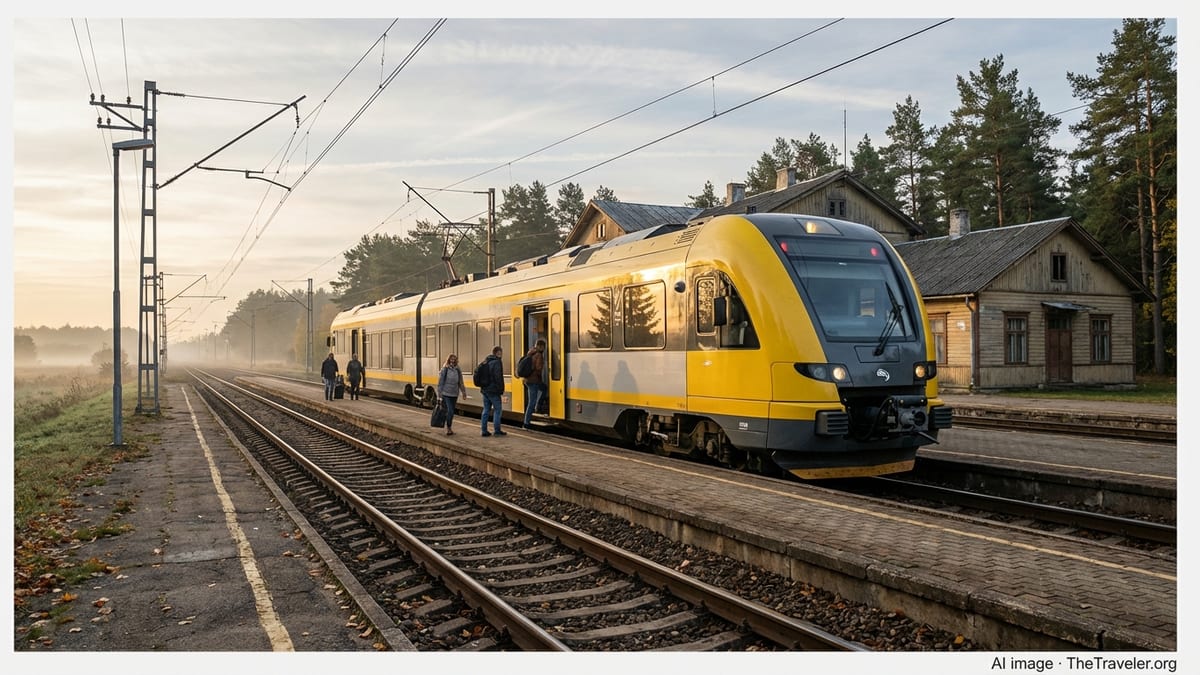
Strategic rail spur planned for Rūdninkai training ground
Publicly available information from transport and defence planning documents indicates that Lithuania intends to construct a new rail branch from the Jašiūnai–Stasylos junction to the Rūdninkai training area, south of Vilnius and close to the border with Belarus. The line would use the 1520 millimetre broad gauge that connects to the rest of Lithuania’s conventional rail network, allowing heavy equipment and personnel to move directly between the national system and the growing military base.
The Rūdninkai area has been designated as the main hub for the permanent stationing of Germany’s 45th Panzer Brigade in Lithuania. Official project descriptions for the base highlight the need for robust transport connections, with rail access singled out as a priority alongside roads, internal circulation routes and logistics zones. The new spur is presented as part of a package of improvements that includes new roads, loading areas and storage facilities across roughly 170 hectares.
Shareholder guidance for the state rail infrastructure company LTG Infra further outlines expectations that the railway infrastructure needed for the Rūdninkai training ground will be completed by the first quarter of 2028. This timing is aligned with defence planning goals that foresee critical infrastructure at Rūdninkai enabling the German brigade to reach full operational capability later in the decade.
Part of a wider push on military mobility
The planned access line to Rūdninkai is emerging against a backdrop of major investment in military mobility across Lithuania. Government budget documents and infrastructure programmes for 2026 to 2028 show increased allocations for road and rail upgrades that support the rapid movement of NATO forces throughout the country and across borders.
Recent reports on LTG Group’s activities describe multiple dual-use projects, including a new handling yard in Palemonas designed to transfer military cargo between European standard gauge and the Baltic broad-gauge network. This facility is intended to streamline the arrival of allied equipment from Central and Western Europe and its onward shipment by rail to destinations such as Rūdninkai, other training grounds and the port of Klaipėda.
The transport ministry’s infrastructure overview also emphasises that priority is being given to transport links serving military facilities, with branch lines and junctions that improve access to bases ranked alongside larger trans-European projects. Within this framework, the Rūdninkai spur is presented not as a standalone initiative but as one element in a broader effort to make Lithuania’s transport system more resilient in crisis scenarios.
EU and EIB funding underpin defence infrastructure drive
The financing context for the Rūdninkai rail connection is closely tied to European Union support for military mobility and to loans from the European Investment Bank. Recent communication from the Lithuanian Ministry of Finance notes that almost 100 million euros of EU funding has been earmarked for military mobility activities within the current investment programme, with additional resources expected through the Connecting Europe Facility and other EU funds.
Separate announcements from the European Investment Bank describe a substantial lending package for the development of the Rūdninkai military base, including phases that will deliver internal roads, logistics zones, accommodation, training facilities and medical services. While the rail spur itself is only one component of the broader project, it benefits from the same framework of lending and guarantees aimed at strengthening NATO’s eastern flank.
Policy papers on Rail Baltica and the North Sea–Baltic transport corridor further underline that dual-use infrastructure is now seen as integral to EU transport policy. Lithuania has actively positioned its rail projects, including the Rūdninkai connection and the Palemonas loading yard, as part of this dual-use agenda, seeking to demonstrate that investments will serve both civilian freight and military requirements.
Integration with existing rail network and future projects
From a technical standpoint, the access line is planned to connect into the existing broad-gauge network near Jašiūnai, south of Vilnius. That location already sits on key freight routes linking the capital to the south and east of the country. By branching into the Rūdninkai training area, planners aim to ensure that military trains can be routed to the base without disrupting regular passenger services on the main lines.
In parallel, Lithuania is advancing major upgrades to its rail system, including the electrification of core freight corridors and ongoing work on the Rail Baltica project. Although the new European standard-gauge line focuses primarily on long-distance international traffic, national planning documents highlight its role in improving overall capacity, which in turn facilitates additional military movements on both gauges.
Industry reports suggest that the combination of a modernised mainline network and targeted branch projects, such as the Rūdninkai spur, will give defence planners more flexibility in route selection and timetabling. This is seen as critical for exercises that bring large volumes of equipment into Lithuania on tight schedules, as well as for any potential reinforcement scenario in a security crisis.
Local and regional implications near the Belarusian border
The Rūdninkai training area lies less than 20 kilometres from the border with Belarus, placing the new rail connection in a region that has gained strategic importance since Russia’s full-scale invasion of Ukraine. Analysis from regional security institutes describes the base as a key node in efforts to deter potential aggression along NATO’s northeastern frontier.
Local development plans indicate that the expansion of the training area and the arrival of the German brigade are expected to bring associated civilian investment, including housing, services and employment opportunities in nearby communities. Improved rail access is presented as a way to support both military logistics and civilian supply chains, although no regular passenger services to the training ground have been announced in the documents reviewed.
At the same time, environmental and land-use considerations are part of the planning process. Rūdninkai is in a region that includes forested land and former training zones from earlier decades, and public materials on the base project note that environmental assessments and mitigation measures are required for new construction, including transport links such as the rail spur.