


More news on this day
On opposite sides of the Danube, Romania and Bulgaria are accelerating a quiet but consequential race: which country will put more new, modern trains onto its railways soonest, using a mix of European funding and national investment to overhaul ageing fleets and lure travellers back to rail.
Get the latest news straight to your inbox!
Two neighbours, one urgent modernisation challenge
Romania and Bulgaria entered the current decade with some of the oldest passenger rolling stock in the European Union, after years of underinvestment and shifting transport priorities. Publicly available information shows that both countries are now trying to reverse that legacy at speed, spurred by climate targets, passenger expectations and access to recovery funds tied to tight deadlines.
In Romania, the Railway Reform Authority has taken the lead in procuring new trains and locomotives that are then leased to state operator CFR Călători and other passenger companies. In Bulgaria, the Ministry of Transport and state-owned BDZ are coordinating a parallel effort to secure new electric multiple units and modern locomotives for intercity and regional services.
Observers of the regional market note that the competition is not only about numbers of trainsets ordered, but also about which country translates contracts into actual trains in service first. Timetables for delivery, approval and commissioning now play as big a role as headline investment totals.
Romania’s strategy: long corridors and next generation trains
Romania has structured much of its rolling stock renewal around long distance electric multiple units and powerful electric locomotives intended to exploit upgraded main lines. According to company releases, Alstom began delivering Coradia Stream regional trains to Romania in late 2024, with units entering commercial service on busy intercity corridors such as Bucharest to Brașov. These trains feature wide doors, climate control, real time passenger information and dedicated spaces for passengers with reduced mobility.
In April 2026, Alstom reported that it had delivered the first Traxx Passenger electric locomotive to the Railway Reform Authority under a 16 unit contract signed in 2024. The new locomotives are designed for 200 km/h operation where infrastructure allows, with regenerative braking and lower energy consumption compared with older classes. Romanian planning documents describe the deployment of dozens of new long distance electric multiple units as part of the country’s wider energy and climate strategy.
Romania’s approach combines new trains with a service contract model covering maintenance and availability over many years. Public documents highlight investments in a dedicated maintenance depot for the new Coradia fleet, intended to avoid the reliability problems that have affected some earlier rolling stock. By linking rolling stock renewal to infrastructure upgrades on key European corridors, Romanian planners aim to cut journey times and make rail a more credible alternative to motorway travel.
However, there are constraints. CFR Călători has stated in its public reports that it continues to face budget shortfalls relative to the compensation levels foreseen in its public service contract. That gap limits the operator’s ability to modernise older coaches at scale or expand services, placing added importance on the timely integration of the new European funded trains already on order.
Bulgaria’s push: rescue tenders and EU deadlines
Bulgaria’s race for new trains has been closely tied to its National Recovery and Resilience Plan, which earmarks funds for electric multiple units to operate on electrified main lines. After an earlier attempt to procure push pull trainsets stalled, the transport ministry opted to relaunch the process with a focus on single deck multiple units, in order to meet the spending deadline for recovery funds in 2026. Economic and transport sector coverage has tracked the tender’s evolution and the risk that delayed approvals could force the government to rely more heavily on the national budget.
Official communications from Sofia indicate that Bulgaria has since signed a contract for 35 new electric multiple units with a consortium supplying Alstom Coradia Stream trains, with a portion financed by the recovery plan and the remainder backed by state funds. Reports explain that units delivered by the cut off date will be paid with European money, while trains arriving later will be funded nationally, a compromise designed to keep the deal intact despite slow administrative procedures.
In parallel, Bulgaria has been taking delivery of Siemens Smartron electric locomotives for BDZ. The transport ministry has stated that all express trains are now hauled by the new locomotives, which replace older classes and provide more reliable traction for long distance services. Additional projects under the Transport Connectivity programme include the purchase of several more trains using European Regional Development Fund resources.
The Bulgarian government presents these steps as the largest investment in rolling stock in decades, pointing out that new trains had not been ordered for roughly 20 years prior to the current wave of contracts. Yet the clock set by Brussels continues to shape the pace of delivery, with national officials acknowledging that some units may enter service after the formal end of the recovery funding window.
Deliveries on the ground: who is moving faster
On the ground, the race is becoming visible to passengers. In Romania, Coradia Stream trains are already running regular services on at least one flagship intercity route, replacing locomotive hauled formations built in previous generations. Passengers are encountering level boarding in many stations, onboard Wi Fi and clear digital information systems that contrast with the printed paper signs still common on older rolling stock.
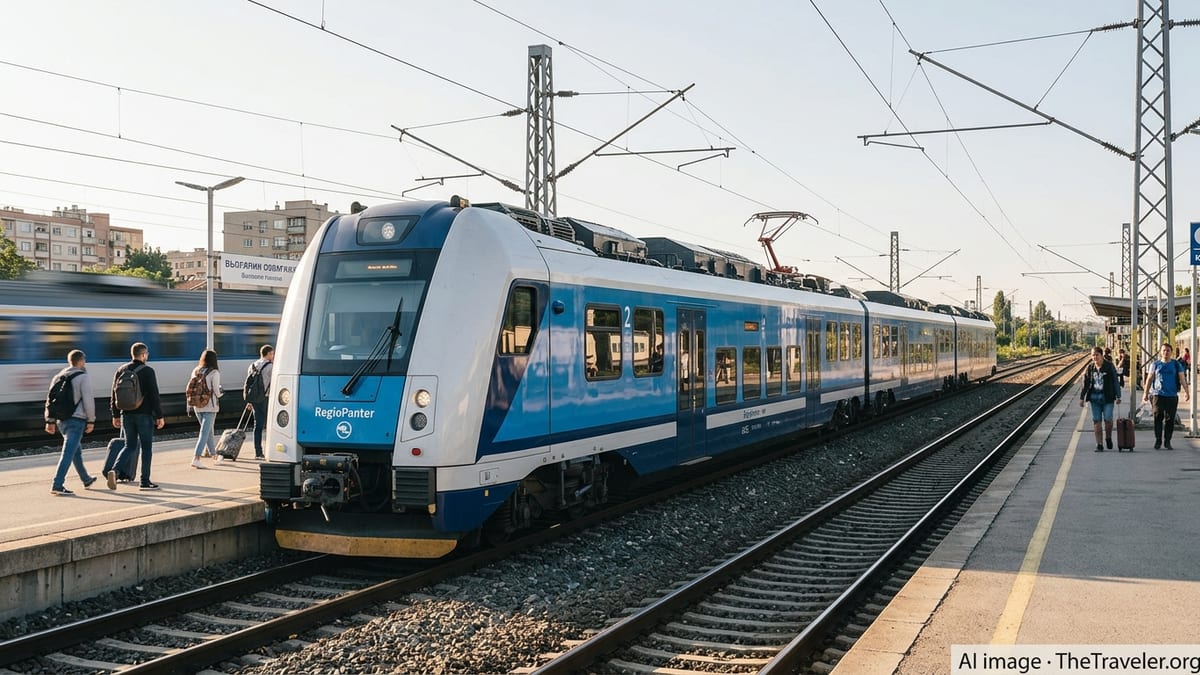
Bulgaria is slightly later to put brand new multiple units into daily passenger service, but recent sightings and specialist reporting point to progress. New Škoda RegioPanter units for regional services have arrived in the country for testing, and the first Alstom Coradia Stream units for BDZ have also begun dynamic trials. The delivery schedules discussed publicly suggest that the full Bulgarian fleet of 35 Coradia units is planned to arrive in batches through 2026 and into 2027, assuming approval processes proceed smoothly.
Locomotive deliveries have moved more quickly in Bulgaria, where the Smartron fleet already powers most express services, while Romania’s new Traxx locomotives are just beginning to appear. Conversely, multiple unit deployment has advanced earlier in Romania, where several Coradia units are in commercial use, whereas Bulgaria remains in the testing phase.
Analysts following the sector observe that both countries face a similar bottleneck in approvals and staff training. Type approval for new rolling stock, preparation of maintenance facilities and the need to train drivers and technical staff all add months to delivery timetables, even after trains have physically arrived. This means that the practical race is not only between Romania and Bulgaria, but also between manufacturers, regulators and rail operators working to compress these timelines.
Beyond new steel: service quality and regional competition
The rivalry over who fields more new trains first is part of a broader shift in the region’s rail market. Liberalisation of passenger services and the presence of private operators on some routes are already creating modest competition within national networks. As new rolling stock arrives, that competition may sharpen, with passengers comparing comfort levels, punctuality and ticket prices more closely across borders and companies.
Romania has signalled that some of its new trains could be used on international services toward Budapest and Vienna once infrastructure works are completed, potentially raising the bar for cross border comfort and travel times. Bulgaria is looking to strengthen connections toward Greece, Türkiye and Serbia, where upgraded routes and modern trains could make rail more attractive for both tourists and business travellers.
For both countries, the long term test will be whether new trains are matched by reliable timetables, integrated ticketing and station upgrades. Modern multiple units can reduce energy use and improve accessibility, but their impact on modal shift depends on wider factors such as journey times, frequency and ease of booking. Public data on passenger volumes in recent years show that rail has struggled to keep pace with road transport, suggesting significant room for growth if service quality improves.
As 2026 progresses, the picture along the Danube is one of convergence rather than clear winners. Romania has taken an early lead in putting new multiple units into service, while Bulgaria has advanced rapidly on locomotive renewal and is pushing to keep its recovery plan financed fleet on track. For travellers, the most tangible result is that the familiar sight of decades old carriages is gradually giving way to new electric trains on both sides of the border, hinting at a more competitive and climate conscious rail future in southeastern Europe.