


Flying home to the United States from Nassau can feel confusing the first time you see signs for “U.S. Departures” and “Preclearance.” Lynden Pindling International Airport (LPIA) is one of a handful of airports outside the United States where you actually complete U.S. immigration, customs and TSA security screening before you board. Done right, it makes your arrival in Miami, Atlanta, New York or Charlotte feel like a simple domestic hop. Done wrong, you could find yourself stuck in a long line while your boarding call echoes over the loudspeakers. This guide walks you through exactly what to expect and how to time it.
Get the latest updates straight to your inbox!
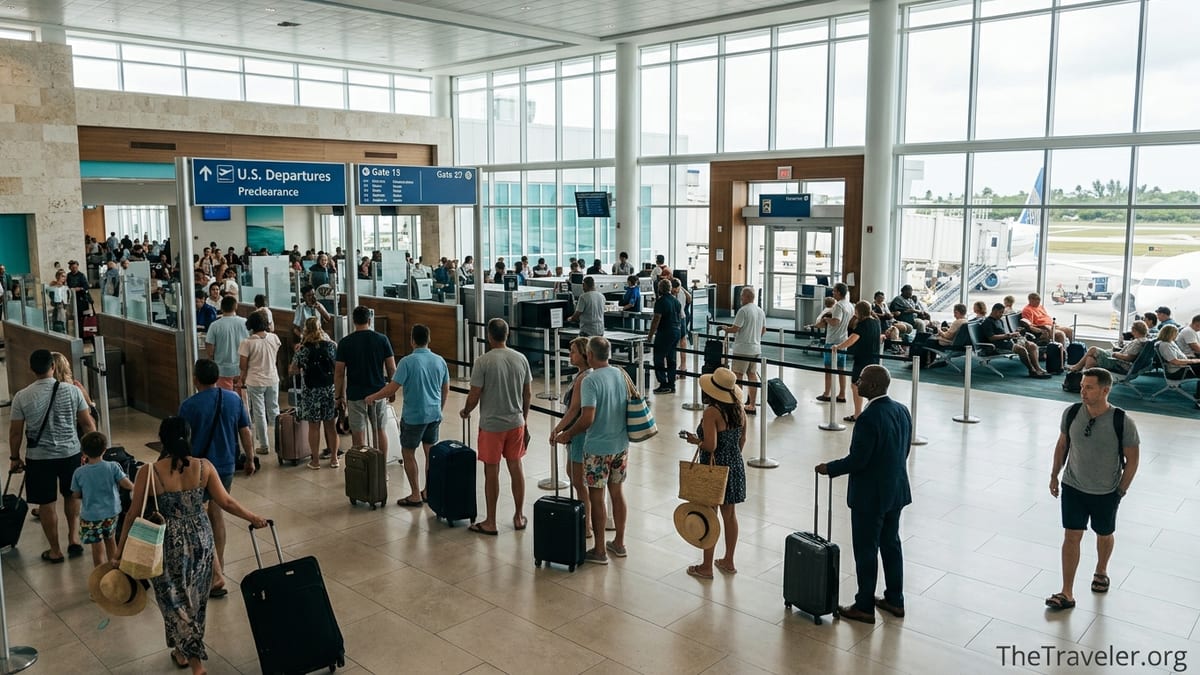
How U.S. Preclearance at Nassau Works
Lynden Pindling International Airport in Nassau is the main air gateway to The Bahamas and hosts a full U.S. Customs and Border Protection preclearance facility in its dedicated U.S. Departures terminal. That means that if you are flying from Nassau to a U.S. airport, you will complete U.S. immigration, customs and TSA-style security screening in Nassau rather than on arrival in the United States. When your flight lands in Fort Lauderdale, Miami, Atlanta, Charlotte, New York or any other U.S. destination, it is treated as a domestic arrival. You simply walk off the plane and head straight to baggage claim or to your onward connection.
In practice, the Nassau preclearance process bundles together several steps that are usually separate in a typical international journey. After you check in with your airline and drop checked baggage, you clear Bahamian exit security, then move into the U.S. preclearance zone. There you pass through TSA-equivalent screening operated in coordination with U.S. authorities, then line up for a U.S. immigration officer, usually using a passport kiosk or mobile app to speed things up. Finally, your flight boards from gates reserved for U.S. departures only.
For example, an American Airlines passenger traveling Nassau to Miami at 3:15 p.m. will check in at the U.S. airlines island in the main hall, clear Bahamian security, then follow signs reading “U.S. Departures / Preclearance.” After being screened and interviewed by U.S. officers, they wait at the U.S. gate. When that flight lands in Miami, the passenger can usually be curbside in minutes, because there is no immigration hall to deal with.
The main advantage for travelers is time predictability on arrival and simpler connections. If you are connecting onward in the United States, preclearance in Nassau sharply reduces the risk of misconnecting because of long immigration lines. A Nassau to Charlotte passenger connecting to a domestic flight to Chicago, for instance, typically just walks from one gate to the next, like any other domestic connection.
When to Arrive: Realistic Timing for U.S. Flights
Because you are effectively doing two sets of checks in Nassau instead of one, you should build in more time at the airport than you might for a domestic U.S. flight. Airport authorities and airlines generally advise arriving at least 3 hours before scheduled departure for U.S.-bound flights from Nassau, and that is realistic for most travelers, especially during busy late-morning and afternoon departure banks.
In practice, timing depends heavily on your travel day and hour. On a quiet weekday morning in the off-season, a U.S. citizen with no checked bags who holds TSA PreCheck might move from check-in to their gate in 45 to 60 minutes. On a busy Saturday in winter, when resorts like Atlantis and Baha Mar are turning over guests, lines for check-in and preclearance can both be long. Travelers reporting on recent Saturday departures have described security queues that snaked back past the airline desks and immigration lines that added another 30 minutes or more on top.
A good rule of thumb: on peak days such as Saturdays and Sundays from December through April, and on holiday Mondays, treat 3 hours as a minimum for families and anyone checking bags. For instance, if your JetBlue flight to New York JFK departs at 1:10 p.m., aim to be at the check-in counters around 10:00 a.m. That allows time for a slow check‑in queue, 20 to 30 minutes at Bahamian security, and potentially another 30 to 45 minutes in U.S. preclearance if several U.S. flights are processing at once.
If you are traveling outside peak periods, are already checked in online, and have only carry-on baggage, you can sometimes cut it closer. A solo traveler on a Tuesday 9:30 a.m. Delta flight to Atlanta might be comfortable arriving just before 2 hours prior. Still, leaving a generous buffer is prudent, because once the preclearance queues back up, there is limited ability for staff to pull late passengers forward. Airlines at Nassau have been known to close check-in counters 60 minutes before departure, so if you must check bags, do not assume you can show up any later than that and still travel.
Step-by-Step: From Curb to U.S. Gate
The layout at Lynden Pindling International Airport is straightforward once you know the sequence. When your taxi or hotel shuttle drops you at the terminal, you enter the main check-in hall, which serves both international and domestic flights. U.S.-bound carriers including American, Delta, JetBlue, United, Southwest and various low-cost or seasonal airlines are grouped on specific check-in islands, with overhead signs listing the airlines and destinations.
Your first task is airline check-in and baggage drop. If you checked in online and have only carry-on luggage, you can proceed directly toward security. For most travelers, though, this is where the first bottleneck appears. On a Sunday around midday, for example, you might find American Airlines’ line stretching across the hall with several full flights to Miami, Charlotte and Dallas all departing within 90 minutes. Build in up to 30 to 45 minutes for this stage during busy periods, and keep your passport and confirmation handy to speed the process.
After you have your boarding pass and your checked bags are tagged, you head to the Bahamian security checkpoint that leads into the departures area. Here, your carry-on bags are x-rayed and you go through a metal detector or body scanner, similar to security at other international airports. Liquids rules are enforced, so large bottles of sunscreen or rum not purchased in duty free should be in checked luggage. Once clear, you emerge into the general departures concourse, where you will see duty free shops and a food court serving familiar brands like Dunkin and Wendy’s, along with Bahamian food outlets.
Keep an eye out for signage directing U.S. passengers to “U.S. Departures / U.S. Customs & Border Protection.” You will walk down a separate corridor into the U.S. preclearance zone. At this point, you are committed to the preclearance process and cannot easily return to the main departures area, so finish any last-minute purchases beforehand. Inside preclearance, you proceed through a TSA-equivalent screening line, which may include a separate lane for TSA PreCheck-eligible travelers, followed by U.S. immigration inspection with CBP officers. Only after clearing both do you reach the U.S. departure gates.
Documents, ESTA, Visas and Who Can Use Preclearance
Because Nassau preclearance is effectively a U.S. border crossing, the same document rules apply as if you were landing at Miami or New York. U.S. citizens need a valid passport book, and the name on the ticket must match the passport. Permanent residents need their green card and passport. Citizens of visa waiver countries such as the United Kingdom, most of the European Union, Australia or Japan must have a valid e‑passport and an approved ESTA authorization. Travelers who require a U.S. visa, such as many citizens of Latin American, African or Asian countries, must have that visa in their passport.
Bahamians have special arrangements in some cases, but those rules can be technical and can change, so local travelers should confirm requirements with U.S. authorities or their airline before departure. In all cases, CBP officers in Nassau have the same authority as officers at a U.S. airport. They can ask questions about your trip, request supporting documents such as proof of onward travel or hotel reservations, and inspect your bags.
For cruise-and-stay visitors who flew into Nassau from the United States without needing a visa due to certain exemptions, it can be tempting to assume departure is equally simple. In reality, your return flight from Nassau to a U.S. airport is treated strictly as an international arrival by U.S. authorities, just like any other foreign origin. For example, a British traveler who entered The Bahamas on a direct London to Nassau flight must still have a valid ESTA or U.S. visa to fly Nassau to Orlando. If ESTA is denied or expired, preclearance officers in Nassau will refuse boarding, and you will have to reroute your trip.
Most travelers will not need to show printed documents beyond passports and, where applicable, visas or ESTA approvals. However, if your circumstances are unusual, such as visiting the United States on a one-way ticket with no fixed address, it is wise to carry printed hotel confirmations, return or onward tickets and evidence of funds. Presenting these calmly if asked can smooth your interview with the CBP officer in Nassau and prevent secondary inspection from delaying your boarding.
Security Screening, TSA PreCheck and What You Can Carry
Security for U.S. flights at Nassau is jointly managed by Bahamian authorities and U.S. partners and is designed to match U.S. aviation security standards. After you exit the general departures area into the U.S. preclearance zone, you will encounter a TSA-style checkpoint where laptops must usually be removed, pockets emptied and bags placed on a belt for x‑ray. Shoes may need to come off, depending on local procedures and any eligibility for expedited screening programs.
TSA PreCheck is available at Lynden Pindling International Airport for eligible travelers flying with participating U.S. airlines. If you are enrolled and your Known Traveler Number is on your reservation, your boarding pass should show the familiar “TSA PreCheck” indicator. In practice, this typically grants access to a dedicated lane where you may be able to leave shoes and light jackets on and keep laptops in bags, similar to PreCheck in the United States. Because Nassau’s terminal is smaller, the PreCheck lane may not always be staffed, but when it is, regular U.S. business travelers report that it can cut 10 to 20 minutes off their wait during busy mid-day departure waves.
Liquid and prohibited item rules mirror those in the United States. This can catch some visitors off guard. For example, if you bought a 750 ml bottle of rum or a large glass jar of hot sauce in downtown Nassau and placed it in your hand luggage before arriving at the airport, it will likely be confiscated unless it meets duty free packaging and transfer rules. To keep your souvenirs, purchase them in the duty free shops located after security inside the U.S. departures area or pack them in checked baggage before you reach the screening point.
Families with small children and travelers with medical devices should plan as they would for any U.S. airport screening. Strollers usually need to be collapsed and sent through the x‑ray, and baby formula or medications should be declared to officers. If you travel with items that require special handling, such as insulin pumps or CPAP machines, arrive early enough to allow for additional screening so you are not under pressure as boarding time approaches.
Customs Declarations, Duty Free and Baggage Checks
Because U.S. customs formalities happen in Nassau, you will complete a U.S. customs declaration before you board. This may be done electronically via self-service kiosks, mobile applications or traditional blue paper forms, depending on your citizenship and the current setup in the preclearance facility. You will be asked about the value of items you are bringing back, including alcohol, tobacco and gifts, as well as whether you are carrying more than 10,000 U.S. dollars in cash or certain agricultural products.
In practical terms, this is where many vacationers confront the question of how much Bahamian rum, cigars or duty free perfume they can legally bring back. U.S. duty allowances depend on your residency and how long you have been abroad. A typical U.S. resident returning from a short stay in Nassau can generally bring back modest quantities of alcohol and tobacco for personal use without paying duty, though the exact amounts and rules can change. If you have loaded up on multiple cases of beer or several boxes of cigars, expect questions and possibly duty assessment from CBP in Nassau.
Checked baggage is screened out of sight after you hand it over at the airline counter, but remember that CBP in Nassau has the authority to inspect it before it is loaded on the aircraft. Random checks or targeted inspections can occur, and if a bag needs to be opened, an inspection notice may be placed inside, just as if the bag had been inspected on arrival in the United States. For this reason, avoid packing prohibited items such as certain agricultural products, meats or fresh produce, and keep prescription medications in their original labeled containers.
A useful example: a couple staying at a Cable Beach resort decide to bring home two bottles of rum, a bottle of local vodka and several duty free cosmetics. They buy all of them in the U.S. departures duty free area, where staff pack liquids in sealed clear bags designed to be carried through security. At the customs kiosk, they honestly declare their purchases. The total value is modest, and they are waved through without paying duty. When they land in Atlanta, they simply pick up their bags and walk out, because all of this was already processed in Nassau.
Peak Times, Line Management and Missed Connections
The biggest practical difference between Nassau and many larger international hubs is how sensitive the experience is to daily peaks. LPIA handles a high proportion of leisure travelers, and flights to the United States tend to cluster in morning and early afternoon waves that coincide with resort checkout times. On Saturdays in particular, you may find several large aircraft boarding for major hubs like Miami, Charlotte, New York, Boston and Atlanta within a narrow window. When this happens, both the security and CBP queues can grow quickly.
Real-world reports from recent travelers highlight the spread of experiences. One family departing on a Wednesday for Orlando described moving from curb to gate in just under an hour, with minimal lines and time to spare for a sit-down lunch in the U.S. departures food court. Another traveler leaving on a Saturday afternoon for Newark reported a long, slow-moving preclearance line where it took nearly 40 minutes just to reach the front of security, followed by a further 30 minutes in the immigration hall. Both flights departed on time, but the second traveler had little time left to use the restroom or refill a water bottle before boarding began.
Airlines will occasionally prioritize passengers with imminent departures by calling them forward in the queue, but you should not rely on this. CBP must balance fairness and security, and staff cannot always pull specific passengers out of line. If you are staying at a resort that arranges airport shuttles, be cautious of pickup times that deliver you to the airport only 2 hours before departure on busy days; negotiate an earlier slot if possible, especially if traveling during school holidays or winter peak season.
For those connecting onward in the United States, preclearance offers one major advantage: if you do experience a long wait in Nassau but still make your flight, your onward connection is almost always easier than it would be if you had to clear U.S. immigration on arrival. For example, a Nassau to Charlotte passenger connecting to a tight 55‑minute flight to Chicago may feel anxious while watching the preclearance line in Nassau. Once they are on the aircraft and airborne, however, they can be reasonably confident that they will make the onward domestic connection, because they do not have to budget time for immigration or customs in Charlotte.
How Nassau Differs from a Typical International Departure
Travelers familiar with international flights from Europe or Asia are used to a pattern where they clear exit security and perhaps passport control in the departure country, then face immigration, customs and a second security screening after landing in the United States. Nassau’s preclearance setup compresses all those U.S. formalities into the departure side of the trip. The trade-off is more work upfront in Nassau in exchange for a smooth, domestic-style arrival in the United States.
One key difference is the feeling of the U.S. departures concourse itself. Once you clear preclearance at LPIA, the gate area feels much like a small U.S. regional terminal. Signage uses U.S. security language, the concessions include familiar coffee and fast food brands, and announcements are geared toward U.S. flights only. There are no onward international gates or mixed flows of passengers heading to other countries from this area, which can make navigation simpler but also means fewer facilities than at a large hub.
Another practical difference involves missed flights or denied entry. Because the legal U.S. border is considered to be at the preclearance facility in Nassau, if you are refused entry by CBP there, you have technically never entered the United States. In that case, you would be escorted back into the Bahamian side of the airport to arrange alternative travel or resolve documentation issues. Similarly, if you miss your U.S. flight because of delays in reaching or getting through preclearance, any rebooking will happen in Nassau rather than at a U.S. immigration hall.
For most visitors, however, the main visible difference is at the end of the journey. Landing in the United States after a Nassau departure feels pleasantly anticlimactic. Instead of lining up with hundreds of international passengers at Miami’s immigration hall, you step into the domestic arrivals stream. A family on a Nassau to Orlando flight, for example, can often be at the rental car center less than 30 minutes after landing, because there is no customs line to slow them down.
The Takeaway
Flying from Nassau’s Lynden Pindling International Airport to the United States is not complicated once you understand that you are essentially shifting all of the U.S. border formalities to the front of your journey. You will check in, clear Bahamian security, then pass through U.S. style security, immigration and customs before boarding your aircraft. On arrival in the United States, your flight behaves like a domestic arrival, which makes onward connections and ground transport much simpler.
The keys to a smooth experience are timing and preparation. Arrive about 3 hours before departure on busy days, especially weekends and peak holiday periods, and at least 2 hours before quieter weekday flights if you are traveling light. Have your passport, ESTA or visa and any supporting documents ready, and pack duty free liquids and souvenirs with security rules in mind. If you are eligible, make sure your TSA PreCheck or trusted traveler details are correctly attached to your booking to take advantage of expedited screening.
By approaching Nassau preclearance with the same seriousness you would give to a major U.S. hub, you can turn what might feel like an extra hurdle into a significant advantage. When you walk off the plane in Miami, Atlanta, New York or Orlando and head straight for your ride or connection while others from non-preclearance flights line up at immigration, you will appreciate having done the work back in The Bahamas.
FAQ
Q1. How early should I arrive at Lynden Pindling International Airport for a U.S. flight?
For most U.S.-bound flights from Nassau, plan to arrive about 3 hours before departure, especially on weekends and during winter and holiday peak seasons. On quieter weekdays and with only carry-on bags, some travelers are comfortable with 2 hours, but more time reduces stress if lines at check-in or preclearance are longer than expected.
Q2. Do I go through both Bahamian and U.S. security when flying to the United States?
Yes. You first clear Bahamian exit security to enter the main departures area. Then, in the U.S. preclearance zone, you pass through a TSA-style checkpoint that follows U.S. security standards before seeing U.S. immigration officers. Both steps are required for U.S.-bound flights.
Q3. Will I have to go through immigration and customs again when I land in the United States?
Normally, no. Once you have completed U.S. preclearance in Nassau, your flight is treated as a domestic arrival when it lands in the United States. You typically walk straight to baggage claim or your connecting gate without visiting an immigration or customs hall, which often saves significant time.
Q4. Is TSA PreCheck available at Nassau, and does it work the same as in the United States?
TSA PreCheck is available at Lynden Pindling International Airport for eligible travelers on participating airlines. When staffed, the PreCheck lane allows you to keep shoes and light jackets on and often leave laptops in your bag, similar to U.S. airports. However, staffing and wait time benefits can vary because Nassau is a smaller facility, so you should still arrive with a full time buffer.
Q5. What documents do I need to use U.S. preclearance in Nassau?
You need exactly what you would need to enter the United States at any other airport. U.S. citizens require a valid passport book, permanent residents need their green card and passport, visa waiver travelers need a valid e‑passport and approved ESTA, and others need the appropriate U.S. visa. Make sure names on your ticket and documents match to avoid delays.
Q6. Can I buy duty free alcohol and carry it onto my U.S. flight from Nassau?
Yes, but it is safest to purchase alcohol and other large liquids in the duty free shops located after security inside the U.S. departures area. Items bought there are typically packaged to comply with security rules. Large bottles placed in your carry-on before security or not in duty free packaging may be confiscated at screening, so pack those in checked luggage instead.
Q7. What happens if U.S. Customs and Border Protection refuses me entry during preclearance?
If CBP in Nassau decides you are not admissible to the United States, you will not be allowed to board your U.S.-bound flight. You will usually be escorted back to the Bahamian side of the terminal to make alternative arrangements or address documentation issues. This is similar to being refused entry at a U.S. airport, except that it happens before you leave The Bahamas.
Q8. How does preclearance affect my connection time in the United States?
Preclearance generally makes U.S. connections easier. Since you arrive as a domestic passenger, you can often connect with shorter layovers than you would normally book when arriving from overseas. For example, a 55‑minute connection from Nassau through Charlotte to another U.S. city is usually workable because you do not need to clear immigration or customs on arrival in Charlotte.
Q9. Are there food and shopping options after U.S. preclearance at Nassau?
Yes. After you clear preclearance, the U.S. departures concourse offers a small selection of cafes, fast food outlets and shops, including duty free. It is more limited than a large U.S. hub, but you can usually find coffee, snacks, simple meals and last-minute souvenirs while you wait to board.
Q10. What if I arrive at the airport late and the lines are very long?
If you arrive with little time before departure and find long queues, speak to airline staff immediately and explain your situation. In some cases, they may be able to direct you to a shorter line or alert preclearance staff, but this is not guaranteed. Your best protection is to arrive with enough time so that unexpected delays at check-in, security or preclearance do not put your flight at risk.