


More news on this day
Hundreds of travellers have been left stranded across Spain and other European hubs after disruption at Adolfo Suárez Madrid-Barajas Airport triggered 224 flight delays and three cancellations affecting services operated by Iberia, Ryanair, Air Europa, TAP Air Portugal and easyJet.
Get the latest news straight to your inbox!
Chain Reaction From Madrid to Key European Hubs
According to industry monitoring data and travel trade coverage, the disruption began building through the day at Madrid-Barajas, Spain’s busiest airport and a major European connection point, as departure and arrival schedules slipped across multiple terminals. The accumulated impact was recorded as more than 224 delayed flights and three cancellations, with knock-on effects quickly spreading to other airports in Spain and across Europe.
Published reports describe a rolling pattern of hold-ups on short and medium haul services that connect Madrid with major capitals including Lisbon, London, Paris and Amsterdam. As aircraft and crews fell out of their planned rotations, delays in Madrid translated into missed slots and late arrivals in those cities, complicating evening and overnight operations.
Data from airport information boards and independent flight-tracking platforms show that both domestic and international services were affected, with some departures held on the ground in Madrid while others operated significantly behind schedule. The combined effect created crowded terminals and longer waits for connections at Madrid-Barajas and at onward hubs.
Travel industry analysis highlights that disruption at a large transfer airport such as Madrid can quickly radiate outward. With Iberia, Air Europa and low-cost carriers all using the Spanish capital as a key node, even a limited number of cancellations can create a surge of rebookings and missed connections across the network.
Multiple Airlines Caught in the Same Operational Squeeze
Publicly available flight data indicate that Iberia, Ryanair, Air Europa, TAP Air Portugal and easyJet all operated services subject to notable delays during the disruption window. These airlines collectively carry a large share of Spain’s short haul traffic, and their overlapping schedules through Madrid magnified the operational squeeze.
Iberia and Air Europa, both with substantial bases at Madrid-Barajas, saw delays on routes linking the Spanish capital with other European gateways, including London and Paris. Their role as network carriers meant that late-running flights out of Madrid risked creating missed onward connections for long haul passengers as well.
Low-cost operators Ryanair and easyJet, which run high-frequency services linking Spanish cities with London and other northern European destinations, also experienced irregular operations linked to Madrid. Flight-tracking feeds showed services departing significantly behind schedule, with rotation pressures and congested airspace compounding ground handling challenges.
TAP Air Portugal, whose Madrid flights are an important bridge in the Iberian Peninsula, was likewise affected, with delays on services between Madrid and Lisbon feeding into the Portuguese carrier’s broader European timetable. With so many airlines relying on shared infrastructure and airspace, disruption for one quickly became a shared problem for all.
Stranded Passengers and Crowded Terminals
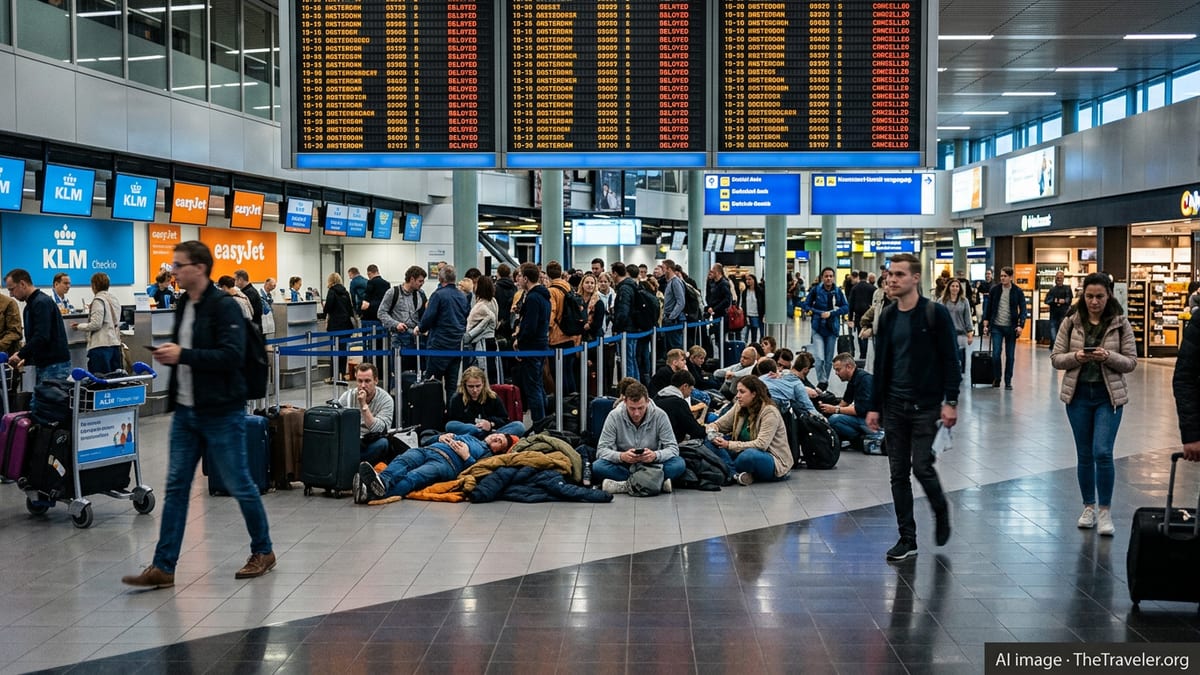
Reports from Spanish and international travel media describe scenes of packed departure halls and long queues at customer service desks as passengers sought information, rebooking options and accommodation. Travellers connecting through Madrid on their way to or from Lisbon, London, Paris and Amsterdam were particularly exposed when missed connections left them temporarily without onward flights.
Standard industry practice in such events sees airlines attempting to reroute affected passengers onto later services or through alternative hubs, but capacity limitations can quickly become apparent when delays impact several carriers at once. With only three flights formally cancelled, most journeys remained technically operable, yet lengthy delays and missed links effectively stranded many travellers for extended periods.
Observers note that the disruption came at a time of high seasonal demand, when aircraft load factors are typically strong and spare seats more limited. This makes same-day rebooking harder and can turn what might otherwise be a routine delay into an overnight stay or an unplanned extended stopover for those without flexible itineraries.
Travel advisories circulating on social channels and in specialist publications urged passengers to monitor airline apps, watch airport display boards closely and allow additional time for connections at Madrid-Barajas and other affected hubs until operations stabilise.
Knock-On Effects in Lisbon, London, Paris and Amsterdam
As delayed flights departed Madrid hours behind schedule, airport operations in Lisbon, London, Paris and Amsterdam also came under pressure. Late arrivals created bunching at gates, extending turnaround times and complicating stand allocation in already busy evening peaks.
Operational data and schedule snapshots show arriving flights from Madrid squeezing into narrow windows at these airports, sometimes overlapping with later departures that relied on the same aircraft. In some cases, departures from secondary airports were held to wait for inbound aircraft from Madrid, prolonging the disruption for passengers starting their journeys outside Spain.
In London and Paris, which are served by both full service and low-cost carriers from Madrid, the mix of airlines and terminals widened the impact beyond a single pier or facility. Meanwhile, at Lisbon and Amsterdam, the effects of late Madrid arrivals were felt in connection banks for intra-European and intercontinental services, potentially tightening minimum connection times for transiting passengers.
Aviation analysts point out that such systemic ripples are a hallmark of modern hub-and-spoke networks, where punctuality at a single major airport can significantly influence delay statistics across an entire region for the rest of the day.
What Travellers Can Expect in the Coming Days
Although the most acute disruption is typically contained within the same operating day, schedule experts warn that irregular operations can leave aircraft and crews out of position, affecting flights in the following 24 to 48 hours. Passengers booked on upcoming services from Madrid to Lisbon, London, Paris, Amsterdam and other busy routes are being advised in public guidance to keep a close eye on their flight status.
Consumer advocates also highlight the relevance of European air passenger protection frameworks, noting that travellers facing long delays or cancellations may, in certain circumstances, be entitled to assistance or compensation. The specifics depend on factors such as the cause of disruption, length of delay and whether alternative transport was offered, and travellers are encouraged to review current official guidance.
For now, publicly available airport and airline data suggest that operations at Madrid-Barajas are in the process of being brought back into line with published schedules, though residual delays may persist while airlines complete aircraft repositioning and clear backlogs. Travellers already in transit are likely to continue feeling the effects until rotations fully stabilise.
Industry observers say the episode underscores how quickly a single day of irregular operations at a major hub like Madrid can strand travellers across multiple countries and highlights the continued vulnerability of tightly timed European air networks during peak travel periods.