


More news on this day
Air passengers across northern and western Europe are facing extensive disruption as a new wave of delays and cancellations sweeps through major airports, with Netherlands, France, Sweden and several neighboring countries reporting more than 1,600 delayed flights and at least 49 cancellations affecting services operated by Lufthansa, Ryanair, easyJet and other leading carriers.
Get the latest news straight to your inbox!
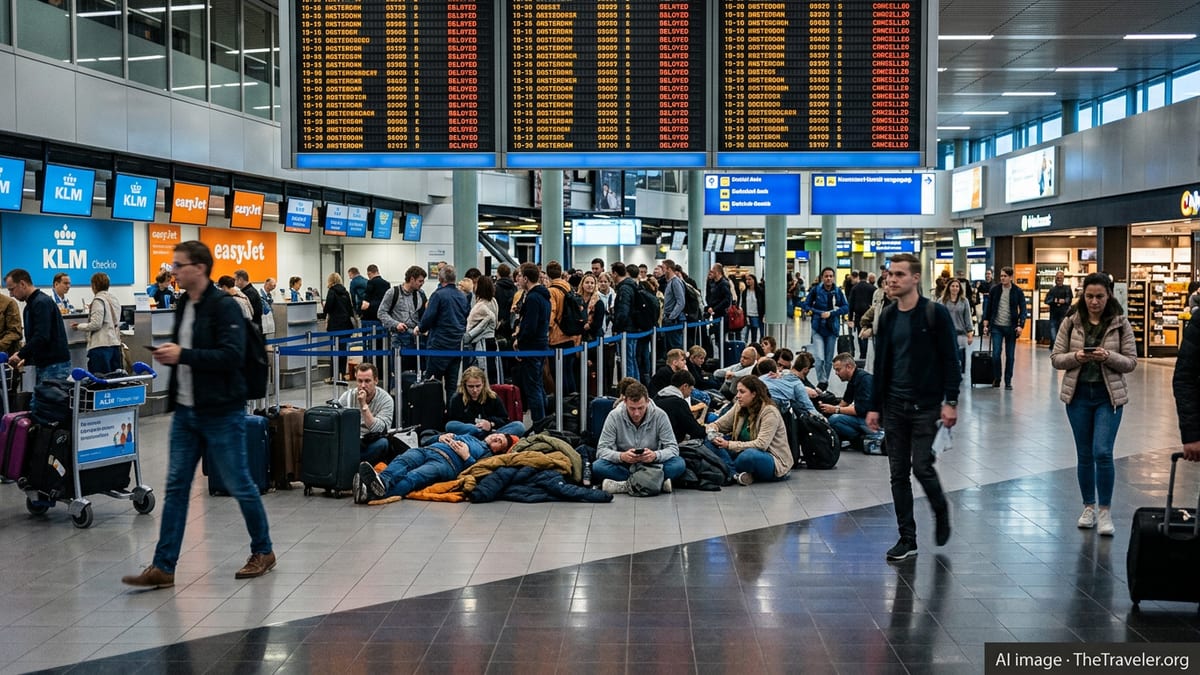
Amsterdam, Copenhagen and Other Hubs Struggle With Backlogs
Reports from aviation data trackers and travel industry coverage indicate that Amsterdam Schiphol and Copenhagen Airport are among the hardest hit hubs, as weather, airspace congestion and tight summer schedules combine to slow operations. Amsterdam, one of Europe’s busiest transfer points, has recorded multiple waves of cancellations and rolling delays in recent days, affecting both short haul and medium haul links to destinations across the continent.
Coverage focused on Amsterdam shows that dozens of departures and arrivals have been disrupted within a single day during the current spell, including services operated by KLM, easyJet and other European carriers. Passengers on affected flights have reported repeated departure time changes, missed connections and lengthening queues at transfer and customer service desks.
In Copenhagen, traffic data and passenger accounts describe a pattern of delays spreading throughout the day as aircraft and crews arrive late from other disrupted airports. Flights involving low cost operators such as Ryanair and network carriers including Lufthansa and SAS have seen schedule changes, with some services ultimately cancelled after extended holds.
Similar pressure is being reported at other regional hubs across Scandinavia and northern Europe, including Oslo and Helsinki, where knock-on delays from earlier sectors have led to tighter turnaround windows and a higher risk of late evening disruptions.
Lufthansa, Ryanair, easyJet and Others Face Mounting Operational Strain
Publicly available airline performance data shows that a wide range of carriers are being caught up in the current wave of disruption, with Lufthansa, Ryanair, easyJet, KLM, SAS, British Airways and several regional airlines all affected. The disruption reflects a combination of high summer demand, constrained airport capacity, localized staffing challenges and intermittent weather-related air traffic restrictions.
Lufthansa services across Germany and neighboring markets have already experienced several rounds of operational stress in 2026, including previous large-scale disruption linked to industrial action earlier in the year. While current issues are more dispersed, they add further pressure to the airline’s network, particularly on routes connecting Frankfurt and Munich with hubs in the Netherlands, Denmark and Sweden.
Ryanair and easyJet, two of Europe’s largest low cost carriers, are similarly exposed because their aircraft typically operate multiple legs per day on dense, time-sensitive schedules. Industry analyses highlight that a delay or air traffic restriction on an early rotation can reverberate through four to six subsequent flights, magnifying the impact by evening and affecting airports far from the original problem.
Other airlines, including Air France, Norwegian Air Shuttle, Finnair and regional operators serving smaller Scandinavian and Baltic cities, are experiencing secondary disruption as they share airspace and airport infrastructure with the hardest hit carriers. This has led to congested departure boards at several airports and limited spare capacity to absorb additional delays.
Impact Spreads Across Netherlands, France, Sweden and Neighboring Countries
The current disruption is not confined to one country or airport. Industry monitoring shows delays and cancellations radiating across the Netherlands, France, Sweden, Denmark, Norway, Finland, Germany, Austria and the United Kingdom, among others. Key airports including Amsterdam Schiphol, Copenhagen, Oslo Gardermoen, Helsinki-Vantaa, Frankfurt, Vienna and multiple London airports have all reported elevated levels of disruption.
Travel reports focusing on northern Europe highlight that Sweden and its neighbors are particularly vulnerable when adverse conditions or congestion arise further south, as many services rely on tightly timed connections through hubs such as Amsterdam, Frankfurt and London. When those hubs encounter bottlenecks, feeders to Stockholm, Gothenburg, Malmö and other Scandinavian destinations face delays and, in some cases, cancellations.
In France, disruption at Paris area airports has been compounded by high summer traffic and intermittent air traffic control constraints, which restrict the number of departures and arrivals during peak periods. This has contributed to delays on intra-European routes that link Paris to Amsterdam, Copenhagen and other northern hubs, affecting both leisure and business travelers.
As a result, passengers are encountering longer travel days across a wide swath of Europe, with some forced to accept rerouting via alternative airports or overnight stays due to missed connections. The cumulative effect is a sense of ongoing instability in the region’s air travel network during what is typically one of the busiest travel periods of the year.
Travelers Face Long Queues, Missed Connections and Rebookings
For passengers, the numerical totals of 1,603 delayed flights and 49 cancellations translate into long queues at check in counters, security lanes and rebooking desks, as well as uncertainty over arrival times. Social media posts and consumer advocacy updates describe travelers waiting hours for information, navigating crowded terminals and, in some cases, racing between gates as last minute gate changes are announced.
At major hubs such as Amsterdam and Copenhagen, the sheer volume of disrupted flights has strained airport facilities and staffing, particularly during peak morning and late afternoon waves. Some airports have introduced additional crowd management measures and urged passengers to arrive earlier than usual, while airlines have encouraged travelers to make full use of mobile apps and digital channels to track changes.
Missed connections are a recurrent theme, especially for long haul passengers relying on European hubs for onward flights to North America, Asia or Africa. When a feeder flight arrives more than an hour late, there is often insufficient time to clear transfer formalities and reach distant gates, forcing rebookings onto later departures and, in some cases, overnight stays in airport hotels.
Low cost passengers may be particularly affected where tickets are purchased as separate segments rather than through itineraries protected by a single booking reference. Travel advisors note that in such cases, a delay on one airline can render a separately booked onward leg a complete loss if the traveler fails to reach the gate on time.
What Passengers Can Do During Ongoing Disruption
Consumer organizations and travel rights groups emphasize that passengers should first verify the status of their flight directly with their airline or departure airport before travelling, as schedules can change at short notice during periods of sustained disruption. Many carriers now provide real time updates through apps and messaging services, which can reduce time spent queuing at information desks.
Under European air passenger protection rules, travelers on flights departing from EU and EEA airports, or flying into the region with EU-based carriers, may be entitled to assistance such as meals, refreshments, hotel accommodation or financial compensation, depending on the length of the delay, the cause of the disruption and the distance of the route. Publicly available guidance stresses the importance of keeping boarding passes, booking confirmations and any written notifications from the airline.
Passengers are also advised to document their experience by noting actual departure and arrival times, photographing airport information screens and retaining receipts for out of pocket expenses. This documentation can later support claims made directly to airlines or via specialized claim firms if the disruption meets the thresholds set by European regulations.
With operational challenges expected to continue intermittently through the busy summer period, travel experts suggest that passengers build extra time into itineraries involving connections, consider earlier departures where possible and remain flexible about routing options. While the immediate spike of 1,603 delayed and 49 cancelled flights has caused acute disruption, industry observers caution that similar episodes may recur as European airspace and major hubs continue to operate close to capacity.