


More news on this day
Passengers travelling through Manchester Airport today, 9 July 2026, are being advised to prepare for a fresh round of disruption, with live flight boards and tracking data indicating a mix of cancellations and significant delays across key departure and arrival banks.
Get the latest news straight to your inbox!
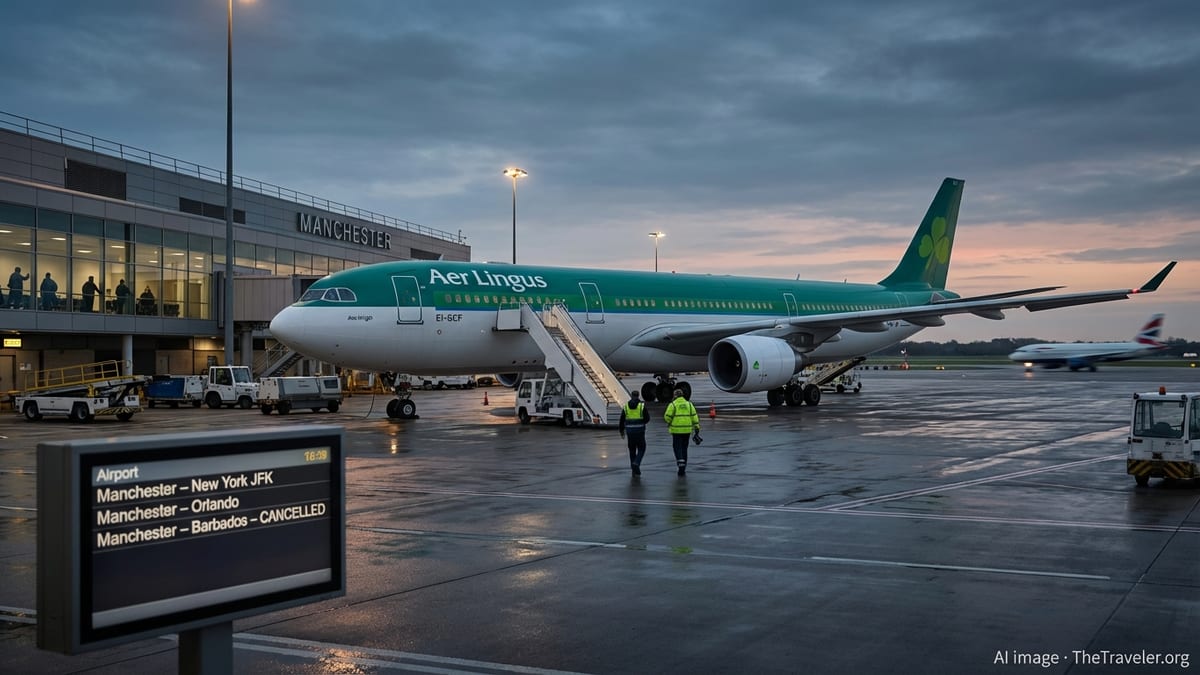
Current snapshot of cancellations and delays
Publicly available departure and arrival boards for Manchester Airport on Thursday 9 July show a familiar pattern for the busy summer period, with a limited number of outright cancellations set against a longer list of delayed services. Early morning departures in particular have seen schedule changes of more than 30 minutes on some short-haul European routes, while a smaller cluster of late-afternoon and evening flights is also affected.
Real-time aviation data services tracking Manchester Airport report average inbound holding times of around half an hour for some arriving aircraft. That additional time in the air is feeding into knock-on delays for later departures as aircraft and crews attempt to recover lost time in a tightly packed daily schedule.
Despite the disruption, today’s picture is one of strain rather than shutdown. The majority of flights are operating broadly as scheduled, and the cancellations that have appeared on live boards so far are concentrated on selected routes rather than any one terminal, airline or destination.
The extent of the disruption continues to fluctuate as airlines update their schedules throughout the day, meaning that any static list of affected services is liable to change at short notice as further delays appear or flights are retimed rather than cancelled.
Routes and time bands most affected
The main pressure points at Manchester Airport today align with the airport’s established peak operating windows. Morning departures between around 6 am and 9.30 am show some of the heaviest delay levels, reflecting the concentration of European leisure flights and feeder services that rely on quick turnarounds.
Holiday destinations around the Mediterranean, together with a handful of northern European city routes, are prominent among the services showing revised departure times. On some flights, departure boards have shifted repeatedly by 15 to 45 minutes as ground operations work to accommodate late-arriving aircraft, baggage loading and air traffic slot restrictions.
The afternoon peak, typically stretching from early afternoon through early evening, is also seeing pockets of disruption, with a smaller number of services either cancelled outright or rescheduled into new time slots. Long-haul flights appear less affected in absolute numbers but can be particularly disruptive for travellers when they do encounter major delays, given the limited alternatives on many intercontinental routes.
On the arrivals side, public information boards show late inbound aircraft from several European hubs, contributing to the rolling pattern of delays for onward departures throughout the day. The overall effect for many passengers is longer-than-expected waiting times both at gates and on board aircraft awaiting pushback.
Underlying causes of today’s disruption
Today’s issues at Manchester Airport are unfolding against a backdrop of already stretched aviation operations across the UK and mainland Europe during the summer peak. Industry reporting over recent weeks has highlighted a combination of factors, including high load factors on many routes, air traffic control constraints in busy European airspace and periodic weather-related restrictions in key hubs.
Manchester’s own published runway and taxiway information for the current season shows that scheduled maintenance windows are concentrated in the early hours, which can leave limited flexibility if earlier tasks overrun into the first departure wave. Any such overrun, even by a short period, can compress the margin between scheduled slots and real-world departure times, creating the conditions for longer queues of aircraft waiting to take off.
Operational performance data released in recent months for the airport has also underlined how quickly on-time performance can deteriorate when several small disruptions collide. Factors such as late inbound aircraft, crew duty-time limits, baggage handling pressures and temporary airfield capacity constraints can each be manageable in isolation, but together they can trigger the type of rolling delays now visible on today’s live boards.
While no single cause fully explains the mix of cancellations and delays on 9 July, the pattern at Manchester Airport today fits within that wider European context of high summer demand meeting capacity that is closely calibrated to average rather than worst-case conditions.
What the live data shows passengers today
Publicly accessible tracking tools and the airport’s own flight information service continue to provide the clearest picture of today’s disruption for individual travellers. For many services, departure and arrival times are still moving within the two hours before scheduled operation, underlining the importance of checking for updates repeatedly rather than relying on a single early-morning snapshot.
Some commercial tracking platforms currently flag Manchester as experiencing moderate arrival delays, with averages around the half-hour mark for inbound traffic that is already in the air. These metrics do not capture the full passenger experience on the ground but do highlight the cumulative effect of today’s congestion on the wider network of flights into and out of the airport.
Travellers whose flights are listed as cancelled on live boards are generally being redirected through airline digital channels and customer service desks, with options varying depending on route demand, ticket type and availability of later services. In many cases, same-day rebooking within the carrier’s network may be possible, though busy summer loads can limit flexibility on popular routes.
For those facing longer delays, some carriers are updating estimated departure times conservatively to avoid repeated revisions, while others are adjusting in smaller increments as operational information becomes clearer. The result across Manchester Airport today is an information landscape that is dynamic rather than fixed, and that requires close attention from passengers as their departure time approaches.
Practical guidance for travellers using Manchester today
Given the evolving nature of today’s cancellations and delays, passenger-facing advice from travel outlets and consumer groups continues to emphasise preparation and vigilance. Travellers are encouraged to monitor airline apps and text alerts closely, and to cross-check those updates with airport flight information screens, which may refresh on different schedules.
Allowing additional time for check-in, bag drop and security screening remains prudent during the peak summer weeks, particularly on morning departures where queues can build quickly even when flights are running to time. At the same time, arriving excessively early for flights that are already heavily delayed can lead to longer waits airside without improving the likelihood of an on-time departure.
Passengers whose flights show a significant delay or cancellation on today’s Manchester Airport schedules are also being reminded, in publicly available consumer guidance, to familiarise themselves with their airline’s policies on rebooking and assistance, as well as with applicable passenger rights regulations. Documenting delay times and keeping receipts for essential expenses can be important later if a claim is pursued.
With the summer season entering a particularly busy stretch, today’s pattern of cancellations and delays at Manchester Airport illustrates how quickly conditions can change, even on days without a single dramatic incident. For now, the best defence for travellers remains a combination of real-time information, flexible planning and a readiness to adapt as the day’s flight list continues to evolve.