


More news on this day
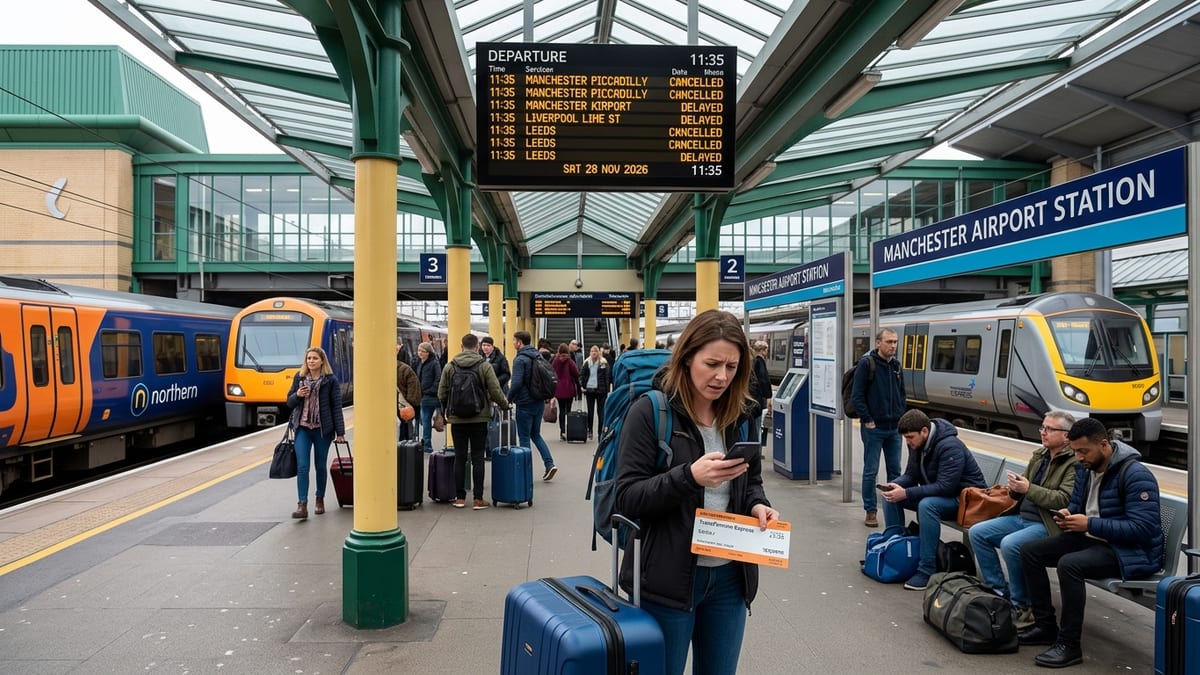
Rail passengers travelling between Manchester Piccadilly and Manchester Airport faced cancellations and delays on Saturday 28 November after a faulty train blocked all lines on the busy airport rail link, with disruption lasting into late morning before services gradually resumed.
Get the latest news straight to your inbox!
Extent and timing of the disruption
The incident was first reported late on the morning of Saturday 28 November 2026, when operators confirmed that a fault on a train between Manchester Piccadilly and Manchester Airport had led to all lines being blocked in both directions. National Rail Enquiries recorded the disruption as beginning at 10:48, with initial estimates suggesting that problems could continue until around 12:30 that day.
JourneyCheck updates for TransPennine Express services between Manchester Piccadilly and Manchester Airport stated that both the line towards the airport and, at one point, all lines between the two stations were blocked because of the defective train. Passengers were warned that trains could be cancelled, significantly delayed or revised at short notice while the stranded unit was dealt with and the route made safe for traffic again.
As the situation developed, Northern’s live service information confirmed that services on the corridor were being disrupted, although its broader disruption messaging later focused on an unrelated signalling fault affecting trains between Manchester Piccadilly and New Mills Central. By early afternoon Northern’s JourneyCheck feed reported that the line between Manchester Piccadilly and Manchester Airport had reopened following the train fault, bringing the most acute phase of disruption to an end, but residual delays and short-notice changes continued.
Impact on Manchester Airport and city connections
The blocked line affected one of the primary rail links to Manchester Airport, a key gateway for passengers travelling from across northern England and beyond. Trains along this corridor are normally operated by Northern and TransPennine Express, with services calling at intermediate suburban stations such as Mauldeth Road, Burnage, East Didsbury, Gatley and Heald Green before reaching the airport. The incident therefore had implications not only for air travellers but also for local commuters and those making onward rail connections through Manchester Piccadilly.
National Rail and operator updates advised that services running to and from Manchester Airport could be cancelled or start and terminate short of their normal destinations while the fault was handled. For some passengers this meant trains being turned back at Manchester Piccadilly, while others encountered extended gaps between services to the airport or altered stopping patterns. Travellers with tight check in times or early afternoon flight departures were particularly vulnerable to delays during the period when the line was blocked.
Although alternative routes exist between central Manchester and the airport, including the Metrolink tram line to Manchester Airport and local bus services, these are separate networks and were not part of the rail incident itself. Passengers choosing to switch modes would have needed to plan extra transfer time and potentially purchase separate tickets if their rail tickets did not permit use on other transport. For many customers the recommended approach was to check live rail information and, where possible, allow additional time to reach the airport rail station.
Operator response and ticketing options
Throughout the disruption, operators and rail information services emphasised the importance of checking journeys immediately before travel. Live departure boards, National Rail Enquiries, and the service update pages of Northern and TransPennine Express provided real time information about which trains were still running, which had been cancelled, and where short-notice changes to routes or calling patterns had been made in response to the blocked line.
Northern’s service update guidance indicated that when its trains are cancelled because of disruption, passengers are typically permitted to use alternative Northern, TransPennine Express and East Midlands Railway services within a specific time window on the same route. This flexibility is designed to help customers complete their journeys without having to obtain new tickets, although exact arrangements can vary by incident and operator and should be checked against the latest advice at the time of travel.
After the immediate fault was resolved and the railway reopened between Manchester Piccadilly and Manchester Airport, Northern’s JourneyCheck information highlighted that customers who had been delayed by at least 15 minutes could submit a Delay Repay claim. Under this scheme, passengers are entitled to compensation based on the length of their delay and the type of ticket held, provided claims are submitted within the time limits set out by the operator. Travellers affected on 28 November were therefore encouraged to keep their tickets or booking confirmations as evidence for any subsequent claim.
Conditions on the route after reopening
By around midday, real time updates for Northern journeys between Manchester Airport and Manchester Piccadilly indicated that the line had reopened following the train fault. However, as is common after a complete line blockage, services did not immediately return to normal. Some trains remained cancelled or revised for a period while operators repositioned rolling stock and crew and worked through the backlog of delayed services on this and connecting routes.
TransPennine Express also continued to warn of ongoing knock on delays and alterations to services to and from Manchester Airport even after the expected end time of the incident. Rolling late running can take time to resolve fully, and subsequent services may operate out of their usual order or skip some intermediate stops to help restore the timetable. For passengers, this meant that checking a specific train’s status remained important throughout the afternoon of 28 November, rather than assuming that reopening of the line meant an immediate return to the published schedule.
Elsewhere around Manchester Piccadilly, a separate issue with signalling between Manchester Piccadilly and New Mills Central was reported by Northern, with disruption on that route expected to last until the end of the day. Although unrelated to the airport train fault, this additional incident contributed to a complex operating environment around Manchester’s main rail hub, potentially affecting some connections for travellers heading to or from the airport by rail.
What air and rail passengers should do next
With the line between Manchester Piccadilly and Manchester Airport now open again, operators are working to deliver the remaining timetable for the day of 28 November as reliably as possible, but some short notice adjustments may persist while services are rebalanced. Passengers with flights later in the day are advised to continue allowing extra time between their planned train arrival at the airport and their airline’s check in or bag drop closure, particularly if they are relying on a single rail connection from the city centre.
Before setting out, travellers should verify the status of their exact train by checking live departure and arrival information through National Rail Enquiries or the relevant train operator’s website or app. This is especially important for those carrying Advance tickets tied to particular departures, as they may need confirmation of any easements or acceptance on alternative services in the event of further cancellations or significant delays.
Passengers whose journeys were disrupted earlier in the day should review eligibility for compensation under Delay Repay or equivalent schemes offered by their operator, using the time their arrival was delayed compared with the schedule as the key measure. Looking ahead, anyone planning future trips via Manchester Airport by rail may wish to factor in a buffer between their planned train arrival and flight check in, recognising that while incidents of this kind are not everyday occurrences, disruption to this busy airport corridor can have immediate consequences for tightly timed connections.