


More news on this day
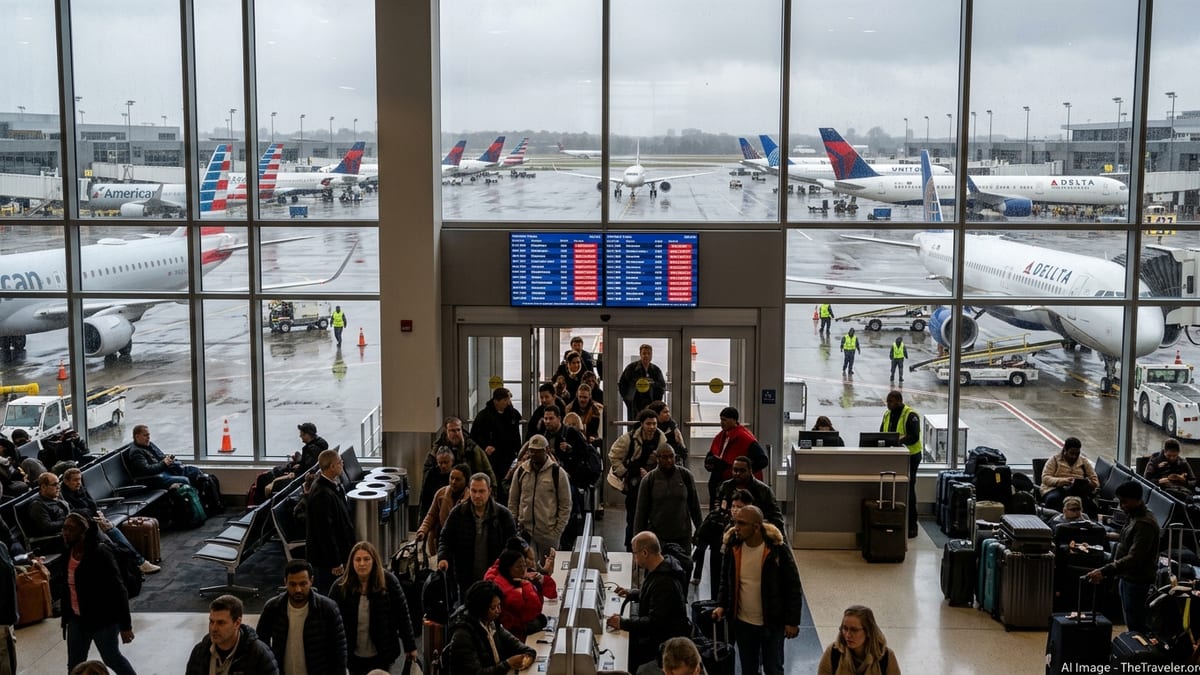
Thanksgiving weekend air travel across the United States remained under strain on Saturday, November 28, as a powerful East Coast storm and a moderate earthquake near Los Angeles combined with record holiday demand to slow parts of the aviation system, prompting officials to warn that delays could persist into early next week.
Get the latest news straight to your inbox!
Record holiday traffic meets a stressed aviation system
The 2026 Thanksgiving period was already forecast to be the busiest for U.S. flying in 16 years, with the Federal Aviation Administration projecting more than 417,000 flights over a nine-day window and over 52,000 departures on Tuesday, November 24 alone. That schedule left limited slack for airlines and air traffic control to recover when disruption hit, whether from weather, technology or local infrastructure problems.
Transportation and aviation officials have attributed the majority of this week’s delays to storms and the sheer number of aircraft moving through the system. Federal briefings in the days before Thanksgiving highlighted that weather and traffic volume would account for the largest share of disruptions, with smaller contributions from runway work, air traffic control staffing constraints and airline equipment issues. Those early assessments have largely been borne out, as the biggest choke points so far have aligned with areas under active weather alerts or experiencing airport-specific incidents.
While full nationwide statistics for the entire holiday week are not yet available, live FAA and TSA feeds through Saturday morning show consistently high flight volumes and passenger screening numbers from Tuesday onward, with only brief periods of reduced activity during the worst weather on the East Coast. Industry forecasts suggest that Sunday, November 29, and Monday, November 30, are likely to rival or exceed the pre-holiday peak in terms of passengers returning home, even if the number of scheduled flights on those days is slightly lower than on Tuesday.
Nor’easter disrupts Thanksgiving along the East Coast corridor
The most significant single source of disruption so far has been a coastal storm that intensified into a nor’easter as it moved from the Southeast toward New England between Wednesday, November 25, and Friday, November 27. National Weather Service offices along the corridor issued high confidence forecasts early in the week for heavy rain, coastal flooding and strong winds from northern Florida through the Mid-Atlantic and into the Northeast on Thanksgiving Day, particularly in and around the metropolitan areas of Washington, Philadelphia, New York and Boston.
On Thursday, November 26, those forecasts translated into low cloud ceilings, reduced visibility and crosswinds at multiple major hubs. Flight-tracking data and FAA advisories indicated ground delay programs and departure metering at New York’s John F. Kennedy, LaGuardia and Newark Liberty airports, as well as constraints at Philadelphia International, the Washington-area airports and Boston Logan. Airlines slowed arrival and departure rates to maintain safe spacing, which in turn produced longer gate holds and taxi times, with knock-on effects for connections across domestic networks.
The same storm also produced one of the most visible non-aviation impacts of the holiday: the first postponement of the Macy’s Thanksgiving Day Parade in its 100-year history. City officials and organizers moved the event from Thursday, November 26, to Saturday, November 28, after high wind warnings for the New York area raised concerns about safely operating large balloons and staging crowds along the route. That decision, taken on Wednesday evening, underscored the strength of the system expected over the region and signaled to travelers that Thursday conditions in the Northeast would be significantly worse than on a typical Thanksgiving.
By early Friday, November 27, the nor’easter had moved offshore, and the FAA’s national airspace status showed a marked improvement, with only localized delay programs and relatively few cancellations compared with the previous day. However, aircraft and crews remained out of position at some carriers following the Thursday disruption, meaning that travelers on early-morning departures from affected hubs sometimes encountered residual delays even as weather conditions improved.
Tech outages and a Southern California quake compound pressure
The weather-related problems came on the heels of a series of technology incidents earlier in November that had already tested airline and federal systems. A Federal Aviation Administration system upgrade triggered a short-lived but rare nationwide ground stop earlier in the month, while a separate computer issue at Delta Air Lines briefly halted flights into its largest hub in Atlanta on Sunday, November 22. Both events caused significant same-day delays and left some aircraft and crews displaced for several subsequent schedules.
United Airlines also experienced an IT disruption in the days before the holiday, leading to a spike in delays from several of its hubs. By the start of Thanksgiving week, those specific outages had been resolved and no longer directly constrained operations, but they reduced the margin for error for carriers already planning dense, high-load-factor schedules to accommodate strong demand. With limited spare aircraft and crews, any new shock to the system risked creating additional ripple effects.
On Saturday, November 28, a new and very different kind of shock arrived on the opposite side of the country. The U.S. Geological Survey reported a magnitude 4.7 earthquake offshore near Manhattan Beach, just southwest of Los Angeles International Airport, late in the morning local time. Residents across coastal and central Los Angeles reported noticeable shaking, and social media posts referenced items falling from shelves and brief evacuations from some buildings.
Initial statements from Los Angeles city authorities and the fire department indicated that there were no immediate reports of major structural damage or serious injuries, but a standard earthquake response protocol was activated. Inspection teams were dispatched to survey critical infrastructure, including transport facilities. At and around LAX, local media and airport officials reported minor issues such as broken ceiling tiles and some damaged windows, which prompted temporary cordons and cleanup in affected areas while structures were checked.
Impact on LAX operations during a peak travel window
As of Saturday afternoon, neither the FAA nor the airport operator had announced a prolonged ground stop or sustained capacity reduction at Los Angeles International directly attributable to the earthquake. Flight tracking services showed some departure and arrival delays around the time of the tremor and inspections, but not the kind of large-scale cancellation wave that would typically follow a major infrastructure problem. Officials emphasized that normal operations would continue with enhanced vigilance while engineers completed additional checks.
LAX had projected handling close to 2.6 million passengers across the 12-day Thanksgiving period, averaging more than 200,000 travelers per day. In such conditions, even a brief pause for inspections or the temporary closure of a concourse or roadway can cause outsized congestion. Travelers arriving at or departing from Los Angeles on Saturday reported slower than usual security screening at some checkpoints and heavier traffic on terminal roadways, consistent with a system absorbing a minor but sudden disruption on top of already high volumes.
Local seismologists noted that earthquakes of around magnitude 4.5 to 5.0 are not uncommon in Southern California and are generally categorized as moderate, though the perceived intensity can vary significantly depending on depth and distance from the epicenter. Early USGS information on Saturday’s event suggested a depth of roughly 12 kilometers and confirmed that the offshore location near Santa Monica Bay accounted for the wide area over which shaking was felt. Authorities warned that aftershocks were likely over the following hours and days, but most were expected to be of lower magnitude.
Airport managers indicated that they were prepared to suspend operations on individual runways or in specific terminals if follow-up inspections after any aftershock raised concerns, but that there was no expectation of a full shutdown based on current information. Instead, the focus remained on keeping passengers moving through the facility while ensuring that any debris from broken fixtures was removed and that structures met safety thresholds.
How airlines and regulators are managing the remainder of the weekend
Airlines entered the Thanksgiving period with expanded schedules designed around strong demand forecasts, but with limited flexibility to absorb irregular operations. Many carriers issued preemptive travel waivers for the Northeast and Mid-Atlantic ahead of the nor’easter, allowing passengers booked through airports such as New York, Boston and Philadelphia to change flights without the usual penalties when severe weather was forecast. Some also extended fee waivers to parts of the Southeast and to connections that might be indirectly affected by disrupted transcontinental flows.
The FAA has been managing congestion through a combination of ground delay programs, miles-in-trail spacing between aircraft and reroutes around the worst weather. During the height of Thursday’s storm, this meant sharply reduced arrival rates at some of the country’s most tightly scheduled airports, particularly in the New York area, which in turn pushed delays back through airline networks. Agency statements have stressed that, where possible, they are trying to avoid very long tarmac holds by coordinating with carriers to adjust departure times at origin airports whenever sustained bottlenecks are likely.
Longer term, transportation officials point to ongoing efforts to reduce air traffic control staffing shortfalls at key facilities and to continue modernizing traffic management systems. However, they acknowledge that these measures will not substantially change the staffing picture before the end of the 2026 winter travel season. For now, both airlines and regulators are instead relying on tactical tools such as schedule adjustments, additional spare crews on reserve and closer coordination with meteorologists to anticipate where constraints will be most severe on any given day.
What travelers should check through Tuesday
Looking ahead to the remainder of the holiday period, federal forecasts indicate that weather across much of the country should be more favorable than on Thanksgiving Day, with the East Coast storm system having exited the region and only more routine seasonal disturbances expected in the near term. That said, residual disruptions from aircraft and crew imbalances are likely to persist in pockets, particularly at major connecting hubs such as Atlanta, Dallas Fort Worth, Denver, Chicago O’Hare and the New York area airports.
Transportation authorities expect daily U.S. flight counts to remain above 50,000 from Sunday, November 29, through at least Tuesday, December 1, with some of the heaviest passenger volumes concentrated into Sunday and Monday. Travelers on those days should be prepared for longer than usual security lines and boarding processes at busy times of day, even if local weather appears calm. Where airlines still have active travel waivers in place, passengers may be able to move to less congested departure times without additional charges, subject to seat availability.
In Southern California, seismologists and emergency managers caution that aftershocks following Saturday’s magnitude 4.7 earthquake near LAX are possible, though most are expected to be relatively small compared with the main event. The airport and city have said that inspection and contingency plans will remain active through the weekend, and that they are ready to respond quickly if any subsequent tremor affects key structures or utilities. For now, flight schedules into and out of Los Angeles for the coming days remain broadly intact, but travelers may wish to allow extra time at the airport in case of temporary gate changes, checkpoint closures or minor delays while inspections continue.
For all routes, officials continue to advise passengers to rely on real-time information rather than assumptions based on earlier conditions. That means checking directly with airlines for the latest departure and arrival status before leaving for the airport, monitoring airport and FAA status dashboards for any ground delay programs or ground stops that could affect their specific route, and building extra time into connections where possible. With daily flight volumes still near multi-year highs through at least Tuesday, even localized problems can cascade across the network, making up-to-date information a key tool for minimizing disruption on the final legs of this year’s Thanksgiving journeys.