


More news on this day
U.S. Thanksgiving travelers are facing a messy trip home after a powerful East Coast storm and a Saturday morning earthquake near Los Angeles combined with record passenger volumes to cause pockets of flight delays and cancellations that officials warn could persist into the middle of next week.
Get the latest news straight to your inbox!
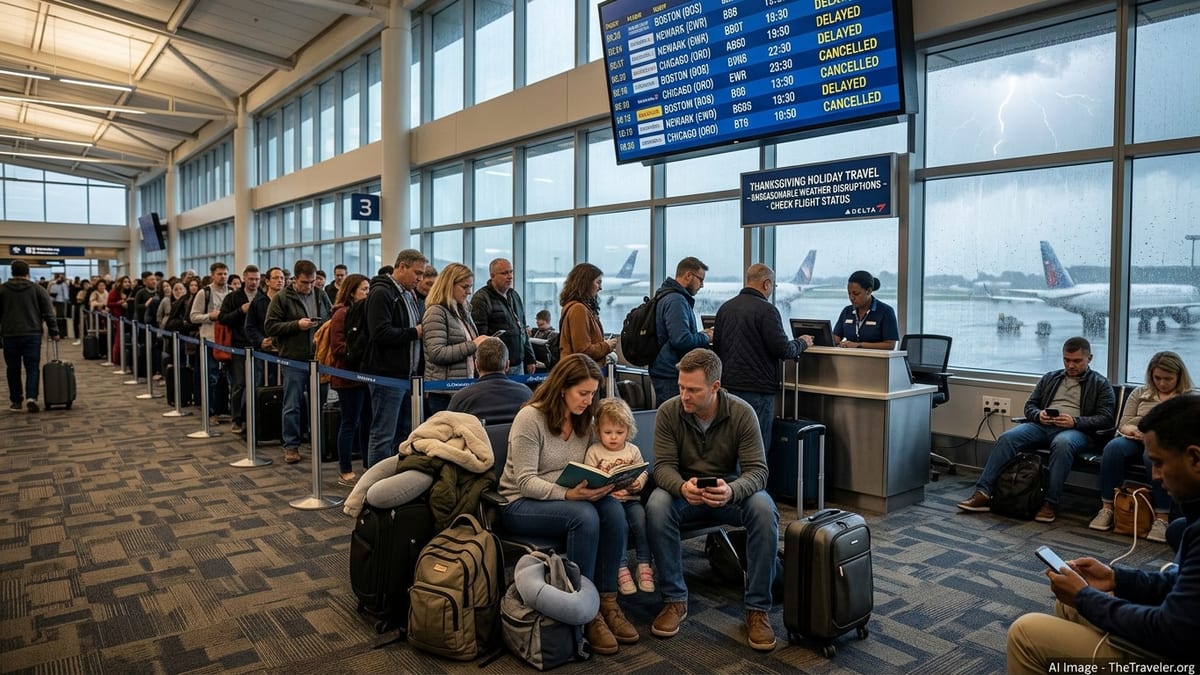
Storm-battered Northeast drives much of the weekend disruption
A coastal nor'easter that peaked on Thanksgiving Day, November 26, has been the single biggest driver of air travel problems heading into the holiday return rush, particularly at airports along the Interstate 95 corridor. The storm brought strong winds, heavy rain and coastal flooding from the Mid-Atlantic into New England, triggering hundreds of thousands of power outages and forcing airlines to trim schedules and slow operations at some of the country’s busiest hubs.
By late Thursday, Boston Logan had reported dozens of cancellations and more than 60 delays, according to figures cited from aviation tracking services. Farther south, Baltimore/Washington International Thurgood Marshall Airport saw roughly a quarter of its flights canceled and about one in five delayed as crosswinds and low ceilings complicated approaches and departures. The Federal Aviation Administration (FAA) had warned in advance that “significant” weather impacts were likely at several major East Coast airports, and those forecasts largely materialized as the holiday unfolded.
Weather-related strain has extended beyond airports. Rail operators reported delays where downed trees and power lines interfered with overhead wires east of Trenton, New Jersey, while coastal flooding and wind damage have slowed road traffic and emergency response in parts of multiple states. Although conditions have gradually improved since Friday, lingering gusty winds and saturated ground continue to create a challenging environment for both air and ground transportation as travelers head home.
Duffy outlines causes and scale of Thanksgiving air delays
Transportation Secretary Sean Duffy said on Saturday, November 28, that severe weather remains the dominant factor in this year’s Thanksgiving air disruptions, even as airlines handle near-record traffic. Citing operational data from Tuesday through Friday of holiday week, Duffy said roughly 45 percent of recorded delays were driven by inclement weather, including the Thanksgiving nor’easter and earlier storm systems that moved across the central and eastern United States.
According to the secretary, the next largest contributor has been heavy flight volume, with runway construction, air traffic control staffing constraints and equipment issues accounting for smaller single-digit shares of the disruption picture. Duffy praised aviation workers for keeping what he described as the world’s most complex and safest airspace functioning through the storms, noting that 167,412 flights operated safely over the first four days of the peak travel period despite the challenges.
Average delay times have so far remained around the half-hour mark on the busiest days, based on figures the Transportation Department has shared publicly. Independent trackers that monitor FAA traffic programs report that nationwide disruption levels, measured by ground stops and other airspace restrictions, have eased somewhat from peaks earlier in the week but remain elevated around select weather-affected hubs. Officials caution that delay statistics are subject to revision as airlines update their operational data.
Delays cluster at key hubs as Sunday and Monday volumes build
By early afternoon on Saturday, flight-tracking services were reporting more than 1,600 delays and several dozen cancellations across U.S. airports, a moderate level for a peak holiday travel day but one that could worsen as late-day thunderstorms or lingering low clouds intersect with the afternoon and evening rush. Chicago O’Hare, a major connecting hub for multiple carriers, led individual airports in total delays at one point during the day, reflecting both its central role in the national network and the knock-on effects of weather systems moving through the Midwest earlier in the week.
Regionally, the New York City area has seen some of the most consistent disruption, with John F. Kennedy, LaGuardia and Newark Liberty all experiencing weather-related arrival and departure slowdowns tied to the nor’easter and its aftermath. While most flights eventually departed, passengers have faced extended waits at gates and on tarmacs during temporary ground delay programs as FAA controllers spaced out arrivals for safety. Dallas Fort Worth and Hartsfield-Jackson Atlanta, two of the nation’s largest connecting hubs, have also recorded a smaller but notable share of cancellations, illustrating how a storm in one region can reverberate through far-flung parts of the network.
The pattern aligns with historic Thanksgiving travel data, which shows that the Sunday after the holiday is routinely one of the most delay-prone days of the year as returning passengers meet winter weather systems. Industry analyses of Transportation Department statistics from recent seasons indicate that roughly one-third of flights on the Sunday after Thanksgiving arrive at least 15 minutes late in a typical year, compared with single-digit percentages on the holiday itself. With another round of unsettled weather forecast for sections of the central and eastern United States, travelers flying Sunday, November 29, and Monday, November 30, are being advised to leave additional time for airport formalities and potential rebooking.
Earthquake near LAX adds fresh uncertainty for Southern California flyers
As airlines and passengers focused on weather and crowding, an unrelated natural event briefly shifted attention to Southern California on Saturday morning. A magnitude 4.7 to 5.0 earthquake struck offshore near Manhattan Beach, just west of Los Angeles International Airport (LAX), according to preliminary estimates from the U.S. Geological Survey. The shaking was strong enough to rattle windows across the west side of Los Angeles and prompted the Los Angeles Fire Department to place the city into its standard “earthquake mode,” sending crews from all 106 neighborhood stations to survey critical infrastructure for damage.
At LAX itself, social media images and local reports showed broken glass at parts of the terminal frontage, with maintenance teams moving quickly to cordon off affected areas and clear debris. As of Saturday afternoon, there were no initial reports of serious structural damage or widespread injuries linked to the quake, and authorities had not issued any long-term closures for the airport. Officials emphasized that assessments were ongoing, and California’s Office of Emergency Services warned residents and travelers to be prepared for aftershocks in the hours and days ahead.
The immediate impact on flight operations at LAX appeared limited, with aircraft movements continuing while airport staff evaluated facilities and ensured passenger safety. Any temporary gate closures or detours inside the terminals could nonetheless add friction for already busy security checkpoints and boarding areas during one of the heaviest travel weekends of the year. Travelers passing through Los Angeles over the next 24 to 48 hours are being encouraged to monitor airport and airline communications closely in case inspections require gate changes or brief operational pauses.
What travelers should expect through Tuesday
Looking ahead, federal officials expect the air travel system to remain under strain through at least Tuesday, December 1, as Thanksgiving travelers complete their return journeys. Secretary Duffy said more than 50,000 flights a day are scheduled to operate from Sunday through Tuesday, a level comparable to or slightly above recent pre-holiday weekdays and near the upper range of typical U.S. daily volumes. That heavy schedule leaves airlines and air traffic control centers with less room to absorb any new weather or operational shocks without knock-on delays.
Forecasters are watching additional weather systems that could interact with the busy travel window. Moisture sweeping into the Pacific Northwest and Rockies may produce snow in higher elevations and low clouds around some mountain airports, while lingering instability in parts of the Northeast could sustain patchy rain and gusty winds, even as the worst of the Thanksgiving nor’easter recedes. Although no nationwide ground stop is anticipated, the FAA has signaled that individual airports may face intermittent ground delay programs depending on local conditions.
For passengers, the combination of weather threats, residual congestion and the recent Los Angeles earthquake means careful preparation remains crucial. Authorities and consumer advocates recommend that travelers check airline apps and airport websites frequently for gate changes, rolling delays or cancellations, especially on connecting itineraries through Chicago, New York, Dallas, Atlanta and Los Angeles. Those whose flights are canceled outright or substantially delayed should familiarize themselves with U.S. Department of Transportation refund rules, which generally provide cash refunds rather than credits when a carrier cancels or significantly changes a flight and the passenger chooses not to travel.
Given the continuing risk of disruption, officials advise packing essential medications and a change of clothes in carry-on bags, allowing extra time for security lines and ground transfers, and keeping flexible plans at the destination in case of late arrivals. With storms still clearing, aftershocks possible near Los Angeles and flight volumes running high into the start of the new week, the Thanksgiving 2026 travel period is not over yet for many Americans making their way home.