


More news on this day
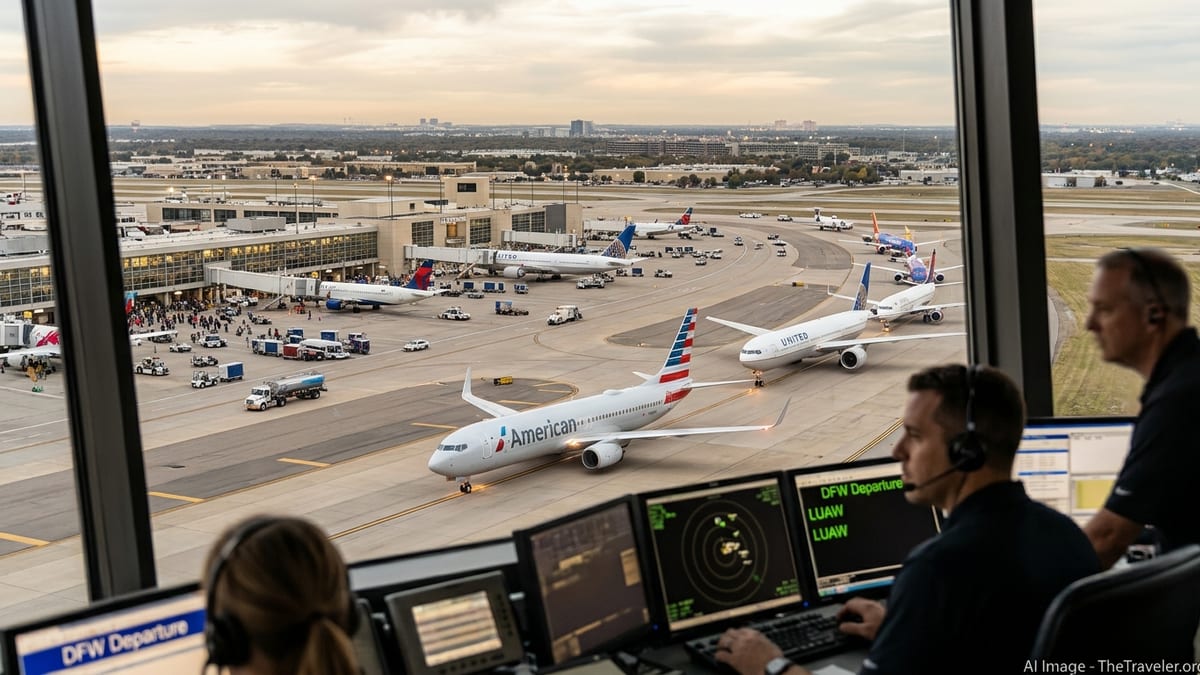
A new Federal Aviation Administration runway safety directive affecting how controllers handle “Line Up and Wait” departures is taking effect in the United States just as Thanksgiving air travel reaches a 16-year high, prompting concern from some aviation professionals that added staffing requirements in control towers could slow takeoffs and compound holiday delays if airports are already stretched.
Get the latest news straight to your inbox!
What the new “Line Up and Wait” rule actually changes
The change centers on a common departure procedure known as “Line Up and Wait,” or LUAW, which allows a controller to instruct an aircraft to enter the runway and hold in position while awaiting takeoff clearance. Under the updated rules, which began phasing in nationwide on November 24, 2026, LUAW operations now require a specific supervisory controller assigned to oversee the runway whenever aircraft are instructed to line up and wait, according to summaries of the directive and controller guidance documents.
Previously, FAA guidance allowed some flexibility, with one controller both issuing LUAW clearances and handling other duties on the tower frequency, provided traffic was manageable. The new policy tightens that standard by formalizing staffing expectations and clarifying that the runway controller must not be distracted by other tasks while aircraft are lined up to depart. The goal, FAA documentation and public statements say, is to reduce runway incursion risk and ensure continuous monitoring of aircraft that are positioned for takeoff.
The directive is framed as a safety enhancement following years of concern about close calls on U.S. runways. FAA orders already specify that an aircraft should not remain in LUAW position for more than roughly 90 seconds without further instructions, but advocates of the change argued that clearly defined staffing responsibilities were needed to keep that safeguard consistently applied. The new rule is being implemented through an agency notice that is currently scheduled to remain in force until June 9, 2027, although the FAA could extend or modify it after further review.
Why the timing overlaps with the Thanksgiving travel peak
The rule’s rollout coincides with one of the busiest travel weeks of the year. FAA projections and federal traffic data indicate that the nine-day window from November 23 to December 1, 2026, will see roughly 417,000 to 418,000 U.S. flight departures and arrivals, with Thanksgiving-period traffic at its highest level in about 16 years. Industry and government forecasts suggest nearly 6 million passengers will fly within the United States over the holiday, while major hubs such as Atlanta, Dallas-Fort Worth, Denver and Chicago O’Hare are preparing for near-capacity schedules.
That heavy volume comes on top of recent disruptions. In mid-November, a telecommunications problem triggered a nationwide ground stop, briefly halting departures and contributing to several days of rolling delays and cancellations at some airports. In the week before Thanksgiving, a separate technology outage affecting an automated aircraft weight-and-balance system at Delta Air Lines produced more than a thousand delays in a single day, illustrating how quickly the system can back up when issues arise close to a major travel period.
Because the LUAW rule directly affects how quickly controllers can sequence departures on busy runways, its first major test is arriving at a moment when the system is already under pressure from high demand, unsettled weather on both coasts and lingering operational strains at some carriers. The FAA chose not to postpone the safety directive until after the holiday and has emphasized its view that the rule will not materially reduce airport capacity. However, several air traffic professionals and pilots who have commented publicly on the change say its practical impact will only become clear once traffic numbers from the Thanksgiving period are analyzed.
How the new requirement could contribute to delays
In practice, the effect of the LUAW rule on departures will depend heavily on local staffing and traffic patterns. At well staffed large hubs where separate runway and supervisory positions are already standard during peak periods, the new requirement may simply formalize existing practice. In those environments, the FAA’s assertion that the rule should not change airport throughput appears consistent with current operations, since controllers already have a dedicated person overseeing active runways when traffic is heavy.
The situation may be different at smaller or medium-sized airports, or at facilities facing staffing challenges. Under the tightened rules, a tower cannot legally conduct LUAW operations unless the necessary supervisory role is filled and focused on monitoring those aircraft. If an airport does not have enough certified personnel on a particular shift to staff that position, controllers can still launch departures, but they must use more conservative procedures that may require keeping aircraft clear of the runway until takeoff clearance is almost ready to be issued. That can lengthen intervals between departures, especially when multiple aircraft are waiting in line.
Travel and aviation outlets that have reviewed the FAA notice report that the directive is nationwide, applying to towered airports across the United States rather than only to a subset of locations. Some controllers quoted in those reports have predicted that, at facilities where staffing is tight, the rule will “probably” lead to longer waits before takeoff, particularly at peak times such as the Sunday after Thanksgiving. At the same time, available data in the first days of the rule do not yet show delays that can be definitively attributed to LUAW changes rather than to weather, residual effects of the earlier nationwide ground stop or airline-specific system issues.
What travelers are seeing so far in the holiday period
As of November 28, 2026, the emerging picture for Thanksgiving week is one of busy but mostly functioning airports, with pockets of significant disruption. Federal statistics cited in news reports indicate that U.S. air traffic reached approximately 52,000 flights on Tuesday, November 24, a 16-year high and a preview of volumes expected across the rest of the holiday period. Long security lines and full departure boards have been common at major hubs, but many passengers have still reported on-time departures and manageable connection times.
Several factors are interacting at once. Storm systems bringing rain, strong winds and coastal flooding to portions of the East and West Coasts have generated traditional weather-related delays, particularly for flights linked to New York, Boston, San Francisco and Seattle. The lingering effects of the earlier nationwide ground stop, as well as airline-specific outages, have created schedule imbalances that carriers are still working through in some markets. In that context, aviation experts caution that it is difficult in the short term to isolate the specific impact of the LUAW rule from these overlapping influences.
Local coverage from major airports such as Chicago O’Hare has highlighted the new runway rule as an additional variable. Some pilot and controller representatives interviewed in those reports have said that the directive is likely to be most noticeable on peak return days when departure queues are longest, suggesting that the Sunday after Thanksgiving may provide the clearest early indicator of how the policy interacts with heavy traffic. For now, travelers are more likely to hear airlines cite weather, volume and previous system outages as primary causes of delay, even if the new safety rule is one of several background constraints.
How long the rule lasts and what travelers should do next
The LUAW directive is currently implemented through an FAA notice with an effective period that runs into mid-2027. While that end date is specified in the document, the agency retains the option to extend, revise or replace the rule depending on how it performs and what incident and delay data show over the coming months. Aviation safety initiatives often begin as time-limited notices so that regulators can adjust them with feedback from controllers, pilots and airports.
This means that the 2026 Thanksgiving rush is only the first of several major travel periods that will unfold under the new procedures. The same requirements are expected to apply during the Christmas and New Year holidays and into next year’s peak summer season unless the FAA announces changes. For airlines, that timeline provides an incentive to review their own scheduling and turn processes to mitigate the risk that longer runway queues at certain airports could ripple into missed connections or late arrivals elsewhere in their networks.
For individual travelers, the most practical response is to factor in the possibility of incremental departure delays without assuming that the LUAW rule will disrupt every flight. Aviation publications and travel advisers recommend building extra time into connections, particularly on itineraries that pass through busy hubs late in the day, and checking airline apps and official FAA delay advisories frequently on the day of travel. Because any delays linked to the new rule will typically appear on boards simply as “air traffic control” or “volume,” rather than under a specific safety code, passengers are unlikely to see explicit references to LUAW. Instead, they will continue to navigate the usual mix of weather, traffic and operational factors, with the new rule operating quietly in the background as regulators prioritize an additional margin of safety on crowded holiday runways.