


More news on this day
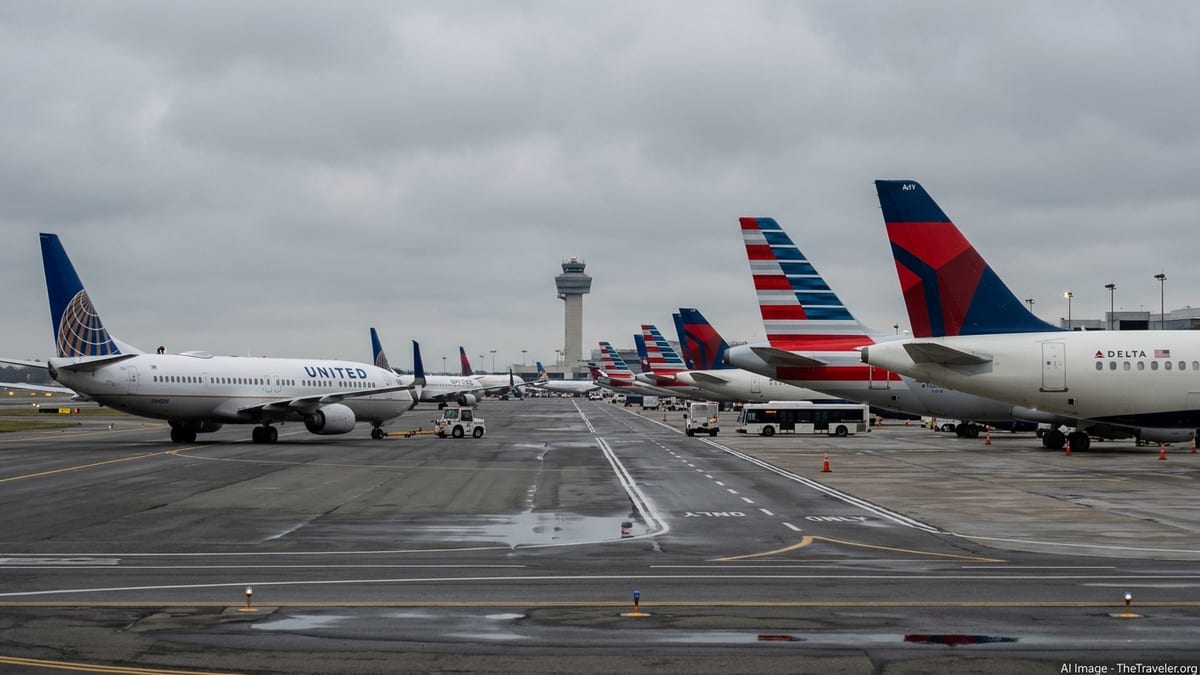
Flights serving New York City’s major airports accounted for one in four of the United States’ longest tarmac delays in September 2026, according to the latest federal Air Travel Consumer Report, underscoring how congestion and disruptions in the region’s airspace continue to weigh on reliability for millions of travelers.
Get the latest news straight to your inbox!
What the federal report says about September’s worst delays
The US Department of Transportation’s November 2026 Air Travel Consumer Report, covering performance in September, lists 16 flights that breached federal thresholds for “extended” tarmac delays. Of those, four flights were either departing from or arriving at John F. Kennedy International Airport or Newark Liberty International Airport, meaning New York metro airports accounted for 25% of all recorded long tarmac delays that month nationwide.
Federal rules define an excessive tarmac delay for domestic flights as more than three hours between leaving the gate and taking off, or between landing and allowing passengers to deplane. For international flights, the limit is four hours. The September figures remain small relative to the hundreds of thousands of flights operated nationwide, but they are scrutinized closely because each incident represents passengers stuck on board without the option to get off.
DOT data also record consumer complaints related to tarmac delays. In September 2026, passengers filed 103 such complaints, bringing the total for the first nine months of the year to more than 800. While not every complaint meets the strict criteria for an “extended” delay, together they illustrate how often travelers are experiencing lengthy waits on aircraft that are not moving.
New York routes feature prominently among the worst cases
The longest New York related delay highlighted in the federal report involved United Airlines flight 123 from London Heathrow to Newark on 21 September. The flight was diverted to New York Stewart International Airport in the Hudson Valley during a wider air traffic control communications outage that affected the entire New York area. After landing at Stewart, the aircraft remained on the tarmac for around four hours and 25 minutes before passengers could disembark, making it one of the most severe tarmac delays of the month.
Regional media coverage of the report notes that three other flights linked to JFK or Newark also crossed the federal thresholds for extended delays in September. The list includes a mix of domestic and international services operated by major US carriers. While the report identifies the flights and timings, it does not assign blame for individual incidents or detail every operational factor behind each delay.
Several other significant long delays in September did not involve New York directly but help illustrate how diversions and congestion can create tarmac problems. For example, an American Airlines flight from Mexico City to New York diverted to Charlotte rather than continuing to the New York area during disruptions, while an Avianca service from Medellín to Miami recorded a tarmac delay of about five hours after being diverted to an alternate US airport. These cases show that when large hubs experience disruption, knock-on effects can spread widely across airline networks.
How New York’s congested airspace affects on-time performance
New York’s three major commercial airports consistently rank among the busiest and most delay prone in the country, and the latest on-time performance data for September 2026 continue that pattern. Federal statistics indicate that arrivals at Newark were on time roughly 77% of the time during the month, while JFK recorded about 75% on-time arrivals. LaGuardia, which is not included in the extended-tarmac list for September, performed worse overall, with an arrival on-time rate of around 69%.
These figures place all three New York airports below the national average on-time arrival rate of roughly 77% for September. LaGuardia in particular has been singled out in separate analyses as one of the country’s weaker performers for punctuality among the 30 largest US airports. The combination of closely spaced airports, limited runway capacity, frequent weather disruptions and intense demand across the New York metro area makes recovery from any disruption slower than at many other hubs.
The impact of New York’s congestion is not limited to local travelers. Because JFK, Newark and LaGuardia function as major hubs and focus cities for several large airlines, delays there can cascade throughout domestic and international networks. Aircraft and crews scheduled to operate onward flights from New York can be delayed or displaced by earlier disruptions, increasing the risk of missed connections, diversions and, in the most severe cases, extended tarmac waits elsewhere in the system.
Airline reliability pressures extend beyond New York
Although New York airports loom large in the September tarmac statistics, the broader federal data show reliability pressures across US airlines in 2026. Through the first nine months of the year, carriers reported more than 120,000 cancellations, according to recent summaries of DOT and Bureau of Transportation Statistics figures, representing a significant increase compared with the same period in 2025. Several major airlines have recorded multi thousand flight cancellation totals during that span.
The rise in cancellations and long delays has coincided with several high profile system disruptions. On 21 September, a communications failure at a key air traffic control facility serving the Northeast led to widespread delays and hundreds of cancellations at New York area airports, including Newark. Then, on 13 November, the Federal Aviation Administration ordered a rare nationwide ground stop after a communications system upgrade triggered a broader outage, halting departures across the country for several hours and leading to multi day knock on disruption that is not yet reflected in the September focused consumer report.
In addition to federal system issues, individual airlines have also recently experienced their own technology problems. Delta Air Lines, for example, reported more than 1,000 delays on a single day in November after an automated system used to calculate aircraft weight malfunctioned, forcing dispatchers and crew to switch to slower backup processes. United Airlines also reported an outage that led to hundreds of delayed flights in the week leading up to the Thanksgiving travel period. These incidents highlight the strain on both public and private aviation infrastructure at a time when passenger volumes are near or above pre pandemic levels.
What travelers should watch for when flying via New York
For passengers planning trips through JFK, Newark or LaGuardia, the latest federal data provide both context and some practical signals. The number of flights that breach the three or four hour tarmac thresholds remains small, but the concentration of such events in the New York area underscores how vulnerable the region is when weather or air traffic control problems arise. Travelers connecting through New York, particularly during peak periods or stormy seasons, may face higher risks of rolling delays and diversions than at less congested hubs.
Because the September consumer report does not yet include the nationwide ground stop on 13 November or the severe storms that disrupted thousands of Thanksgiving week flights, the next several editions of the report will be important for understanding whether extended tarmac delays are becoming more frequent or whether September’s cluster of New York incidents was an outlier. Regulators also continue to monitor airline compliance with the tarmac delay rule, which obliges carriers to provide food, water and functioning lavatories during long waits and, in most cases, to allow passengers to deplane before they exceed specified time limits.
Looking ahead, travelers using New York airports may wish to leave additional connection time, especially when booking itineraries that rely on tight domestic to international transfers or last flights of the day. Checking real time flight status, monitoring for ground stops or route specific flow restrictions, and keeping contact details updated with airlines can help passengers respond quickly if diversions or lengthy runway queues start to build. While systemic improvements to air traffic control technology and airport capacity are expected to unfold over several years, the latest federal data make clear that New York’s crowded skies will remain a key pinch point for US air travel in the near term.