


More news on this day
U.S. Transportation Secretary Sean Duffy says rough weather and record-breaking traffic, not system failures, were responsible for the vast majority of flight delays during the peak 2026 Thanksgiving travel rush, even as a recent nationwide FAA telecommunications outage keeps the resilience of the country’s airspace infrastructure under intense scrutiny.
Get the latest news straight to your inbox!
Weather And Record Traffic Drive Most Holiday Delays
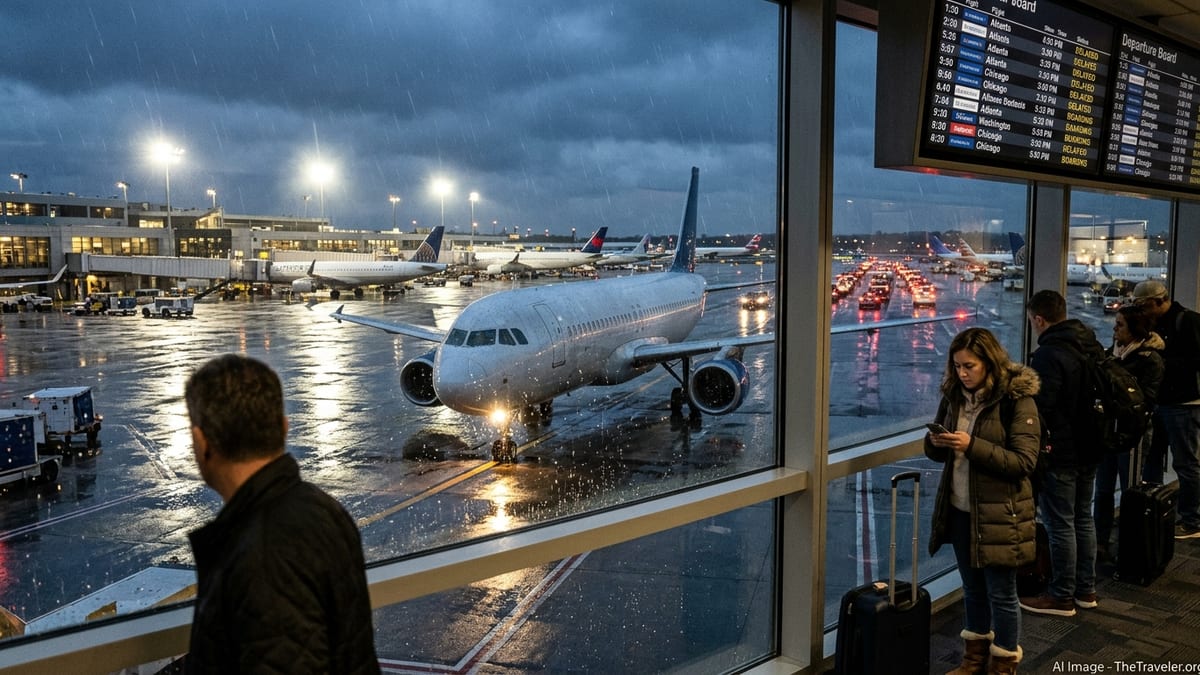
In a weekend update summarizing conditions from Tuesday November 24 through Friday November 27, Duffy said preliminary Federal Aviation Administration data show that inclement weather and sheer flight volume together accounted for about 80 percent of U.S. flight delays during the opening wave of the Thanksgiving travel period.
According to those early figures, weather disruptions were linked to roughly 45 percent of delays, while congestion from heavy traffic volumes explained another 35 percent. The Transportation Department has not yet published a full statistical breakdown, but Duffy’s percentages are broadly consistent with long-standing FAA assessments that weather typically drives between half and two-thirds of daily flight disruptions.
Duffy said around 167,000 flights operated nationwide across those first four days of the nine-day holiday window. That period included significant coastal storms and bands of heavy rain that swept across multiple regions, particularly along the East Coast, where flooding and strong winds were widely reported on Thanksgiving Day and into Friday.
FAA Forecasts Busiest Thanksgiving Skies In 16 Years
The disruption figures land against the backdrop of what the FAA projected as the busiest Thanksgiving air travel period in 16 years. In a forecast released on November 23, the agency said it expected more than 417,000 flights between November 23 and December 1, with daily volumes ranging from just under 28,000 on Thanksgiving Day to more than 52,000 on the peak pre-holiday travel day.
FAA Administrator Bryan Bedford and Duffy have both described the 2026 forecast as modestly higher than last year’s holiday period, reflecting continued demand for domestic and international travel even as airfares and general costs remain elevated compared with pre-pandemic norms. The agency has not yet published final realized totals for flights and passengers, but early volumes have tracked close to its projections.
Duffy said that despite the combination of significant storms and high traffic, average flight delay times during the first four days of the rush stayed around 30 minutes. He credited air traffic controllers, airline operations teams and airport workers with keeping delays contained as weather systems moved through key corridors in Florida, the Gulf Coast, the Southeast, the Mid-Atlantic and the Northeast.
Localized Technical And Staffing Issues Still Hit Major Hubs
While the preliminary national breakdown suggests that equipment problems represented only a small share of total delays, several localized technical and staffing issues did affect travelers at major hubs in the run-up to Thanksgiving.
In Chicago, the FAA briefly ordered a ground stop for flights bound for O’Hare International Airport earlier in the week after a problem was detected with airport surveillance or related equipment. The agency later transitioned to a more targeted ground delay program while technicians worked on the system. Separately, staffing constraints at the Chicago Terminal Radar Approach Control facility led to temporary flow restrictions, adding to delays for some O’Hare and Midway flights as pre-holiday traffic ramped up.
In Atlanta, Delta Air Lines experienced widespread delays at Hartsfield–Jackson Atlanta International Airport on Sunday November 22, after a malfunction involving the carrier’s automated weight and balance system. Delta said the issue, which occurred at the start of one of the busiest outbound weekends of the year, forced manual workarounds and contributed to knock-on delays across its U.S. network. The carrier reported no safety incidents arising from the software problem, but flights were pushed back as crews verified load calculations before departure.
Recent Nationwide FAA Outage Keeps Infrastructure Under Pressure
The Thanksgiving performance also came less than two weeks after a separate, highly disruptive event: a nationwide FAA telecommunications failure on Friday November 13 that led to a rare systemwide ground stop for departing flights across the United States.
According to an FAA question-and-answer summary and subsequent briefings, communications within the agency’s Federal Telecommunications Infrastructure network began showing signs of instability around 3:30 p.m. Eastern time on November 13. Within minutes, officials determined that the problem was affecting multiple air traffic control facilities and ordered a nationwide halt to departures shortly before 4 p.m. Arriving flights already in the air were allowed to continue to their destinations.
Air traffic gradually resumed after about 8:15 p.m., once the network was stabilized, but the cascading effects were felt for days. Federal summaries indicate that airlines canceled or significantly delayed thousands of flights on November 13 itself, followed by thousands more cancellations over the next two days as carriers tried to reposition aircraft and crews and accommodate stranded passengers.
Investigators Focus On New Router And Aging Telecom Network
Investigators have traced the November 13 failure to the interaction between new and legacy equipment within the FAA’s telecommunications network, which carries radar data and critical voice communications between air traffic facilities. The network is operated under contract by L3Harris Technologies, which has been replacing older copper lines and time-division multiplexing gear with fiber and internet protocol equipment at hundreds of sites.
Early FAA findings and public statements by Duffy point to a newly installed router at a radio communications facility in El Dorado, Arkansas as the trigger for the outage. After the device came online, it began broadcasting in a way that flooded parts of the network with connection attempts every few seconds, overwhelming older routers at 17 of the agency’s 22 en route air traffic control centers. A radar facility in Amarillo, Texas was also initially examined as a possible contributor, but officials now describe the El Dorado router as the primary source of the excessive data traffic.
Duffy has said that the type of router had been installed successfully at dozens of other locations before the November 13 incident. The problematic unit has been removed and sent to an L3Harris laboratory in Florida, where specialists from the contractor, the FAA, Hewlett Packard Enterprise, the router manufacturer and federal investigators, including the FBI, are running tests to pinpoint the root cause. Officials say they have been able to recreate the failure in a controlled environment but have not yet publicly named the underlying technical flaw.
Modernization Push And Funding Debate Intensify
The outage has sharpened focus on the state of the FAA’s aging communications and air traffic control infrastructure at the very moment when holiday demand is stressing the system. Duffy and FAA Administrator Bedford have used recent appearances on national television and at press briefings in Washington to argue for a multi-year funding increase specifically targeted at modernizing telecommunications equipment and building in more redundancy.
They have said they are seeking roughly 50 billion dollars in additional funding from Congress over several years to support the transition away from decades-old copper-based networks and to accelerate broader air traffic control modernization. Lawmakers on relevant House and Senate committees have requested detailed technical briefings from the FAA and L3Harris on the November 13 incident, including why a single malfunctioning router was able to destabilize such a large portion of the network and what interim safeguards are now in place.
In the near term, the FAA and its contractor have halted further installations of the same router model involved in the outage and disabled a broadcasting function on similar devices that remain in service. Officials emphasize that there is currently no evidence of a cyberattack or other malicious activity related to the failure, describing it instead as a complex interaction between new hardware and legacy systems that was not fully anticipated in testing.
What Travelers Should Watch In The Days Ahead
With the busiest return days of the Thanksgiving period still underway, Duffy has urged travelers to treat both weather forecasts and real-time airline updates as their primary tools for minimizing disruption. The FAA expects another run of heavy traffic from Sunday November 29 through Tuesday December 1, with daily flight counts again topping 50,000 on the busiest days as travelers return home.
For passengers, that means local weather remains the biggest variable, particularly in regions already affected by this week’s coastal storms and flooding. Even where skies are clear at departure or arrival airports, storms along common routing corridors can lead to reroutes, air traffic flow constraints and holding patterns that translate into delays at the gate or in the air.
Travelers are being advised to arrive early at airports, monitor their flight status frequently through airline apps or websites, and pay attention to any rebooking options offered in advance of forecast storms. For those with tight connections, especially at hubs such as Chicago O’Hare, Atlanta, Dallas–Fort Worth and the New York area airports, building extra time into itineraries may reduce the risk of misconnecting if delays ripple through the system.
While the FAA and the Transportation Department continue to investigate the November 13 outage and pursue longer-term upgrades, officials stress that safety margins remain the overriding priority in decisions to slow or halt traffic. For travelers navigating this year’s record Thanksgiving skies, that means the greatest sources of delay are still familiar ones: fast-changing weather and crowded skies, rather than unseen glitches in the background infrastructure.