


More news on this day
A newly updated view of the United States government’s highest level of travel advisories is drawing fresh attention to the countries where Americans are urged not to go at all, as conflicts, health emergencies and political turmoil reshape the global risk landscape in mid‑2026.
Get the latest news straight to your inbox!
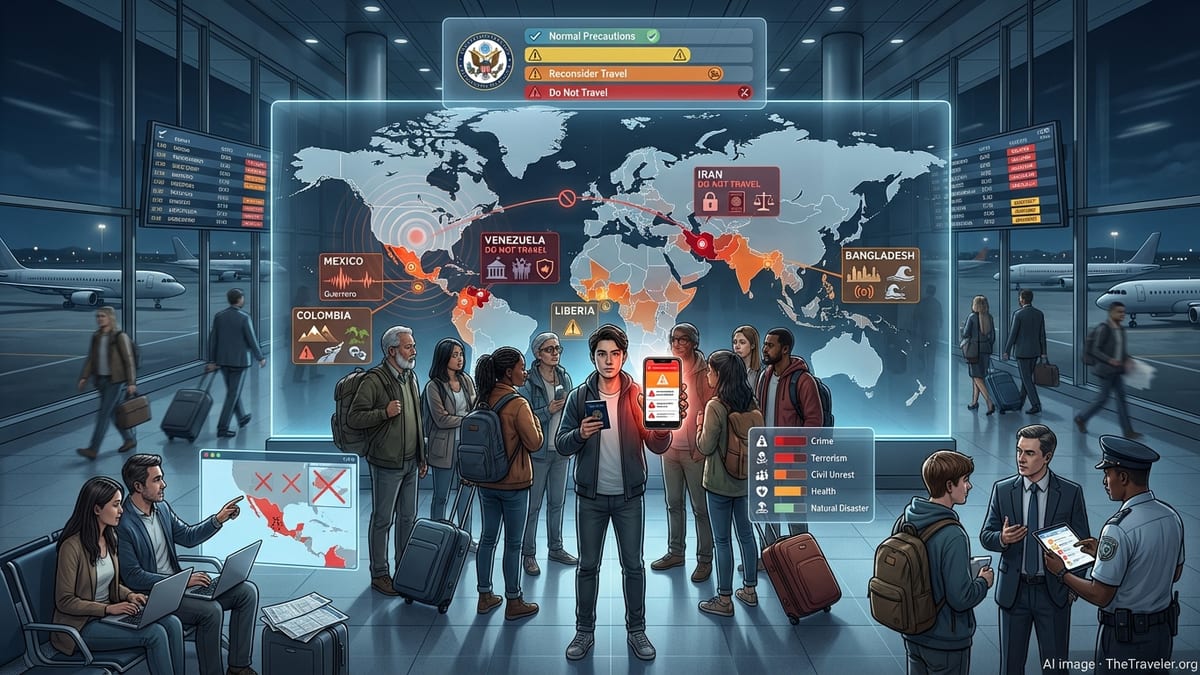
What Level 4 “Do Not Travel” Means
The US Department of State uses a four tier advisory scale to describe security conditions abroad, with Level 4 designated “Do Not Travel.” Publicly available guidance explains that this category is reserved for destinations where there is a greater likelihood of life threatening risks, ranging from armed conflict and terrorism to rampant crime, civil unrest or severe limits on consular assistance.
Travelers are advised that a Level 4 designation signals conditions so dangerous and unpredictable that American citizens should avoid going entirely, or depart as soon as it is safe to do so if already present. Supporting material from the Bureau of Consular Affairs notes that in such places, the US government may have limited or no ability to help in an emergency, whether due to the absence of an embassy, restrictions imposed by local authorities or the intensity of fighting or lawlessness.
The advisory system is separate from public health notices issued by the Centers for Disease Control and Prevention, although both may apply to the same destination. The State Department scale is focused on security and political risk, while CDC alerts concentrate on disease outbreaks and health infrastructure. For some locations currently shown in red on the State Department map, both types of warnings now overlap.
Countries Most Affected on the Current Map
The latest version of the interactive advisory map on the State Department’s travel website highlights a cluster of Level 4 countries across the Middle East, parts of Africa and the Caribbean. Recent updates and independent compilations of the government data point to Afghanistan, Haiti, Russia, Iran, Iraq, Lebanon, Syria and Yemen among the destinations where Americans are told not to travel at all.
In Haiti, the guidance reflects a prolonged breakdown in public order, with gang violence, kidnappings and a weakened health system driving the advisory to the highest level. In Afghanistan, the combination of terrorism, armed conflict and limited Western diplomatic presence leaves few contingencies for travelers who run into trouble. Coverage of the region indicates that similar security dynamics underpin Level 4 warnings in countries such as Syria and Yemen, where active conflicts and fragmented control complicate any potential assistance.
Russia remains at Level 4 as well, with the advisory framed around risks linked to the ongoing war in Ukraine, arbitrary enforcement of local laws and restrictions on consular support. Analysts note that the severity of that warning has in turn affected air routes and overland itineraries across neighboring states, as travelers and airlines look to avoid Russian airspace or land borders with elevated risk ratings.
The list of Level 4 destinations is not static. University risk management bulletins and travel industry roundups show that the Democratic Republic of the Congo, for example, was moved into the highest category after the emergence of an Ebola Bundibugyo virus disease outbreak in several eastern provinces, layered on top of chronic insecurity. Other countries have shifted down over time as conditions stabilise, illustrating how closely the map can track rapid changes on the ground.
How the Advisory Map Works for Travelers
The State Department’s global advisory map color codes every country according to the four level scale, allowing users to zoom in, compare regions and click for destination specific details. For some locations, the overall national rating is paired with additional guidance at provincial or city level, flagging areas where the risk profile is significantly higher or lower than the countrywide score.
Mexico is one of the best known examples of this more granular approach. While the country carries an intermediate advisory level overall, several individual Mexican states carry Level 4 “Do Not Travel” warnings because of crime and kidnapping concerns. Recent maps compiled from US government data also show that a small number of other countries have internal regions with different ratings, reflecting localized conflicts or criminal activity.
Universities, study abroad programs and major corporations increasingly rely on the State Department map as a baseline. Institutional travel policies often restrict or prohibit official trips to Level 4 locations and may require extra approvals for Level 3 “Reconsider Travel” destinations. As a result, changes in a country’s color on the map can quickly influence everything from student exchanges to corporate project timelines.
Independent mapmakers and travel risk platforms frequently redraw the underlying advisory data into new visualizations, sometimes combining it with similar scales maintained by Canada, Australia or the European Union. These composite maps aim to give travelers a comparative sense of where multiple governments see alignment on the highest risk destinations.
Health Emergencies and Overlapping Warnings
Alongside security and political instability, public health emergencies have become a more visible driver of travel warnings. The Centers for Disease Control and Prevention maintains its own tiered alert system, with Level 4 notices urging travelers to avoid all nonessential travel to affected areas due to disease outbreaks or health system collapse.
Recent CDC notices highlight the Democratic Republic of the Congo and neighboring Uganda in relation to Bundibugyo virus disease, a form of Ebola, with guidance for travelers to postpone visits to affected provinces. These alerts exist alongside the State Department’s Level 4 security advisory for the DRC, creating a compound risk picture in which both violence and infectious disease are material concerns.
The overlap of different warning systems can be confusing for travelers scanning maps and color codes from various agencies. Travel risk specialists recommend looking at both security and health advisories when planning, since a destination may pose limited crime risk but serious disease hazards, or vice versa. In places where both scales simultaneously reach their highest levels, such as conflict zones experiencing outbreaks, the practical effect is a de facto halt to discretionary travel.
Because advisories are updated frequently as new information emerges, any static map snapshot can become outdated within weeks. For that reason, guidance from universities and international organizations emphasizes checking the most recent advisory text for a destination rather than relying solely on third party graphics circulating on social media.
What Travelers Should Take From the Level 4 Map
For individual travelers, the expanding patches of red on US advisory maps serve primarily as a warning that some trips are simply not advisable under current conditions. Insurance policies may be voided when traveling to destinations under formal “Do Not Travel” advisories, and airlines or tour operators can cancel services at short notice if security deteriorates further.
Risk management experts note that even seasoned travelers or humanitarian workers familiar with unstable environments are increasingly constrained by institutional rules tied to the State Department scale. Where journeys to Level 4 countries do go ahead, they tend to involve tightly controlled operations with detailed evacuation plans and robust security support, rather than leisure travel.
At the same time, the map highlights how uneven global risk has become. While large parts of Europe, East Asia and the South Pacific remain coded at the lowest advisory levels, a growing arc of countries from the Sahel through the Red Sea region into parts of Eastern Europe and the Caribbean now sit at the opposite end of the spectrum. For many would be visitors, the visualization is a reminder that international travel in 2026 still depends heavily on where peace, order and functioning institutions can be taken for granted, and where they cannot.