


Perched in the quiet Cimiez district above central Nice, the Marc Chagall National Museum is one of the Riviera’s most rewarding cultural stops. Purpose-built around the artist’s Biblical Message cycle, this small but dense museum can feel overwhelming if you arrive at the wrong time, rush the key rooms or underestimate the logistics. With a little planning, however, you can move through the galleries at an easy pace, see the essential works and still have time for the garden, café and shop without feeling you have missed anything important.
Get the latest updates straight to your inbox!
Understanding the Marc Chagall National Museum Before You Go
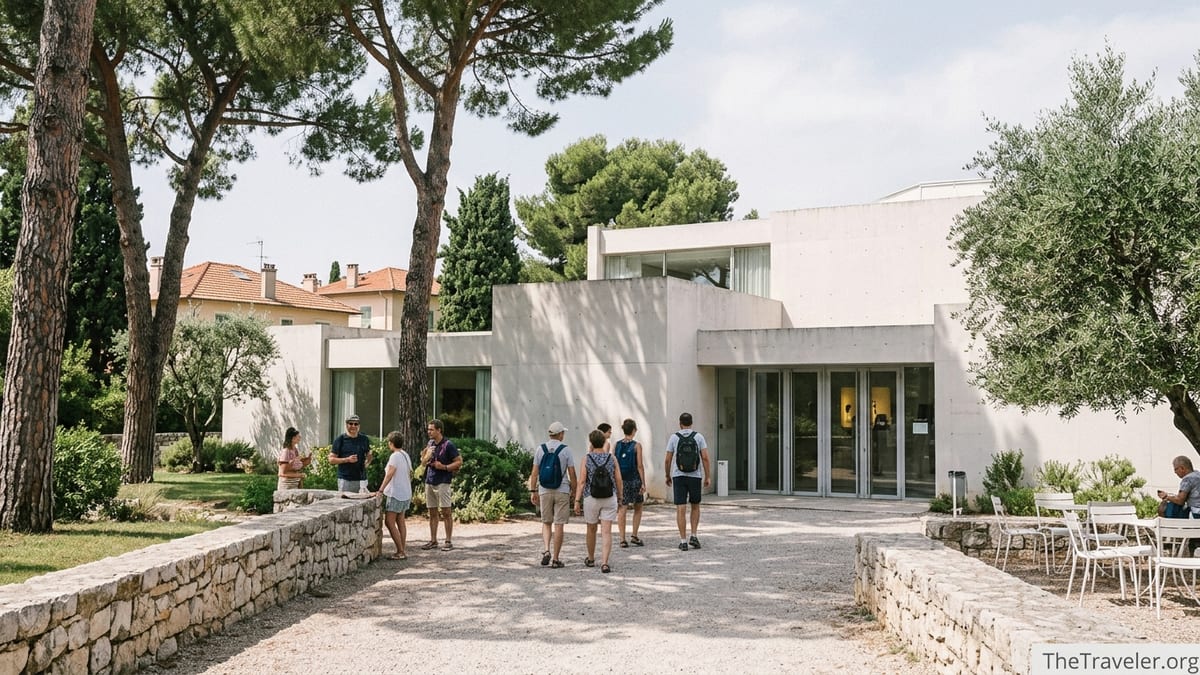
The Marc Chagall National Museum is a French national museum dedicated almost entirely to Chagall’s work, particularly his religiously inspired paintings. Created during the artist’s lifetime and inaugurated in 1973, it was designed around the Biblical Message series he gave to the French state. This matters for visitors because the building itself is part of the experience: its calm, low-slung architecture, white walls and abundant natural light are all meant to slow you down and draw your eye to color and detail.
The museum sits on Avenue du Docteur Ménard, in the residential Cimiez neighborhood, a little uphill from the seafront and Old Town. From Nice Ville train station it is around a 15‑minute walk, mostly uphill but straightforward, so allow extra time if you are arriving on foot in warm weather. Many visitors underestimate the climb and arrive already tired; planning for this makes it easier to concentrate once you reach the galleries.
Inside, the museum is compact but not tiny. It holds the Biblical Message rooms, spaces for temporary exhibitions, smaller rooms with drawings and prints, and an auditorium with luminous stained glass. Around it, a Mediterranean garden with pines and olive trees creates a buffer from city noise. Because the museum is not enormous, you can see the essentials in 90 minutes, but a relaxed visit that includes the garden and a coffee in the café usually takes around two to three hours.
Knowing this layout in advance helps you structure your time: instead of wandering randomly, you can go straight to the Biblical Message cycle first, then loop through secondary rooms and finish in the garden once your eyes and mind need a break.
Opening Hours, Tickets and the Best Times to Visit
The museum is open every day except Tuesday, as well as closed on 1 January, 1 May and 25 December. From roughly early November to the end of April, it operates with shorter winter hours, usually 10:00 to 13:00 and 14:30 to 17:00, with last entry before closing. From early May to the end of October, it remains open later in the afternoon, typically until 18:00. These afternoon closures catch many travelers by surprise, so avoid arriving just before the midday break or near last admission when gallery staff begin gently shepherding people toward the exit.
Standard admission during temporary exhibitions is currently in the low‑teens in euros for adults, with a slightly lower price when there is no major exhibition running. Reduced tickets are available for certain categories such as young adults and teachers, and there is a group rate for organized parties of around ten people or more. Additionally, entry is free for everyone on the first Sunday of each month, and visitors under 26 who are nationals or residents of EU countries generally qualify for free admission year‑round with proof of age and residency. These policies can change, but they offer good value if they match your travel dates and status.
If you are planning to visit on the first Sunday, be prepared for significantly higher crowds. A practical strategy is to arrive shortly before opening in the morning, go directly to the Biblical Message rooms and leave the smaller spaces, garden and shop for later, once the museum becomes busier. On a regular paid day, mornings between 10:00 and 11:00 and late afternoons in the last hour before closing are often quieter, especially outside peak summer months and French school holidays.
For those building a wider cultural itinerary, keep in mind that the Chagall museum sometimes offers combination or “twinned” tickets with the Fernand Léger National Museum in Biot on the coast. If you know you want to see both, ask at the ticket counter what is currently available so you do not accidentally pay full price twice.
Getting There: Transport, Access and Practical Logistics
Although the museum feels tucked away in a quiet residential area, it is accessible by several forms of transport. From central Nice and the seafront, the most straightforward public option is bus line 5, which stops at “Musée Chagall” a short walk from the entrance. The ride from the city center is usually under 15 minutes, though you should add time in summer or on busy weekends. The popular hop‑on hop‑off sightseeing bus, often marketed as Nice Le Grand Tour, also stops near the museum, which can be convenient if you are combining the visit with other sights like the Promenade des Anglais or Castle Hill.
If you prefer to arrive by tram, take line 1 to the Gare Thiers stop next to Nice Ville train station. From there the museum is about a 15‑minute walk uphill through city streets. Many visitors simply follow navigation on their phones, but it is wise to budget a little extra time in summer because of heat and to allow for stopping to photograph viewpoints over the city as you climb.
Coming by car, you can exit the A8 motorway at Nice Centre, follow the urban expressway known locally as the Voie Mathis and then take the Cimiez exit. The museum offers free parking for both cars and coaches, which is relatively rare for central Nice. That said, spaces can fill on busy days, particularly when a major temporary exhibition is on; have a backup plan to park lower down the hill and walk up if needed.
The museum is designed with step‑free access and provides accessible toilets. Visitors with reduced mobility should still allow a bit of extra time to move between the different indoor and outdoor areas, but there are no long staircases to contend with. If you are visiting with children in strollers, the compact size and calm atmosphere make this one of the easier major museums in the city to navigate compared with larger complexes where distances between galleries are greater.
What Not to Miss: The Essential Highlights Inside
The heart of the visit is the suite of large canvases known as the Biblical Message, which occupies several adjoining rooms. These seventeen works, inspired by stories from the Old Testament, are the reason the museum exists and are what most visitors remember years later. The rooms are bathed in natural light and arranged to surround you with Chagall’s intense blues, reds and greens. To avoid missing key details, step back to take in each canvas as a whole, then move in closer to look at faces, animals and small narrative elements that reveal his interpretation of the stories.
One practical way to approach the Biblical Message is to choose three or four works to linger over instead of trying to give equal attention to every canvas. For example, many visitors are struck by Chagall’s treatment of the Creation and Paradise stories, while others focus on works dealing with the Exodus or the prophets. If you are visiting as a couple or family, it can be engaging to decide in advance that each person will “adopt” a painting, read the wall text carefully, and later explain to the others what they noticed. This creates a natural rhythm to the visit and ensures you are actively looking, not just passing through.
Do not forget the auditorium, which many travelers skip without realizing it contains some of the most beautiful stained glass in the building. The windows that illustrate the Creation of the World suffuse the space with rich blues and yellows that shift as the sun moves. Try to step into the auditorium at a quiet moment and sit for a few minutes rather than just peering in from the doorway. If you check the museum’s program in advance, you may be able to time your visit with a chamber music concert or lecture, which gives you a chance to experience the space as Chagall intended.
Beyond these core highlights, smaller rooms feature drawings, prints and sometimes ceramics or tapestries that show different sides of Chagall’s practice. These spaces are less crowded and can be a welcome pause after the more intense Biblical rooms. Even if you are not normally a fan of works on paper, stopping at a few key pieces helps you connect large-scale religious images with the more intimate, often autobiographical motifs that recur throughout his career.
Planning Your Visit Route So You Do Not Miss Anything Important
To make the most of your time and avoid backtracking, it helps to think in terms of a simple route before you enter the galleries. A practical sequence for most visitors is: start with the Biblical Message rooms, continue to any temporary exhibition on view, then explore the smaller permanent‑collection spaces before taking a break in the garden and café, finishing with the auditorium if there is no event underway.
For example, if you have a 10:00 entry, you could plan to spend the first 45 to 60 minutes exclusively in the Biblical Message, moving slowly through the rooms while your energy and attention are highest. Around 11:00, shift to the temporary exhibition, where you can browse more quickly if it is not your main interest. By about 12:00, when the museum is often at its busiest and staff are preparing for the midday closure in the cooler months, you can retreat to the café terrace and garden, review what you have seen and decide if there are rooms you want to revisit after the break.
In the afternoon, reserve at least 20 to 30 minutes for the smaller rooms and the auditorium. If you are the type of traveler who likes to sketch or take notes, these quieter areas are ideal because you can usually find a bench and stay a little longer without feeling you are in the way. Keep in mind that near closing time staff will begin gently guiding visitors toward the exit, starting from the farthest rooms, so do not leave your must‑see spaces for the very last minutes.
Families traveling with children might adapt this route so that the more contemplative spaces are balanced with periods outdoors. For instance, you could visit half of the Biblical Message rooms, take a short break in the garden, then return to complete the cycle. The museum’s relatively small size makes it realistic to step out and back in without losing the thread of your visit, which is helpful if younger travelers become restless.
Combining the Museum With Other Nice Highlights
Because the Marc Chagall National Museum sits in Cimiez, many visitors choose to pair it with other sights in the same area. A natural combination is the Matisse Museum, located higher up in Cimiez near Roman ruins and an olive grove. You can either walk between the two in about 15 to 20 minutes or use local buses, creating a themed day focused on two of the 20th century’s most important colorists. In practice, many travelers spend the morning with Chagall and the afternoon with Matisse, stopping for lunch at a café in the neighborhood or heading back to central Nice to eat in the Old Town.
If you prefer variety rather than two museums in one day, you might instead schedule Chagall for the morning and then descend into the city for a completely different experience. For example, after a late morning visit you could take bus 5 back toward the center, get off near Avenue Jean Médecin, stroll down through the shopping district and end on the Promenade des Anglais for a late lunch at a seafront brasserie. This contrast between quiet, contemplative museum and lively seafront is one of Nice’s pleasures.
Travelers with more time on the Riviera sometimes use Nice as a base and purchase regional transport passes that cover both urban buses and regional trains. In that case, you could dedicate one day to Nice’s art museums, including Chagall, and another to excursions by train to Antibes, Cannes or even Monaco. The key is not to stack too many major museums on the same day; Chagall’s work is visually and emotionally rich, and most visitors enjoy it more when they are not rushing to reach another gallery by a fixed time slot.
If you happen to be in Nice when a concert or special event is being held in the Chagall museum’s auditorium, consider shaping your day around it. For instance, you might plan an early evening chamber music performance there, then walk or take a short bus ride back down to the Old Town for a late dinner on a terrace once the temperatures have cooled.
Tickets, Passes and Money-Saving Tips
While the museum is not especially expensive by big‑city standards, the cost can add up for families or travelers visiting several institutions. In addition to the first‑Sunday free admission and free entry for many under‑26 EU visitors, there are situations where you can make the visit part of a broader value strategy. For example, Nice and the wider Côte d’Azur region sometimes promote multi‑day transport and attraction passes that, while mainly designed for buses and regional trains, help free up your budget for museum tickets.
If you are traveling on a tight budget, one realistic approach is to schedule your stay so that the first Sunday of a month falls early in your time in Nice. You could then plan to see the Chagall museum that morning at no cost, and if you find you love Chagall’s work, choose to pay for a return visit on a quieter weekday later in the week. Many art‑interested travelers do exactly this, using the free entry day as a low‑pressure introduction and then returning for a slower, more focused session later.
Another tip is to ask at the ticket counter about twinned or combination tickets if you intend to visit other national museums in the region, such as the Fernand Léger museum in Biot. Even modest savings can be worthwhile if you are a party of several adults. Finally, remember that museum shops and cafés in France can range from modestly priced to quite expensive. At Chagall, you may find high‑quality art books and reproductions; if you already know you like to buy such items, factor that into your budget so you do not feel pressured to choose between a catalog and a later meal out in town.
Card payments are widely accepted, but it is still useful to carry a small amount of cash in euros for bus tickets, a quick coffee near the museum or a snack on the way back into town. Public transport in and around Nice relies on rechargeable cards and mobile apps; buying or loading these in advance, for example at tram stops or kiosks in the city center, will save time on the morning of your museum visit.
The Takeaway
Visiting the Marc Chagall National Museum in Nice without missing the highlights is less about racing through every room and more about a series of simple, practical choices. Arrive at a quiet time, go first to the Biblical Message rooms while your attention is fresh, then slow your pace in the smaller galleries, auditorium and garden. Build in a break at the café terrace, and remember that the museum’s modest size works in your favor: you have time to look closely without feeling overwhelmed.
With a bit of forethought about transport, opening hours and ticket options, the Chagall museum can be the anchor of a relaxed day in Nice rather than a rushed stop on a checklist. Whether you pair it with the nearby Matisse Museum, a stroll along the Promenade des Anglais or a simple afternoon people‑watching in a café, planning your route and priorities will ensure that the images, colors and atmosphere of Chagall’s world stay with you long after you leave the quiet gardens of Cimiez.
FAQ
Q1. How long do I need to visit the Marc Chagall National Museum without feeling rushed?
Most visitors are comfortable with about two hours, which allows time for the Biblical Message rooms, the smaller galleries, the auditorium and a short break in the garden or café.
Q2. Do I need to buy tickets in advance, or can I just show up?
You can usually buy tickets on arrival, especially outside peak summer and free Sundays, but checking current conditions and possible events before you go helps you avoid queues or unexpected closures.
Q3. What is the best time of day to avoid crowds?
Mornings shortly after opening and the final hour before closing are often quieter, especially on weekdays that do not fall during French school holidays or major local events.
Q4. Is the museum suitable for children and teens?
Yes, but it is a contemplative space. Planning a shorter, focused route, taking breaks in the garden and involving children by asking them to choose favorite paintings can make the visit more engaging.
Q5. Can I take photos inside the museum?
Photography rules can change, but in many French museums non‑flash photography is allowed in permanent collections and sometimes restricted in temporary exhibitions. Always check signs at the entrance and follow staff instructions.
Q6. Is the museum accessible for visitors with reduced mobility?
The museum offers step‑free access and accessible toilets, and its relatively compact layout keeps walking distances reasonable, though visitors using wheelchairs or with limited mobility should still allow a bit of extra time.
Q7. How do I get to the museum from central Nice using public transport?
From the city center or seafront, bus line 5 stops near the entrance at the “Musée Chagall” stop. Alternatively, you can take tram line 1 to Gare Thiers and walk about 15 minutes uphill to the museum.
Q8. Are there good places to eat nearby, or should I plan to eat in central Nice?
The museum has a small café and garden terrace that are pleasant for a snack or light refreshment, but for a full meal many visitors prefer to head back toward central Nice or the Old Town after their visit.
Q9. Can I combine the Chagall museum with another major attraction in the same day?
Yes. A common pairing is the nearby Matisse Museum in Cimiez, or you can visit Chagall in the morning and spend the afternoon on the Promenade des Anglais or exploring the Old Town.
Q10. What should I prioritize if I only have one hour?
Go directly to the Biblical Message rooms, spend at least a few minutes in the auditorium to see the stained glass and, if time allows, take a short walk through the garden for a final look back at the building before you leave.