


More news on this day
Travelers across Asia faced widespread disruption on June 29 as six regional carriers collectively canceled 90 flights and delayed nearly 800 more, snarling operations from Beijing and Jakarta to Kagoshima and leaving thousands of passengers struggling to rebook onward journeys.
Get the latest news straight to your inbox!
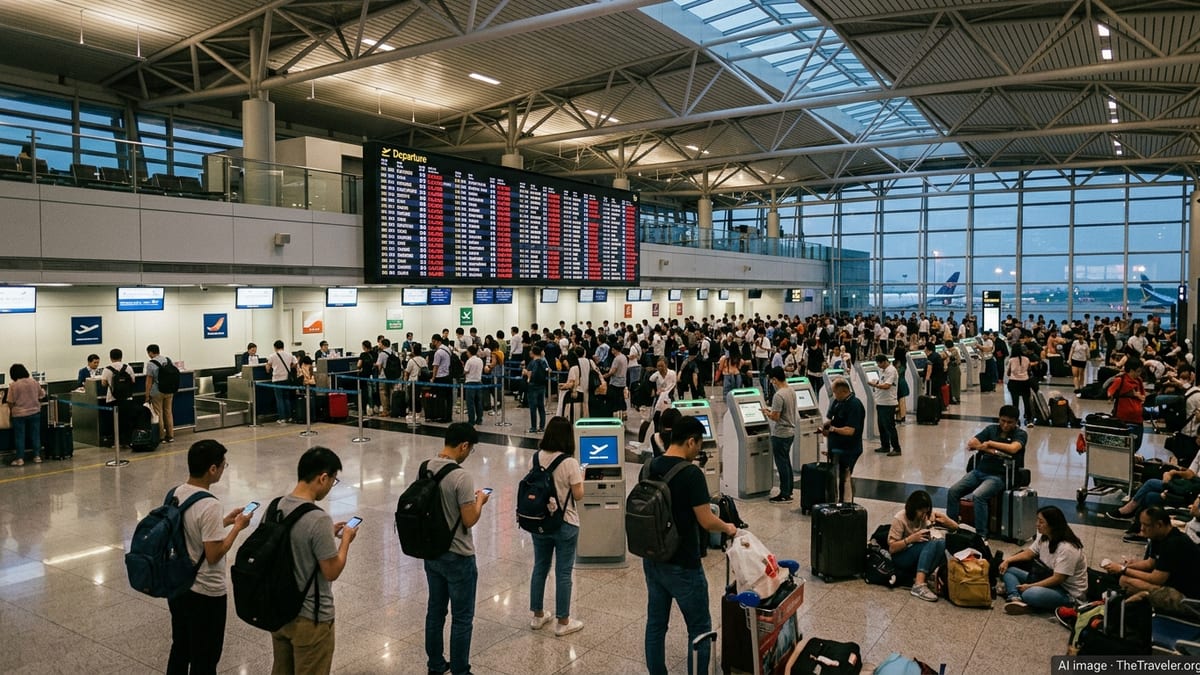
Major Asian Hubs Grapple With Cascading Delays
According to published coverage, China Eastern, Batik Air, Hainan Airlines, Air China, Japan Air Commuter and China Express together logged 90 cancellations and 796 delays across their networks, with disruptions concentrated in China, Indonesia and Japan. The combined 886 affected flights produced knock-on effects across regional schedules and crowded terminals at some of Asia’s busiest hubs.
Publicly available flight data indicates that Beijing’s airports, Jakarta Soekarno Hatta and Kagoshima in southern Japan were among the hardest hit, with services either grounded or pushed back by several hours. The pattern mirrors earlier disruption events in June in which Chinese and Indonesian gateways such as Beijing Capital, Shanghai Pudong, Guangzhou Baiyun and Soekarno Hatta experienced waves of late departures and scrubbed services.
Reports indicate that while the latest round of disruption was centered on domestic and regional routes, the impact extended to long haul connections, as missed links forced travelers to rebook or overnight in transit. Airlines were seen adjusting subsequent rotations throughout the day to recover schedules, creating additional uncertainty for passengers departing later in the evening.
Industry analysts quoted in recent aviation coverage describe these incidents as part of a broader period of operational strain for Asian carriers as they rebuild capacity on dense regional corridors. Even modest scheduling disruptions at a handful of congested airports can quickly propagate across multiple fleets, particularly where turn times are tight and spare aircraft are limited.
China Eastern and Air China Under Pressure in Beijing
China Eastern and Air China, two of China’s largest network airlines, were among the carriers most visibly affected at Beijing’s airports. Beijing Capital and Beijing Daxing both serve as key hubs for domestic and international connections, meaning delays on feeder services from secondary cities can ripple into onward flights to Southeast Asia, Europe and North America.
Recent performance statistics for China Eastern routes linking Beijing with cities such as Kunming and Jakarta already show elevated delay rates over recent months, suggesting limited slack in the system when additional operational challenges arise. The latest disruption has added pressure as ground teams juggle rebookings, aircraft rotations and crew duty limits across a packed summer schedule.
Air China has faced similar headwinds as it works to maintain punctuality on trunk routes from Beijing to other Asian capitals. Public flight tracking information for services into and out of the Chinese capital on June 29 showed a mix of on time operations and meaningful pushbacks, reflecting a network still in recovery mode even as demand for business and leisure travel remains strong.
According to aviation data providers, Beijing’s dual airport system is particularly sensitive to stacking delays during peak hours, when runway throughput and air traffic control flow measures are already operating near capacity. As a result, any cluster of late arrivals can slow departures, compounding initial schedule disruptions.
Batik Air and Regional Knock Ons in Indonesia
In Indonesia, Batik Air recorded a portion of the cancellations and delays that contributed to the region wide total. The carrier, which operates a high frequency domestic network anchored at Jakarta Soekarno Hatta, has been a central player in Indonesia’s post pandemic aviation rebound. That intensity of flying, however, leaves little margin when operational issues arise during busy travel periods.
Recent reporting on Indonesian aviation highlights how delays at Soekarno Hatta often cascade into secondary cities as aircraft run late on multiple rotations. With Batik Air operating hundreds of daily flights, a single wave of disruptions in Jakarta can affect travelers across the archipelago, including those connecting onward to international services.
The latest disruption coincided with an already active period for Indonesian carriers, following an earlier June event in which Batik Air and other regional airlines logged several hundred delays and dozens of cancellations across Indonesia, China, Malaysia and Singapore. Travel advisers note that passengers booked on tight domestic to international connections in Jakarta may be particularly vulnerable when such events occur.
Publicly available information from airport operators in the region points to a combination of weather constraints, airspace congestion and aircraft rotation challenges as recurring contributors to irregular operations. While each incident has its own triggers, the result for travelers is a familiar pattern of crowded departure halls and long queues at customer service desks.
Hainan Airlines, China Express and Strain on Chinese Domestic Networks
Hainan Airlines and China Express also featured among the carriers reporting disrupted services, adding to strain on China’s extensive domestic network. Both airlines operate heavily within China’s internal market, linking major hubs to provincial cities that depend on air service for business and tourism.
Earlier reports from late May and mid June described operational breakdowns at Shanghai Pudong and other mainland airports, where Hainan Airlines and China Eastern were involved in clusters of cancellations and over one hundred delayed flights in a single day. Those events underscored how quickly domestic bottlenecks can arise when multiple airlines experience schedule challenges at the same hub.
China Express, which focuses on regional operations, is particularly exposed when air traffic control measures or ground handling issues lengthen turnaround times. Even small delays can lead to missed slots at congested airports, pushing flights further down the queue and disrupting carefully sequenced rotations.
Travel industry observers note that China’s rapid recovery in domestic air travel, while positive for carriers’ bottom lines, has also increased the complexity of day to day operations. High aircraft utilization rates and dense wave patterns at key hubs mean that any interruption is likely to create downstream effects lasting well beyond the initial incident window.
Japan Air Commuter and Localized Impact in Kagoshima
In Japan, Japan Air Commuter experienced part of the disruption, with Kagoshima Airport in Kyushu among the airports reporting affected services. As a regional carrier feeding Japan Airlines’ broader network, Japan Air Commuter plays an important role in linking smaller communities to the country’s main domestic and international gateways.
Published flight information from Kagoshima during the disruption period showed delays on selected regional sectors, reflecting how even localized issues can cause inconvenience for travelers connecting onward via larger hubs such as Osaka and Tokyo. For passengers relying on tight same day connections, even modest pushbacks may result in missed flights and unexpected overnight stays.
Japan’s domestic system is generally regarded as highly punctual, but it is not immune to weather, air traffic restrictions and ground handling constraints. When regional carriers like Japan Air Commuter adjust their schedules, the effects are often most acutely felt in smaller cities where alternative flights are limited and train connections may not be practical for all itineraries.
Travel planners recommend that visitors transiting through regional airports during periods of elevated disruption risk consider longer connection windows and flexible tickets, particularly when onward journeys involve separate bookings or non aligned carriers.
What Travelers Should Expect in the Coming Days
While many of the disrupted flights on June 29 were expected to operate later in the day or be absorbed into revised schedules, recent patterns suggest that residual delays can persist for 24 to 48 hours after a major event. Aircraft and crew out of position may continue to affect punctuality on seemingly unrelated routes as airlines work to reset their operations.
Public guidance from aviation consumer organizations emphasizes the importance for travelers of monitoring flight status closely, especially when connecting across different airlines or ticket types. Given the complex web of codeshares linking carriers such as Air China, China Eastern and regional partners, disruption on one leg can have implications for multiple bookings.
Observers of the Asian aviation market point out that June has been marked by several large scale irregular operations events across China and Southeast Asia, highlighting both the strength of demand and the vulnerability of networks operating near capacity. As peak summer travel continues, further isolated disruption episodes cannot be ruled out.
For now, passengers heading through Beijing, Jakarta, Kagoshima and other affected airports are being advised by travel agents and consumer advocates to build extra time into itineraries, ensure they have access to airline apps or notification services, and review the rebooking and care policies that apply to their specific tickets in case of further delays.