


More news on this day
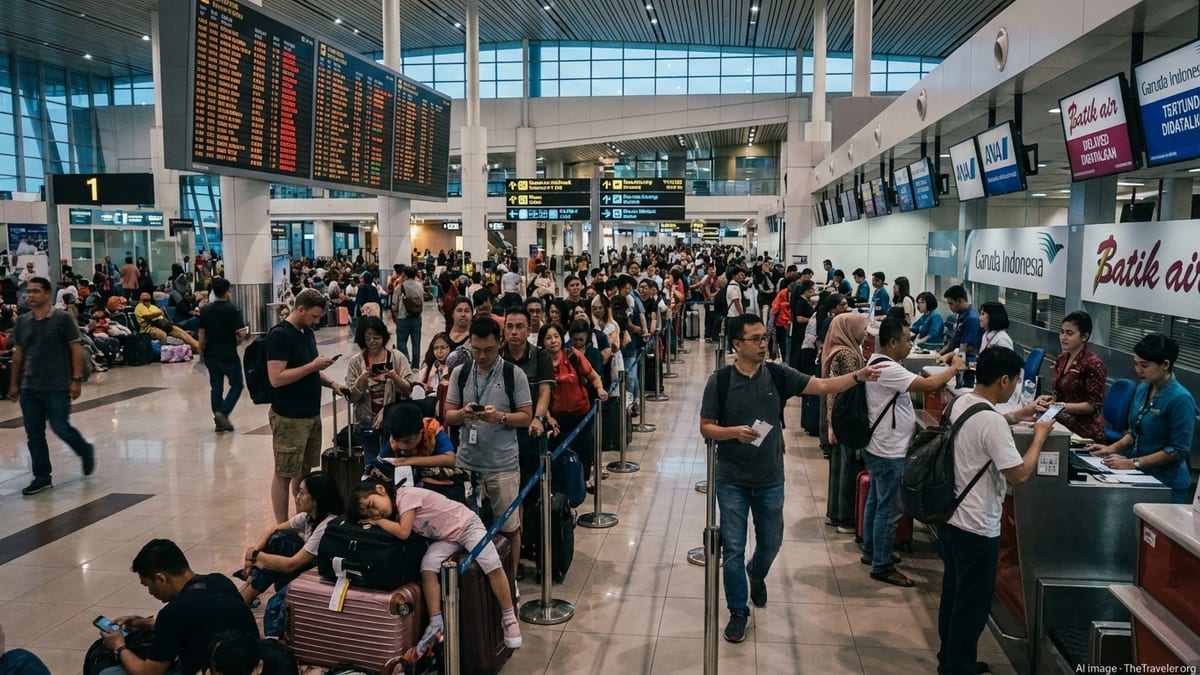
Jakarta’s Soekarno-Hatta International Airport experienced significant operational disruption as 111 flights were delayed and 14 services cancelled, according to live tracking data compiled on Sunday, with domestic and international passengers facing hours-long hold-ups across the region’s busiest hub.
Get the latest news straight to your inbox!
Live Data Shows Scale of Delays and Cancellations
Publicly available flight-tracking boards for Soekarno-Hatta International Airport on Sunday indicated an unusual spike in operational disruption, with a combined 111 departures and arrivals marked as delayed over the course of the day. A further 14 flights were listed as cancelled, pointing to one of the most difficult operating days at Indonesia’s main gateway so far this year.
Tracking data aggregating flights into and out of Jakarta showed disruption across both domestic trunk routes and regional international services. Morning wave movements, which normally define the day’s on-time performance, were already showing late departures and rolling delays that extended into the afternoon schedule, creating knock-on congestion at several Indonesian airports.
Published coverage of on-time performance trends for Indonesian carriers has noted recurring reliability challenges at Jakarta’s primary hub, and the latest figures appear to align with those medium-term patterns. Previous analyses of delay statistics highlighted Jakarta as a persistent bottleneck in the national network, particularly during peak travel periods when runway and terminal capacity are stretched.
While the precise causes of each delay were not listed on public dashboards, operational disruption of this scale typically reflects a combination of aircraft rotation issues, late inbound flights, ground handling constraints and weather-related restrictions along key routes in the archipelago.
Batik Air Carries Full Burden of Cancellations
Data from live status boards and flight-tracking services indicated that all 14 cancellations recorded at Soekarno-Hatta on Sunday were operated by Batik Air, part of the Lion Air Group. The cancellations affected both domestic and short-haul international services, disrupting itineraries for passengers connecting through Jakarta and those originating in the capital.
Several Batik Air flights on core routes linking Jakarta with major provincial capitals were shown as cancelled, while other flights remained in delayed status. In practice, cancellations of this scale can trigger widespread rebooking efforts as travelers are moved onto later Batik Air departures or onto other Lion Air Group services where seat availability permits.
According to previous performance analyses that examine delay patterns across Indonesian airlines, Batik Air has faced a substantial share of late operations in recent years, reflecting the pressure on high-frequency routes into Jakarta. The latest cancellation cluster places additional focus on the carrier’s scheduling resilience and its capacity to recover from early-morning disruptions.
For travelers, an all-Batik concentration of cancellations means fewer immediate alternative options within the same brand, particularly on routes dominated by the Lion Air Group. Many passengers are forced to accept significant timetable changes, overnight stays or rerouting via other Indonesian hubs when same-day seat inventory runs short.
Garuda Indonesia, Lion Air, Citilink and Super Air Jet Hit by Widespread Delays
The wider disruption at Soekarno-Hatta was far from limited to one airline. Live departure and arrival boards showed Garuda Indonesia, Lion Air, Citilink and Super Air Jet all carrying a heavy burden of delayed flights on Sunday, affecting services across Java, Sumatra, Kalimantan and Sulawesi, as well as some regional international connections.
Flight status snapshots from multiple Indonesian airports indicated delayed arrivals from Jakarta, with services operated by these carriers landing significantly behind schedule at key destinations such as Yogyakarta, Surabaya and Palembang. In several cases, late-arriving aircraft were then scheduled to turn around quickly for return flights to Jakarta, embedding further delays through the day.
Historical studies of on-time performance at Soekarno-Hatta have pointed to high delay ratios across several mainline and low-cost operators, including Garuda Indonesia, Lion Air, Citilink, Batik Air and Super Air Jet. The current episode appears to mirror those findings, with a broad cross-section of airlines affected rather than a single operator experiencing isolated disruption.
For passengers, that breadth of impact reduces the value of switching between carriers at short notice, since many competing flights on similar routes were also showing late departures. The result at Jakarta on Sunday was a crowded terminal environment, with travelers from multiple airlines simultaneously attempting to rebook, claim assistance or adjust onward travel plans.
Systemic Strain at Indonesia’s Busiest Air Hub
Soekarno-Hatta International Airport functions as a primary hub for several Indonesian airlines, including Batik Air, Citilink, Garuda Indonesia, Lion Air and Super Air Jet. The concentration of operations at this single gateway magnifies the knock-on effects when disruption hits, particularly during busy holiday and weekend periods when load factors are high and spare capacity is limited.
Published background information on the airport has long highlighted infrastructure and capacity challenges as traffic volumes have outpaced earlier projections. Even with terminal expansions and additional runways, the combination of dense domestic scheduling, transfer passengers and weather-sensitive operations across Indonesia’s vast archipelago leaves little margin when operational issues arise.
Recent academic and industry analyses of flight delays in Indonesia have recommended more robust delay-management strategies, including better coordination between airlines and airport operators, improved ground-handling efficiency and more conservative scheduling on high-density routes. The pattern of cascading delays observed at Soekarno-Hatta on Sunday underscores how vulnerable the current system remains to disruption.
For aviation planners, episodes involving more than a hundred delayed flights in a single day serve as a stress test of existing procedures. They also offer a data-rich window into where bottlenecks form first, which carriers struggle most to recover and how quickly the network returns to normal once the peak of disruption passes.
What Travelers Through Jakarta Should Expect Now
For passengers with upcoming itineraries through Jakarta in the days following the disruption, recent events suggest the importance of allowing generous connection times and monitoring flight status from multiple independent sources. Experience from previous irregular-operation days at Soekarno-Hatta indicates that residual delays can persist into subsequent schedules as airlines work through aircraft positioning and crew-shift limitations.
Travel platforms and airport information boards showed that, even as some services continued to depart roughly on time, others remained subject to shorter delays. In many cases, the difference came down to whether aircraft and crews were starting their day in Jakarta or arriving late from elsewhere in the network.
Passenger reports collected on social platforms in earlier disruption events have frequently emphasized the value of flexibility, including willingness to accept rerouting via alternative Indonesian hubs, switching to earlier flights when offered, or adjusting travel dates where possible. Given the latest round of delays and cancellations, similar strategies may again reduce the risk of missed connections and overnight stranding.
With Batik Air carrying the full weight of Sunday’s cancellations and Garuda Indonesia, Lion Air, Citilink and Super Air Jet all facing elevated delay levels, Jakarta’s main airport is once more at the center of Indonesia’s wider aviation reliability debate. For now, travelers transiting Soekarno-Hatta are likely to plan journeys with caution, building in extra time and backup options as the network gradually stabilizes.