


More news on this day
Hundreds of air travelers across France faced severe disruption today as widespread delays and cancellations hit major airports from Paris to Lyon, Nice and Bordeaux, affecting services operated by Air France, easyJet, Lufthansa, Ryanair and other carriers.
Get the latest news straight to your inbox!
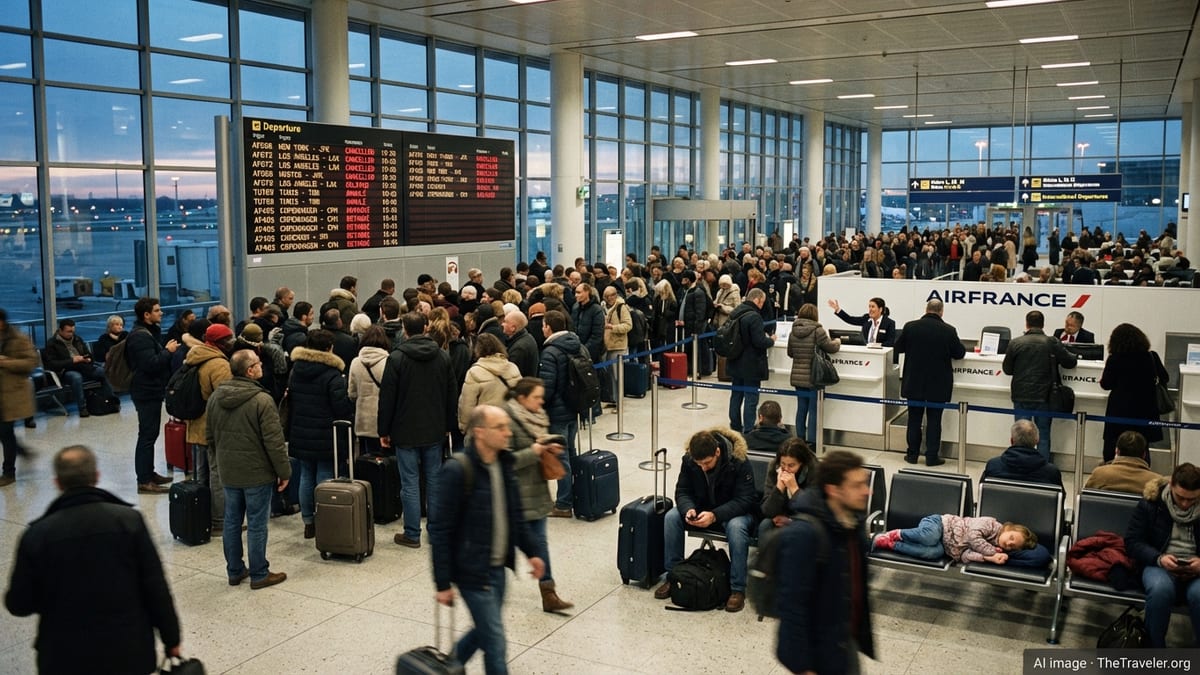
Major French Hubs Hit by Wave of Delays
Publicly available flight-tracking data and industry reports indicate that French airports collectively recorded 1,146 delayed flights and 51 cancellations over the course of the day, creating extensive backlogs at key hubs. The impact has been most visible at Paris Charles de Gaulle and Paris Orly, but significant disruption has also been reported at Lyon Saint-Exupéry, Nice Côte d’Azur, Bordeaux-Mérignac and Marseille Provence.
Earlier in June, similar congestion episodes at French hubs were already being recorded, with hundreds of delays and multiple cancellations in a single day, particularly involving Air France, easyJet and Ryanair. Those earlier patterns have now intensified into a broader network event, with today’s figures surpassing previous disruption levels and pushing airport operations close to capacity.
Data compiled from recent operational performance summaries for Paris and Marseille show average delay times creeping upward in late June, underscoring how even modest schedule slippages can quickly scale when traffic is heavy. With the summer holiday period ramping up, the latest wave of disruption is hitting at one of the busiest times of the year for French aviation.
The pressure on French airspace is also magnified by the country’s role as a key transit corridor between northern and southern Europe, as well as a major gateway for long-haul links to North America, Africa and Asia. When schedules unravel at Paris, Lyon, Nice or Marseille, knock-on effects are often felt at secondary airports including Toulouse, Nantes and Montpellier, extending the disruption well beyond the main metropolitan centers.
Thousands of Passengers Stranded or Forced to Rebook
The immediate human impact of the delays and cancellations has been visible in crowded terminals, long queues at check-in and customer service desks, and extended waits at boarding gates. Reports from affected airports describe travelers in Paris, Lyon, Nice and Bordeaux struggling to secure onward connections or overnight accommodation as aircraft and crews fell out of position.
Short-haul European routes have been especially vulnerable, with passengers on intra-EU services facing missed connections and itinerary changes at short notice. Travelers on Air France, easyJet, Lufthansa and Ryanair services were among those most heavily affected, alongside passengers flying with other European and leisure carriers that rely on French hubs for transfers.
Families starting school holidays, business travelers with tight schedules and tourists connecting to Mediterranean destinations all faced uncertainty over their arrival times. In some cases, passengers reported being rebooked onto flights departing many hours later or even the following day, reflecting the limited spare capacity available during peak summer operations.
Consumer advice published in recent weeks in response to earlier French disruption episodes has urged passengers to monitor their flight status frequently, arrive earlier at the airport than usual, and be prepared for re-routing via alternate hubs where space permits. For travelers already in transit, the scale of today’s delays has sometimes left few immediate alternatives.
Operational and Weather Pressures Converge
A combination of operational constraints and challenging weather conditions across parts of Western Europe has contributed to the latest disruption. French air traffic management has been operating under heavy load, while severe thunderstorms and convective weather over neighboring countries have periodically restricted airspace capacity along key flight corridors.
Analyses of recent European network performance highlight how bottlenecks in French airspace have played a recurring role in regional delays, particularly when staffing or capacity limitations coincide with adverse weather. A single air traffic control restriction can force airlines to compress or reroute multiple services, rapidly amplifying delays at already-busy hubs.
Earlier strikes and capacity reductions at French control centers over the past two summer seasons have also illustrated how sensitive the system can be to even short interruptions. Although today’s disruption is being driven primarily by operational and weather-related factors rather than industrial action, the underlying structural vulnerabilities remain similar.
Industry observers note that airlines such as Air France, easyJet, Lufthansa and Ryanair operate dense schedules that leave little margin for recovery once delays accumulate. When an inbound aircraft arrives significantly behind schedule, its subsequent departures, crew rotations and maintenance slots can all be affected, generating rolling disruption throughout the day.
Ripple Effects Across the European Air Network
The disruption centered on France is also having wider repercussions across the European air network. Flights departing from or bound for French airports often feed long-haul departures to and from hubs in Germany, the Netherlands, the United Kingdom and Spain, meaning that delays in one country can cascade across multiple others.
Recent reports on network performance have already documented how earlier French congestion contributed to passengers being stranded at airports as far away as Malaga and other Mediterranean gateways when aircraft and crews could not reposition on time. Today’s higher level of disruption is likely to produce a similar pattern, with missed connections and late arrivals affecting airports well beyond French borders.
Airlines are attempting to absorb some of the shock by consolidating lightly booked services and prioritizing key trunk routes, but the sheer scale of the delays and cancellations limits their flexibility. Once a critical mass of flights is disrupted, it becomes increasingly difficult to reset the schedule without further cancellations or substantial re-timings.
Travel industry analysts suggest that the situation could take at least a full operating cycle to stabilize, particularly if evening storms or localized air traffic restrictions further constrain capacity. For travelers booked on flights touching French airspace over the next 24 hours, the risk of knock-on disruption remains elevated.
What Travelers Should Expect in the Coming Days
With French airports and airlines working to clear the backlog, publicly available guidance strongly encourages passengers to check their flight status repeatedly on the day of travel and to allow additional time at the airport for check-in, security and boarding. Even flights that are still scheduled to depart on time may experience last-minute changes as airlines adjust rotations.
Travelers holding connecting itineraries through Paris, Lyon, Nice or Bordeaux may be particularly exposed to further disruption, given the limited spare capacity on popular onward routes at the height of the summer season. Where possible, some passengers may choose to rebook via alternative hubs in neighboring countries, though availability on those routes is also tightening as airlines accommodate displaced travelers.
Passenger rights frameworks in the European Union generally provide for care provisions such as meals and accommodation in cases of extended delays or cancellations, depending on the specific circumstances. However, travelers often need to initiate claims after the event, and processing times can vary widely between carriers.
For now, the focus at French airports is on restoring a stable operating rhythm and moving stranded passengers to their destinations. With demand for air travel running high and the summer season still in its early stages, today’s events highlight how quickly conditions can deteriorate when multiple pressures converge on an already stretched air transport system.