


More news on this day
Air travel across the Gulf continues to face heavy disruption as conflict-linked airspace restrictions and congestion trigger what observers describe as a rolling wave of delays and cancellations, with recent data indicating at least 706 flight delays and 87 outright cancellations affecting major hubs such as Jeddah and Dubai alongside airports in Bahrain, Kuwait, Qatar and Oman.
Get the latest news straight to your inbox!
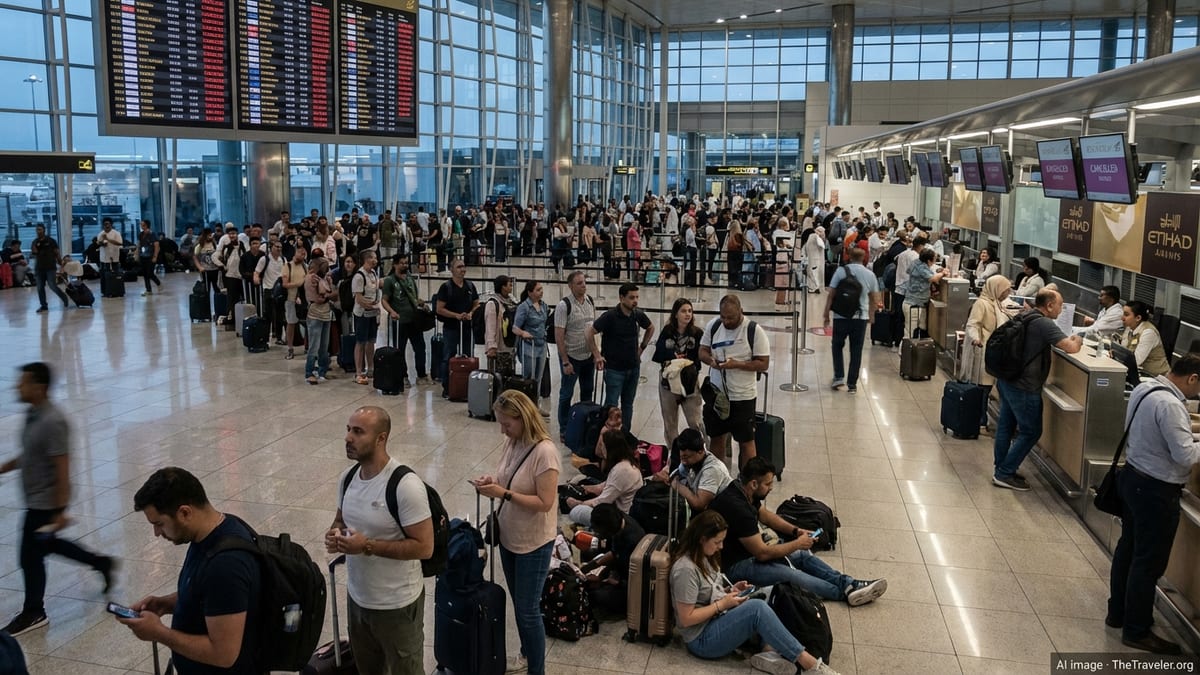
Delays and Cancellations Ripple Across Gulf Hubs
Publicly available aviation data and regional media coverage point to a sustained period of operational strain in Gulf airspace, where commercial traffic has been repeatedly rerouted or paused in response to security concerns. The latest composite figures compiled from flight-tracking services and industry briefings highlight 706 delayed operations and 87 cancellations across a cluster of Gulf airports over a short recent window, underscoring the scale of disruption for passengers connecting through Jeddah, Dubai, Doha, Manama, Kuwait City and Muscat.
Reports indicate that Dubai International Airport, one of the world’s busiest long-haul hubs, has continued to move a substantial number of departures even on difficult days, but at the cost of mounting delays. In parallel, Jeddah’s King Abdulaziz International Airport, a critical gateway for religious travel and regional connections, has experienced waves of schedule changes as airlines adjust routings and frequencies in line with evolving airspace guidance.
At times, operations in Bahrain, Kuwait and Qatar have been sharply curtailed, with periods in which few or no commercial departures were recorded. Industry data referenced in Gulf-based newspapers and specialist aviation digests suggest that, on some days, well over 40 percent of scheduled flights across the wider region have been canceled or substantially delayed, leaving passengers facing missed connections, extended tarmac waits and unplanned overnight stays.
The tally of 706 delays and 87 cancellations represents only a snapshot of a broader pattern of disruption that has been unfolding over recent months as carriers, regulators and air navigation authorities attempt to keep key corridors open while minimizing exposure to risk.
Conflict, Closures and Crowded Corridors
According to analysis from aviation consultancies and travel-industry briefings, the primary driver of the current Gulf travel chaos has been a conflict that has periodically threatened key airspace segments and prompted precautionary closures around the Strait of Hormuz and neighboring flight information regions. When specific corridors are closed or restricted, traffic must be compressed into a limited number of approved routes, creating airborne bottlenecks that cascade into ground delays at major hubs.
Reports from recent flights into and out of the region describe diversions, extended holding patterns and last-minute changes to flight plans as crews adapt to shifting routings. In several documented cases, aircraft approaching Gulf airports such as Bahrain or Dubai have been forced to circle for prolonged periods or divert temporarily before receiving clearance to land, contributing to the growing count of late arrivals and missed onward connections.
Industry summaries circulated to corporate travel managers note that almost all Gulf flight information regions have reopened in phases following earlier full closures, but that traffic still operates under a regime of heightened caution and route flexibility. This patchwork of restrictions and permissions has left airlines planning schedules in an environment where a corridor deemed usable one day can become constrained the next, increasing the likelihood of same-day delays and ad hoc cancellations.
The cumulative effect has been particularly acute at hubs that rely heavily on smooth banked connections. When one wave of inbound flights arrives late, outbound departures are often held for transferring passengers, pushing delays further into the network and contributing to the aggregate total of 706 delayed operations recorded over the most recent disruption cycle.
Airlines Cut, Reroute and Trim Schedules
Publicly available airline schedules and executive briefings show that many international carriers have responded by trimming or suspending some Gulf routes, while regional airlines attempt to maintain as much connectivity as possible. Several European and Asian brands have halted services to select Gulf destinations or extended existing suspensions, citing a mix of airspace constraints, insurance considerations and volatile jet fuel costs.
Specialist travel and hospitality digests note that some European network airlines have suspended operations to Jeddah entirely and pushed back target restart dates for Dubai and Doha, while others have kept limited frequencies with extended block times to accommodate longer routings. Low-cost and leisure-focused carriers have also reduced their exposure, cutting certain point-to-point services that transit Gulf airspace.
By contrast, Gulf-based airlines such as Emirates, Etihad, Qatar Airways and Saudia have largely sought to preserve core trunk routes, adjusting timings and routings rather than withdrawing completely wherever feasible. Data cited in regional newspapers indicates that several of these carriers are operating at a substantial share of their pre-conflict capacity, albeit with higher volatility in on-time performance and greater use of widebody aircraft to consolidate demand.
Industry analysts say that this blend of cancellations, schedule thinning and tactical rerouting helps explain the pattern of disruption. The 87 documented cancellations concentrate around periods of acute airspace closure or security alerts, while the much larger number of delays reflects the daily operational friction of flying longer, more crowded routes through constrained corridors.
Passenger Experience: Long Waits, Missed Trips and Uncertainty
Accounts from travelers shared on public forums and social media describe an inconsistent passenger experience across the Gulf hubs. Some report relatively smooth journeys with only modest delays despite the backdrop of conflict, particularly on flights operated by carriers that have adjusted schedules conservatively and built in additional buffers for ground handling and refueling.
Others recount significant disruptions, including last-minute flight cancellations out of Jeddah, extended ground holds in Dubai while crews wait for clear routing, and diversions that have added hours to journeys. In certain cases, travelers landing in Gulf hubs have faced long queues at rebooking desks, limited availability of alternative flights and uncertainty over hotel or meal arrangements during forced stopovers.
Travel insurance claims and compensation inquiries have reportedly increased, as passengers seek clarity on their rights when flights are canceled due to airspace closures or rerouted for security reasons. Legal frameworks vary by jurisdiction and carrier, but consumer advocates note that disruption tied to conflict or airspace restrictions is often categorized as an extraordinary circumstance, limiting automatic compensation even when out-of-pocket expenses rise.
Against this backdrop, some travelers with nonessential plans have opted to reroute via alternative hubs in Europe, Turkey or South Asia, while those undertaking religious journeys or essential business trips continue to rely on Gulf gateways despite the elevated risk of disruption. The uneven nature of the chaos means that two passengers traveling on similar routes on different days can have markedly different experiences.
What Travelers Should Watch in the Weeks Ahead
Travel advisories from governments, airline operational updates and notices from aviation safety bodies remain key reference points for anyone planning to transit the Gulf in the near term. While several states have recently softened broader travel warnings as front-line tensions ease compared with the earliest phase of the conflict, dedicated guidance for civil aviation continues to emphasize caution and the need for route flexibility.
Published commentary from industry associations suggests that airlines are gradually rebuilding schedules as fuel prices ease from recent peaks and as air navigation authorities refine safe corridors. However, the presence of intermittent security incidents, combined with the complex geography of Gulf airspace, means that sudden spikes in delays and cancellations cannot be ruled out. The recent cluster of 706 delays and 87 cancellations illustrates how quickly operational stability can unravel when one or two corridors become temporarily unavailable.
Travel experts recommend that passengers transiting Jeddah, Dubai and neighboring airports build additional buffer time into itineraries, particularly when connecting to long-haul flights or time-sensitive events. Flexible tickets, comprehensive insurance coverage and a willingness to accept rerouting via alternative hubs can help mitigate the impact of sudden schedule changes.
For tourism boards and airport operators, the immediate priority is to restore confidence in the reliability of Gulf hubs while maintaining safety margins. Observers note that the region’s long-term strategy to position itself as a global super-connector remains intact, but that the current episode of travel chaos underscores how vulnerable even the most advanced hubs are to geopolitical shocks that constrict the skies around them.