


More news on this day
South Korea’s rapidly evolving rail network is compressing national geography, with a growing number of cities effectively brought within a roughly two hour travel window of Seoul as new high speed and express corridors come online.
Get the latest news straight to your inbox!
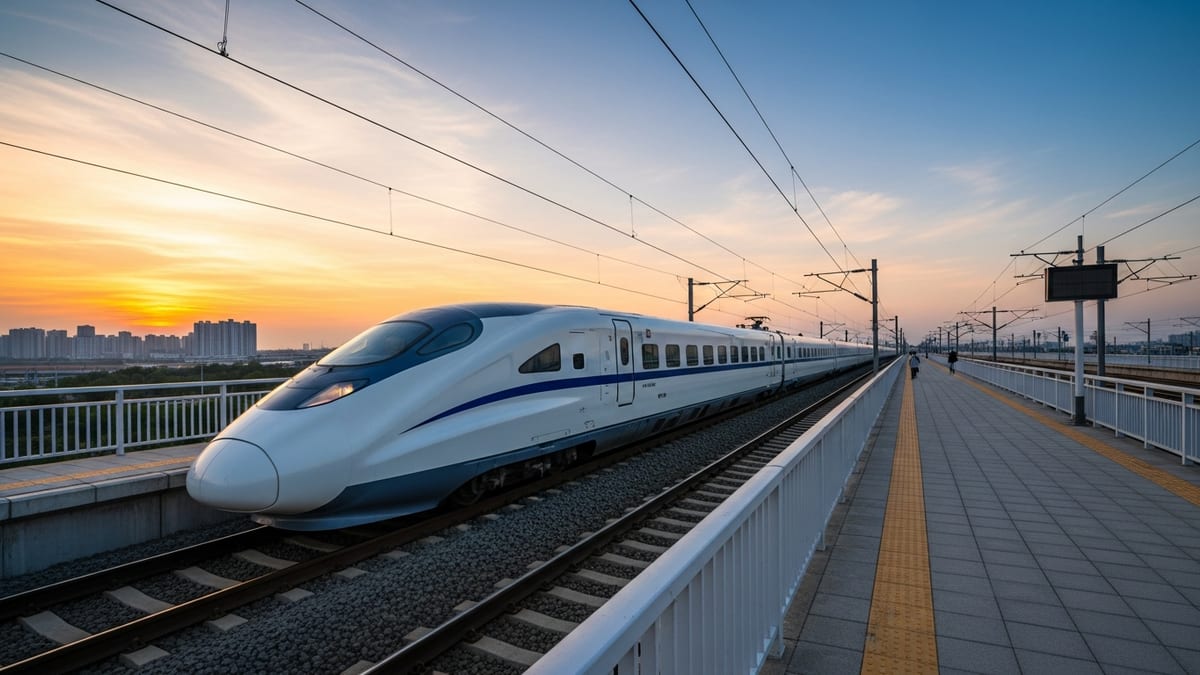
High Speed Spine Nears a New Phase
South Korea’s high speed system has long been anchored by the Gyeongbu and Honam corridors, linking Seoul with Busan and the southwest. Successive upgrades and extensions have steadily reduced journey times, shifting domestic travel patterns toward rail. Travel between the capital and major regional hubs that once took most of a day is increasingly measured in just a few hours.
Publicly available technical summaries of the network describe how successive construction phases on Gyeongbu and Honam high speed lines, plus the Suseo–Pyeongtaek link, were designed to support non stop timings of around two hours between the capital area and key southern cities. While actual schedules vary by stopping pattern, promotional material and engineering studies have consistently treated a sub two and a half hour benchmark from greater Seoul to Busan or Mokpo as the planning target.
These journey time cuts have had a cumulative effect: for many residents, a trip from the Seoul region to the country’s far south, once a rare weekend project, has become manageable as a long day trip. In turn, tourism bodies and local governments now routinely market major coastal and cultural destinations as being “within two hours” of Seoul on selected high speed departures, even when typical services take slightly longer.
GTX Express Network Shrinks the Capital Region
If the high speed lines have shortened intercity travel, the emerging GTX express metro network is transforming perceptions of distance within the wider capital region. Government information on the A line reports that the opening of the Unjeongjungang to Seoul Station section cut the typical Paju to central Seoul trip from around 90 minutes by road to about 22 minutes on the fastest trains.
Additional segments are scheduled to connect Suseo in southeast Seoul to Seoul Station in the second half of 2026, with through services planned from the satellite city of Paju in the northwest to Dongtan in the south in roughly 50 minutes. Official route descriptions for GTX B and C lines, targeted to open around the end of the decade, outline similar sub one hour timings from outlying cities into central Seoul, recasting commuting sheds and housing markets across Gyeonggi Province.
For travelers, the practical meaning of “within two hours” is expanding. Cities such as Paju, Dongtan, and other GTX served suburbs will sit less than an hour from central Seoul, yet also form fast interchange points with intercity KTX and SRT services. This layered network is expected to allow some passengers to reach distant regional cities via one transfer while still staying close to the two hour mark door to station to station.
Cross Operation of KTX and SRT Boosts Connectivity
Another significant step in tightening the travel web came in February 2026, when cross operation between KTX and SRT began on a pilot basis. According to official announcements, KTX trains started running from Suseo Station in southeast Seoul toward Busan, while SRT services began entering Seoul Station, the country’s main conventional and high speed hub.
Previously, the two operators used separate terminals, effectively splitting the capital area market and requiring some passengers to choose between convenience and journey time. The pilot integration allows riders in southern and eastern districts of Seoul to board KTX services closer to home, while those living near the traditional city center gain direct access to SRT trains without traveling out to Suseo.
Transport analyses suggest that, when paired with GTX connections and existing subway links, this cross operation will give more neighborhoods a one seat or single transfer ride to high speed departures. The change nudges more regional destinations into the practical two hour envelope from various points in metropolitan Seoul, especially once future timetable adjustments shorten interchange times.
New Rolling Stock and Capacity for Longer Trips
The hardware of the network is also evolving to support more frequent and reliable long distance services. Recent briefings from the national rail operator indicate plans to procure new generations of high speed trains through the early 2030s, gradually replacing first generation KTX sets and expanding total fleet capacity.
The renewal program is framed as essential to maintaining high speeds while accommodating rising demand generated by express commuter lines and integrated ticketing. As more passengers feed into trunk high speed routes from GTX and upgraded regional lines, operators are under pressure to offer additional peak period departures that can still achieve fast end to end timings.
Travel industry observers note that added capacity in the 2028 to 2032 window, when several GTX lines and high speed extensions are due to be fully operational, is likely to lock in the concept of “two hour Korea” for a wider share of the population. With more seats and more direct trains, the fastest journey times become accessible not just to early bookers but to casual travelers and last minute business trips.
A Shifting Mental Map for Residents and Visitors
The cumulative effect of these projects is a subtle but far reaching shift in how distance is perceived in South Korea. Where guidebooks once separated “day trip from Seoul” and “overnight excursion” destinations on the basis of long bus or slow train journeys, newer itineraries increasingly bracket much of the peninsula within a two hour travel band when using selected express and high speed services.
Tourism marketing, real estate promotion, and regional development plans all reflect this compression. Provincial cities emphasize their high speed links and impending GTX connections in English language materials, often illustrating sample door to station travel times to underscore proximity to the capital. For international visitors landing at Incheon or Gimpo, the practical takeaway is that coastal resorts, historic capitals, and even far flung industrial ports can often be reached in what feels like a short intercity hop.
For residents of Seoul, the same network evolution is reconfiguring commuting and lifestyle choices, making it feasible for some to live in coastal or inland cities while staying tethered to jobs or universities near the capital. As more lines open and integration deepens, the idea of Seoul as a distant center gives way to a view of the capital and its surrounding regions as a tightly woven, two hour wide urban and regional system.