


Prague’s Václav Havel Airport sits about 15 kilometres west of the historic centre, and you have several reliable ways to get into town. In 2026 the key decision is usually between excellent, inexpensive public transport or more expensive but direct door to door options. This guide walks you through trolleybus 59 plus Metro A, bus 100 plus Metro B, the Airport Express bus, taxis and Uber, and private transfers, with current prices, travel times and real world tips for different types of travellers and luggage.
Get the latest updates straight to your inbox!
Understanding Prague Airport and Ticket Basics
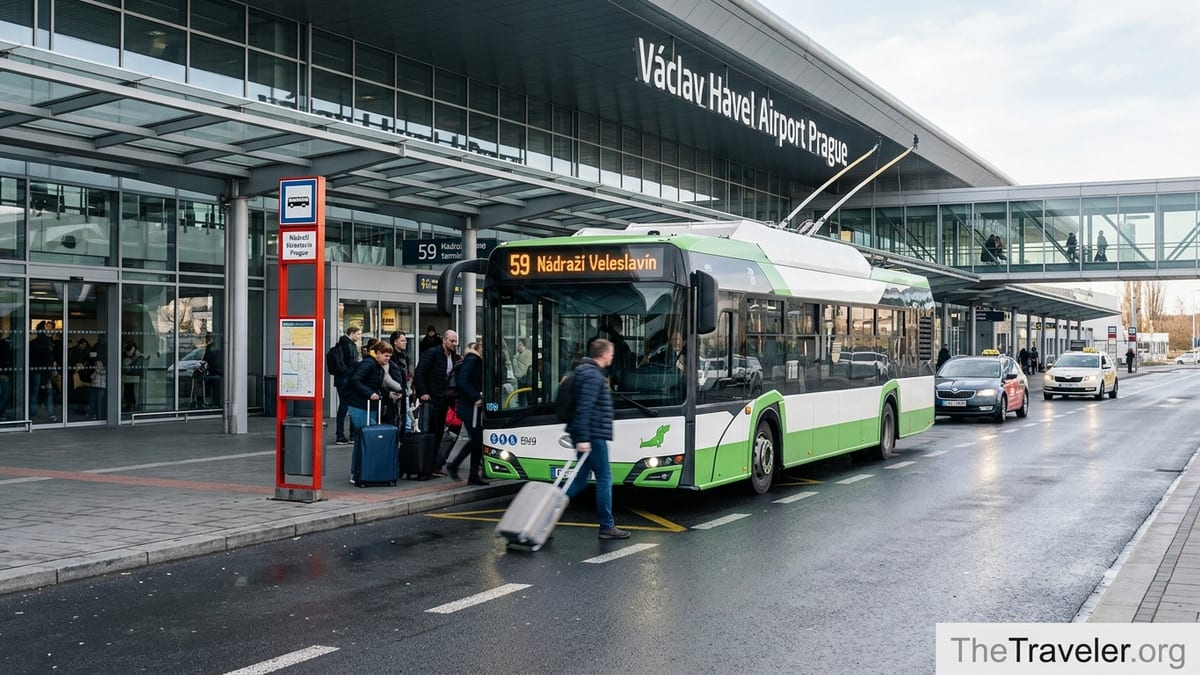
Václav Havel Airport Prague has two main passenger terminals used by most international flights, Terminals 1 and 2, which are within walking distance of each other. None of the public transport lines go underground into the terminals; instead they stop just outside the arrivals halls, with clearly signed bus and trolleybus bays. When you walk out of customs, you will see yellow Public Transport signs pointing you towards the city buses and trolleybuses, and separate signage for taxis and private shuttles.
Prague’s public transport is integrated under the PID system, which covers metro, trams, buses, trolleybuses and most suburban trains. Tickets for lines 59 and 100, as well as the metro, are the same regular PID tickets. As of mid 2026, a standard 90 minute ticket for the city zones that cover the airport and centre costs just under 50 CZK and is enough for a single journey airport to downtown with one or two transfers, provided you complete the whole journey before the ticket expires. Longer validity 24 hour and 72 hour passes are also available and are valid on the airport trolleybus and bus, though not on the special Airport Express line.
You can buy tickets right in the arrivals halls and at the bus stops from yellow ticket machines that accept cards and coins, or via the official PID Lítačka mobile app. If you buy a paper ticket from a machine, remember to stamp it in the small yellow validator when you first board trolleybus 59 or bus 100 or before you enter the metro. If you forget, ticket inspectors can issue on the spot fines that are far more expensive than a day pass.
In broad terms, public transport works best for most travellers arriving between about 4:30 in the morning and shortly after midnight, especially if you are staying near a metro station in neighbourhoods like Old Town, New Town, Vinohrady or Smíchov. Taxis, Uber and prebooked private transfers make more sense late at night, if you have very heavy luggage, are travelling with young children, or are staying in areas far from the metro such as some parts of Prague 4 or Prague 5’s hillsides.
Trolleybus 59 + Metro A: Fastest and Cheapest for the Historic Centre
The current flagship public transport route is trolleybus 59 from the airport to Nádraží Veleslavín, where you transfer to Metro Line A. This replaced the older bus 119 and runs very frequently throughout the day. The trolleybuses are long, articulated electric vehicles with low floors, so getting on with a large suitcase or stroller is manageable. Typical daytime frequency is every 4 to 8 minutes, and the journey from Terminal 1 or 2 to Nádraží Veleslavín takes around 15 to 20 minutes in normal traffic.
At Nádraží Veleslavín you simply follow the green Metro A signs into the underground station. Metro A runs directly to popular central stops such as Malostranská for access to Prague Castle area, Staroměstská for Old Town Square, and Můstek or Muzeum for Wenceslas Square and the main shopping district. From the airport to Staroměstská you can realistically expect a total journey time of about 30 minutes in off peak hours, often quicker than a taxi stuck in rush hour.
Costs remain very low: you can make the whole journey on one standard PID ticket. A 90 minute ticket priced in the mid 40s CZK range is enough for nearly all airport to centre trips via trolleybus 59 and Metro A, and many visitors choose a 24 hour ticket for roughly the cost of a modest café lunch because it covers all onward journeys that first day. For example, a couple arriving at 10:00 can buy two 24 hour passes, ride trolleybus 59 and Metro A to Old Town, then continue using metro and trams for sightseeing until the following morning on the same passes.
The main limitations of the 59 plus Metro A option come with very heavy luggage or mobility issues. At Nádraží Veleslavín there are escalators and lifts, but in peak times the passageways can be crowded. If you are travelling solo with two large checked suitcases and a carry on, navigating the escalators and busy metro carriages might feel tiring after a long flight. In that case, consider a taxi or private transfer. However, for most travellers with one medium suitcase and a backpack, trolleybus 59 plus Metro A is the best blend of speed, reliability and cost.
Bus 100 + Metro B: Best for New Town, Smíchov and Business Areas
Bus 100 offers another excellent public transport link, running from Prague Airport to Zličín, a terminus of Metro Line B. Like trolleybus 59, bus 100 uses regular city tickets and is included in the 90 minute and day passes. The bus ride to Zličín takes roughly 15 to 20 minutes, and from there Metro B continues through districts such as Nové Butovice and Anděl before reaching the wider city centre around Národní třída and Florenc.
This route is particularly convenient if your hotel is near the yellow Metro B line. For example, travellers staying around Anděl in Smíchov, which has several large hotels and shopping centres, can ride bus 100 to Zličín, then Metro B directly to Anděl without changing lines again. Typical overall journey time from the airport to Anděl is around 35 to 40 minutes. For business travellers heading to office parks near stations like Nové Butovice or Jinonice, bus 100 plus Metro B can be even more efficient than going via Metro A and then changing.
As with trolleybus 59, you can buy a single 90 minute ticket or use a 24 or 72 hour pass for the whole journey. The price level is the same: under 50 CZK for a single timed ticket, which is dramatically cheaper than almost any other European capital for a similar airport to city connection. Because bus 100 does not run as frequently late at night, it is most attractive for daytime and early evening arrivals.
One thing to keep in mind is that Zličín is at the western edge of the city, so if your final destination is in Old Town or near Prague’s main railway station, going via trolleybus 59 and Metro A to the closer central zone will usually be faster. However, bus 100 plus Metro B can be more comfortable at very busy times because some travellers overlook this option and crowd onto trolleybus 59 instead. If you see a long queue for 59 at the airport but an almost empty stop for 100, and you are heading somewhere served easily by Metro B, choosing bus 100 can make your arrival smoother.
Airport Express Bus: Direct to Main Station at a Premium
The Airport Express, labelled AE, is a special bus line linking the airport with Prague’s main railway station, Praha hlavní nádraží. It is run in cooperation with Czech Railways and carries a special tariff. In practice this means that your regular 90 minute or 24 hour PID ticket is not valid; you need either an AE ticket or a rail ticket that explicitly includes the Airport Express segment. In 2026 the fare for AE for a standard adult ticket is significantly higher than city buses, with many local observers noting that the price has roughly doubled compared with just a few years ago.
Journey time from the airport to the main station is typically around 35 to 45 minutes, depending on traffic. The bus runs at intervals of about 20 to 30 minutes during the day. For travellers catching onwards trains to cities like Brno, Vienna or Berlin, the big advantage is that you arrive directly at the main station’s ground level, just a short escalator ride from the platforms. You avoid navigating the metro with luggage and can often step straight off the bus into the station concourse.
The downside is cost. While exact tariffs can change, the AE fare for a single adult can easily be several times the price of a standard 90 minute PID ticket. For a couple or family this quickly adds up. For example, two adults and a teenager might spend well over 500 CZK on AE tickets one way, compared with under 150 CZK total using trolleybus 59 or bus 100 plus the metro with regular tickets. This price gap is why many Prague locals and long term residents regard AE as a product aimed mainly at visitors who value convenience over budget.
AE also becomes less compelling if your hotel is not within easy walking distance of the main station. Many central hotels are actually closer to metro stations on lines A or B, or in neighbourhoods like Malá Strana that require a tram connection. In those cases, you end up taking a tram or metro from the main station anyway, losing much of the time saving. The Airport Express is best reserved for travellers with heavy luggage heading directly to or from the main station, or anyone for whom a higher fare is acceptable in exchange for a very simple, one seat ride.
Taxi and Uber: Door to Door with Regulated Pricing
Taxis and ride hailing services such as Uber are abundant at Prague Airport and offer the simplest experience for most visitors: you walk out of the terminal and are driven straight to your hotel door. The city has introduced regulated maximum taxi fares and the airport works with licensed providers, but experiences can still vary. The general pattern in 2026 is that an honest taxi or UberX style ride from the airport to a central area around Old Town, New Town or Malá Strana costs somewhere in the low to mid hundreds of Czech crowns, depending on traffic and exact destination.
In real terms, many recent travellers report paying roughly what you would expect for a 25 to 35 minute car journey of about 15 kilometres in a Central European capital. During lighter traffic, rides take under 30 minutes. In peak congestion, particularly on weekday afternoons, the same trip can approach 40 minutes or more. Ride hailing apps display an estimated price before you confirm, which you can compare with the regulated per kilometre rates published by the city and at the taxi stands. If an offer looks surprisingly high compared to others, it is sensible to refresh the app or consider a different option.
For a group of three or four, the cost per person of a taxi or Uber can become competitive with the Airport Express, especially when you factor in the convenience. A family of four with two large suitcases and two smaller bags, staying in a hotel on a cobbled side street near Old Town Square, may reasonably decide that paying a few hundred crowns more than public transport is worth avoiding two transfers and crowded metro corridors. Older travellers or those arriving after a long intercontinental flight often find this especially appealing.
To reduce the risk of overcharging, use official taxi ranks directly outside the terminals or request a ride via a reputable app rather than accepting offers from drivers approaching you inside the arrivals hall. It is also worth having your hotel address written clearly, including the district number, so the driver can input it correctly into the navigation system. If you are concerned about ease of communication, many hotels in Prague will happily call a trusted taxi for you when you check out to return to the airport, ensuring the same smooth door to door experience both ways.
Private Transfers: Prebooked Comfort and Fixed Prices
Private transfers are a popular middle ground between public transport and on demand taxis. Numerous local companies offer prebooked airport pickups with English speaking drivers, fixed prices and often extras like child seats or minibuses for small groups. Typically you book online in advance, provide your flight number and hotel address, and a driver meets you at arrivals with a sign, helps with luggage and escorts you to a waiting car in the nearby parking area.
The cost of a private transfer is generally higher than a standard UberX but lower or comparable to some premium ride hailing services, particularly for groups. For example, a group of five friends arriving from London and staying in an apartment in Vinohrady might book a van transfer that costs roughly the same as two separate taxis yet allows everyone to travel together with luggage in a single vehicle. Because the price is fixed in advance, there is no meter running in traffic and no surprise surcharges during busy periods.
Private transfers make particular sense for travellers with special requirements. Families needing guaranteed child seats, older visitors who appreciate a driver waiting even if their flight is delayed, or business travellers who want to know the exact cost before submitting expenses can all benefit from this model. Some providers also offer return transfers at a slight discount when booked together with the arrival leg, making it easy to budget the total cost of airport transport for your trip.
The main trade off is that you lose the cost advantage of public transport. Even with a competitive transfer company, a solo budget traveller would pay many times more than the under 50 CZK of a 90 minute public transport ticket. For that reason, private transfers are best viewed as a comfort and convenience product. If you are travelling light, on a flexible schedule and staying near a metro stop, trolleybus 59 or bus 100 plus the metro will almost always be more economical.
Choosing the Best Option for Your Route, Budget and Luggage
Deciding between these options comes down to three main factors: where in Prague you are staying, how much luggage you have, and what budget and comfort level you prefer. If your accommodation is near a Metro A station such as Staroměstská, Můstek, Muzeum or Náměstí Míru, then trolleybus 59 plus Metro A is almost always the best combination of price and convenience. A solo traveller with just a carry on can usually get from the airport to Old Town for less than the cost of a coffee in a hotel bar and in around half an hour.
If you are staying near Metro B stations like Anděl, Karlovo náměstí or Florenc, bus 100 plus Metro B might be faster and involve fewer changes than going via Metro A. For instance, a business traveller checked into a hotel near Anděl can ride bus 100, change once at Zličín, and then stay on Metro B until their stop with no need to cross platforms. For people heading to or from the main railway station specifically, the Airport Express or a taxi provide the simplest one seat ride, though the AE cost premium should be weighed carefully against the price of taxis and Uber for your party size.
Luggage matters more than many visitors expect. Prague’s metro and older tram stops often involve escalators or stairs, and even where lifts exist they can be busy. A couple each with one medium suitcase and a backpack will usually manage fine on public transport, especially outside the peak commuter crush. In contrast, a family of four with multiple large cases and a stroller may find the cost and effort of hauling everything on and off vehicles across several changes outweighs the savings. For them, a taxi or prebooked minivan that loads all suitcases directly at the curb and drops them at the hotel door can transform the arrival experience.
Finally, your arrival time plays a role. During the main daytime and evening hours, both trolleybus 59 and bus 100 plus the metro run frequently and feel safe and straightforward. Very late at night or in the very early morning when services are less frequent and connections might require night buses, a door to door taxi, ride hail or private transfer often becomes the most sensible choice, particularly in winter or in poor weather. Many visitors use a taxi on arrival after a long flight and then rely on the excellent public transport network for the rest of their stay once they are rested and more familiar with the city layout.
FAQ
Q1. Can I use a 24 hour or 72 hour public transport pass on trolleybus 59 and bus 100 from Prague Airport?
Yes. Short term PID passes are valid on trolleybus 59 and bus 100, as well as on the metro and trams. They are not valid on the special Airport Express bus, which has its own higher fare.
Q2. How long does it really take to get from Prague Airport to Old Town using public transport?
In typical daytime conditions, expect around 30 minutes total from the airport to a central Metro A station like Staroměstská using trolleybus 59 and the metro. Allow a little extra during rush hour or if you are unfamiliar with the ticket machines and wayfinding.
Q3. Where exactly do I catch trolleybus 59 at the airport?
Trolleybus 59 stops are directly outside Terminals 1 and 2. After exiting customs, follow the yellow public transport signs to the outdoor bays marked with the 59 line number. Ticket machines are nearby and the stop information displays the direction Nádraží Veleslavín.
Q4. Is it worth paying extra for the Airport Express bus to the main station?
It depends on your priorities. The Airport Express is more expensive than regular public transport but gives a simple direct ride to the main railway station, which can be convenient if you are catching a train with heavy luggage. If you are heading to a hotel elsewhere in the city centre, trolleybus 59 plus the metro or a taxi often make more sense.
Q5. Are taxis from Prague Airport safe and how much should I expect to pay?
Licensed taxis from the official stands are generally safe, and the city regulates maximum fares. A typical ride to central districts usually falls in the low to mid hundreds of Czech crowns. Using a reputable app or ordering through your hotel reduces the risk of overcharging.
Q6. Is Uber cheaper than a regular taxi from the airport?
Often Uber or similar ride hailing services are slightly cheaper or comparable to standard taxis for the same route, and you see the estimated price in advance. However, during peak demand or bad weather, dynamic pricing can push app fares higher, so it is sensible to compare options in real time.
Q7. What is the best option if I arrive late at night?
After midnight, public transport connections to and from the airport become less frequent and may involve night buses. For late arrivals or very early departures, many travellers prefer taxis, ride hailing or prebooked private transfers, which provide direct, predictable journeys at all hours.
Q8. I am travelling with young children and a lot of luggage. Should I still use public transport?
Public transport is safe and affordable, but navigating crowded vehicles and station escalators with multiple bags and a stroller can be tiring. In this situation, a taxi or prebooked private transfer that includes child seats and extra luggage capacity is often worth the extra cost.
Q9. How do I validate my public transport ticket from the airport?
If you buy a paper ticket for trolleybus 59 or bus 100, insert it into the yellow validation machine when you first board to stamp the date and time. From that moment, the ticket is valid for its stated duration across buses, trolleybuses, trams and the metro. App based tickets are activated on your phone instead.
Q10. Which option should I choose if I am staying near Wenceslas Square?
For Wenceslas Square, trolleybus 59 to Nádraží Veleslavín followed by Metro A to Můstek or Muzeum is usually the fastest and cheapest. If you are arriving very late, very tired, or with heavy luggage, a taxi or private transfer direct to your hotel on or near the square offers greater comfort at a higher price.