


For most visitors landing at Melbourne Airport, the bright red SkyBus is the simplest way to reach the city. It runs around the clock between the terminals at Tullamarine and Southern Cross Station on the edge of the central business district, with frequent departures, simple ticketing and no need to navigate local myki cards on arrival. This guide walks you through how it works in 2026, from buying tickets and handling luggage to late-night arrivals and when SkyBus is a smarter choice than an Uber or taxi.
Get the latest updates straight to your inbox!
What Is SkyBus and Where It Runs
SkyBus is a dedicated airport bus service that connects Melbourne Airport at Tullamarine with key hubs around the city. The flagship route is the Melbourne City Express, which runs non-stop between the airport and Southern Cross Station on the western edge of Melbourne’s central business district. Buses use the Tullamarine Freeway and CityLink and do not make intermediate stops, so travel times are typically around 25 to 35 minutes depending on traffic.
From Tullamarine, SkyBus also operates services to several suburbs and regional hubs. Current routes include links to St Kilda and bayside suburbs, the Mornington Peninsula and Frankston corridor, Melbourne’s eastern suburbs such as Doncaster and Box Hill via the Eastern Express service, and Sunshine Station in the west. These services are particularly useful if you are staying outside the central city and want to avoid changing between multiple public transport modes with luggage.
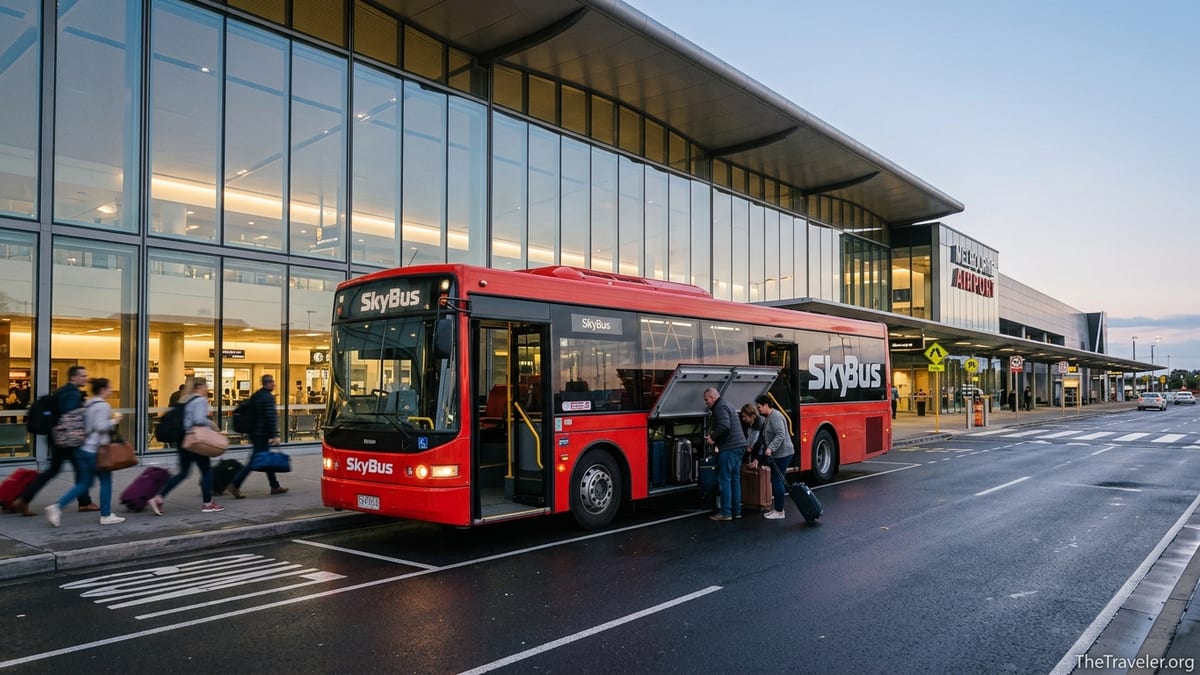
All services are designed as turn up and go airport transfers rather than standard public buses. You do not need to tap on with a myki card, and you can bring large suitcases without worrying about blocking aisles or doors. Buses are easily recognisable: they are bright red, branded with SkyBus, and depart from clearly signed bays outside Terminals 1, 3 and 4 at Melbourne Airport, and from the coach bays at Southern Cross Station.
For most short-stay visitors and business travellers, the Melbourne City Express between the airport and Southern Cross Station will be the main service of interest. The other routes become relevant if your hotel is in St Kilda, around Frankston, or if you are connecting to trains in the eastern or western suburbs.
Timetables, Frequency and 24/7 Operations
One of the main advantages of SkyBus compared with regular buses is its frequency. On the Melbourne City Express, services run roughly every 10 minutes during the daytime and evening peak. That means that if you walk out of customs at 9:30 in the morning, it is realistic to have bought a ticket and be on a bus by 9:45 without checking a timetable in advance. During quieter periods, including very early mornings, the gap between buses can be longer, but they remain relatively frequent by airport standards.
SkyBus promotes the Melbourne City Express as operating 24 hours a day, 7 days a week, 365 days a year. In practice, that means that through the middle of the night, departures are less frequent but still coordinated with flight arrivals. Travellers arriving on late international flights around midnight or 1:00 can usually expect a service without having to wait more than an hour or so. Some overnight passengers have reported a last bus around 1:00 and the next one around 4:00 in the very quiet pre-dawn period, so if you are landing during those hours it is worth checking the latest timetable before you fly and not assuming a strict every-10-minutes pattern all night.
The suburban SkyBus routes such as the services to St Kilda, Frankston and the eastern suburbs generally operate from early morning until the evening, but not 24 hours. For example, a typical pattern might see first departures around 5:00 or 6:00 in the morning and last buses around 8:00 to 10:00 at night, depending on the route and day of the week. If you arrive on a late flight and your destination is one of these areas, you may need to take the City Express to Southern Cross Station and then connect to a train, tram, or rideshare rather than relying on a direct SkyBus all the way.
Southern Cross Station itself has long trading hours but is not fully open around the clock. Most shops and food outlets close late in the evening, particularly on weeknights, although convenience kiosks and some fast-food options stay open later. If your SkyBus drops you there around midnight, expect limited food and retail but basic facilities like toilets, indoor seating and signage to remain available.
Tickets, Current Prices and How to Buy
SkyBus uses its own ticketing rather than Melbourne’s myki system, which simplifies things considerably for new arrivals. As of mid 2026, an adult one-way fare on the Melbourne City Express is typically in the mid-twenties in Australian dollars. A return ticket that covers one person for two trips between the airport and Southern Cross Station is usually priced a little under double the one-way fare, effectively giving a small discount per trip. Visitor information outlets often quote promotional return pricing in the low forty dollar range for adults, and tourism sites highlight return fares that work out to roughly the low twenty dollar range each way when you do the math.
You can buy tickets in several ways. Online purchase through the SkyBus website or app lets you pay by credit or debit card before you travel and either show a QR code on your phone or a printed voucher at boarding. At Melbourne Airport, there are bright red SkyBus ticket booths and machines in the arrivals area of Terminals 1, 3 and 4. These accept major cards and, at staffed counters, usually cash as well. At Southern Cross Station, SkyBus has a prominent ticket counter in the coach terminal area at street level, along with machines where you can quickly buy or collect pre-purchased tickets before heading to the boarding area.
Tickets for the suburban routes such as the St Kilda, Peninsula, Eastern and Western services are similarly priced on a per-person basis, usually a bit higher than the City Express if you are travelling longer distances, like from the Mornington Peninsula. Many routes offer child fares, and there are often discounted family options where two adults and several children travel together for a capped price, making SkyBus competitive against ordering two Ubers for a family. Some airport workers and regular commuters can purchase discounted multi-trip passes, which bring the per-trip cost down but require proof of eligibility.
In practice, most short-stay visitors either purchase a return ticket if they already know their departure date, or they buy a single on arrival and decide later how they want to return to the airport. Tickets are generally valid for a window of time rather than tied to a particular departure. That means if your flight is delayed, you do not lose your booking; you simply board the next available bus with your existing ticket.
Using Southern Cross Station and City Connections
Southern Cross Station is the city terminus for the Melbourne City Express and the main interchange point between SkyBus and Melbourne’s trains, trams and regional coaches. The SkyBus arrivals area is in the coach and bus terminal at the western end of the station. After the bus pulls in, luggage is unloaded from the side compartments and you enter the station through clearly signed doors. Inside, escalators and lifts connect you to the concourse level where you will find ticket machines for myki, station information and access to platforms.
If your hotel is in the central city, Southern Cross often places you within walking distance. For example, properties in Docklands, around the western CBD grid and Southbank near the riverside promenades can be 5 to 15 minutes on foot with a wheeled suitcase. Hotels such as the Crowne Plaza in Docklands, the major chains along Spencer Street and Clarendon Street, and several budget hotels on King Street are all within an easy walk, even at night, assuming you are comfortable with your luggage and the weather.
To reach hotels further into the CBD, many travellers connect to the free tram zone. Trams along routes such as the 86 and 96 towards Bourke Street Mall, the 11 and 48 towards Collins Street, or the 12 down to Albert Park all pass through or near Southern Cross. You buy or top up a myki card at station machines or nearby convenience stores, then tap on as you board. Once you are within the central grid, short tram rides are handy for reaching hotels near Parliament, Melbourne Central, Chinatown or the top of Collins Street, where walking from Southern Cross with heavy luggage might be less appealing.
Regional and suburban train connections are straightforward too. If, for example, you are landing at Melbourne Airport and heading to Geelong, Ballarat or Bendigo, you can take SkyBus to Southern Cross and step straight onto a V/Line train from the same station. For suburban rail, platforms serve lines heading to the western and northern suburbs. Someone staying in the inner north, such as Brunswick or Coburg, might take SkyBus to Southern Cross, hop on an Upfield or Craigieburn line train, and be at their local station in under half an hour.
Luggage, Comfort and Onboard Experience
SkyBus is built for air travellers, so luggage handling is straightforward. Large suitcases and bulky items go into the underfloor compartments on the side of the bus. The driver or onboard staff open these before departure and passengers load their own bags. Cabin-sized wheelie bags and backpacks are usually fine to bring aboard and place on overhead racks or under your seat. If you are carrying items like surfboards or bicycles, it is best to check the latest SkyBus guidelines, but most standard travel gear is accepted without issues.
On board, the buses are modern and comparable to long-distance coaches. Seating is padded and arranged in two-by-two rows, with enough legroom for most travellers to sit comfortably for the 30-minute ride. There is typically air conditioning, which is valuable during Melbourne’s summer heatwaves when outside temperatures can reach well into the thirties Celsius. Many buses are equipped with free Wi‑Fi, so you can message family to say you have landed or quickly check maps to your hotel. The cellular signal along the freeway route is generally strong, so even without Wi‑Fi you can usually access online services.
Real-time information has improved in recent years. At Melbourne Airport, SkyBus bays outside Terminals 1, 3 and 4 feature digital screens showing upcoming departures and estimated times. Similar displays at Southern Cross Station indicate when the next airport-bound service will leave, offering reassurance if you are catching an evening flight and want to know exactly how long you can linger in the city before boarding.
From a comfort perspective, SkyBus compares favorably with the typical rideshare or taxi for solo travellers and couples. You do not have to worry about your driver’s knowledge of the route or whether there will be space for your luggage in the boot. Boarding can sometimes involve a short queue at busy times, but buses are scheduled frequently enough that long waits are rare. If a service fills up, staff usually direct late arrivals to the next bus rather than squeezing extra passengers in.
Hotel Connections and Alternatives to the Old Transfer Service
In earlier years, SkyBus marketed a dedicated hotel transfer service that used smaller minibuses to shuttle passengers from Southern Cross Station to a long list of central hotels. That model has largely been phased out and reshaped as other transport options have grown. Some conference brochures and older travel guides still mention these hotel shuttles, which can confuse first-time visitors reading outdated material. In practice in 2026, you should not rely on a free or bundled SkyBus shuttle taking you directly to your hotel door unless you have confirmed a current offering with SkyBus before travel.
Instead, most travellers now pair SkyBus with a short walk, tram ride or rideshare from Southern Cross Station. For example, someone staying at a boutique hotel near Flinders Lane might ride the City Express to Southern Cross, walk ten minutes down Spencer Street and cross into the laneways, or hop on a tram down Collins or Bourke Street for a couple of stops. The total door-to-door journey still often comes in cheaper than a direct Uber, especially if you are arriving during peak traffic or surge pricing periods.
For hotels well beyond the CBD, SkyBus’s suburban routes can be helpful. A family staying in St Kilda, for instance, could take the St Kilda express service that stops near the beach and amusement park, then walk or taxi a short distance to a guesthouse on Acland Street. Guests heading to the Mornington Peninsula might choose the Peninsula Express to Frankston, then connect to local buses or be picked up by friends or a pre-booked car. Eastern suburbs hotels in Doncaster or Box Hill can be reached by the Eastern Express plus a local connection.
If you prefer a more door-to-door experience, Melbourne has a competitive market of private shuttle companies and chauffeured car services that work alongside SkyBus. A typical pattern might be using SkyBus inbound from the airport when you are still fresh and can manage a short walk, then booking a rideshare or private car for your early morning departure a few days later when convenience outweighs cost.
Late-Night Arrivals, Safety and Practical Tips
Many international flights into Melbourne land late in the evening or close to midnight, making late-night logistics especially important. SkyBus is generally regarded as one of the safer and more predictable ways to reach the city after dark because it runs a direct freeway route, is well lit at both ends, and is typically used by a mix of tourists and business travellers. The boarding areas at the airport are in front of the main terminals, under CCTV, and with airport staff nearby, which tends to feel more secure than walking to remote bus stops.
On arrival, factor in the time it takes to clear immigration and collect luggage. If you land on a long-haul flight from Asia or Europe at around 11:00 at night, you may not be landside until close to midnight. Check the current SkyBus overnight timetable before you fly so you know whether services are running every 20 to 30 minutes or if there is a longer gap in the very small hours. Several travellers have shared experiences where the last bus left around 1:00 and the next did not depart until the early morning. In those cases, some chose to rest inside the terminal rather than pay high overnight Uber or taxi surcharges.
Southern Cross Station late at night is quieter than during the day but remains a major hub, with station staff, security and occasional police patrols. If you are walking to a nearby hotel after midnight, stick to the main streets such as Spencer Street or Collins Street rather than dark back alleys. Most big name hotels in the area are accustomed to guests arriving at odd hours and maintain staffed receptions around the clock. If you are heading further into the suburbs, consider pre‑planning your connection, such as knowing the time of the last train or tram, or arranging a rideshare pickup near the station entrance.
For those with very long overnight layovers, staying in the city between flights can be tempting, but factor in the SkyBus schedule. Travellers who took an evening bus into the city and then discovered the first morning bus back to the airport was not until around 4:00 reported short and restless nights. If your onward flight leaves in the early morning, an airport hotel or simply resting landside at the terminal can be more realistic than trying to sleep at a city hotel and commuting back in the small hours.
SkyBus vs Uber and Taxis: Cost and When It Wins
In 2026, the typical SkyBus adult fare from Melbourne Airport to Southern Cross Station is in the mid-twenties in Australian dollars one way. An UberX for the same journey often starts around the high forties to low fifties in light traffic, and can climb into the sixties or higher during peak times or in wet weather when surge pricing applies. A standard taxi can be similar or slightly more, particularly once airport tolls and rank fees are added. For a solo traveller or a couple, SkyBus almost always works out significantly cheaper, sometimes half the price, for a journey of similar duration.
The balance shifts when more people share the ride. A family of four paying separate SkyBus fares might come close to or exceed the price of a single UberXL or larger taxi, especially if their hotel is within a short drive of the airport or in a suburb that lies en route. For instance, a group of four staying in Carlton or Fitzroy might find that splitting a rideshare fare door-to-door is only marginally more expensive than four SkyBus tickets plus tram or train connections, while being more convenient with tired children and luggage.
Travel time can also favour SkyBus during busy periods. The buses make use of dedicated coach facilities at both ends and stick to a simple freeway route. An Uber or taxi caught in heavy CBD traffic or routing through backstreets can easily take longer and feel less predictable. On the other hand, if your hotel is well outside the city grid, such as in the outer eastern suburbs or beyond, a direct rideshare from the airport can be faster and more straightforward than riding into Southern Cross and then back out again on suburban transport.
Comfort and stress levels are another consideration. SkyBus removes the need to watch a meter, worry about whether the driver will accept card payments, or debate the best route. For first-time visitors, knowing they can follow signs to a clearly branded service and be deposited at a major station is reassuring. Frequent visitors or locals who know the city’s layout often mix and match, taking SkyBus when travelling alone or with light luggage, and choosing Uber or taxis when in groups, with children or when late-night connections would be awkward from Southern Cross.
The Takeaway
For most arrivals at Melbourne Airport, SkyBus remains a reliable, good-value way to reach the city. The 24/7 Melbourne City Express between the terminals and Southern Cross Station offers frequent daytime services, reasonable overnight coverage and clear ticketing, with fares that tend to undercut rideshares and taxis for solo travellers and couples. Once in the city, access to trains, trams and key hotel districts is straightforward, and suburban SkyBus routes offer options for those staying in St Kilda, along the bayside or in the eastern and western suburbs.
If you are arriving late at night or travelling with a group, it is worth spending a few minutes checking the current timetable and comparing SkyBus fares with rideshare estimates to your specific hotel. Use SkyBus when you value predictability, clear pricing and an easy connection to Southern Cross, and consider Uber or taxis when door-to-door convenience with multiple passengers makes financial or practical sense. With a little planning, SkyBus can slot neatly into your Melbourne arrival or departure, giving you a smooth start or finish to your time in the city.
FAQ
Q1. Does SkyBus really run 24/7 between Melbourne Airport and Southern Cross Station?
Yes, the Melbourne City Express is scheduled to run every day of the year, with very frequent services during the day and reduced frequency overnight. In the quietest early-morning hours there can be longer gaps, so check the timetable if your flight arrives around 2:00 or 3:00 in the morning.
Q2. How much does a SkyBus ticket cost compared with an Uber or taxi?
An adult one-way SkyBus ticket on the Melbourne City Express is typically in the mid-twenties in Australian dollars. A comparable Uber or taxi ride often ranges from the high forties upwards in normal conditions, so SkyBus is usually noticeably cheaper for one or two people.
Q3. Where do I catch SkyBus at Melbourne Airport?
SkyBus stops are directly outside Terminals 1, 3 and 4 at Melbourne Airport. Follow the red SkyBus signs from the arrivals hall to the forecourt, where you will see dedicated bays, ticket machines and digital departure screens.
Q4. Do I need a myki card to ride SkyBus?
No, SkyBus uses its own ticketing system and does not accept myki. You buy a SkyBus ticket online, from a ticket counter or from a machine, and show it to staff when boarding. You only need myki once you transfer to regular trains, trams or buses in Melbourne.
Q5. Can I use SkyBus if I arrive late at night?
Yes, SkyBus is designed to meet late-night and early-morning flights, and many travellers use it after midnight. However, overnight services are less frequent than daytime ones, so it is sensible to confirm departure times that match your specific flight.
Q6. What happens if my flight is delayed and I miss the bus I planned to take?
SkyBus tickets are generally valid for a period rather than tied to a single departure, so if your flight is delayed you simply board the next available service. You do not need to change your ticket as long as it is still within its validity window.
Q7. Is there still a SkyBus hotel transfer shuttle in Melbourne?
Older brochures mention a separate SkyBus hotel shuttle, but this has largely been wound back. Today most passengers combine the main SkyBus service with a short walk, tram ride or rideshare from Southern Cross Station or from the end of a suburban SkyBus route.
Q8. How much luggage can I bring on SkyBus?
SkyBus is set up for air travellers, so standard airline luggage is accepted. Large suitcases go in the luggage bays under the bus, while smaller bags and backpacks can be taken on board. If you have unusually large or bulky items, check SkyBus guidelines before you travel.
Q9. Is SkyBus safe for solo travellers at night?
SkyBus is widely considered a safe option, including for solo travellers arriving late. Stops are located at the main terminals and at Southern Cross Station, both of which are staffed and monitored. As always, use normal precautions, keep your belongings close and stick to well-lit areas when walking to your accommodation.
Q10. When is it better to book an Uber or taxi instead of SkyBus?
Uber or taxis can be better value and more convenient for groups of three or more, especially when staying outside the central city. If you are travelling with small children, have very heavy luggage, or are heading to a distant suburb, a direct door-to-door ride may be faster and no more expensive than multiple SkyBus tickets plus local transport.