


Mexico City now has two commercial airports serving domestic and international travelers: the long-established Mexico City International Airport, officially Aeropuerto Internacional de la Ciudad de México Benito Juárez (AICM, code MEX), and the newer Felipe Ángeles International Airport (AIFA, code NLU), built to relieve congestion. They both "serve Mexico City," but they are very different experiences. Choosing the wrong one can easily add an extra hour or more to your arrival, change your transfer costs, and even affect your airline and schedule options. This guide compares AICM vs AIFA in clear, practical terms so you can decide which airport makes the most sense for your trip.
Get the latest updates straight to your inbox!
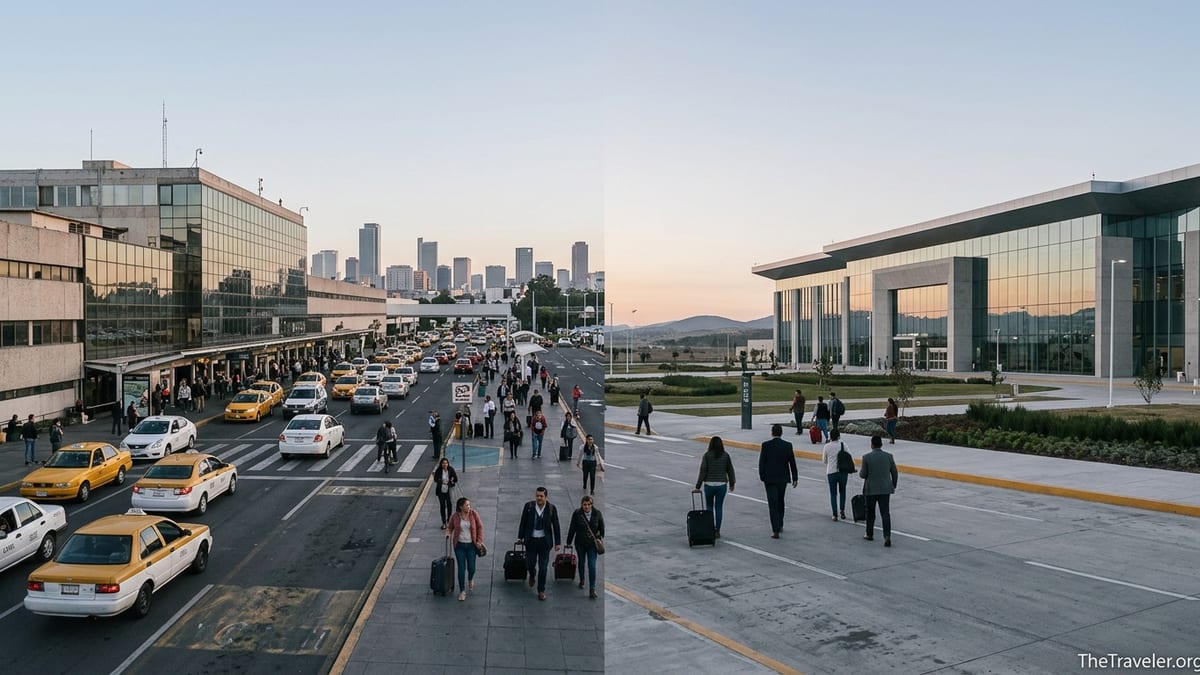
Location: Which airport is actually closer to Mexico City?
AICM sits on the eastern edge of Mexico City’s urban core, only around 8 to 10 kilometers from the Historic Center and the Zócalo. In off-peak traffic, a licensed taxi or app-based ride from a hotel near the Zócalo, Roma, Condesa or Reforma often takes about 20 to 35 minutes. In heavy rush hour, that can stretch closer to an hour, but you are still within the city, and many neighborhoods feel a short ride away.
Felipe Ángeles International Airport is a very different story. AIFA lies to the north of the city in the State of Mexico, roughly 45 to 50 kilometers from central districts such as the Zócalo, Reforma or Condesa. Even with the new rail link, it is a genuinely out-of-town airport. Early-morning or late-night drives can be done in about an hour, but daytime trips by road can easily reach 90 minutes or more, depending on traffic and where you are staying.
For most visitors whose main destination is central Mexico City, AICM is significantly closer in both distance and real travel time. If your hotel is in Centro Histórico, Roma, Condesa, Juárez, Polanco or Coyoacán, arriving at MEX almost always means a quicker, simpler transfer and more options for buses and public transit. AIFA begins to look more reasonable only if you are staying in northern suburbs or have specific reasons to fly in via that airport.
Transfers and typical costs: From runway to hotel
From AICM, travelers have a broad mix of transfer options at different price points. Official airport taxis and app-based rides are the most popular for first-time visitors. A typical licensed airport taxi purchased at an official counter inside the terminal to a hotel in Centro Histórico often runs in the region of 250 to 350 Mexican pesos, with Roma, Condesa or Reforma usually somewhere in the 300 to 450 pesos range, depending on time and traffic conditions. App rides can be a bit lower or higher depending on demand.
Budget-conscious travelers can use the Metrobus line that runs from AICM toward the city center, connecting with the metro and other surface transport. It is possible, for example, to land at Terminal 1, take Metrobus toward the city, and connect to the Zócalo area for only a fraction of the taxi cost, usually in the tens of pesos rather than hundreds. The trade-off is comfort and ease: airport crowds, luggage, and transfers can be tiring after a long flight, and you stand during parts of the journey.
At AIFA, the picture is evolving quickly but is still dominated by longer journeys. The most game-changing development is the dedicated train connection between AIFA and Buenavista station in central Mexico City. The journey is designed to be around 40 to 45 minutes from downtown to the airport once fully optimized, making it the backbone of public transport access. From Buenavista, travelers can connect to Metro and other lines to reach Centro, Roma, Condesa or Polanco. Ticket prices for this type of mass transit are generally affordable by international standards, usually well under what you would pay for an airport taxi.
However, many travelers still rely on buses, vans and private transfers to and from AIFA. Shared vans from the airport to central Mexico City points have been reported around the equivalent of 200 to 300 pesos per person, often with extra charges for large luggage. A private transfer or app-based ride for a family or group from AIFA to neighborhoods like Reforma or Condesa can easily reach or exceed 700 to 900 pesos, especially in heavier traffic or late at night. When you compare that to typical AICM taxi fares, the “cheaper” airport sometimes ends up costing more to reach your hotel.
Airlines and routes: Who flies where?
AICM remains Mexico City’s main international gateway and busiest airport, with two terminals handling the majority of flag carriers and big international brands. At MEX you will typically find the main operations of Aeroméxico, many SkyTeam partners, North American carriers such as American Airlines, Delta and United, plus a wide range of European and Latin American airlines. For long-haul flights from North America, Europe or South America, MEX is usually the default option in booking engines.
AIFA was designed to relieve pressure on AICM and is actively growing, but it currently hosts a more limited mix of airlines. It has become a focus for some domestic and low-cost carriers and for the revived state-owned Mexicana de Aviación. Travelers may see flights operated by Mexican airlines such as Viva Aerobus and Aeroméxico Connect on select domestic and regional routes. The route map tends to favor domestic destinations and a handful of international links rather than the full slate of global long-haul options.
In practice this means that if you are flying from cities like New York, Los Angeles, Madrid, Paris or São Paulo on a major airline, you are highly likely to arrive at AICM. If you are flying a domestic route, especially on a low-cost Mexican carrier, you might be offered both MEX and NLU as options, or in some cases only NLU. Travelers booking complex itineraries with connections, status benefits and lounge access usually find AICM better aligned with their needs.
Because airlines can and do shift routes between the two airports, it is important to check your reservation carefully when buying tickets. The same airline might operate a flight from Monterrey to MEX in the morning and to NLU in the evening. Assuming “Mexico City” automatically means AICM is one of the easiest ways to create an unwanted airport surprise.
Public transport: Metro vs suburban train
One of the biggest practical differences between AICM and AIFA is how they connect to the city’s transit network. AICM is directly on Metro Line 5 and is served by Metrobus routes, which means that experienced city travelers can step out of the terminal and be on a public transport vehicle within minutes. For example, a traveler landing at Terminal 1 can cross into the Metro station and ride toward Pantitlán or other transfer hubs for only a few pesos. From there, the Zócalo, Bellas Artes, and other central sights are only a couple of metro changes away.
Felipe Ángeles International Airport relies instead on overground connections. The dedicated train link between AIFA and Buenavista uses suburban train infrastructure to move passengers at relatively high speed between the airport and the city. Travel time is typically under an hour and is designed to drop over time as operations mature. From Buenavista, travelers can connect directly into the Metro and city buses, making it more integrated than early bus-only solutions.
Beyond the train, AIFA also connects to regional bus services and lines such as Mexibús, which thread through the northern suburbs before reaching metro and bus nodes closer to the city core. This can be useful for commuters and locals, but for short-stay visitors focused on central neighborhoods, each additional transfer adds friction and uncertainty. By contrast, AICM’s integration into the city’s existing metro and bus grid gives budget travelers a simple, predictable way to get in and out, even if it can be crowded and less comfortable with luggage.
If you are comfortable using urban public transport, arriving at AICM generally offers cheaper and more straightforward options. If you prefer to rely on a single rail ride and then a taxi or metro hop, AIFA’s new train may appeal, but you should still budget more overall time from gate to hotel.
Ground experience: Terminals, queues and comfort
AICM is a classic big-city airport: busy, sometimes crowded, but efficient enough when you know your terminal and allow enough time. It has two separate terminals, Terminal 1 and Terminal 2, connected by an air train and road shuttles. This matters in real life. An Aeroméxico passenger on an international arrival into Terminal 2 connecting to a low-cost domestic flight at Terminal 1 must factor in transfer time within the airport. Lines for security, immigration and check-in can be significant at peak times, especially holidays and Monday mornings, but years of experience mean that services such as currency exchange, ATMs, restaurants and airport hotels are well developed.
AIFA, by contrast, feels newer and less crowded. Many travelers describe short security queues and wide open spaces. For an early morning domestic departure, it is common to move from curb to gate relatively quickly, with little of the queuing found at AICM. Facilities are modern and the architecture is striking, although the range of restaurants, lounges and shopping is still developing compared with the older airport.
The trade-off is what happens outside the terminal doors. At AICM, the moment you exit you are in an urban environment with taxis, app pick-up zones, buses, and Metrobus platforms fairly close by. At AIFA, the immediate area is much more like a standalone, out-of-town hub. If you arrive late in the evening and miss a specific bus or train connection, your options may shrink to a more expensive taxi or private transfer. For solo travelers on tight budgets, that can be a significant and stressful difference.
In terms of comfort, families and travelers with mobility issues may appreciate AIFA’s lighter crowds, but they should balance that with the longer and sometimes more complex journey into the city. AICM can feel crowded but its proximity and dense services make life easier if you need a quick hotel, medical attention, or simply a wide choice of food at odd hours.
Common booking mistakes and how to avoid them
One of the most frequent mistakes visitors make is assuming that “Mexico City” in a booking engine always means AICM. Because AIFA is newer and sometimes offered on cheaper fares, it can appear as “Mexico City Felipe Ángeles” or simply “Mexico City NLU.” Tired or distracted travelers sometimes notice only the words “Mexico City” and click through, only to realize weeks later that their cheap flight actually lands far from where they thought it would.
Another common error occurs with separate tickets and self-made connections. A traveler might buy an international ticket to MEX and a separate domestic ticket from NLU, thinking both airports are interchangeable. In reality, this means landing at AICM, clearing immigration and baggage, then traveling across the entire metropolitan area to AIFA to board the next flight. Even in perfect traffic, this inter-airport journey can take well over an hour and involves at least one or two transfers if using ground transport services. For anything less than a long daytime gap, the risk of missed flights is substantial.
A more subtle mistake involves hotel and transfer planning. For example, a visitor might book a hotel in Condesa with an expectation of a short, 300-peso ride from the airport, based on a friend’s experience at AICM, but their own flight arrives at AIFA. The resulting taxi or private transfer cost can be two or three times higher, and late-night arrival may reduce options further. Clarifying your arrival code (MEX vs NLU) before booking transfers avoids awkward conversations at the taxi counter.
To avoid these problems, get in the habit of double-checking airport codes whenever you book flights to or from Mexico City. Confirm MEX vs NLU on your confirmation email, in the airline’s app, and on any connecting tickets. If you plan to buy separate tickets, try to keep all segments on the same airport, and avoid tight connections between airlines at different fields. When in doubt, favor itineraries that keep you at AICM unless you have a specific reason to choose AIFA.
Who should choose which airport?
If your main destination is central Mexico City and you value convenience, AICM is usually the best choice. Business travelers staying on Paseo de la Reforma, tourists booked into boutique hotels in Roma or Condesa, and first-time visitors planning to explore Centro Histórico all benefit from AICM’s shorter transfers and richer transit options. In many cases, the extra 10 or 20 dollars saved by flying into AIFA is quickly eaten up by higher ground transport costs and additional travel time.
AIFA can make sense for specific traveler profiles. Residents of northern metropolitan suburbs may find it physically closer and less stressful than crossing the city to AICM. Travelers flying with airlines that use AIFA as a hub, such as the re-launched Mexicana de Aviación or certain low-cost carriers, might enjoy shorter queues and simpler connections within the same modern terminal. Some domestic routes may only operate from NLU, making it the default option for those destinations.
There are also strategic reasons a traveler might choose AIFA for a domestic leg. For example, a frequent visitor who has already spent several days in central Mexico City may decide to move to a hotel in the northern suburbs the night before a morning flight from AIFA. In that case, the overall experience can be smooth, avoiding rush-hour congestion closer to the city center. However, such plans require more local familiarity and careful timing than the average short city break.
For most short-stay visitors, the simpler rule of thumb works well: if you are unsure, choose AICM. The extra convenience and flexibility usually outweigh any marginal fare differences.
The Takeaway
Mexico City’s dual-airport system offers travelers more choice, but also more room for confusion. AICM is the traditional, centrally located hub integrated into the city’s metro and bus network, with a full range of international carriers and well-worn transfer routines. AIFA is newer, less crowded and increasingly well connected thanks to the dedicated train, but it remains a genuinely out-of-town airport whose distance from central neighborhoods shapes every part of the arrival and departure experience.
When comparing AICM vs AIFA, think practically: where are you sleeping that first night, how much time do you have, and how comfortable are you with public transport versus taxis or private transfers. For a long weekend in Roma Norte or Condesa, your best bet is almost always to fly into and out of MEX. If you are based in the northern suburbs or flying a route specifically built around AIFA, then NLU can work, especially if you plan your ground journey carefully.
Above all, check your airport codes. Many travel headaches in Mexico City start not on the tarmac but on the booking page, when a traveler clicks “Mexico City” without noticing whether it is MEX or NLU. Take an extra minute to verify, align your flights and hotels with the same airport, and you will start or end your Mexico City trip with less stress and more time to enjoy the city itself.
FAQ
Q1. Which airport is closer to central Mexico City, AICM or AIFA?
AICM (MEX) is much closer, roughly 8 to 10 kilometers from the Historic Center, while AIFA (NLU) is around 45 to 50 kilometers to the north, often translating into significantly longer transfer times.
Q2. How long does it take to get from each airport to the Zócalo?
From AICM, reaching the Zócalo typically takes about 20 to 45 minutes by taxi or app ride, depending on traffic. From AIFA, even with good conditions, you should expect at least about an hour by train plus connections, and often 60 to 90 minutes or more by road.
Q3. What is the typical taxi cost from AICM to central neighborhoods?
Licensed airport taxis from AICM to areas like Centro Histórico, Roma, Condesa or Reforma usually cost in the general range of 250 to 450 Mexican pesos, varying with distance and time of day.
Q4. Is there a direct train from Mexico City to Felipe Ángeles Airport?
Yes, there is a dedicated train link between central Mexico City’s Buenavista area and AIFA. It is designed to cover the journey in under an hour and connects onward to the city’s metro and bus network.
Q5. Which airlines mainly use AICM, and which use AIFA?
AICM hosts most major international carriers, including Aeroméxico and many foreign airlines, while AIFA is used more by select Mexican airlines, low-cost operators and the re-launched Mexicana de Aviación on domestic and regional routes.
Q6. Can I easily transfer between AICM and AIFA for a connection?
Transfers between AICM and AIFA are possible by bus or private transport, but the journey is long and subject to traffic. It is generally not recommended to schedule tight connections that require switching airports.
Q7. Is public transport from AICM to the city center safe to use with luggage?
Many travelers safely use the Metrobus and Metro from AICM with luggage, especially during daytime. However, it can be crowded, and first-time visitors or those with large bags often prefer licensed taxis or pre-booked transfers for comfort.
Q8. Is AIFA cheaper to fly into than AICM?
Airfares to AIFA can sometimes be lower, especially on domestic routes, but the savings may be offset by higher ground transport costs and longer travel times into central Mexico City.
Q9. Which airport should I choose for a short city break in Roma or Condesa?
For a short stay in central neighborhoods like Roma, Condesa or Juárez, AICM is usually the best choice because it offers shorter, cheaper transfers and more frequent transport options.
Q10. How do I avoid booking the wrong Mexico City airport?
Always double-check the airport code when booking. AICM uses the code MEX and AIFA uses NLU. Confirm the code on your ticket, in the airline app, and when arranging your hotel and transfers so everything lines up with the same airport.