


Landing at Miami International Airport and sailing from PortMiami on the same day is one of the most common cruise itineraries in North America. The airport and cruise port sit less than 10 miles apart, but there are several very different ways to bridge that short gap. Your choice can affect not only your budget, but also how stressed or relaxed you feel in those crucial hours before embarkation. This guide walks through the main options and how they work in real life, with a special focus on luggage and cruise schedules.
Get the latest updates straight to your inbox!
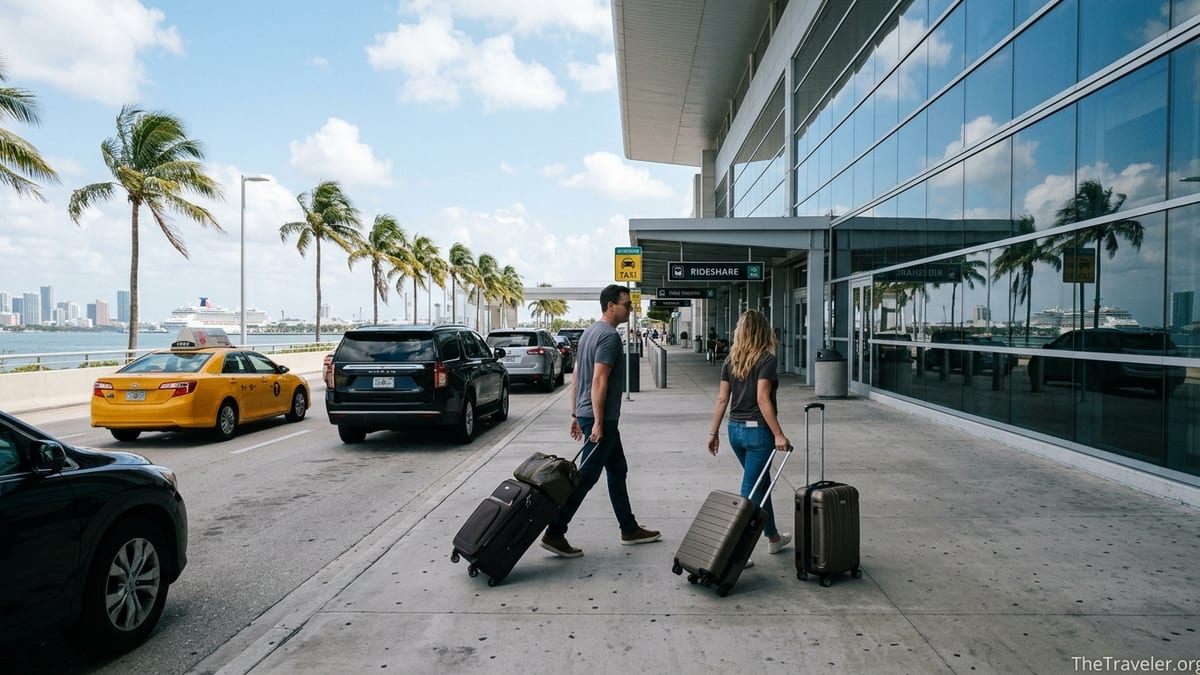
Understanding the Miami Airport to PortMiami Journey
Miami International Airport sits inland, northwest of downtown, while PortMiami occupies Dodge Island just off the mainland, connected by the Port Boulevard bridge. The driving distance between the airport and the cruise terminals is roughly 8 to 9 miles, and under light traffic conditions the ride can take as little as 15 to 20 minutes. In practice, morning cruise days often mean heavier traffic and more congestion at the terminal entrances, so a 25 to 35 minute door-to-door time is a safer expectation.
Most cruise passengers arrive on the same day as their sailing, especially for short Caribbean itineraries. This compresses everything into a narrow time window. Flights that touch down at Miami International between 9:00 and 11:00 a.m. are particularly popular for same-day cruises, and that is exactly when curbsides and access roads get busy. It is usually wise to plan at least an hour between clearing the airport and arriving at your terminal, even though the transfer itself is short.
Cruise terminals at PortMiami are spread along a single main spine road, with specific drop-off zones for each line. For instance, Royal Caribbean ships typically use the large modern terminal on the far eastern end of the island, while Carnival and Norwegian vessels use different numbered terminals closer to the bridge. Whatever transfer you choose, confirm your exact terminal number with your cruise line or boarding documents so your driver can follow the signs and drop you as close as possible to the luggage porters.
Because this is a heavily cruised route, nearly every transport provider in Miami has a product tailored to airport-to-port trips. That is good news for choice, but it also means prices and availability can fluctuate with cruise schedules and major events in the city. Saturday and Sunday mornings, as well as holiday weeks and big festival weekends, tend to see both heavier traffic and higher demand for cars.
Cruise-Line Shuttles: Simple but Not Always Cheapest
Most major cruise brands that sail regularly from PortMiami offer their own airport transfer buses between Miami International Airport and the cruise terminals. These are usually branded coaches or shared shuttle vans that run only on embarkation and debarkation days. You book them directly through the cruise operator before departure, often via your online cruise planner or a travel agent.
Pricing is almost always per person rather than per vehicle. In recent seasons, large lines such as Royal Caribbean, Carnival, Norwegian, and MSC have typically charged in the ballpark of 18 to 25 dollars per person each way from Miami International. For a solo traveler, that can be competitive with other services. For a couple or a family of four, however, the total often exceeds what you would pay for a single taxi or rideshare vehicle covering the same distance.
The big advantage of cruise-line shuttles is predictability. Once you have checked in at the cruise line desk in the arrivals area or baggage claim, staff direct you to the correct bus and handle loading luggage into the under-floor bays. You do not have to think about where to meet your driver, how long the ride app will take to arrive, or which terminal to select, because the shuttle is dedicated to passengers on your exact sailing. If your flight is delayed and you booked air through the cruise line, they may also reassign you to a later bus automatically.
On the downside, cruise-line shuttles rarely leave immediately. A typical process involves waiting in a holding area until a bus fills up, then driving to the port and stopping at multiple terminals along the way. If you land at 10:00 a.m., you might not reach the ship until closer to noon, even though the actual drive is short. Families managing strollers or multiple large suitcases may appreciate not having to handle bags themselves, but they will still need to keep carry-ons and valuables with them on a sometimes crowded coach.
Taxi Cabs: Flat-Rate Convenience at the Curb
Traditional taxis remain one of the most straightforward ways to travel from Miami International Airport to PortMiami. Official, licensed cabs line up outside the baggage claim level, and there are clear signs directing arriving passengers to the taxi stands. Uniformed airport staff help organize the queue and assign cabs, which can be reassuring if this is your first time in Miami or if you are arriving with older relatives or children.
Miami-Dade uses a regulated zone and meter system for airport trips, and PortMiami falls within one of the set zones for flat-rate fares. Recent published examples suggest that a standard taxi from the airport to the cruise port generally runs in the region of 30 to 35 dollars for the vehicle under normal traffic, including the minimum airport trip charges. Larger vehicles such as minivans can carry more luggage or up to five or six passengers, but may add a surcharge over the base rate. Tolls, if your driver uses a tolled causeway or express lane, are usually charged on top of the fare.
Compared with cruise-line shuttles, the financial equation changes quickly with two or more people. A couple who would have paid 40 to 50 dollars total for two seats on a shuttle can often step into a taxi for around 30 dollars and be taken directly and privately to their specific terminal. A family of four can divide the same fare across everyone and end up paying less per person than on a shared bus, while saving time and hassle.
From a luggage perspective, taxis are friendly. The trunk of a standard sedan can hold two large checked suitcases and a couple of smaller bags, and minivan cabs can handle more. Drivers are accustomed to cruise passengers with multiple bags, and many will help lift them into the trunk. Just be sure to keep medications, passports, and fragile items like electronics in a small carry-on that you keep with you inside the cabin. If you are sailing during peak season, it is still rare to wait more than 10 to 15 minutes for a taxi, even when several ships are turning around on the same day.
Uber and Lyft: Flexible and Often Good Value
Rideshare services such as Uber and Lyft are extremely popular on the airport-to-port corridor. Both companies are authorized to pick up at Miami International, and designated ride app pickup zones are clearly marked near the arrivals level. Once you have your bags, you open the app, set “PortMiami” or your specific cruise terminal as the destination, and the app directs you to the correct pickup area where your driver meets you.
Recent fare tracking by consumer and travel sites indicates that a standard rideshare option like UberX or Lyft Standard between Miami International and PortMiami usually ranges around 20 to 35 dollars in 2026 under normal demand. Larger vehicles such as UberXL, better suited for families with several checked bags, typically run higher, often in the 40 to 65 dollar range. These figures fluctuate with surge pricing, which can spike on weekend mornings when many ships are boarding and debarking at the same time or during major events in town.
In practice, many cruise passengers report paying around the mid-20s for an UberX from the airport to the port on a normal Saturday, including the airport pickup fee that is automatically added in the app. For comparison, a family of four using a cruise-line shuttle might pay close to 80 dollars total, while the same family in an UberXL with all their bags might pay roughly half that amount, arrive faster, and have a more private experience. The tradeoff is that you need to be comfortable using the app, meeting your driver in a busy pickup area, and handling your own luggage.
On the return trip from PortMiami back to the airport, rideshare demand can create bottlenecks when several thousand passengers disembark at once. PortMiami has designated rideshare pickup areas, but you may see wait times in the apps creeping toward 20 or 30 minutes around 9:30 or 10:00 a.m. on a heavy cruise day. Some travelers respond by walking slightly away from the most congested terminal exits or waiting 10 to 15 minutes for surge pricing to drop before requesting a ride. If you are catching a tight flight, a taxi waiting at the curb may be the faster choice, even if the app shows a slightly lower rideshare fare.
Private Transfers and Small-Group Shuttles
For those who prefer to have everything locked in ahead of time, private transfer companies and small-group shuttle services offer a middle ground between a taxi and a cruise-line coach. These services are typically booked in advance through specialist transfer operators, car services, or local transportation companies that focus on cruise passengers. Vehicles range from sedans and SUVs to passenger vans and even minibuses for larger groups traveling together.
Pricing varies widely depending on vehicle type and level of service. As a rough guideline, a pre-booked private sedan from Miami International to PortMiami might start somewhere in the 60 to 90 dollar range, with SUVs and vans costing more but able to carry additional passengers and luggage. Shared shuttles, where you pay per person and ride with other passengers on similar schedules, may advertise prices such as 15 to 25 dollars per person, comparable to or slightly lower than the cruise-line buses but operated by independent providers.
One clear advantage of a private transfer is the meet-and-greet element. Many operators station a driver or representative in the arrivals hall with a sign, then escort you and your luggage directly to a waiting vehicle in a nearby parking area. For older travelers, families with young children, or groups who do not want to wrestle with ride apps or taxi lines after a long flight, this can relieve a lot of stress. It also means your route and timing are tailored to you. If your flight arrives early and you are through customs quickly, you can often depart for the port ahead of the main crowds.
However, it is worth weighing cost versus convenience. A group of six friends sharing a private van might find that a fixed rate of 120 dollars feels like good value compared with buying six individual cruise-line shuttle tickets. By contrast, a couple on a budget might be better served by a taxi or UberX at a fraction of that price. Before you book any private transfer, read recent customer reviews and verify what is included. Clarify how long the driver will wait if your flight is delayed, whether child seats can be provided if needed, and how many and what size of suitcases the vehicle can handle comfortably.
Public Transit: Metrorail, Metromover, and Free Trolley
For independent travelers who pack light and are comfortable navigating urban transit systems, Miami’s public transport network offers a remarkably inexpensive way to reach PortMiami from the airport. The key components are the Metrorail Orange Line, which runs between the Miami Intermodal Center near the airport and downtown, the free Metromover loop in the city center, and the City of Miami’s Coral Way trolley route, which connects downtown to the cruise terminals.
The journey usually begins at the Miami Intermodal Center, which is linked to the airport terminals by the elevated MIA Mover train. After collecting your luggage, you follow airport signs for the MIA Mover and ride it to the Intermodal Center. From there, you purchase a transit card or ticket and board an Orange Line Metrorail train headed toward downtown and Dadeland. The typical one-way fare for Metrorail is in the low single digits per person, making it a fraction of even the cheapest shuttle or rideshare.
Most cruise passengers change from Metrorail to the Metromover system at Government Center station in downtown Miami. Metromover is a free, automated people-mover that loops through the central business district and nearby neighborhoods. From Government Center, you can ride Metromover to the stations closest to the Port Boulevard bridge, such as Bayfront Park or College Bayside. From there, the city’s Coral Way trolley line, which is also free, operates buses that run along a route including a segment to PortMiami on cruise days, dropping riders off near the cruise terminals.
Using public transit in this way is easily the most budget-friendly option, with the only paid segment typically being the short Metrorail ride between the Intermodal Center and downtown. For a solo backpacker arriving with a carry-on and a small suitcase, spending just a few dollars and forty minutes on trains and a trolley instead of 30 dollars or more on a taxi can be attractive. The tradeoffs are that you will need to manage your own luggage through stations, elevators, and platforms, and be prepared for potential schedule gaps or service changes. On days with very tight flight or embarkation times, most cruise travelers still opt for a direct car or shuttle to reduce connection risks.
Luggage, Timing, and Choosing the Right Option
When deciding which transfer makes sense for you, it helps to start with two simple questions. First, how much luggage will you have and how easy is it for you to move with it? Second, how much buffer time do you have between your scheduled flight arrival and the latest recommended time to be at the cruise terminal? Your answers usually narrow the field quickly.
If you are a couple with two large checked bags and two carry-ons, arriving around 10:00 a.m. for a 4:00 p.m. sailing, a taxi or UberX is often the best combination of price and simplicity. You wheel your bags to the curb or pickup area, load them into the trunk, and ride directly to your terminal in about half an hour. In contrast, a family of five with four big suitcases, two strollers, and a few backpacks might lean toward a larger rideshare like UberXL, a minivan taxi, or even a pre-booked private van to ensure enough space for everyone and everything.
Cruise-line shuttles become more appealing when you value cruise company support over speed or cost. For example, an older couple who have bundled their flights and transfers through the cruise line may appreciate being shepherded from the arrivals hall straight to a branded coach with porters handling most of the luggage. They may pay more per person than with a taxi, but they gain the reassurance that everyone around them is headed to the same ship, and that cruise staff will monitor flight delays and adjust buses if needed.
Public transit makes the most sense for independent travelers who are comfortable in big-city environments, travel with one or two manageable bags, and are not under tight time pressure. A solo traveler landing at 8:00 a.m. for a mid-afternoon departure, with just a rolling carry-on and a backpack, might enjoy riding the Orange Line into downtown and glimpsing the skyline from the Metromover before boarding the free trolley to the cruise port. The savings compared with a taxi may not change the overall cruise budget dramatically, but for some travelers it is part of the adventure.
Whatever you choose, it is wise to plan for small delays. Build at least an hour of ground-time cushion between your expected airport exit and the time you want to arrive at the cruise terminal, and more if you are traveling at very busy times of year. Keep essential items in a small bag you can carry on your shoulder or back, rather than relying on luggage that might be loaded into a shuttle bay or a distant corner of a taxi’s trunk.
The Takeaway
While Miami International Airport and PortMiami are only a few miles apart, the way you connect them can shape the start and end of your cruise vacation. Taxis, Uber, and Lyft offer flexible, direct service that is often the best value for couples and families, especially when splitting the cost across several people. Cruise-line shuttles trade some speed and independence for simplicity and the reassurance of traveling in a group organized by your cruise operator.
Private transfer services add a layer of comfort and predictability for those willing to pay more, with meet-and-greet staff and spacious vehicles that can handle extra luggage or larger groups. At the opposite end of the price spectrum, Miami’s Metrorail, Metromover, and free trolley routes give confident, light-packing travelers a chance to reach the cruise port for only a few dollars, at the expense of extra time and effort handling their own bags.
No single option is perfect for everyone. The right choice from Miami International to PortMiami depends on how you balance cost, convenience, and your comfort with technology and public transport. By considering your group size, luggage load, and schedule, and by understanding how each option works in real life, you can pick the transfer that lets you start your cruise relaxed instead of rushed.
FAQ
Q1. How much time should I allow to get from Miami International Airport to PortMiami?
Plan on at least one hour from the moment you exit the terminal to arriving at your cruise check-in, and more if you land during busy weekend mornings or holidays.
Q2. What is the typical taxi fare from the airport to the cruise port?
A standard licensed taxi from Miami International to PortMiami generally costs in the region of 30 to 35 dollars per vehicle under normal conditions, plus any tolls.
Q3. Are Uber and Lyft cheaper than a taxi for this route?
Often yes, especially for one or two people. Standard rideshare options like UberX or Lyft Standard typically fall around 20 to 35 dollars, though surge pricing can push fares higher at peak times.
Q4. Is the cruise-line shuttle worth the extra cost?
It can be, if you prioritize simplicity and cruise line support. Solo travelers or those uncomfortable with apps often appreciate being guided straight from the airport to a branded bus, even if it costs more per person than a taxi.
Q5. Can I use public transit from Miami International to PortMiami with luggage?
Yes, but it is best suited to light packers. You will ride the MIA Mover to the Intermodal Center, take Metrorail to downtown, then transfer to Metromover and the free Coral Way trolley, all while handling your own bags.
Q6. What is the best option for a family with small children and several suitcases?
A larger taxi, an UberXL, or a pre-booked private van usually works best. These options provide enough space for car seats, strollers, and luggage, and minimize the need for multiple transfers or crowded buses.
Q7. How early should I book a private transfer or shared shuttle?
Booking at least a few weeks before sailing is sensible, especially for peak cruise seasons or holiday periods. This gives you time to compare operators, confirm luggage limits, and arrange child seats if needed.
Q8. Is it hard to get a ride from PortMiami back to the airport after the cruise?
You will usually find taxis waiting outside the terminals, but rideshare pickup areas can get busy when many ships disembark at once. Expect possible waits of 20 to 30 minutes during peak times and build that into your flight plans.
Q9. What if my flight is delayed on embarkation day?
If you booked flights and transfers through the cruise line, they may adjust your shuttle or help with alternatives. With independent taxis or rideshares, you can simply request a car when you land, but keep the cruise check-in deadline in mind.
Q10. Do I need to tip drivers for transfers between the airport and cruise port?
Tipping is customary. Many travelers add a few dollars for a short taxi or rideshare trip, or around 15 to 20 percent of the fare, especially if the driver helps with heavy luggage.