


More news on this day
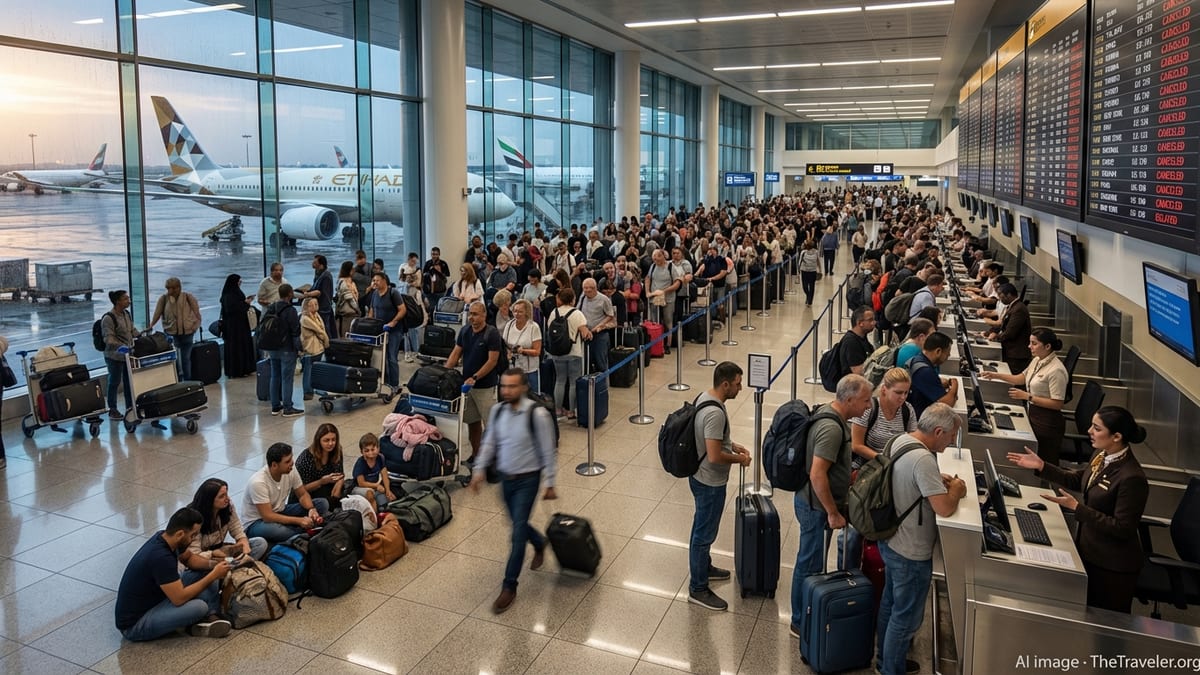
Months after a series of airspace closures and strikes disrupted aviation across the Gulf, travelers flying through the United Arab Emirates and Saudi Arabia’s capital Riyadh are still navigating rolling flight cancellations, reduced frequencies and late schedule changes that can upend long-planned itineraries.
Get the latest news straight to your inbox!
How the Middle East flight disruption began
Regional flight schedules were thrown into disarray in late February and early March 2026, when escalating conflict involving Iran, the United States and Israel led several Gulf states, including the United Arab Emirates, to restrict or temporarily close their airspace to civil traffic. Publicly available timelines show that Dubai International and Abu Dhabi airports halted normal operations after Iranian strikes caused damage and triggered a broad security lockdown at key hubs across the region.
Industry analysis from the International Air Transport Association indicates that during the first week of March roughly 85 percent of flights to and from major Gulf airports were cancelled, with fewer than half of originally planned services operating by the end of the month. Airlines responded by grounding fleets, diverting aircraft to alternative hubs and stripping out capacity from summer schedules, removing several percent of planned global capacity for June through August.
Additional reporting on the economic impact of the 2026 Iran war highlights that widespread airspace closures across the Gulf, including the UAE, contributed to thousands of daily cancellations and stranded hundreds of thousands of passengers. The disruption has been compared to the most severe shocks to international air travel since the pandemic, with knock-on effects for trade, tourism and connecting traffic between Asia, Europe and North America.
Although restrictions have eased since the initial shutdown, the legacy of those closures continues to shape timetables, frequencies and routings through Dubai, Abu Dhabi, Riyadh and other regional gateways as airlines rebuild cautiously against a backdrop of ongoing geopolitical risk.
Current status in the UAE: a patchwork of resumptions and suspensions
Operations in the UAE have gradually restarted, but they remain far from pre-crisis normal, especially for foreign carriers. Public flight information and airline advisories show Dubai and Abu Dhabi airports working on reduced schedules, with priority given to home carriers and high-demand trunk routes. Some international airlines have resumed limited services, while others maintain full suspensions to UAE airports through parts of the summer 2026 season.
Travel waivers and operational notices from major Gulf carriers describe “limited operations” and repeatedly extend flexible rebooking windows, indicating that schedules are still being adjusted week by week. Emirates and Etihad have restored many long-haul links but continue to publish special guidance on rebooking, rerouting and stopover services for passengers whose journeys have been affected by altered routings or reduced frequencies.
By contrast, information circulating among travelers and in airline communications shows that several European and Asian carriers have suspended or sharply curtailed their Dubai and Abu Dhabi flights into August, citing a mix of security considerations and higher insurance and fuel costs on detour routes. Some have opted to consolidate Middle East flights into a single hub or shift connecting traffic to alternative gateways outside the Gulf.
The result for passengers is a patchwork network in and out of the UAE, where a route that appears in search results may operate only a few days a week, and where last-minute timetable changes remain more common than on other long-haul corridors. Travelers relying on UAE hubs for onward connections to Europe, North America or Africa are particularly exposed to missed links if upstream flights from Asia or the Indian subcontinent are retimed or cancelled at short notice.
Riyadh and Saudi Arabia: more stability, but indirect effects
Saudi Arabia’s main airports, including Riyadh’s King Khalid International, have generally remained open through the recent escalation, and published coverage suggests that their operations have been less directly affected than those of the UAE. Domestic flights and many international services have continued, providing an alternative transit point for some travelers whose usual routings through Dubai or Abu Dhabi are unavailable.
However, Riyadh has not been entirely insulated from the wider regional disruption. Airspace closures and no-fly zones over neighboring states have forced airlines to redesign flight paths serving Saudi airports, lengthening some journeys and raising operating costs. Industry commentary notes that higher war-risk insurance premiums and longer routings can prompt airlines to reduce frequencies or upgauge aircraft, concentrating demand onto fewer flights and leading to higher load factors.
Schedule data and network announcements also show that some foreign carriers have rebalanced their Middle East presence, trimming services to certain Saudi gateways while reinforcing others. That means passengers may find non-stop options to Riyadh reduced from some European or Asian cities, even though the airport itself remains fully open.
For travelers, the main challenge in and out of Riyadh is less about blanket cancellations and more about subtle shifts in timings, aircraft types and available connections. A flight that once offered a comfortable onward link may now arrive too late for the same-day connection, or seats on popular weekend departures may sell out more quickly as airlines consolidate capacity.
What travelers connecting via Dubai, Abu Dhabi or Riyadh should do
Given the fluid environment, travel experts and publicly shared airline guidance strongly emphasize proactive trip management. Passengers are being encouraged to monitor their bookings directly through airline apps rather than relying solely on itinerary snapshots from online travel agencies, which may not reflect the latest timetable changes or rolling cancellations.
Many carriers serving the UAE and Saudi Arabia have published flexible policies allowing free date changes, refunds or rerouting for tickets issued before key cutoff dates tied to the onset of the crisis. Travelers holding older bookings should review the conditions attached to their tickets, as some travel insurers now treat the conflict as a “known event,” limiting coverage for policies purchased after late February or early March 2026.
For those planning new trips, route choice has become a strategic decision. Some passengers are opting to avoid tight connections through Dubai or Abu Dhabi by building in longer layovers or selecting itineraries via alternative hubs in Europe or Asia that are not directly affected by Middle East airspace restrictions. Others continue to use UAE and Riyadh connections but remain prepared for extended journeys and potential overnight delays.
Practical steps can reduce the impact of sudden disruptions. Checking real-time departure boards for Dubai, Abu Dhabi and Riyadh before leaving for the airport, ensuring contact details are up to date in airline profiles, and carrying essential items in cabin baggage can all help travelers respond quickly if flights are cancelled or retimed on the day of travel.
How long the disruption could last
Forecasts from airline and industry bodies suggest that the consequences of the spring 2026 shutdown will extend well beyond the immediate crisis period. Capacity data cited by aviation analysts shows that airlines removed a meaningful share of planned seats to and from the Middle East for the peak summer season, with only a gradual rebuild expected as carriers test demand and reassess security and insurance costs.
The IATA assessment notes that aviation networks are likely to remain more fragile around the Gulf while geopolitical risks stay elevated. Airlines may keep extra buffers in schedules, maintain longer routings that avoid sensitive airspace, and be slower to add back marginal routes where yields are uncertain. That implies that travelers using UAE and Saudi hubs should anticipate a prolonged period of less predictable schedules compared with other global regions.
Experience from previous regional conflicts and airspace closures suggests that once restrictions ease, major hubs with strong underlying demand, such as Dubai and Riyadh, eventually recover traffic volumes but not always the same route mix. Some secondary routes may be permanently dropped, while others re-emerge with different operating carriers or fewer weekly frequencies.
For now, the most realistic expectation for passengers is continued volatility. While the worst of the blanket shutdowns has passed and more flights are operating through both the UAE and Riyadh, the network remains in flux, and travelers booking for late summer and early autumn 2026 should build flexibility into their plans and stay alert to further schedule changes.