


More news on this day
Travellers across the Middle East are facing a new wave of disruption as regional carriers including Saudia, Kuwait Airways, Gulf Air, flydubai and EgyptAir cancel or ground nearly 20 flights and log more than 100 delays in a single day, straining already fragile air links between Saudi Arabia, the UAE and Kuwait.
Get the latest news straight to your inbox!
Fresh Cancellations Hit a Fragile Recovery
The latest schedule cuts come as airlines in the Gulf are still rebuilding networks after weeks of airspace closures and rerouting triggered by regional conflict and subsequent ceasefire arrangements. Publicly available tracking data and regional coverage indicate that carriers are operating with reduced frequencies and condensed networks, leaving limited slack when operational issues arise.
Reports from regional travel outlets describe clusters of cancellations involving Saudia services into and out of the UAE, flydubai flights on key regional routes, and disrupted operations for Gulf Air and EgyptAir linking Gulf hubs with cities such as Cairo and Amman. These targeted cancellations, combined with rolling delays across busy hubs in Dubai, Jeddah and Bahrain, have cascaded into missed connections and extended airport stays for passengers traveling onward to South Asia, Europe and North Africa.
Industry analysts note that while many airlines have resumed flying along pre-approved safe corridors, overall capacity on some Middle East corridors remains well below pre-crisis levels. That constrained capacity is magnifying the impact of each grounded aircraft, meaning a relatively small number of cancellations can strand large numbers of travellers across the region.
Saudi Arabia, UAE and Kuwait Routes Most Affected
Routes linking Saudi Arabia, the United Arab Emirates and Kuwait appear to be among the hardest hit, reflecting the region’s reliance on short-haul connectors between Gulf hubs. Saudi carrier Saudia has been rebuilding links from Jeddah and Riyadh into Dubai and Abu Dhabi on a limited schedule, but has continued to adjust frequencies and aircraft types as airspace restrictions and demand patterns evolve.
In the UAE, Dubai International Airport and Abu Dhabi’s main hub are operating with trimmed schedules as airlines navigate temporary routings around closed or restricted airspace in parts of the region. Travel advisories highlighted in regional media continue to urge passengers not to proceed to airports until they have a confirmed departure time, underscoring how quickly live schedules can change.
Kuwait, which has faced prolonged airspace restrictions since late February, remains a particular pinch point. Publicly available information shows that some Kuwait-bound traffic has been rerouted through Saudi airports, with passengers transported by road to complete their journeys. Against that backdrop, disruption to Kuwait Airways services or onward links via Gulf Air and EgyptAir risks further isolating travellers who depend on these connections for essential travel.
Knock-On Delays and Stranded Passengers
The grounding of 19 flights across these carriers in a short window has generated more than 100 follow-on delays, according to aggregated schedule data cited in regional travel reports. With aircraft and crews out of position, airlines have been forced to push back departure times on subsequent legs, affecting passengers far beyond the originally cancelled routes.
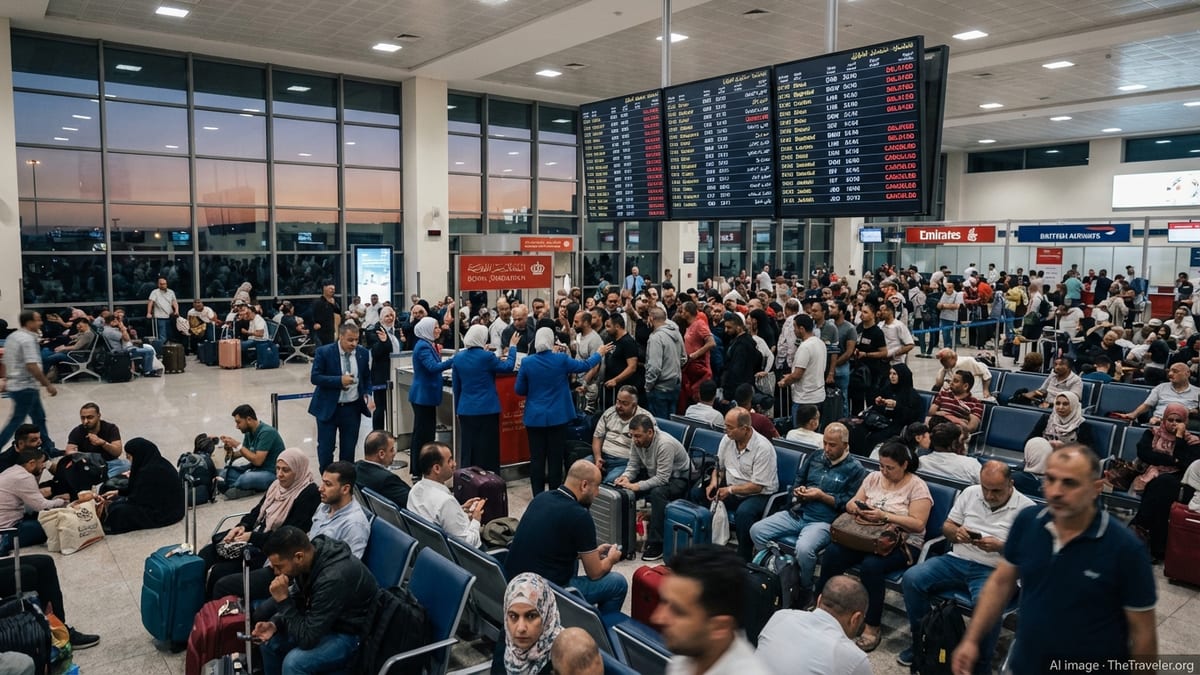
Travel-focused publications in the region describe crowded departure halls in Dubai, Abu Dhabi and Jeddah as passengers wait for updated departure times or rebooking options. Some travellers bound for cities such as Jeddah, Cairo, Baghdad and Addis Ababa have been left overnight in transit after their connecting services on Saudia, flydubai or EgyptAir were scrubbed or heavily delayed.
Operational updates from carriers highlight the complexity of rebuilding rotations under current constraints. Flydubai, for example, has signalled that it is running a reduced schedule with warnings of longer flight times and potential last-minute changes as routes are diverted around restricted airspace. Similar advisories from Saudia, Gulf Air and EgyptAir urge passengers to monitor flight status closely, acknowledging that schedules remain subject to short-notice adjustment.
Airlines Balance Safety, Capacity and Demand
Behind the immediate disruption lies a deeper operational challenge for the region’s airlines as they balance safety considerations, regulatory approvals and fluctuating demand. Published coverage on Middle East aviation notes that some Gulf carriers are operating at a fraction of pre-war capacity, gradually restoring routes as airspace reopens and security assessments permit.
Carriers such as Saudia, Gulf Air and EgyptAir are focusing initially on high-demand city pairs, often with one or two daily frequencies, while retaining flexibility to add or remove services as conditions change. Kuwait Airways and flydubai are similarly adjusting networks in real time, with some services temporarily suspended while others are rerouted or operated with longer block times.
This cautious approach, while necessary from an operational and safety perspective, leaves little buffer to absorb unexpected events such as technical issues, crew shortages or sudden airspace closures. When disruptions occur, options for rapid re-accommodation are limited, particularly for travellers heading to secondary cities or relying on tight connections across multiple Gulf hubs.
What Travellers Are Being Advised to Do
With schedules in flux, airlines and airports across Saudi Arabia, the UAE and Kuwait are emphasizing the importance of checking flight status before leaving for the airport and remaining alert to last-minute changes. Public advisories reported in regional media consistently tell passengers to wait for direct confirmation from their carrier rather than relying on generic timetable information.
Flexible booking policies remain in place at several Gulf airlines, allowing passengers whose flights are cancelled or significantly delayed to rebook at a later date or request refunds within specified windows. Travel industry commentary suggests that many affected travellers are opting to postpone nonessential journeys until schedules stabilize and more capacity returns to the market.
For now, however, the experience on the ground remains highly variable. While some routes are operating close to normal, others continue to see rolling cancellations, aircraft substitutions and extended layovers. Until airspace restrictions ease further and carriers can restore more robust schedules, travellers on Saudia, Kuwait Airways, Gulf Air, flydubai and EgyptAir should expect the possibility of sudden disruption and plan their journeys through Saudi Arabia, the UAE and Kuwait with additional time and contingency in mind.