


More news on this day
Major airports across the Middle East are grappling with a fresh wave of disruption, with publicly available aviation data indicating 63 flight cancellations and 801 delays in a short reporting window, straining already fragile schedules at some of the region’s busiest hubs.
Get the latest news straight to your inbox!
Snapshot of the Latest Disruption Numbers
The latest figures on Middle East operations, compiled from flight tracking dashboards and regional aviation coverage, point to a total of 63 cancellations and 801 delays affecting departures and arrivals across the region’s key airports. These numbers sit within a broader pattern of elevated disruption recorded in recent weeks, where single days have seen more than 1,200 delayed flights and dozens of cancellations centered on Gulf and Levant hubs.
Dubai International, Abu Dhabi International, Hamad International in Doha, and major Saudi gateways in Riyadh and Jeddah continue to feature prominently in disruption tallies, reflecting their role as transfer points on long haul routes between Europe, Asia, and Africa. Published data from late August and early September shows that these airports have repeatedly logged several hundred delayed flights in 24 hour spells, with cancellations typically concentrated on routes crossing constrained airspace over Iran, Iraq, Israel, and neighboring states.
Industry trackers and specialist travel outlets note that the latest wave involving 63 cancellations and 801 delays appears to be part of an ongoing cycle, in which modest schedule instability can escalate quickly once airspace restrictions tighten or local weather and staffing issues add further pressure. Disruption levels have fluctuated from day to day, but the overall trend points to a regional network still operating with limited margin for shocks.
Airspace Restrictions and Network Bottlenecks
Reports indicate that airspace closures and restrictions imposed since late February 2026 remain a central driver of irregular operations. Flight information regions covering Iran, Iraq, Israel, Jordan, Kuwait, Bahrain, Qatar, and the United Arab Emirates have all seen periods of closure or tight constraint, forcing airlines to route services around affected corridors and extend flight times. Analysts tracking these changes describe a regional network that is still adjusting to longer routings and congested alternative paths.
Publicly available briefings on the economic impact of the 2026 Iran conflict highlight how partial or full closures over several Middle Eastern states have pushed carriers to redesign core east west links, with major hubs such as Dubai and Abu Dhabi operating under sustained operational stress. Regional business press and travel advisories also note that Bahrain, Doha, Kuwait City, and Tel Aviv have periodically faced heavy congestion whenever restrictions shift or reopenings trigger sudden bursts of traffic.
Even when airports themselves remain open, the knock on effect of rerouting can feed into the 63 cancellations and 801 delays now being reported. Aircraft and crews may be out of position after long diversions, turnaround times can lengthen as ground teams manage disrupted banks of arrivals, and connecting passengers can miss onward flights, forcing additional rebookings that further strain schedules.
Airports and Routes Most Affected
Recent disruption tallies suggest that Dubai International continues to record some of the highest individual delay counts of any airport in the region, with certain 24 hour periods showing more than 250 delayed movements alongside a smaller cluster of cancellations. Abu Dhabi, Doha, and key Saudi hubs in Riyadh and Jeddah have also featured prominently, alongside Bahrain and Kuwait City, which act as important connectors for regional and short haul traffic.
Coverage focused on specific days of disruption has highlighted that routes linking Gulf hubs with major cities in Europe and South Asia, as well as busy intra regional sectors such as Riyadh to Cairo, are among those most vulnerable to knock on delays. On heavily trafficked corridors, some data providers have estimated that close to one in five flights can operate late on the worst affected days, with average delays stretching toward or beyond the one hour mark when airspace restrictions and local bottlenecks coincide.
Secondary hubs and regional airports, including Jeddah, Dammam, and Kuwait International, have also seen elevated delay counts when weather events or local incidents overlay an already stretched network. Travel reporting from July and August described instances where localized security alerts or drone activity led to temporary suspensions at certain airports, generating queues of holding aircraft and late arriving services that then rippled outward through the schedule.
Impact on Travelers and What Passengers Are Experiencing
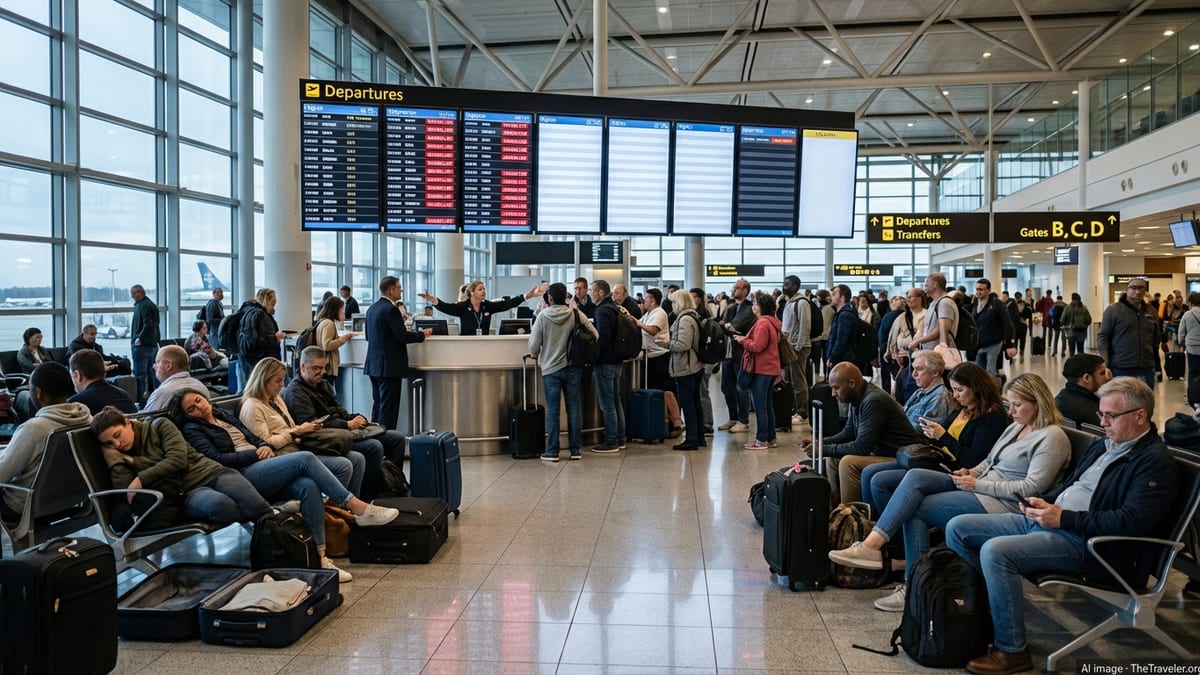
For passengers, the 63 cancellations and 801 delays translate into missed connections, overnight stays, and extended waiting times at some of the busiest terminals in the world. Reports from regional travel outlets and global media describe terminals in Dubai, Doha, Abu Dhabi, and Kuwait filling with stranded or delayed travelers during recent disruption spikes, with long queues at transfer desks and rebooking counters.
Travel advisories compiled over the last month emphasize that even travelers on seemingly straightforward itineraries can be affected if a single late inbound flight prevents a tight connection at a Gulf hub. Disruptions have hit both leisure and business travelers, as well as transit passengers using Middle Eastern hubs as stepping stones between Europe, Asia, Africa, and Oceania. In some cases, airlines have had to reroute passengers via alternative gateways in Saudi Arabia or Oman to work around pressure points.
Consumer rights resources focused on the Middle East note that, depending on the airline and the route, passengers may be entitled to assistance with meals, hotel accommodation, and rebooking when delays or cancellations reach certain thresholds. However, the fragmented regulatory landscape means that protections can vary considerably by country and carrier, leaving many travelers reliant on individual airline policies and the goodwill of ground staff when disruption peaks.
Planning Ahead: Practical Steps for Upcoming Trips
Publicly available travel guidance for the region encourages anyone with upcoming flights through Middle Eastern hubs to pay close attention to real time status updates. Airlines and airports maintain their own live departure and arrival boards, while global flight tracking services provide an additional snapshot of delay patterns at specific airports and on individual routes.
Several recent advisories recommend building extra buffer time into itineraries involving Gulf connections, particularly when separate tickets or tight minimum connection times are involved. Travelers are also urged to monitor airline notifications closely, as schedule changes and rebookings are often processed digitally before they appear on airport screens. For those with flexible plans, avoiding late night or early morning connections on heavily affected routes can sometimes reduce exposure to rolling knock on delays.
Travel coverage in late August and early September has also underlined the value of checking broader airport and airspace status pages before departure. These resources aggregate updates from civil aviation authorities and NOTAM systems, labeling airports as fully operational, limited, or suspended. While conditions can shift quickly, such tools can help travelers understand whether isolated delays are affecting their flight, or whether they form part of a larger disruption pattern similar in scale to the 63 cancellations and 801 delays now being reported.
https://www.nomadlawyer.org/middle-east-air-travel-disruptions-dubai-erbil-istanbul-saudi-hubs-2026
https://www.airhelp.com/en-int/flight-disruptions/middle-east-flight-delays-cancellations-31082026/
https://avi-go.com/news/articles/e367558de4148442abb93412efb2c440