


More news on this day
Minneapolis–St. Paul International Airport has been thrust into the spotlight after a severe operational breakdown triggered hundreds of cancellations and delays on Delta Air Lines and Sun Country Airlines, unleashing a wave of travel chaos for passengers across the United States.
Get the latest news straight to your inbox!
Hub Under Strain as Operations Unravel
Minneapolis–St. Paul International Airport is one of the country’s busiest hubs, anchored primarily by Delta Air Lines with a significant presence from low-cost carrier Sun Country. Public data from the Metropolitan Airports Commission shows Delta handling roughly 70 percent of passenger traffic in recent years, with Sun Country accounting for more than 10 percent. That concentration of traffic means disruptions affecting both carriers can rapidly snowball into a systemwide breakdown.
During the latest meltdown, flight-tracking data and published coverage indicate that cancellations at Minneapolis surged far above normal levels, with Delta and its regional partners scrubbing a large share of departures. Sun Country, which operates from a separate terminal but shares key airport resources, also reported sizable schedule cuts and rolling delays as the situation deteriorated.
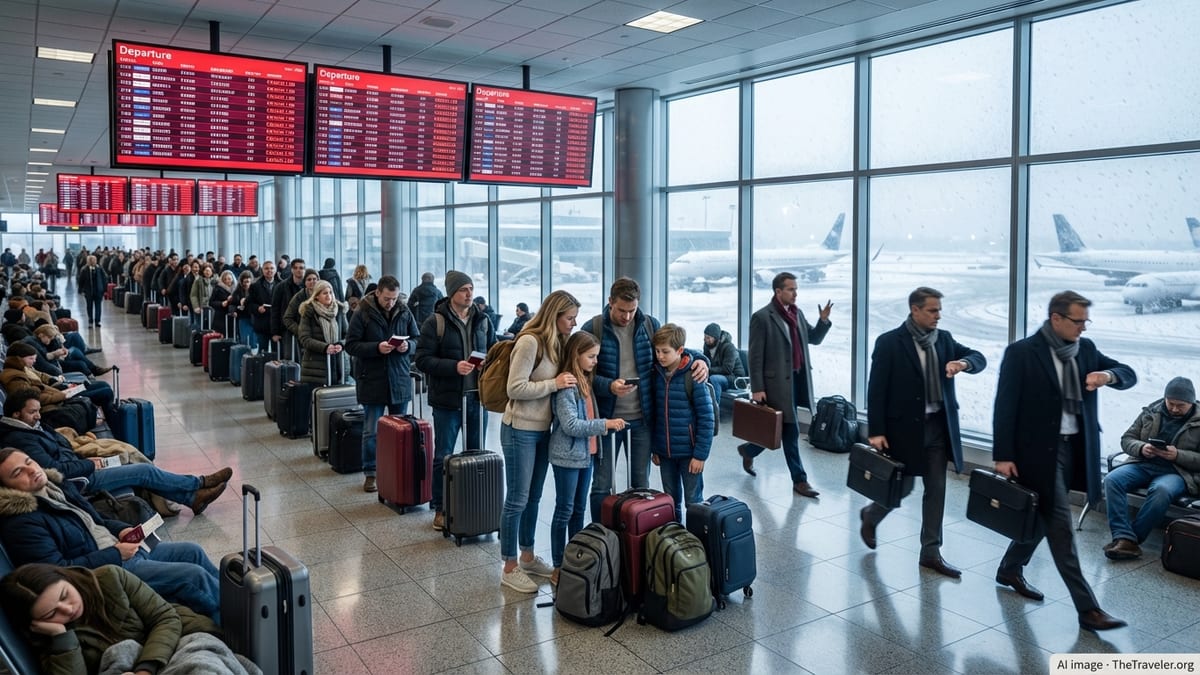
As aircraft and crews fell out of position, the airport’s tightly choreographed operation began to fray. Reports from travelers describe crowded gate areas, lengthy check-in lines, and mounting departure boards filled with canceled or severely delayed flights. The disruption quickly radiated beyond Minnesota, creating knock-on effects at connecting airports around the country.
The breakdown has underscored the vulnerability of hub-and-spoke systems when multiple carriers at the same airport are hit at once. With so many itineraries flowing through Minneapolis, even a relatively short disruption can strand thousands of passengers and take days to unwind.
Delta’s Network Disruption Amplifies the Chaos
Delta’s troubles at Minneapolis are occurring against the backdrop of a broader pattern of high-profile disruptions over the past several years. The airline’s protracted recovery from a global technology outage in July 2024, linked to a faulty software update, led to more than 5,000 cancellations over several days across its network, according to federal data and news reports. Minneapolis, one of Delta’s key hubs, was among the airports hardest hit during that episode.
In the most recent Minneapolis meltdown, publicly available flight statistics again show Delta canceling a disproportionate number of flights compared with some competitors, concentrating the disruption at its hubs. As aircraft and crews reached mandated duty limits or wound up in the wrong cities, the airline increasingly turned to preemptive cancellations in an effort to stabilize its schedule.
These decisions left many travelers facing multiple rebookings or involuntary overnight stays. Social media posts and local coverage from Minneapolis describe passengers sleeping in terminal seating, waiting in customer-service lines for hours, and in some cases opting to rent cars or buses to complete trips that would normally be a short flight away.
Regulators have taken interest in Delta’s handling of such events. Following the 2024 technology outage, federal transportation officials opened an investigation into whether the airline properly communicated passenger rights and refund options during the prolonged disruption. Although that inquiry focused on an earlier episode, the latest Minneapolis chaos is renewing scrutiny of how quickly large carriers can recover from shocks to their operations.
Sun Country’s Parallel Struggles at Its Home Base
While Delta draws most of the attention as Minneapolis’s dominant carrier, Sun Country’s difficulties have added another layer of complexity to the meltdown. The budget airline has expanded rapidly at the airport in recent years, promoting itself as a leisure-focused alternative with a growing network of seasonal and charter services.
That growth has also increased its exposure when operations go wrong. Travelers posting publicly during the current wave of disruptions describe Sun Country cancellations announced with limited notice and a heavy reliance on refunds or same-airline rebookings rather than accommodating passengers on other carriers. Industry analysts note that, unlike the largest network airlines, many low-cost carriers have fewer interline agreements, reducing flexibility when irregular operations cascade.
Weather-related events earlier in 2026 highlighted some of these structural challenges. During a March snowstorm in the Upper Midwest, for example, regional coverage documented both Delta and Sun Country implementing extensive schedule changes at Minneapolis and nearby airports to protect safety and manage limited de-icing and runway capacity. The latest meltdown appears to have revived those operational strains, but on a wider and more sustained scale.
For passengers, the net effect has been similar regardless of whether they booked with a full-service airline or a low-cost carrier. Canceled flights, long queues, and difficulty reaching call centers have combined to create a perception of systemwide fragility at Minneapolis during peak demand periods.
Passenger Impact and Confusion Over Rights
As the cancellations mounted, many travelers expressed confusion about their rights and options. Previous federal reviews of airline disruptions have highlighted gaps between what passengers believe they are owed and what carriers are legally required to provide, particularly around hotel vouchers, meal assistance, and cash refunds versus travel credits.
After the 2024 technology-driven meltdown, investigators examining Delta’s handling of cancellations looked closely at text and email notifications sent to passengers, citing concerns that some messages did not clearly explain refund eligibility. Consumer advocates argue that similar communication issues tend to emerge whenever major disruptions hit, especially at hubs like Minneapolis where large volumes of passengers are rebooked at once.
The Minneapolis chaos has also resurfaced questions about the accessibility of customer support during crises. Reports indicate that many passengers encountered multi-hour waits to reach airline agents by phone or in person. For those traveling with children, older adults, or tight international connections, the lack of timely information has often been as stressful as the cancellations themselves.
In response to past meltdowns, federal officials have urged airlines to update customer-service plans and improve transparency about compensation and rebooking policies. Whether those measures will meaningfully ease the experience of passengers caught in the latest Minneapolis disruptions remains an open question.
Broader Questions About Resilience at a Critical Midwestern Hub
The turbulence at Minneapolis arrives at a time when U.S. aviation is already under pressure from rising demand, staffing constraints, and aging technology systems. National statistics show that even on ordinary days, carriers are operating with less slack in their networks, leaving them more vulnerable to any disruption that removes aircraft, crew, or airport infrastructure from the equation.
Minneapolis plays an outsized role in that system as a primary connecting point between the Upper Midwest and destinations across North America and Europe. Economic-impact studies released in recent months highlight the airport’s importance to regional tourism and business travel, emphasizing the reliance of local companies on reliable connectivity provided by Delta, Sun Country, and other carriers.
The latest meltdown is likely to feed a broader conversation about how much redundancy and resilience is built into hub operations. Industry analysts have suggested that airlines and airports may need to invest more in backup systems, cross-training, and contingency planning to handle simultaneous disruptions affecting multiple carriers at the same facility.
For now, travelers using Minneapolis are being urged by publicly available advisories and media coverage to monitor flight status closely, build extra time into connections, and review airline policies on refunds and accommodations before heading to the airport. As schedules gradually normalize, the episode is expected to become another case study in how quickly a critical aviation hub can grind to a halt when two of its largest players suffer parallel breakdowns.