


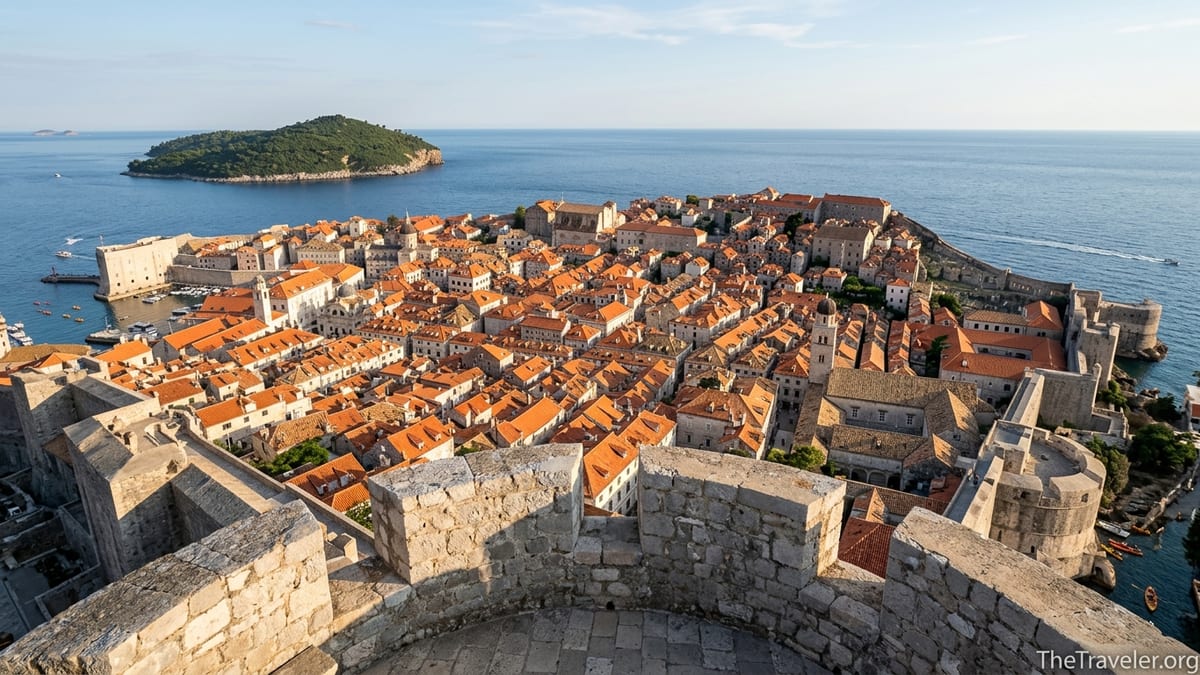
There are views that you plan for, the ones you have seen a hundred times on Instagram before you arrive. Then there are the views that still manage to knock the breath out of you, even in a city as photographed as Dubrovnik. The moment I stepped onto the top terrace of Minčeta Tower, the highest point of the Old Town walls, I realized I was not remotely prepared for what I was about to see.
Get the latest updates straight to your inbox!
Meeting Minčeta Tower, Dubrovnik’s Stone Crown
Minčeta Tower rises from the landward side of Dubrovnik’s city walls like a stone crown, a round fortress layered onto centuries of fortifications. Originally built in the early 14th century and later reinforced after the fall of Constantinople, it was designed as the muscular northern shield of the old Republic, facing potential threats from the interior of the Balkans rather than from the sea. Today, its function is almost the opposite: it invites visitors up, away from the noise of the Old Town, to see just how exposed and yet protected Dubrovnik really is.
Most people reach Minčeta as part of a full loop of the walls, a circuit of roughly 2 kilometers that wraps around the tight knot of the medieval streets below. Tickets for the walls are not cheap; in 2025, standard adult admission was widely reported around 40 euros, with reduced prices for children and inclusion in some versions of the Dubrovnik Pass. The sticker shock is real, especially if you are traveling as a family, but Minčeta is a compelling argument that the walls are not just another pretty viewpoint. They are the key to understanding how this tiny republic survived, and sometimes thrived, in a dangerous neighborhood.
As you approach the tower along the northern ramparts, the wall suddenly broadens and tilts upward into a long stone ramp. This gentle climb, broken up by shallow steps, was engineered centuries ago to allow cannons and heavy equipment to be hauled up. Today it serves a very different purpose: it slows you down. The city falls away at your right shoulder, and the roofs begin to arrange themselves into a rust-colored ocean, pulling your eyes forward to where the tower bulges against the sky.
The Climb That Quietly Steals Your Breath
The final ascent into Minčeta Tower comes as a surprise even if you think you are prepared. A narrow stone staircase curls inside the thick wall, almost tunnel-like, and for a few moments you are climbing in near silence, just the scrape of footsteps and the occasional echo of a voice from below. It is short, but steep enough that in the heat of July or August you will feel it in your legs. Travelers who track steps on their phones often report that a full walls circuit, including Minčeta, can easily surpass 10,000 steps in a day, and locals sometimes warn that if you dislike heights or narrow stairs, this may not be your favorite part of Dubrovnik.
There is a small practical detail here that matters. In high summer, the stone of Dubrovnik’s walls can feel like a heat sink, radiating warmth absorbed through a full day of sun. That is why many guides and local tour operators strongly recommend starting the wall walk as close to opening time as possible, often around 8 a.m., or saving it for the last 90 minutes before closing when the light softens and cruise visitors start to drift back to their ships. Walking that inner spiral of Minčeta at midday, when the heat concentrates in its stone shell, can turn an inspiring climb into a test of endurance.
Yet those who time it well talk about an almost ceremonial transition as they emerge from that shadowed staircase into the open light of the upper terrace. Early in the morning, when the city is still shaking off sleep, there might be just a handful of people circling the parapet, cameras half-forgotten in their hands. Late in the afternoon, the Adriatic fades into a milky blue, and the stone seems to cool under your palms as a light breeze funnels between the tower’s battlements. In both cases, you are stepping from an interior past into an unexpectedly expansive present.
The View I Was Not Ready For
No photograph of Dubrovnik can really prepare you for the way the city rearranges itself when you stand atop Minčeta’s crown. Below, the Old Town no longer feels like a tangle of lanes and squares; it hardens into a geometric pattern of terracotta rectangles, pale limestone streets and cloistered courtyards. The main artery, the Stradun, becomes a single shining line of stone running from the inland Pile Gate down to the harbor, dotted with the slow movement of early walkers or afternoon strollers.
To the south, the city walls themselves suddenly make sense. From street level they feel like individual segments: a bastion here, a stair there, a cafe perched on a random corner. From Minčeta, they resolve into a complete ribbon of defense looping almost unbroken around the town. You can trace the curve towards the sea-facing forts, follow it as it wraps around the harbor, then watch it climb back up along the cliffs until it reconnects with the tower beneath your feet. It is a view that makes the cost and effort of walking the walls feel not just justified but necessary.
Offshore, the wooded bulk of Lokrum Island anchors the skyline, a green contrast to the stone chessboard beneath you. On clear days you can see small kayaks hugging the base of the sea walls, bright dots of red and yellow threading below Fort Bokar and St John’s Fortress. Farther inland, the cable car line to Mount Srđ draws a faint diagonal in the air, leading your gaze up toward the ridgeline that locals insist is home to Dubrovnik’s most expansive panorama. It is only from Minčeta, though, that you can appreciate how the city sits delicately pressed between sea and mountain, a narrow strip of life nestled into an improbable location.
Game of Thrones, But Also Something Older
For many travelers, Minčeta Tower comes with a label attached long before they see it. This round fortress famously doubled as the House of the Undying in Game of Thrones, and guided tours of filming locations often pause here to line up shots and stories with screenshots from the show. You will sometimes see visitors climbing the last steps in Daenerys costumes or pausing in specific spots to recreate scenes, their friends crouched in the shade of the battlements holding phones at exactly the right angle.
The association with a global television phenomenon has undeniably boosted Dubrovnik’s profile, especially among visitors who might not otherwise choose a fortified Adriatic city as their summer focus. But standing on Minčeta’s upper terrace, the fictional memory fades surprisingly fast. The view is simply too present, too alive with detail, to feel like a set. The shouts from the open-air market near Gundulić Square rise faintly on the air, teenage boys throw themselves from the rocks near Buža bar into the glitter of the sea, and church bells slice through the heat at irregular intervals. You remember that this tower safeguarded a real maritime republic long before it became an image on a streaming service.
Local guides are often adept at using the show as an entry point before pivoting back to the city’s deeper history. A guide might point to the inward-facing land walls and explain how Ragusan diplomacy relied less on military might than on a careful balancing act between more powerful neighbors. Minčeta, towering above the inland approach, was a visible reminder that the city was not defenseless, even if it preferred treaties to sieges. The panorama from the top, with its complete sweep from mountains to open sea, makes that geopolitical tightrope suddenly, vividly clear.
Planning Your Visit: Timing, Tickets, and Practical Details
By 2026, walking Dubrovnik’s walls had become a carefully managed experience, a response to the city’s struggle with overtourism. Local authorities have discussed and begun introducing advance booking systems for wall entry, particularly in peak months, in order to spread visitor numbers more evenly through the day. For travelers, that means spontaneity is no longer guaranteed. It is increasingly wise to check current policies before you fly and to secure a time slot if the system requires it, especially if you only have one full day in the city.
One frequent budgeting dilemma is whether to buy a standalone city walls ticket or invest in a Dubrovnik Pass, which bundles museum entries, local bus transport, and wall access at a price that can be good value if you plan to explore beyond the basic photo stops. For example, a visitor planning to tour the Maritime Museum, climb Lovrijenac Fortress across the bay, and use public buses to reach the cable car station or Lapad beaches may find that a 24 or 72 hour pass costs only slightly more than a single wall ticket while adding significant flexibility. Travelers focused purely on the walls and a quick wander around the Old Town might prefer to pay for the walls alone and keep the rest of their plans unstructured.
Whatever ticket you choose, timing remains the decisive factor. In July and August, the combination of heat, limited shade, and cruise ship crowds can turn the walls into a slow-moving queue by mid-morning. Waking early to be at the Pile or Ploče gate entrance within the first hour of opening is not a romantic suggestion; it is a practical necessity if you want to experience Minčeta without jostling shoulder to shoulder at every step. Shoulder months such as May, June, September and early October tend to offer a much more balanced experience: warm enough for clear views and perhaps a swim afterward, but with noticeably lighter foot traffic and slightly gentler prices on accommodation and dining.
How to Make the Most of Minčeta’s Panorama
Once you reach the top, it is tempting to hurry through a standard set of photos and then move on with the loop. The best way to appreciate Minčeta, though, is to give yourself permission to linger. Step first to the seaward side and trace the coastline, noticing how the water shifts from bright turquoise close to the cliffs to a deep, saturated blue toward the horizon. In the early morning, fishing boats and small tour craft leave faint wakes like pencil lines across the calm surface; late in the day, reflected sunlight sparkles so intensely off the sea that you might need to shade your eyes.
Then turn inland and look at the neighborhoods that lie beyond the Old Town, where modern Dubrovnik spills up the hillside in terraces of apartments, hotels and small gardens. This contrast between the self-contained medieval core and its contemporary surroundings is easy to miss if you only move at street level. From Minčeta, you understand at a glance why most locals no longer live inside the walls, and how tourism has reshaped the city’s geography. The Old Town feels almost like a carefully preserved stage, with daily life taking place just beyond its stone curtain.
For photographers, Minčeta rewards careful observation far more than frantic shooting. Because the walls trace a loop, many visitors rush to keep moving, worried about finishing before closing time or before the day gets too hot. If you have timed your visit for early morning or late afternoon, try instead to wait for the small, unscripted moments: a laundry line flapping between two houses, a cat drifting along a rooftop ridge, a single figure pausing on the Stradun far below. These details, captured against the broad sweep of sea and stone, tell a more honest story than any perfectly framed panoramic shot.
Beyond the Tower: Pairing Minčeta With the Rest of Dubrovnik
One of the smartest ways to structure your time in Dubrovnik is to think about viewpoints in layers. Minčeta offers the most dramatic close-range panorama of the Old Town itself, but it is only one angle in a larger composition. After completing the wall circuit, many travelers head straight to the cable car up Mount Srđ, where an entirely different view unfolds. From the terrace near the summit, Dubrovnik shrinks into a neat ochre-and-limestone stamp pressed against the sea, with the Elafiti Islands scattered beyond. If Minčeta shows you the details, Srđ gives you the context.
Sea-level perspectives complement that picture in yet another way. Kayak tours that depart near Pile Gate in the late afternoon paddle beneath the same western walls you earlier walked along, looking up at Minčeta’s bulk and the curved line of Fort Bokar from the surface of the water. Evening boat trips, some simple and others marketed as sunset or wine cruises, trace lazy arcs around Lokrum Island and back past the harbor. Watching the city walls blush gold in the last light from this low vantage helps you appreciate how consciously the old builders used topography and stone to create a layered defense that is now, ironically, one of the world’s most photogenic promenades.
Inside the walls, it makes sense to cool off after the climb with something simple and local. Even in a city where prices tend to be higher than elsewhere in Croatia, you can still find a scoop of gelato or a coffee for a few euros in a side street away from the main tourist drag. Some travelers swear by ducking into the quiet cloisters of the Dominican or Franciscan monasteries, where arcades of pale stone and small museum collections offer shade, history, and a reminder that Dubrovnik’s story is as much spiritual and intellectual as it is defensive.
The Takeaway
Minčeta Tower is often described in guidebooks as just one stop on the Dubrovnik walls circuit, a highlight among many. That description is technically accurate but emotionally insufficient. The moment you step onto its upper terrace and feel the city arrange itself beneath you in planes of color and stone, you realize that this is not simply an observation deck. It is the point at which Dubrovnik reveals its full geography and its full vulnerability, framed between mountain and sea.
Nothing quite prepares you for that first sweep of the eyes: the terracotta rooftops closing around the Stradun, the precise line of the walls curving away towards the harbor, Lokrum reclining offshore, and the faint suggestion of other islands on the horizon. It is a view that justifies the cost of admission, the early alarm, the climb, and even the crowds. More importantly, it lingers. Long after you have left Croatia, other coastal towns and fortified cities start to feel like echoes of something you have now seen clearly from above.
If you allow it, Minčeta also changes the rhythm of your visit. Planning your day around the cooler hours on the walls, slowing down instead of racing from attraction to attraction, and pairing the tower’s perspective with others around the city can turn a quick Dubrovnik stop into a more considered encounter with a place under pressure from its own beauty. In a world of over-planned itineraries and over-shared images, it is rare to find a view that still surprises. The view from Minčeta Tower is one of them.
FAQ
Q1. How difficult is the climb to Minčeta Tower for an average visitor?
The climb involves a steady ascent along the walls and a short but fairly steep stone staircase inside the tower. Most reasonably fit visitors manage it without issue, but it can be challenging in strong heat or for those with knee problems, fear of heights, or mobility limitations.
Q2. What is the best time of day to visit Minčeta Tower for views and fewer crowds?
The first hour after the city walls open is usually the quietest and coolest, especially in summer. The last 60 to 90 minutes before closing often provide softer light, more comfortable temperatures, and fewer large tour groups than midday.
Q3. Do I need a separate ticket for Minčeta Tower, or is it included with the walls?
Minčeta Tower is part of the Dubrovnik city walls circuit, so there is no separate ticket. Access is included in the standard walls admission or in passes that explicitly list the city walls among their covered attractions.
Q4. Can I visit Minčeta Tower with a Dubrovnik Pass instead of buying a single walls ticket?
Many versions of the Dubrovnik Pass include city walls entry, which covers Minčeta as well. If you plan to ride local buses and visit several museums or additional fortresses, the pass often represents better overall value than a standalone walls ticket.
Q5. How long should I allow for the walls walk if I want to enjoy Minčeta properly?
Most visitors take between 90 minutes and two hours to complete the full circuit at a relaxed pace, with time for photographs and short breaks. If you know you like to linger at viewpoints, plan on two hours so you do not feel rushed at Minčeta or other key terraces.
Q6. Is there much shade at the top of Minčeta Tower?
Shade is limited. The upper terrace is exposed, and most of the surrounding walkway on the northern walls lies in direct sun for much of the day, especially in high summer. A hat, sunscreen, and a bottle of water are strongly recommended.
Q7. Are there any height or vertigo concerns at Minčeta Tower?
The parapets are solid and reasonably high, but the sense of exposure can be intense if you are sensitive to heights. The views drop sharply over the Old Town on one side and toward the modern hillside neighborhoods on the other, so those with strong vertigo may prefer to stay a little back from the edge.
Q8. Can children safely climb Minčeta Tower?
Many families visit with children, and older kids often enjoy the adventure of the climb and the castle-like setting. Parents should be prepared for narrow steps and crowded sections, keep close hold of younger children near edges and staircases, and factor in the heat when deciding whether to attempt the full circuit.
Q9. Is Minčeta Tower accessible for visitors with limited mobility?
Unfortunately, the city walls and Minčeta Tower are not well suited to wheelchairs or serious mobility impairments. Access involves multiple staircases and uneven stone surfaces, and there are no elevators. Those who find long climbs difficult may still enjoy lower sections of the walls, but reaching Minčeta’s top is not realistic without being able to manage stairs.
Q10. Can I visit Minčeta Tower in bad weather or outside the main season?
The city walls, including Minčeta, generally operate year-round, but opening hours are shorter in winter and access may be restricted in heavy rain, strong wind, or storms for safety reasons. In shoulder seasons such as April, May, September and October, you can often enjoy clearer air, cooler temperatures and thinner crowds than in peak summer.