


Askja is one of Iceland’s most remote and memorable volcanic areas, and where you base yourself shapes the entire experience. The highlands around the caldera offer only simple mountain huts and campgrounds managed within Vatnajökull National Park, while most travelers opt for more comfortable lodgings around Lake Mývatn and treat Askja as either a long day trip or a one night detour. A third option is to stay in larger North or East Iceland hubs such as Akureyri, Möðrudalur or Egilsstaðir and combine Askja with a broader regional itinerary. Each strategy has clear advantages and trade offs in terms of comfort, driving time, flexibility and access to tours.
Get the latest updates straight to your inbox!
Understanding the Main Bases for an Askja Visit
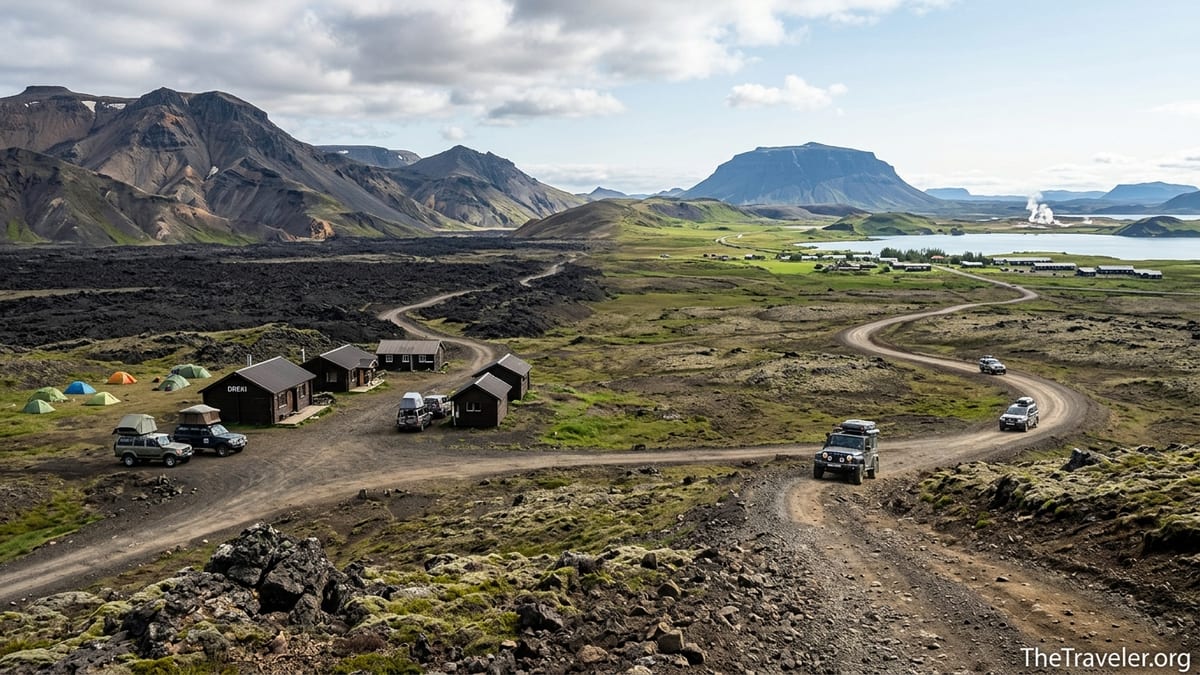
Askja sits in the central highlands within the northern territory of Vatnajökull National Park, far from services and on rough F roads that are usually accessible only for a short summer window, typically from late June or July until early September, depending on conditions. The closest accommodation to the caldera is a cluster of basic huts and a campground at Dreki, near the mouth of Drekagil canyon, with a smaller hut and campsite at Herðubreiðarlindir oasis further north. These sites are managed in cooperation with Icelandic touring clubs and park authorities and are intended for self sufficient travelers who arrive with their own food, fuel and proper vehicles.
Most visitors, especially on a first trip, stay in the Lake Mývatn region around Reykjahlíð and the ring road. This area has a full range of hotels, guesthouses, farm stays, campsites and geothermal baths, and it acts as the main gateway for guided Askja tours. A long Askja day trip from Mývatn commonly runs to 10 to 12 hours including driving and the hike to the crater lake, so travelers should factor in an early start and late return if they choose this strategy.
A third category consists of bases slightly farther from Mývatn. These include highland farm guesthouses on or near Route 1 such as Möðrudalur, which market themselves as gateways to the interior, and larger towns like Akureyri and Egilsstaðir. These appeal to travelers who want more urban services or are linking Askja with longer itineraries around North and East Iceland, but they involve longer drive times to reach the Askja access roads or reliance on long day tours.
In practice, your ideal base depends on how much wilderness immersion you want, your comfort expectations and whether you have a suitable 4x4 or prefer to join a guided tour. The sections below compare these options in more detail to help you choose.
Dreki Huts and Herðubreiðarlindir: Simple Bases Inside the Highlands
Dreki, at the entrance to Drekagil canyon just below the Dyngjufjöll mountains, is the closest accommodation area to the Askja caldera that most travelers can realistically use. According to information from Vatnajökull National Park and the Touring Club of Akureyri, the Dreki huts together accommodate roughly 55 people in bunk style shared rooms, with an adjacent campground and a simple service building that offers toilets and showers during the summer season. Travelers should confirm precise opening dates each year, but in normal seasons Dreki operates only in summer when F roads are open and hut wardens or rangers are present.
Herðubreiðarlindir, an oasis east of the iconic table mountain Herðubreið, offers a quieter alternative still within the highlands. The Thorsteinsskáli hut here typically sleeps about 25 people in bunks, and there is a separate sanitary house with toilets and a gas operated shower that is opened when wardens are on site in summer. There is also a basic campground. Facilities at both Dreki and Herðubreiðarlindir follow the same general pattern: shared sleeping rooms with mattresses or bunks, a common kitchen or cooking area with gas stoves and limited utensils, cold or mixed temperature running water where available, and no private rooms.
Travelers planning to stay in these huts should directly confirm current hut capacities, exact operating dates and booking rules with the managing touring club or via official park channels before committing to an itinerary. In recent seasons, advance reservations have usually been required for bunks, with online booking or email contact through the respective touring club office, while camping has been more flexible but still subject to local rules and a camping fee. Prices tend to be charged per person for hut bunks and per tent or per person for camping, with summer hut rates that are often in the mid to higher budget range by Icelandic standards. Payment by card is increasingly common but cannot be guaranteed; travelers should check in advance whether the specific hut accepts cards or requires cash.
Guests should expect to bring their own sleeping bags unless a particular hut explicitly states that linens can be rented or are included. Quiet hours, check in times and kitchen use rules are set by the hut wardens and posted on site, and travelers must follow them closely, both out of courtesy and due to the compact shared spaces. These are staffed mountain huts rather than hotels, and guests are expected to clean up after themselves, manage waste carefully and comply with any park regulations about gray water and camping boundaries. Because of the remoteness, there are no shops, restaurants or fuel at Dreki, Herðubreiðarlindir or in the Askja area, so visitors must arrive with all food, snacks, cooking supplies and enough fuel to complete the round trip back to the ring road.
Who Should Choose the Highland Huts and Campsites
Staying at Dreki or Herðubreiðarlindir suits travelers who value time on the trail and flexibility over comfort. By spending a night in the highlands you gain the option to visit the Askja caldera either in the evening after most day tour groups have left, or early the following morning, which can mean a quieter experience and more flexibility to wait out passing showers or low cloud. The shorter daily driving time compared with a full return to Lake Mývatn also helps reduce fatigue on rough roads and allows for slower, more cautious river crossings where applicable.
The huts and campsites are particularly appealing for hikers completing multi day routes across the northern Vatnajökull highlands or photographers who want a base close to Askja and Herðubreið. The remoteness does have real consequences, however. Anyone choosing this option needs a suitable 4x4 vehicle that is legally permitted on F roads, experience or comfort with highland driving, and the ability to carry enough food and warm clothing for conditions that can remain wintry even in mid summer.
This strategy is less suitable for travelers who expect hotel level privacy, who are nervous about shared sleeping spaces or who prefer to dine in restaurants after a long day out. Families with young children may also find the logistics demanding unless they are experienced with hut to hut hiking or backcountry camping. For these visitors, it often makes more sense to stay in the Mývatn area and either book a guided Askja tour or, for confident drivers, tackle a long but single day self drive with a clear weather window.
Before committing to hut nights, travelers should also consider how comfortable they are with flexible plans. Summer storms, late snow or heavy rain can temporarily render F roads impassable or lead to closures on short notice. Booking terms for huts and tours vary, so it is important to verify cancellation policies so that you understand what happens if the road to Askja is closed and you cannot safely reach or leave Dreki or Herðubreiðarlindir on the planned date.
Lake Mývatn and Reykjahlíð: Comfortable Gateway to Askja
The Lake Mývatn region, centered on Reykjahlíð village along the ring road, is the most popular base for visiting Askja because it combines decent road access with a wide range of accommodation and services. From Mývatn, the drive to the Askja approach roads on F88 or the F905 and F910 combination is still several hours each way, and a round trip to the caldera, including the hike from the car park to the Víti crater and Óskjuvatn, commonly runs to 10 to 12 hours in total. Even so, starting and ending the day in Mývatn offers hot showers, restaurants and geothermal baths that many travelers appreciate after a demanding highland excursion.
Accommodation around Lake Mývatn spans almost every category. There are modern full service hotels with on site restaurants, such as properties near Reykjahlíð and along the southern shore, which tend to suit couples, small groups and travelers who prefer higher comfort and are willing to pay more for convenience. Typical high summer prices for double rooms in this category often fall into the mid to upper price range for rural Iceland, with significant variation by property and booking date. Travelers are advised to check current seasonal price ranges directly with chosen hotels, as demand can shift from year to year.
Alongside the hotels are numerous guesthouses and farm stays located around the lake shore and surrounding farmland. These often provide private or shared bathrooms, breakfast and sometimes simple evening meals, and they are popular with independent travelers, photographers and families who appreciate a homely feel. Self catering cottages and apartments, some on working farms, provide additional flexibility for those wanting to cook their own meals and keep irregular hours, which can work well when planning very early departures for Askja or late returns from highland tours.
The Mývatn area also has several campgrounds, including sites near Reykjahlíð and on the lake’s north shore. These typically offer grassy pitches, access to toilets and showers, and sometimes kitchen or lounge buildings. Camping is the most budget friendly way to base near Mývatn, though prices still reflect Icelandic costs and vary with facilities and the season. Importantly, Mývatn has fuel, small supermarkets or convenience stores and multiple restaurants or cafés, so travelers can easily stock up before heading inland.
Askja Tours and Practical Advantages of a Mývatn Base
One of the strongest arguments for staying around Lake Mývatn is the convenience of guided Askja tours. Several local operators, including long running highland specialists, run daily or near daily Askja excursions in peak summer, usually in 4x4 minibuses or super jeeps. These tours typically depart from central pick up points in Reykjahlíð or directly from selected Mývatn hotels and guesthouses, which means that travelers without a suitable 4x4 or those who prefer not to handle river crossings can still visit Askja in relative comfort.
Exact pick up locations change over time, but it is common for operators to list key hotels, guesthouses and the main tourist information area around Reykjahlíð among their standard stops. Travelers should confirm when booking whether their accommodation is an official pick up point or whether they need to meet the tour at a central location. Staying locally simplifies logistics, as tours often start early in the morning and return in the evening, and it reduces the fatigue and risk associated with self driving on long gravel stages after a full day of sightseeing.
Beyond Askja, the Mývatn region is an attraction in its own right, with geothermal areas such as Hverir, the crater at Hverfjall, lava formations at Dimmuborgir and popular geothermal bathing facilities. Choosing Mývatn as a base allows travelers to hedge against highland weather: if F roads are temporarily closed, there is still plenty to see and do in the immediate area. This makes it an appealing option for families, older travelers and anyone planning a few days in North Iceland rather than a single targeted dash to Askja.
Because of the combination of attractions and limited bed capacity, high season accommodation in Mývatn can sell out weeks or months in advance, particularly in July and August. Current booking trends indicate that flexible travelers who book mid week or shoulder season dates have more choice, while those wanting peak weekends or specific properties should secure reservations early and pay close attention to cancellation terms in case weather prevents an Askja visit on the planned day.
Alternative Bases: Möðrudalur, Akureyri and Egilsstaðir
For travelers on longer ring road or regional itineraries, it can make sense to base either nearer to the F road junctions or in larger towns that offer wider services. Möðrudalur, a small settlement and working farm on or near Route 1 between Mývatn and Egilsstaðir, is one such option. Local guesthouse and camping operations here promote themselves as gateways to the highlands, including Askja, and offer a mix of rooms, cabins and a campground, along with a café or simple restaurant and fuel. Staying here trims some driving time to certain highland routes compared with Akureyri or Egilsstaðir and provides a quieter, more rural atmosphere than Mývatn, though with fewer dining options and activities.
Akureyri, North Iceland’s main town, lies significantly farther from Askja but offers a wide range of hotels, guesthouses, hostels, apartments and restaurants, as well as supermarkets, car rental offices and tour providers. For visitors who want an urban base with museum visits, shops and easier road conditions on most days, Akureyri can work as the start point for an Askja day tour run by specialized operators or for self drivers willing to invest a very long day behind the wheel. The trade off is substantial extra drive time on both paved and gravel roads before even reaching the F road junctions, which can make an Askja excursion from Akureyri more demanding.
On the eastern side of the country, Egilsstaðir plays a similar role. It is the main service town in East Iceland, with a choice of hotels and guesthouses, supermarkets, restaurants and a small airport. Some travelers choose to stay here and make a long day trip to Askja or join tours that connect East Iceland with the highlands. Others stop in Egilsstaðir before or after staying at Möðrudalur or Mývatn as part of a loop. Those basing in Egilsstaðir should be ready for long driving days, and anyone without highland driving experience may prefer to rely on organized tours.
These alternative bases are particularly suited to travelers who see Askja as one highlight among many rather than the sole focus of the trip. If you are planning a week or longer in North or East Iceland, using Akureyri or Egilsstaðir as hubs can simplify logistics, spread out your driving, and provide more consistent dining and shopping options, with Askja either as a dedicated long day or a one night detour via Möðrudalur or the highland huts.
Comparing Drive Times, Comfort and Services
While exact drive times vary with road conditions, weather and chosen routes, some broad comparisons help frame the decision. From Lake Mývatn, a round trip to Askja via the usual F road combinations, plus time at the caldera, commonly takes a full day of 10 to 12 hours. From Möðrudalur, the approach to F roads is shorter, which can shave some time from the overall journey. From Akureyri or Egilsstaðir, travelers must first drive a significant distance along Route 1 before even reaching highland access points, making an Askja outing longer and more tiring.
Comfort levels differ sharply between bases. Dreki and Herðubreiðarlindir provide authentic highland immersion but with dormitory bunks, shared facilities and no catering. Lake Mývatn offers mid range to higher comfort levels across hotels and well equipped guesthouses, plus camping for those who want to stay on a budget. Akureyri and Egilsstaðir add the amenities of small towns, such as multiple restaurant choices, pharmacies and a variety of lodging styles, but require more time on the road to reach Askja.
For travelers without a suitable 4x4 or who are not comfortable driving F roads, access to tours can be decisive. Guided Askja tours are most easily joined from the Mývatn area, where operators run frequent departures in peak summer and pick up directly from or near many accommodations. Tours from Akureyri or Egilsstaðir exist but may be less frequent and involve longer days, while staying at Dreki or Herðubreiðarlindir generally presupposes that you already have your own capable vehicle and will not rely on daily pick ups.
The following simple table offers a broad comparison of common bases for Askja visits. Distances and drive times are indicative and assume summer conditions; travelers should always confirm current road status and estimated durations before departure.
Base | Approximate drive time to Askja area in summer | Comfort level | Restaurants and shops | Access to tours | Suitability without 4x4
Dreki huts / Askja highlands | Shortest final approach, but requires full day of F road driving to reach | Very basic huts and camping | None | Not a normal tour pick up point | Not suitable without 4x4
Herðubreiðarlindir | Short to moderate highland drive from F road junctions | Basic hut and camping | None | Occasionally used as route stop, not a main base | Not suitable without 4x4
Lake Mývatn / Reykjahlíð | Commonly 10–12 hours round trip including visit | Wide range from hotels to camping | Several restaurants, fuel and small shops | Multiple daily tours in season with local pick up | Very suitable, as many take tours
Möðrudalur area | Shorter access to some highland routes than large towns | Rural guesthouse, cabins, camping | Limited café or restaurant and fuel | Selected tours or self drive | Possible but more limited without 4x4
Akureyri | Long day including extra ring road distance | Wide mix of town hotels, guesthouses and hostels | Numerous restaurants and full services | Some long day tours, less frequent | Possible on tours, but long days
Egilsstaðir | Long day from East Iceland side | Town hotels, guesthouses and apartments | Restaurants, supermarkets and services | Limited highland tour options | Possible on tours, but long days
Booking Strategies, Seasons and Weather Risks
Regardless of where you stay, planning ahead is crucial for an Askja visit. The effective season for road access is short, in many years limited to a few weeks from late June or July into early September. Within that window, demand for both highland huts and Mývatn accommodation peaks in July and August. It is wise to book hut bunks, Mývatn hotels and organized tours well in advance, particularly if you are traveling in a small group or have specific dates that cannot easily shift.
At the same time, flexibility remains important because highland roads can close quickly if conditions deteriorate. When booking huts, hotels or tours, pay close attention to cancellation and change policies, including whether refunds or credits are offered if F roads to Askja are officially closed by the road authorities or if operators must cancel due to weather or safety concerns. Some providers allow date changes within the season, while others charge modification fees or treat weather related disruptions differently from personal cancellations.
Travelers should also consider trip sequencing. Spending a few days around Mývatn before attempting Askja lets you monitor local forecasts, speak with rangers or tour operators and pick the best available day for the highland excursion. Those staying at Dreki or Herðubreiðarlindir must be prepared to adjust plans if late snow or heavy rain delays the hut opening or makes onward routes temporarily impassable. Keeping one contingency day in your itinerary for weather can reduce disappointment in a season with unsettled conditions.
Basic safety preparation is vital for any Askja visit. Even if you are basing in comfort at Mývatn, you will spend many hours in remote terrain with limited phone coverage. Ensure your vehicle is suitable and permitted for F roads if you self drive, carry extra layers, food and water, and check the latest road and weather updates on official channels every day you plan to enter the highlands. If you are uncertain about conditions or your own highland driving experience, opting for a guided tour from the Mývatn area is the safer choice.
Choosing the Best Base for Your Askja Priorities
For travelers who prioritize comfort, dining options and a range of other activities, basing around Lake Mývatn is usually the most balanced choice. You can enjoy hot showers, restaurants and geothermal baths, explore iconic nearby sites such as Dimmuborgir and Hverir, and either self drive or join one of several Askja tours that pick up locally. This option works especially well for families, couples on a scenic holiday and first time visitors who want a high impact day in the highlands without sacrificing evenings in a comfortable setting.
If your main goal is immersion in Iceland’s interior and you are ready to trade comfort for proximity, spending a night or two at Dreki or Herðubreiðarlindir offers the most direct highland experience. You will sleep in simple bunk rooms or a tent under a vast sky, share facilities with fellow travelers and step out into a landscape of lava and mountains before most visitors have arrived. This strategy suits experienced hikers, keen photographers and adventurers with the right vehicle and a high tolerance for basic conditions and flexible plans.
Travelers on broader North and East Iceland itineraries, or those who prefer the familiarity of a town base, may lean toward Akureyri, Egilsstaðir or a rural stop like Möðrudalur. These allow you to weave Askja into a longer journey, balancing one very long day or a short detour into the highlands with easier days on the ring road and more consistent access to restaurants, shops and other services. In any of these cases, starting early, monitoring conditions closely and, when in doubt, joining a reputable tour are key to a safe and rewarding visit.
Whichever base you choose, the same core principles apply: book early for high season, verify current hut capacities, operating dates and tour schedules, and pay careful attention to cancellation terms in case F roads or excursions are disrupted by weather. By matching your base to your priorities, vehicle and appetite for adventure, you can experience Askja in a way that is both practical and deeply memorable.