


For a place that once helped decide the fate of a revolution, Trenton today barely registers for most travelers. Drivers speed past New Jersey’s capital on Interstate 295 or the Turnpike. Amtrak passengers only glimpse the hulking "TRENTON MAKES THE WORLD TAKES" sign as their train rolls over the Delaware River. Even many New Jersey residents will tell you there is "nothing to do" there beyond state government. Yet when you step off the train or wander a few blocks from the capitol complex, a different Trenton appears: a walkable river city with serious history, an under-the-radar arts scene, and a food culture that mixes state workers, longtime locals, and creative newcomers at the same counters. The disconnect between reputation and reality might be one of this small city’s biggest misunderstandings.
Get the latest updates straight to your inbox!
The Reputation Problem: A Capital People Pass By
Ask someone in New York or Philadelphia about Trenton and you are more likely to hear jokes about bureaucrats and budget fights than tips on where to spend a weekend. Major guidebooks often skip the city entirely or fold it into vague "Central Jersey" entries, nudging readers toward Princeton’s collegiate streets or Lambertville’s antique shops instead. Online, Trenton appears in news headlines about politics, not as a destination. Even some residents of nearby suburbs talk about it as a place to commute into for work and flee from by 5 p.m.
Part of the problem is geography. Trenton sits almost exactly between two heavyweight cities, an hour or less by rail from both New York Penn Station and Philadelphia’s 30th Street Station. Commuter trains and the River Line light rail treat Trenton as a transfer point, not a place to linger. The capital complex, with its imposing state offices, has long overshadowed the surrounding neighborhoods. For visitors who only know the view from the highway or the station platform, it is easy to mistake Trenton for little more than a government campus ringed by surface parking.
Another factor is perception of safety and amenities. Ask around and you will hear the same refrain: Trenton is "not that bad" if you keep your wits about you, but there are few obvious draws once the state offices close. That narrative discourages casual explorers who might otherwise wander into local parks or museums. It also glosses over the fact that several pockets of downtown and nearby neighborhoods are seeing slow but real reinvestment, from renovated rowhouses in Mill Hill to creative projects supported by local nonprofits and state redevelopment grants.
What gets lost in that reputation is nuance. Trenton is not a polished, fully gentrified destination. But it is also not the empty, dangerous void some imagine. At street level, out-of-towners are surprised to find a friendly, small-city rhythm: regulars chatting with staff at 1911 Smokehouse BBQ on West Front Street, families pushing strollers through Cadwalader Park, and students crossing between restored stone townhouses near Thomas Edison State University’s campus on West State Street.
A Revolutionary City Hiding in Plain Sight
Historically, Trenton should be on every American history buff’s shortlist. The city’s role in the Revolutionary War is outsized for its modest footprint today. The famed Battle of Trenton in December 1776, when George Washington’s troops crossed the icy Delaware River to surprise Hessian forces, is often credited with reviving the patriot cause at a desperate moment. Modern Trenton still carries visible traces of that era if you know where to look.
Near the gold-domed State House, you can walk streets that align roughly with the colonial town plan. Washington is commemorated on statues and plaques, including sculptures that reference the Delaware crossing and the subsequent victories at Trenton and Princeton. The city’s grid, particularly in the Mill Hill Historic District, preserves 18th and 19th century streetscapes in brick and stone rather than behind glass in a recreated village. Unlike more curated historic attractions, this is living infrastructure: rowhouses with Greek Revival and Italianate details, iron railings, and narrow brick sidewalks that people still use every day.
Cadwalader Park, designed in part by Frederick Law Olmsted, offers another kind of historic connection. Sprawling over hundreds of acres on Trenton’s west side, it is a reminder of the late 19th century belief that cities needed large public greens. On a warm Saturday you might see a youth soccer game on one field, a family cookout under a pavilion, and a couple taking engagement photos along winding paths. From certain vantage points you can glimpse the Delaware River and understand why this bluff-top city became a crucial crossing and industrial hub.
Because Trenton’s visitor numbers remain modest compared with Boston or Philadelphia, you can often experience these historic sites without crowds. A weekday morning walk from the State House complex through Mill Hill to the Assunpink Creek feels almost like stepping behind the scenes of the American story. For travelers who dislike queues and commercialized reenactments, that low-key authenticity is a feature, not a bug.
Arts, Museums and a Quiet Cultural Core
Just as overlooked as Trenton’s history is its cultural infrastructure. The New Jersey State Museum, set along West State Street near the capitol, combines natural history, archaeology, and fine art under one roof. Visitors can see everything from dinosaur fossils and Native American artifacts to modern paintings by New Jersey artists, plus rotating exhibits that touch on the state’s social history. The museum is sized for a half-day visit, not a marathon, which makes it especially manageable for families with children in tow.
Across the street, the New Jersey State Library and several historic university buildings used by Thomas Edison State University add an academic feel to the neighborhood. The university has refurbished notable structures like the Kelsey Building and Kuser Mansion, helping stabilize blocks that might otherwise have fallen into disrepair. Walking these streets feels a bit like touring a compact college town, with state workers on lunch breaks sharing the sidewalks with adult learners heading to evening classes.
Beyond the official institutions, Trenton’s arts scene has taken root through grassroots projects like the Creek to Canal Creative District. Spearheaded by the local nonprofit Isles, this initiative supports working artists, small creative businesses, and community organizations in and around downtown, offering grants and networking events that bring people into the city’s galleries and studios. Recent programs have included grants for public art and creative placemaking, and a 2026 networking brunch for local creatives that signals how energy is pooling in this corridor between the Assunpink Creek and the Delaware & Raritan Canal.
For visitors, that means chances to stumble upon pop-up exhibits, open studio nights, and events like short film festivals hosted in downtown venues. Schedules change from season to season, but stopping by a gallery-opening reception or small music performance can be a memorable way to connect with residents who are actively shaping Trenton’s future identity.
Neighborhoods With Character: Mill Hill, the Riverfront and Beyond
While many travelers never venture far from the capitol complex, the neighborhoods immediately beyond it may be Trenton’s strongest argument against its "nothing there" reputation. The Mill Hill Historic District, just southeast of downtown, is perhaps the most visually striking. Added to the National Register of Historic Places in the 1970s, Mill Hill showcases two- and three-story brick rowhouses in styles ranging from Greek Revival to Second Empire, set along narrow streets that bend gently with the landscape.
On a walk down Mercer Street or Jackson Street you might see residents sitting on stoops, planters overflowing with flowers, and restored cornices painted in deep greens and reds. Architectural details like arched doorways and ornate brackets reward slow exploration. During warmer months, neighborhood associations sometimes open selected homes for tours, illustrating how 19th century rowhouses can be adapted to modern living. Even without a formal event, simply wandering these blocks provides a sense of an ordinary Trenton that does not match the city’s caricature.
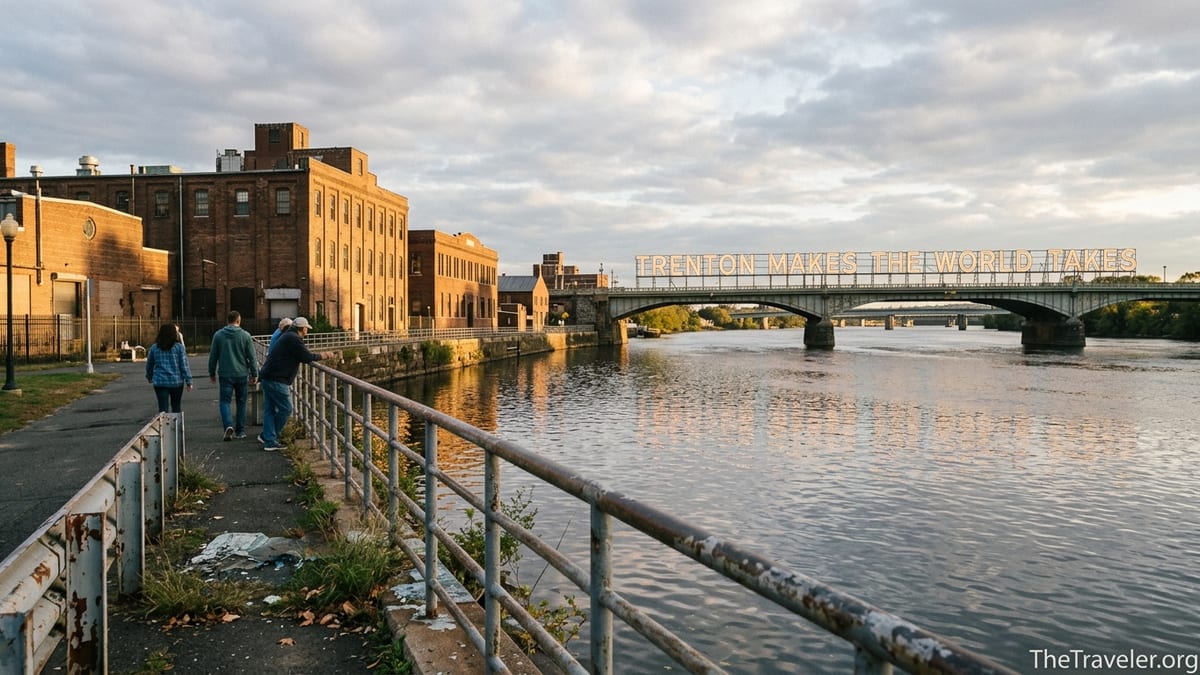
Near the Delaware, the waterfront area remains a work in progress, with ongoing conversations about downgrading highway segments to create a more accessible riverfront park. For now, river views are a bit fragmented by infrastructure, but a patient walker can still find vantage points where the "Trenton Makes" bridge dominates the horizon. In the evening, the red neon letters reflecting on the water are both a photo opportunity and a symbol of the city’s industrial past, when factories along the river supplied wire, steel, and ceramics around the globe.
On the west side, streets around Cadwalader Park and pockets of historic housing offer another perspective. Here, large trees and detached homes soften the city’s image further. Visitors who only see this leafier side, especially during autumn foliage or spring blossoms, sometimes react with surprise that it is the same Trenton they have heard maligned.
Food and Local Flavor: Eating Like a Trentonian
Even in a city with a modest tourism profile, food can function as a gateway. In Trenton’s case, the draw is less about national-name chefs and more about a tight cluster of locally beloved spots that blur the line between neighborhood hangout and destination. A standout example is 1911 Smokehouse BBQ on West Front Street, just a few blocks from the river and the transit center. Well reviewed for its brisket, rib tips, and pulled pork, the restaurant also surprises first-time visitors with options like vegan sausage, hearty sides, and a burger topped with Trenton’s signature pork roll instead of bacon.
Lunchtime sees a mix of state workers grabbing platters before heading back to offices and families settling in for slow meals. On game days or during special events, the space takes on more of a bar-and-grill energy, reinforcing the sense that this is a place where locals actually spend their evenings. Prices for a plate of smoked meat with two sides are typically in the mid- to high-teens in dollars, comparable to casual barbecue spots in larger cities but with a friendlier, small-town pace.
Beyond barbecue, downtown and nearby corridors support a changing cast of diners, coffee shops, food trucks, and small ethnic restaurants that cater to Trenton’s diverse population. Dominican, Puerto Rican, and West African spots are particularly common along certain stretches of the city, though specific names come and go as rents and ownership change. For travelers, that flux is part of the appeal: a chance to try a pastelillo or jollof rice in a setting where you may be the only out-of-towner in the room.
One practical tip for visitors is to time meals to daytime or early evening, when the downtown core still has foot traffic. Many offices and state buildings close by late afternoon, and while some restaurants remain open into the night, the streets can become very quiet. Planning a late lunch or early dinner before heading to a performance, museum event, or back to your lodging makes it easier to experience Trenton at its most active.
Getting In, Getting Around and Feeling Safe
Trenton is easier to reach than many better-known destinations. Amtrak’s Northeast Corridor, NJ Transit’s commuter rail from New York and Newark, and SEPTA’s Trenton Line from Philadelphia all terminate at Trenton Transit Center, a busy hub east of downtown. From there, visitors can walk into the city core in about 10 to 15 minutes or connect to local buses and the River Line light rail, which follows the Delaware south through smaller towns to Camden.
Drivers approach on Interstate 295, U.S. 1, or Route 29, which runs along the river. Parking in downtown tends to be a mix of metered street spaces and surface lots, many originally sized for state employees. Daytime availability is generally good, especially outside of legislative sessions, but nights and weekends can feel oddly empty in some blocks due to the sheer number of underused lots. That emptiness is one reason many out-of-towners form a negative first impression; they see concrete expanses instead of lively streets.
Safety is often the first question prospective visitors raise. Like many small post-industrial cities, Trenton has neighborhoods with elevated crime and visible poverty, alongside streets where residents walk dogs after dark without a second thought. For travelers, the usual urban common sense applies: stay aware of your surroundings, stick to well-lit routes at night, and avoid wandering deep into unfamiliar residential areas after bars close. During the day, routes between the State House, New Jersey State Museum, downtown restaurants, and Mill Hill see regular foot traffic from workers and residents, and most visitors report feeling comfortable.
Those particularly cautious about safety can schedule visits around daytime events, such as museum activities for children, film festivals, or creative district programming that brings crowds into the center. The presence of college students, state employees, and visitors from nearby suburbs during these times lends a sense of normalcy that may contradict what you have heard about Trenton but aligns with what you actually experience on the ground.
Why Trenton Feels Different From Polished Neighbors
One reason Trenton is misunderstood is that it refuses to conform to the tourist-friendly image projected by its neighbors. Princeton, a short train ride away, offers manicured quads and curated boutiques. Lambertville and its Pennsylvania counterpart, New Hope, have built reputations on antique stores, craft galleries, and riverside restaurants that hum every weekend. Trenton, by contrast, is still wrestling with vacant lots, aging infrastructure, and the legacy of big industries that left town decades ago.
For some travelers, that roughness is off-putting. There are blocks where handsome facades are interrupted by boarded-up structures, and you can go from picture-perfect rowhouses to an empty parcel in half a minute on foot. Yet for others, that in-between quality feels honest and compelling. You are seeing a capital city that is still very much in the process of redefining itself, not one that settled long ago into a single, marketable story.
State and local initiatives hint at that transition. Redevelopment corporations and neighborhood revitalization programs have been channeling grants toward downtown projects, small-business support, and housing repairs, aiming to convert some of those surface parking lots and vacant properties into active blocks over time. Cultural organizations secured funding to support artists and city museums, while plans for expanding Trenton-Mercer Airport and improving transit connections show that state leaders recognize the capital’s potential as more than an office park.
For visitors, the result is a city where you might walk past a construction fencing banner advertising a future mixed-use building, then duck into an old-school diner that has served the same clientele for decades. That juxtaposition, and the sense of watching change unfold at a human scale, is something you rarely get in more fully polished destinations.
The Takeaway
Trenton’s biggest misunderstanding may be the idea that nothing in the city merits a traveler’s time. The reality, visible as soon as you slow down and look past the parking lots, is a compact capital with layers of Revolutionary War history, a surprisingly rich cultural core, and neighborhoods like Mill Hill that reward unhurried walking. You will not find the density of attractions you might in a larger city, but you will find a mix of museums, parks, and local food spots that comfortably fill a day trip and can anchor a weekend in Central New Jersey.
Choosing to visit Trenton is less about ticking off a list of blockbuster sights and more about engaging with a place that many people write off without ever seeing it. It is about standing under the "Trenton Makes" sign and thinking about how a small river city once helped shape a continent, then eating barbecue alongside state workers on their lunch hour, or listening to a local artist explain a mural funded through a creative district grant. In that respect, Trenton offers not only a destination but also an invitation to reconsider how easily we let reputations, and other people’s anxieties, tell us where we should and should not go.
If you are willing to approach New Jersey’s capital with curiosity and a bit of street savvy, you will find a city that is rough-edged but real, short on gloss but rich in stories. Trenton may still be overlooked by most travelers, but for those who step off the train instead of riding through, that oversight turns into an opportunity.
FAQ
Q1. Is Trenton, New Jersey safe for tourists to visit?
Trenton has both safe and higher-crime areas, similar to many small cities. Visitors who stay around the State House, New Jersey State Museum, Mill Hill, and the main downtown streets during the day and early evening, use well-lit routes, and practice basic urban awareness usually report uneventful, comfortable visits.
Q2. How long do I need to see the main sights in Trenton?
A full day is enough to visit the State House exterior, tour the New Jersey State Museum, walk through Mill Hill and Cadwalader Park, and enjoy a couple of local meals. With an extra day, you can add events, galleries, or side trips to nearby towns like Princeton or Lambertville.
Q3. What is the easiest way to get to Trenton without a car?
Trenton Transit Center is served by Amtrak’s Northeast Corridor, NJ Transit commuter trains from New York and Newark, and SEPTA’s Trenton Line from Philadelphia. From the station, you can walk downtown in about 10 to 15 minutes or connect by local bus or taxi to reach the State House, museum district, and riverfront.
Q4. Are there good places to eat in downtown Trenton?
Yes. Spots like 1911 Smokehouse BBQ on West Front Street draw a loyal following with smoked meats, hearty sides, and a relaxed bar atmosphere. Around downtown you will also find diners, coffee shops, and small ethnic restaurants serving Dominican, Puerto Rican, and West African dishes, though specific venues change over time.
Q5. What neighborhoods are most interesting for visitors to walk through?
For many visitors, the Mill Hill Historic District is the highlight, with its brick rowhouses, cobbled feel, and restored 19th century architecture. Streets around West State Street, the capitol complex, and Cadwalader Park also make rewarding walks, offering a mix of civic buildings, university structures, and leafy residential blocks.
Q6. Is Trenton worth visiting if I am already planning to see Princeton or New Hope/Lambertville?
If you have even one extra day, Trenton offers a very different perspective from those polished destinations. Combining a Trenton day trip with time in Princeton or Lambertville gives you a fuller picture of Central New Jersey, from elite college town to river resort to working capital city.
Q7. What are the must-see attractions for first-time visitors?
For a first visit, prioritize the New Jersey State Museum, an exterior look at the State House and surrounding historic government buildings, a walk through the Mill Hill Historic District, time in Cadwalader Park if the weather is good, and at least one meal at a locally beloved restaurant near downtown.
Q8. Can I visit Trenton as a family with young children?
Yes. Families often appreciate that the New Jersey State Museum is compact and manageable, with exhibits that appeal to kids, including natural history and planetarium shows when available. Cadwalader Park provides playgrounds and open space, and most downtown restaurants are accustomed to serving families during daylight hours.
Q9. When is the best time of year to visit Trenton?
Spring and fall are ideal, with comfortable temperatures for walking and attractive foliage in parks and historic neighborhoods. Summer can be hot and humid but brings more outdoor events, while winter is quieter and better suited to museum visits and short strolls between indoor stops.
Q10. How should I plan my day to get the best feel for the city?
Arrive by late morning, walk from the transit center or parking to the State House and New Jersey State Museum, then head into Mill Hill or Cadwalader Park for an afternoon stroll. Schedule a late lunch or early dinner at a local favorite downtown before catching an evening train or returning to your hotel, and look for any special events or gallery openings that coincide with your visit.