


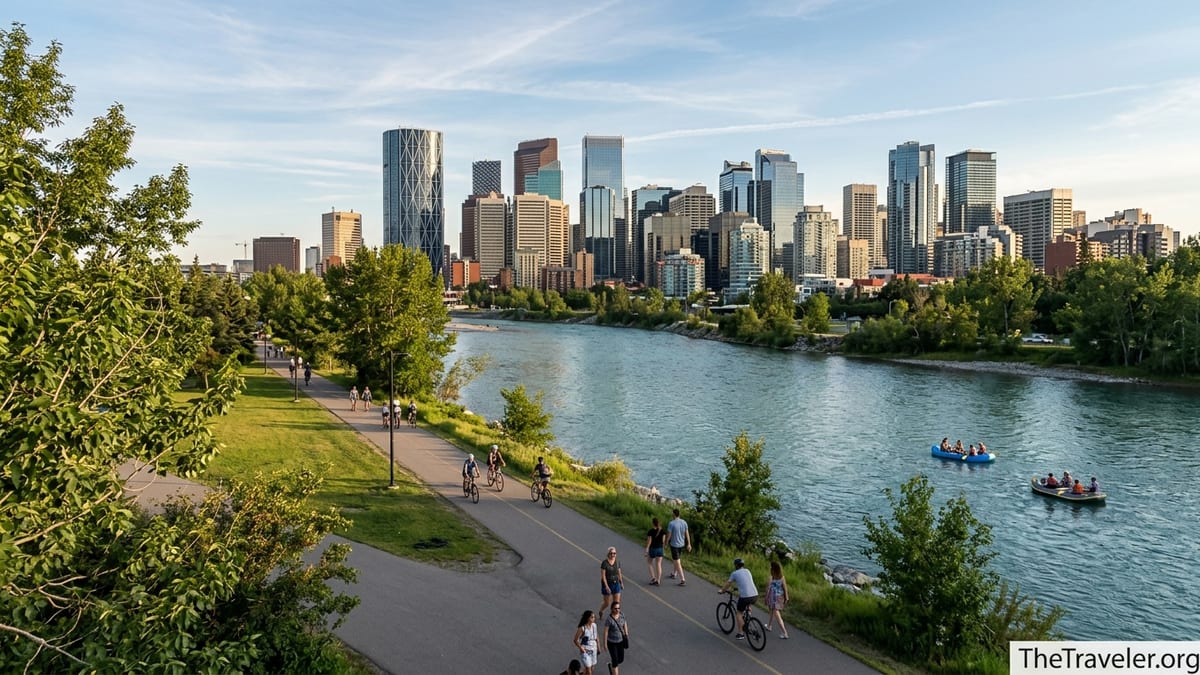
Arriving in Calgary, it is easy to mistake the city for a purely buttoned-up business hub. Glass towers rise over the Bow River, downtown streets hum with energy executives, and major conventions fill the BMO Centre at Stampede Park throughout the year. Give it a day or two though, and a different Calgary begins to emerge. Underneath the corporate polish is a city obsessed with the outdoors, where rafting launches just below office towers, coyotes wander the riverbanks at dawn, and a ten-day rodeo every July pulls everyone into denim and dust.
Get the latest updates straight to your inbox!
First Impressions: Towers, Conventions and a Corporate Skyline
On a weekday morning, Calgary feels all business. The downtown core is dense with head offices, especially in energy, finance and engineering, and many visitors arrive for meetings at companies clustered along 8 Avenue and 9 Avenue Southwest. The glass and steel towers, connected by more than 18 kilometres of enclosed +15 walkways, give the central grid a utilitarian, efficient feel that can seem interchangeable with other North American business districts at first glance.
The rhythm of the city reinforces this impression. Coffee lines at spots like Deville Coffee or Monogram in the Core Shopping Centre are dominated by people in ID lanyards and suits, laptops under one arm, paper cups in the other. At lunch, the Calgary Telus Convention Centre and the expanded BMO Centre at Stampede Park empty into the streets as conference attendees swarm nearby restaurants before hustling back into fluorescent light. For many business travelers, this is the only Calgary they see, and it is neat, convenient and slightly anonymous.
Even the way many hotels are configured supports the corporate mood. Business-focused properties near the core routinely advertise proximity to office towers and in-house meeting space as their main selling points. Corporate rates, airport shuttles and quiet lounges can make it tempting to treat Calgary as a place to land, work and leave. Yet in doing that, you miss what truly sets the city apart from other Canadian business centres: the way nature keeps intruding, insistently, into the urban fabric.
Look a little closer from the same hotel window and you will notice that the skyline breaks where the Bow River carves through downtown, that bikes outnumber briefcases on the river pathway at sunrise, and that, within a 20-minute walk, glass towers give way to cottonwoods, dirt trails and a river busy with rafts.
The Bow River: Where Suits Trade Shoes for Sandals
The Bow River is where Calgary’s wild side is easiest to find. A formal pathway system follows both banks for roughly 48 kilometres, linking neighbourhoods and parks from the western suburbs through downtown to Fish Creek Provincial Park in the south. In the city centre, that pathway passes right below major office towers, creating an unusual daily crossover between corporate life and outdoor leisure.
Early in the morning, before most boardrooms are occupied, you will see runners in technical gear pacing along the paved trail, office workers commuting by bike, and anglers in breathable waders casting lines in water that stays cold and clear thanks to its Rocky Mountain source. By lunchtime on a warm day, the crowd changes: people from nearby offices walk the pathway with takeaway sushi or sandwiches, while a few swap dress shoes for sandals and eat with their feet dangling over the riverbank.
From late spring to early autumn, rafting on the Bow becomes one of the most visible signs that Calgary is not just about business. Raft rental companies operate out of neighbourhoods like Sunnyside and Inglewood, offering inflatable rafts and stand-up paddleboards, plus life jackets and shuttle services back to the start. A typical trip might begin upstream near Bowness Park or Shouldice Park and drift through the middle of the city, under bridges carrying rush-hour traffic, before finishing east of downtown. On a sunny weekend, it is common to see flotillas of colourful rafts moving past the skyline, some with portable speakers and packed coolers, others hosting families with kids leaning over the sides, tracking mergansers and the occasional beaver.
For a visitor in town on business, joining a half-day rafting float is one of the simplest ways to experience this contrast. It requires no experience, just a willingness to trade a collared shirt for a quick-dry T-shirt and to see the same city you have been walking through from a much more relaxed angle, with swallows darting under bridge arches and office windows reflecting clouds instead of spreadsheets.
Prince’s Island Park: An Urban Oasis in the Corporate Core
If the Bow River is Calgary’s outdoor artery, Prince’s Island Park is its green heart. Sitting on an island in the river at the north edge of downtown, the park covers about 20 hectares and feels like a sudden escape from traffic and glass. Accessed by several pedestrian bridges from both banks, it is close enough to the office towers that people often head there for a 15-minute walking break between meetings, yet once you are under the cottonwoods the city noise softens to a distant hum.
The island is laid out with manicured lawns, flower beds, a wetland area with interpretive signage and a network of paved and dirt paths. On a weekday, you might see a pair of colleagues in business attire eating takeaway salads at a picnic table while, a few metres away, children chase geese and cyclists glide past. On summer weekends and evenings, the dynamic flips entirely: office workers recede, and the park becomes home to festivals, outdoor theatre and concerts. Events like the Calgary Folk Music Festival transform the island, with stages erected against a backdrop of willows and river channels, and crowds lounging on blankets well into the long prairie dusk.
For a traveler, Prince’s Island is where you can literally feel the city’s dual character in a single hour. Start with a morning coffee from nearby Eau Claire Plaza, join the stream of joggers circling the island, then step off onto a side trail where ducks feed in the shallows and you can hear the rush of the river. From certain bends, you look back at Calgary’s skyline rising abruptly beyond the trees, a reminder of how little distance there is between fluorescent cubicles and wild-water channels.
Even in winter, when snow muffles the park and the river steams in sub-zero temperatures, people in parkas and insulated boots keep moving through the island. Office lunch breaks turn into brisk walks over crunchy snow, and photographers come hunting for ice formations and frosted branches. For those used to cities where green space is something you drive to on weekends, the sight of beavers, owls or coyotes within view of conference hotels can be quietly startling.
Olympic Legacy: From Training Ground to Everyday Playground
Calgary’s reputation as a business hub often overshadows another key part of its identity: this is a city that hosted the 1988 Winter Olympics and built serious sports infrastructure in the process. Much of that legacy is still in daily use, not just by elite athletes but by ordinary Calgarians who treat former Olympic venues as after-work playgrounds.
WinSport’s Canada Olympic Park, in the city’s southwest, is the best example. Originally developed for events like ski jumping, bobsleigh and luge, it has evolved into a multi-season sports complex where local kids learn to ski, snowboard and mountain bike. Winter visitors can still ski or ride here on runs that are modest by Rocky Mountain standards but ideal for practice laps before a workday or in the evening under lights. The same slopes transform in summer into a lift-accessed bike park, one of the only such facilities within a major Canadian city, where riders in full-face helmets weave down groomed dirt trails.
Beyond skiing and biking, Canada Olympic Park now layers in activities that appeal to people who might never set foot on a race course. In the warmer months, families and groups of colleagues try downhill karting on a paved track that twists down the hillside, or play a casual round of mini golf with views over the city. Corporate groups that might spend the morning in a strategy session at an on-site meeting room often end the day with outdoor team-building, racing karts or tackling a ropes course, a very different kind of networking than a cocktail reception.
What makes this especially interesting from a traveler’s perspective is the proximity. From many downtown hotels, you can reach Canada Olympic Park in about 20 minutes by car in light traffic. That makes it entirely feasible to attend a full day of meetings, then be clipping into skis or strapping on body armour for mountain biking before sunset. The symbolism is hard to miss: the same city that negotiates multimillion-dollar deals also invests heavily in getting people out on snow and dirt.
Other Olympic-era facilities contribute in quieter ways. The Olympic Oval at the University of Calgary, with its famous long-track speed skating rink, is open to public skating at selected times. You may find yourself sharing ice with competitive athletes while families push skating aids nearby. It is a small, everyday reminder that in Calgary, high performance sport and ordinary life regularly share the same space.
Stampede Season: When a Business City Puts on Its Cowboy Boots
Every July, Calgary’s businesslike facade loosens during the Calgary Stampede, a ten-day event that mixes rodeo, agricultural fair and citywide party. Officially, it begins on the first Friday of the month and runs through the following weekend, but in practice the mood shift stretches well beyond those dates. Office towers hang banners, and many workplaces embrace a more relaxed dress code, with denim, plaid shirts and cowboy boots appearing in boardrooms.
Stampede Park, just southeast of downtown, becomes the focal point. The daily program features a major rodeo in the afternoon and an evening show combining chuckwagon races and grandstand performances, along with live music, agricultural displays and a sprawling midway. For a visitor mindful of the animal welfare debates that often accompany rodeo, there are plenty of ways to experience Stampede culture without attending the most controversial events. You can focus on the music stages, sample fairground food, visit Indigenous cultural exhibitions or watch trick-riding demonstrations.
Beyond the park gates, the entire city tilts toward celebration. Free pancake breakfasts, often sponsored by companies or community associations, pop up across neighbourhoods. Corporate clients are entertained at private parties in venues ranging from hotel ballrooms to repurposed warehouses. Deals that might normally be discussed in a boardroom move to informal conversations over barbecued beef on temporary patios. For many residents, the social networking that happens at Stampede is as important as any formal industry conference.
For business travelers, the key decision is whether to lean into the Stampede atmosphere or intentionally schedule trips around it. Visiting during the event means higher room prices and busier restaurants, but also the chance to see Calgary demonstrate a brand of hospitality not captured in meeting agendas. Visiting in shoulder months allows you to explore the city’s wild side with fewer crowds, trading rodeo dust for quieter time on the river or in its parks.
Neighbourhoods Where the Wild Creeps In
One of the most surprising things about Calgary is how quickly its neighbourhoods transition from urban to almost rural. Areas that initially appear like typical inner-city districts often hide pockets of nature that feel far removed from conference rooms and light rail lines.
Take Inglewood, just east of downtown, where old brick buildings now house design studios, wine bars and independent shops. At first it plays into the creative side of a modern business city. Yet a short walk from its main street brings you to the Inglewood Bird Sanctuary, a protected riverside area crisscrossed by dirt trails. Here, visitors track seasonal migrations of waterfowl and songbirds, and it is not unusual to spot deer grazing in clearings. From some viewpoints, the glass towers of downtown are still visible in the distance, but the dominant sounds are wind and birdsong.
In the northwest, Kensington appears at first as a lively commercial district serving nearby offices and university buildings, with cafes where people work remotely and restaurants busy with after-work gatherings. Walk down to the river, however, and you connect again with the Bow River pathway, where informal gravel paths branch off toward shaded benches and patches of native vegetation. Locals meet here for running clubs or impromptu picnics, using the same space as a thoroughfare and an escape.
Even suburban communities reveal this pattern. Neighbourhoods backing onto Nose Hill Park, one of the largest urban parks in North America, enjoy direct access to a landscape of native fescue grassland and rolling hills. From certain vantage points, you see hawks circling over rough prairie while, on the horizon, the downtown skyline glints in the sun. It is a visual summary of Calgary’s character: business centre in the distance, wildness underfoot.
Planning a Trip: Turning a Work Visit into an Adventure
For many travelers, Calgary first appears on the calendar as a work obligation: a conference at Stampede Park, a meeting at a downtown tower, a few hours between flights. With a little planning, those same trips can become gateways to unexpected outdoor experiences, without requiring a full vacation’s worth of time or equipment.
One of the easiest strategies is to build in unscheduled margins at the beginning or end of a work trip. Arriving a day early allows you to adjust to the time zone and immediately get outside, perhaps with a sunset walk through Prince’s Island Park or a short ride along the Bow River on a rented bike. Staying an extra night after your meetings gives you time for a morning rafting float or a half-day visit to Canada Olympic Park for biking or karting before you head to the airport.
Calgary’s dry, sunny climate also works in your favour. The city averages a high number of sunny days each year compared with many Canadian destinations, so packing light layers and comfortable shoes pays off. Even in winter, daytime temperatures often climb above freezing for short stretches when chinook winds roll in, abruptly melting snow from pathways. On those days, you might walk from a business lunch directly into a riverside park, coat open, breathing in air that smells more like early spring than deep winter.
If your schedule is especially tight, think in terms of micro-adventures. A 45-minute break between sessions is enough time to walk from most downtown hotels to the river’s edge and back, pausing briefly to watch ducks navigate the current or to stand on a pedestrian bridge and study the patterns of ice and water. An early alarm lets you join locals running or cycling before breakfast, when the sky over the prairie often turns pastel pink and orange. None of this requires special gear, just a willingness to step outside the predictable routine of hotel, taxi, meeting room.
The Takeaway
Calgary can certainly feel like a business city at first. It has the skyline, the convention infrastructure and the corporate energy to match that reputation. Yet the longer you walk its riverbanks, wander through its parks and watch residents drift down its central waterway, the harder it is to sustain a purely corporate image of the place. What emerges instead is a hybrid city that treats the outdoors not as a weekend escape but as an everyday companion.
For travelers, particularly those arriving on business, that duality is an opportunity. You can attend your meetings, network at receptions and catch up on email in the +15 walkways, then, in the same 24 hours, raft under the bridges you crossed earlier, watch the sun set behind former Olympic slopes or eat lunch under cottonwoods on an island that feels far from any boardroom. Calgary’s wild side is not a marketing slogan. It is built into its pathways, its festivals, its Olympic legacy and its residents’ unwavering habit of heading outside, no matter what else is on the agenda.
FAQ
Q1. Is Calgary worth visiting if I am mainly there for business?
Yes. Many visitors arrive for work but find the city’s river pathways, parks and sports facilities make it easy to squeeze in memorable outdoor experiences between meetings.
Q2. How close is nature to downtown Calgary?
Very close. The Bow River, Prince’s Island Park and extensive pathway networks run directly alongside the central business district, all within a short walk of major hotels and offices.
Q3. Can I go rafting on the Bow River if I am a beginner?
Yes. Local outfitters provide stable rafts, life jackets and basic safety briefings, and popular float routes through the city are generally gentle, making them suitable for novices.
Q4. What is Canada Olympic Park, and can visitors use it?
Canada Olympic Park is a former Winter Olympics venue now run as a multi-season sports complex. Visitors can ski, snowboard, mountain bike or try activities like downhill karting, depending on the season.
Q5. Do I need a car to enjoy Calgary’s outdoor areas?
No, but it helps for some sites. Downtown parks and the Bow River pathway are easily reached on foot or by public transit, while places like Canada Olympic Park are more convenient by car or rideshare.
Q6. When is the best time of year to experience Calgary’s wild side?
Late spring to early autumn offers the broadest range of outdoor activities, including rafting and festivals, but winter brings its own appeal with skating, skiing and crisp, sunny days.
Q7. Is it possible to visit the Calgary Stampede during a work trip?
Yes. Many business travelers plan meetings to coincide with the Stampede’s ten days in early July so they can attend evening shows, concerts or simply explore the midway after work.
Q8. Are Calgary’s parks and pathways safe to explore alone?
Generally yes, especially during daylight when they are busy with locals. As in any city, it is wise to stay aware of your surroundings and stick to well-used routes after dark.
Q9. What should I pack if my main purpose is business but I want outdoor time?
Bring comfortable walking shoes, a light waterproof jacket, and casual layers suitable for changeable prairie weather, plus a small daypack if you plan to bike or raft.
Q10. Can I fit a trip to the Rocky Mountains into a short Calgary stay?
Possibly. Banff is roughly a 90-minute drive from Calgary, so with a full free day you can make a there-and-back visit, but even without that, the city itself offers plenty of wild experiences.