


I landed in Calgary fully expecting it to be a practical layover on the way to the Rockies: an easy airport, a place to sleep, maybe a quick wander downtown before catching a bus to Banff. Within 24 hours, that idea unraveled. Between the way locals actually use their city, the food that goes far beyond steak and chain restaurants, and a river valley that feels more like a national park than an urban core, Calgary quietly became the main event instead of the stopgap.
Get the latest updates straight to your inbox!
First Impressions From a Supposed “Transit City”
My expectations for Calgary were shaped by maps. From the air you see a classic prairie city laid out in tidy quadrants, with a light rail system and a grid of wide roads feeding the downtown towers. I imagined something efficient but forgettable, the kind of place built for passing through on your way to somewhere more photogenic. Instead, within an hour of leaving the airport, small details started to chip away at that assumption.
Calgary International Airport sits about 17 kilometers from downtown, and the lack of a rail link sounds inconvenient on paper. In practice, the Route 300 Airport Bus Rapid Transit service turned out to be a very workable welcome. For the price of a standard transit ticket, I was in the core in about 30 minutes, watching the glass skyline rise over the Bow River. The ride felt more like entering a lived-in city than a resort gateway. Teenagers with backpacks, nurses coming off shift, and a couple hauling skis all shared the same bus, setting the tone: this is a place people build ordinary lives, not just vacations.
Downtown, the CTrain light rail network surprised me again. Along Seventh Avenue, trains glide through what is officially the TD Free Fare Zone, meaning you can hop between downtown stations without paying a fare. On my first evening I used it like a horizontal elevator, shuttling from City Hall station to the west end to get my bearings. That frictionless movement gave me an immediate sense of the compact core. It also quietly undercut my notion that Calgary was just a launchpad for somewhere else. The city itself was quick to move through, easy to read, and inviting to explore.
By the time I checked into a modest hotel near the Eau Claire area, with the Bow River cycling paths just outside the lobby, I realized I had already done more “city” in a few hours than I had managed in some weekend breaks elsewhere. Calgary was not just where you change planes. It was already a place with its own rhythm.
Downtown Energy and the River I Did Not Expect
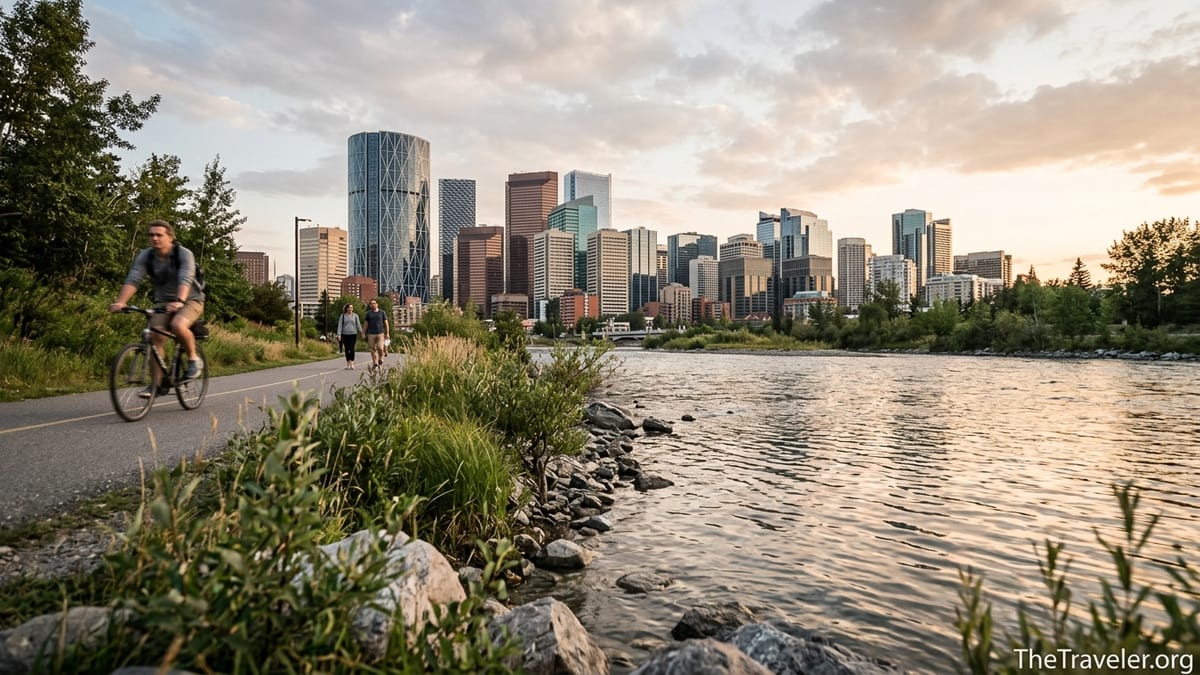
Most visitors, myself included, imagine Calgary as glass towers on the prairie. Few people talk about the river. Yet the Bow and Elbow Rivers carve a wide green corridor through the middle of the city, and they are where I began to see why locals fall quietly in love with their home. From Prince’s Island Park, you can look one way and see office buildings reflecting in the water, and the other way and feel as if you have stepped into a riverside park in a much smaller town.
On a mild spring morning, I rented a city bike and joined the commuting crowd along the pathway. Office workers in reflective vests passed me, coffees in hand, on their way to downtown. Joggers looped around the island, and a family of geese blocked a section of the trail like they owned it. It is easy to plot your own little adventure here: ride west toward Kensington, where independent coffee shops spill onto the sidewalks, or cross one of the pedestrian bridges into Eau Claire to find patios overlooking the water. The city’s reputation for long winters is accurate, but the payoff is a fierce appreciation for any day warm enough to be outside.
Even in the heart of the financial district, Calgary makes space for play. Stephen Avenue, the historic pedestrian mall lined with sandstone buildings, filled up in the late afternoon with office workers shedding their jackets and heading for happy hour. Instead of a sterile canyon of banks, I found live buskers, patios offering local craft beer, and shops that were actually independent rather than international chains. Prices felt relatively reasonable by big-city Canadian standards: a pint of local pale ale on a Stephen Avenue patio was in the range you might pay in a mid-size American city, not a capital of oil wealth.
What caught me most off guard was how quickly you can go from that urban energy back to quiet. Five minutes’ walk from the busy core, I was back at the river, watching people launch inflatable rafts for a lazy float downstream. I had come prepared for mountain photos and maybe a skyline shot or two. Instead, my camera roll began to fill with images of downtown towers reflected in surprisingly turquoise water.
Neighbourhoods With More Personality Than I Bargained For
I had expected Calgary’s character to begin and end with the Stampede grounds and the belt of bars near the arena. The reality unfolded across a handful of distinct neighbourhoods, each with its own texture. Inglewood, often described as Calgary’s oldest neighbourhood, was my first real hint that the city has a creative undercurrent as strong as any better-known cultural capital.
Inglewood’s main street is a walkable strip of brick shopfronts that feels closer to a small arts town than a metropolitan suburb. In one afternoon I browsed a meticulously curated vinyl record shop, sampled small-batch chocolate from an indie chocolatier, and ducked into a tucked-away gallery showing work by Alberta painters. The warehouses back from the main street house everything from craft breweries to furniture studios. It was not the generic strip of chain stores I had lazily assumed I would find on the city’s fringes.
Across the river, the historic community of Kensington gave me another jolt. Here, coffee culture is elevated to an art form, with specialty cafes pulling espresso for laptop-toting locals and visitors alike. Independent bookstores sit next to vintage clothing shops. On a weekday afternoon, the sidewalks were busy with students from nearby SAIT, young families with strollers, and older residents who had clearly seen the area evolve. It felt like a place where you might easily slip into a daily routine, not just a sightseeing box to tick.
South of downtown, the Mission and Beltline neighbourhoods layered yet more personality on top. Mission’s 4th Street corridor is thick with brunch spots and late-night eateries, while 17th Avenue in the Beltline has grown into a dense strip of restaurants and bars that could keep you busy for several nights. I had come convinced I needed to rush out of Calgary after one night. By the time I had spent an evening people-watching on a 17th Avenue patio, then a morning wandering the boutiques in Inglewood, I started mentally reworking my itinerary to build in an extra day.
A Food Scene That Outgrew Its Stereotypes
I arrived in Calgary with one food cliché in mind: steak. The province’s ranching history and oil wealth conjured images of dark wood steakhouses and corporate expense accounts. Those restaurants exist, and they do their job, but I quickly discovered that recent years have reshaped the city’s food culture into something much more varied and ambitious.
Along the already busy 17th Avenue, new openings have pushed beyond the familiar. I walked past a Korean fine-dining spot serving wagyu, a ramen bar with a queue out the door, and casual rooms offering everything from Mexican street food to Middle Eastern mezze. On one evening I grabbed a bowl of rich tonkotsu ramen and a craft beer for what felt like downtown Toronto prices, then the next day found myself sharing small plates of skewered grilled meats and pickled vegetables that would not have been out of place in Seoul.
Downtown, the presence of established chains is balanced by thoughtful independents and inventive concepts. I ate lunch at a modest counter-service spot where the line was mostly office workers and construction crews ordering hearty grain bowls and pressed juices. Nearby, a new outpost of a well-known Jasper dessert café had just opened, its menu built largely around elaborate waffles and gelato. The crowd skewed younger, the prices casual, and the energy far from the stiff corporate scene I had pictured before arriving.
What struck me most was the sense that Calgary’s food scene is still in motion. Local magazines and food blogs were full of writeups on the latest openings, from small neighborhood wine bars in Bridgeland to destination-worthy bakeries in previously overlooked corners of the city. At the same time, long-running favourites continued to draw loyal regulars. That mix of stability and experimentation means the city rewards visitors who dig even a little below the surface instead of settling for whatever is closest to their hotel.
Practical Surprises: Transit, Prices, and Getting Around
One of the greatest surprises in Calgary was how easy it was to function as a visitor without a car, at least for city-based days. Calgary Transit operates as a single fare zone, so the same ticket works on buses, the CTrain, and bus rapid transit routes. As of 2026, an adult single fare sits at around four Canadian dollars for 90 minutes of travel, which includes transfers. For someone used to complex zoned systems and time-based surcharges in larger cities, that simplicity was refreshing.
The downtown free fare zone on the CTrain turned out to be more valuable than I expected. On my second day, I needed to cross from a meeting near City Hall to a coffee shop in the west end. Instead of trekking several blocks in sleet, I ducked into the nearest station, waited a couple of minutes, and rode a few stops without tapping a card or fumbling for change. For short hops between hotels, the convention centre, and key attractions like the Calgary Tower or the Arts Commons, the free zone acts like an unofficial shuttle system.
For a city of its size, Calgary’s prices were also less punishing than I anticipated. A mid-range sit-down dinner with a main, a shared appetizer, and a drink came in at a level you might expect in a smaller North American city rather than a booming energy hub. Groceries at downtown supermarkets were in line with other Canadian cities, and ride-hailing fares within the core generally fell into the modest range for five to ten minute trips. The days of rock-bottom Canadian dollar bargains are gone, but I never felt price-gouged as a visitor.
The one place where costs can sneak up is accommodation during peak events. Calgary Stampede, major conventions, and big concert weekends can send nightly hotel rates in the downtown core and Beltline sharply higher. If you are transiting through on your way to Banff or Jasper, it is worth checking dates carefully and looking at neighbourhoods like Kensington or the University district for better value. Even there, the CTrain keeps you connected, and late-night trains and buses make it possible to enjoy downtown without committing to central hotel prices.
Day Trips and Detours: When the Mountains Are No Longer the Only Stars
Before I arrived, every conversation about Calgary centered on its role as a gateway to the Rockies. The numbers support that reputation: tour buses shuttle countless visitors between the city and Banff National Park, and rental car counters at the airport are well stocked with SUVs heading west. What I had not appreciated was how many day trips and short detours are possible in the opposite direction or closer to town, making Calgary a hub for more than just mountain selfies.
Within city limits, the network of parks is reason enough to stay put for a day or two. Nose Hill Park in the northwest offers wide open prairie views and a sense of big sky that you do not fully get once you are down in mountain valleys. Fish Creek Provincial Park in the south, one of the largest urban parks in Canada, feels like a green corridor carved into suburbia, with cycling trails and shaded picnic areas that are especially appealing on hot summer days. On a shoulder-season afternoon, I hiked short sections of both and saw more locals walking dogs and pushing strollers than tourists.
Beyond Calgary, smaller communities and landscapes tempt you in multiple directions. To the west, the town of Cochrane offers a compact historic main street and views of the Bow River valley without the crowds of Banff. To the southeast, the prairie transitions into the hoodoo formations of the Alberta badlands, with Drumheller and the Royal Tyrrell Museum of Palaeontology within reasonable day-trip distance. Heading north, the growing city of Airdrie has been working on closer transit ties to Calgary, reflecting how intertwined the region has become.
The mountains still matter, of course. Many visitors will continue to fly into Calgary specifically to reach Banff, Lake Louise, or Kananaskis. What changed for me on this trip was the realization that you could just as easily build an itinerary that gives Calgary equal billing. Spend two or three nights exploring its neighbourhoods, parks, and food scene, then tack on a shorter mountain stay. Instead of a rushed overnight before a tour bus departure, the city becomes an integral chapter in a longer Alberta story.
The Takeaway
Calgary does not shout. It does not market itself with the same intensity as some coastal cities or resort towns. Its airport signage and glossy brochures still lean heavily on cowboy imagery, the Calgary Stampede, and snow-capped peaks on the horizon. Yet on the ground, the city has quietly evolved into a place that can stand on its own as a destination, even if you arrive thinking of it only as a stopover.
What surprised me most was the balance. Calgary offers a functioning, straightforward transit system that makes car-free travel realistic in the core, without the complexity of some larger networks. It has a food scene nimble enough to incorporate global influences while still tipping its hat to Alberta’s ranching roots. Its neighbourhoods, from Inglewood’s creative main street to Kensington’s café culture and the Beltline’s nightlife, have their own identities rather than feeling like interchangeable suburbs.
If you are planning a trip that routes through Calgary on the way to the Rockies, consider resisting the urge to minimize your time in the city. Give yourself at least two full days. Walk the river paths at sunrise, ride the CTrain just to feel how locals move, linger over dinner at a restaurant that did not exist three years ago, and explore a neighbourhood that rarely makes it into glossy brochures. You may find, as I did, that Calgary shifts from layover to highlight almost before you realize it is happening.
FAQ
Q1. Is Calgary worth more than a one-night stop before heading to Banff?
Yes. With walkable neighbourhoods, a growing food scene, and extensive riverfront parks, Calgary easily justifies at least two full days on most itineraries.
Q2. Can I explore Calgary without renting a car?
Within the central areas, yes. The CTrain, buses, and the downtown free fare zone make it easy to get between major sights, while rideshares cover late nights or trips beyond transit routes.
Q3. How long does it take to get from Calgary airport to downtown?
By Route 300 airport bus it is usually around 30 minutes depending on traffic. A taxi or rideshare is often similar in travel time but more expensive.
Q4. What time of year is best for visiting Calgary if I also want to see the Rockies?
Late June to early September offers the most reliable weather for both city exploring and mountain hiking, though shoulder seasons can be quieter and less expensive.
Q5. Is downtown Calgary safe to walk around at night?
Central areas are generally busy and feel reasonably safe, especially around major streets and transit hubs, but normal big-city precautions are still wise after dark.
Q6. Which neighbourhoods should first-time visitors focus on?
Inglewood for history and arts, Kensington for cafés and shops, the Beltline and 17th Avenue for dining and nightlife, and the downtown riverfront for parks and views.
Q7. Are hotels in Calgary expensive?
Prices vary by season and events. Outside major festivals and Stampede, mid-range downtown hotels are often reasonably priced compared with other large Canadian cities.
Q8. How many days do I need in Calgary if I am also going to Banff?
If your schedule allows, plan at least two full days for Calgary and three for Banff, so the city feels like part of the trip rather than just a transfer point.
Q9. Is Calgary a good destination for food lovers?
Yes. Beyond steakhouses, you will find strong Korean, Japanese, Middle Eastern, and modern Canadian options, plus craft breweries and inventive bakeries across the city.
Q10. What should I budget for daily expenses in Calgary?
A typical mid-range traveler might expect to spend enough for meals, transit or short rideshares, and attraction fees, excluding accommodation, with costs varying by personal style.