


New York looms so large in the American imagination that it often warps everything around it, especially places nearby. Philadelphia feels that gravitational pull more than most. Travelers planning an East Coast trip routinely ask a version of the same question: should we just add a day trip to Philly from New York, or skip it altogether? The assumption is baked in that Philadelphia is a supporting act to New York’s star turn. In reality, that view says more about New York’s outsized branding than it does about what Philadelphia actually offers on the ground in 2026.
Get the latest updates straight to your inbox!
New York’s Megaphone vs Philadelphia’s Volume
New York’s dominance in global media, finance and entertainment shapes how travelers imagine the United States. Broadway, Times Square, Wall Street and the skyline of Midtown appear in films, music videos and social feeds almost daily. That saturation creates a sense that New York is not just one American city but the default urban experience against which all others are measured. When visitors sketch an East Coast itinerary, they often begin and end with New York, then wonder if they should squeeze in a few side trips.
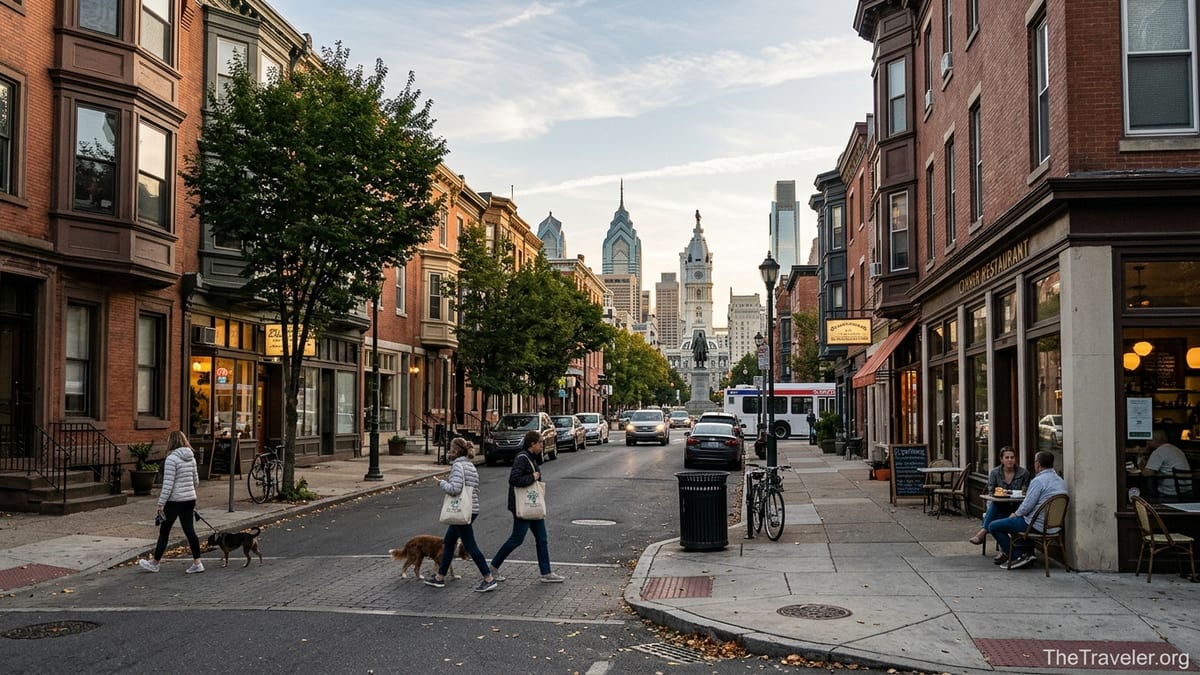
Philadelphia rarely gets that level of exposure, despite being the nation’s first World Heritage City and the cradle of American independence. Yet when you walk its streets, the gap between perception and reality becomes clear. A late afternoon stroll from Rittenhouse Square to the Schuylkill River, or an evening wandering South Philly’s restaurant-packed Passyunk corridor, delivers a dense, lived-in city feel that surprises travelers expecting a minor-league version of New York. The city’s scale is smaller, but the urban experience is far from second tier.
Part of the imbalance comes from sheer marketing muscle. New York has a global tourism budget and a ceaseless stream of media coverage that constantly reinforces its must-see status. Philadelphia’s tourism board works on a more modest scale, even as it prepares for the visitor surge tied to the 250th anniversary of the Declaration of Independence and the FIFA World Cup matches in 2026. The quieter drumbeat does not reflect weaker offerings, only a smaller megaphone.
For travelers, that asymmetry can work in their favor. While headlines and social chatter funnel millions into the same New York neighborhoods, Philadelphia’s great museums, parks and restaurants operate with more breathing room. A Saturday afternoon at the Barnes Foundation or the Franklin Institute might be busy, but you are unlikely to encounter the shoulder-to-shoulder crush that can make a visit to New York’s most popular museums feel more like queue management than cultural exploration.
Culture on the Parkway: World-Class, Lower Profile
If New York’s Museum Mile on Fifth Avenue is shorthand for big-city culture, Philadelphia’s Benjamin Franklin Parkway is its lower-key counterpart. Within a short walk you can move between the Philadelphia Museum of Art, the Barnes Foundation, the Franklin Institute, the Academy of Natural Sciences and the Rodin Museum, all clustered around leafy Logan Square. At the Barnes, visitors wander through one of the world’s finest collections of Impressionist and Post-Impressionist art, including dense ensembles of Renoir, Cézanne and Matisse arranged in intimate, salon-style rooms rather than vast white cubes.
Nearby, the Franklin Institute functions as both a beloved family museum and a serious science center, home to hands-on exhibits and a giant walk-through heart that generations of local schoolchildren remember vividly. In 2026 it has again been recognized among the country’s top science museums and planetariums, a reminder that Philadelphia’s marquee institutions can stand comfortably next to better-known peers in Manhattan. Yet tickets are typically easier to secure on short notice, and the experience feels more relaxed once inside.
Beyond the Parkway, the city’s cultural fabric spreads in a way that invites exploration. The African American Museum in Philadelphia in Old City, the National Constitution Center steps from Independence Hall, and the revitalized Penn Museum in University City all offer deep dives into history that feel grounded rather than staged. Compared to the sometimes theme-park atmosphere around New York’s most iconic landmarks, Philadelphia’s historic core still functions as a working downtown, where residents queue at food trucks on Market Street and office workers share sidewalks with tour groups heading for the Liberty Bell.
For travelers, this translates into a different rhythm. A day of museum-hopping in New York often requires time-stamped tickets booked weeks ahead and strategic planning around crowds. In Philadelphia, you can frequently decide that morning to visit the Barnes, then wander on to the Philadelphia Museum of Art, stopping for a casual lunch in nearby Fairmount. That kind of spontaneity is increasingly rare in major global cities and is one of Philadelphia’s quiet luxuries.
Food City: From Cheesesteaks to Michelin Talk
New York’s restaurant scene is legendary, with a long-established Michelin Guide presence and a reputation for sky-high tasting menus. That reputation can overshadow the fact that Philadelphia’s dining culture has been on a steady, confident rise. In recent years the city’s chefs have drawn national attention, with local spots like River Twice in South Philadelphia landing on shortlists of the best restaurants in the country and earning praise from major newspapers for inventive, regionally focused cooking.
As of late 2025 and into 2026, Philadelphia’s food scene is having a broader moment. A wave of ambitious openings includes Stephen Starr’s high-profile Italian restaurant Borromini on Rittenhouse Square, a lavish two-level trattoria where pastas like a hundred-layer lasagna and spaghetti al limone share a menu with Champagne-forward wine lists. Elsewhere, chefs are experimenting with hybrid formats: bakery-cafes that morph into wine bars by night, neighborhood spots that double as bottle shops, and supper clubs that run on fixed menus and prepaid reservations announced through social media. Observers describe a “bakery renaissance” in the city, as new artisan bakeries join beloved stalwarts to make morning pastry crawls a genuine travel activity.
Philadelphians are also waiting to see how the arrival of the Michelin Guide for the Northeast will land. Industry watchers expect the city to pick up its first Michelin stars in the near term, with contenders ranging from intimate tasting-menu venues in East Passyunk to refined Center City dining rooms. The awards ceremony being hosted at the Kimmel Center underscores how seriously the international food world now takes Philadelphia. For travelers, this means you can book a table at restaurants that would be near-impossible to access in New York, often at significantly lower prices.
Crucially, Philadelphia’s culinary identity still embraces the democratic. Visitors can grab a cheesesteak at long-running rivals in South Philly, debate the merits of roast pork sandwiches at corner shops, wander Reading Terminal Market for Amish donuts and scrapple, then pivot to a Khmer tasting menu or Filipino-inspired small plates for dinner. The result is a food culture that feels both sophisticated and deeply local, without the sense that every meal is chasing an Instagram moment.
Cost, Space and Sanity: The Value of a Second City
One of the clearest ways New York’s gravitational pull distorts perceptions is on price. Travelers arrive primed to accept that a central Manhattan hotel will cost several hundred dollars per night, that cocktails will routinely reach twenty dollars, and that a simple dinner can blow through a budget. By the time they look at Philadelphia, they may assume that savings will be marginal, not transformative. Yet current cost of living comparisons suggest a sharper difference. Recent 2026 data puts average one-person monthly rent in New York City at around 2,700 dollars or more, versus roughly 1,500 dollars in Philadelphia. Nightly hotel rates tend to mirror that gap, particularly in mid-range and boutique categories.
In practical terms, this means a couple might pay 350 to 450 dollars per night for a small but stylish Manhattan hotel room in a central neighborhood, while a comparable room near Rittenhouse Square or in Old City often falls in the 220 to 300 dollar range outside of peak event weeks. Restaurant prices track similarly. A three-course dinner with drinks at a buzzed-about New York bistro can easily top 100 dollars per person before tip. In Philadelphia, diners often find tasting menus in the 85 to 120 dollar range and can still have excellent neighborhood meals for significantly less.
Space is the other underappreciated luxury. Streets in Center City and South Philly are busy and energetic, but on most days you can cross a square or browse a market without the claustrophobic feeling that sometimes hits in Midtown or SoHo on summer weekends. The Schuylkill River Trail offers long, uninterrupted stretches for jogging or cycling with skyline views and plenty of benches, a calmer parallel to New York’s Hudson River Park. For visitors balancing sightseeing with remote work, it is easier to find a quiet cafe table or hotel lobby corner that does not feel like a co-working zoo.
This relative breathing room extends to infrastructure. The compact, walkable grid means you can cover most key neighborhoods using a combination of walking, short subway or trolley rides and the occasional rideshare. SEPTA, the regional transit authority, has its quirks but rarely feels as overwhelmed as New York’s subway system at rush hour. For travelers, that translates into more time spent in museums, parks and restaurants, and less time standing in bottlenecked station corridors or hunting for a spot on overflowing trains.
Character, Not Just Scale: Neighborhoods That Feel Lived In
New York’s sheer size guarantees a staggering diversity of neighborhoods, each with its own story. Philadelphia, by contrast, offers a smaller but more immediately legible patchwork of districts that can be understood over the course of a long weekend. Visitors staying near Independence Hall can walk west through the office core into the leafy brick townhouses of Rittenhouse Square, then south into Graduate Hospital and East Passyunk, where rowhouses mix with bars, bakeries and small restaurants. The transitions feel organic, the result of decades of residents shaping their blocks rather than rapid-fire speculative development.
South Philadelphia in particular showcases the city’s layers: Italian markets sit next to Mexican groceries and Indonesian restaurants, while blocks that once centered exclusively on red-gravy joints now host Cambodian, Vietnamese and Middle Eastern kitchens. East Passyunk Avenue, which not long ago felt like a quiet local strip, now draws diners from across the region to spots like River Twice and a constellation of younger wine bars and bakeries. Yet even in the buzziest stretches, you are never far from a neighborhood park where families gather on summer evenings or from a corner bar that still feels resolutely local.
Other districts reveal different faces of the city. Fishtown and Northern Liberties, northeast of Center City, have evolved into hubs for creative businesses, live music venues and craft breweries housed in former factories and warehouses. University City across the Schuylkill mixes collegiate energy from the University of Pennsylvania and Drexel with a growing set of food halls and research towers. For travelers, this diversity means that each day can focus on a different micro-urban world without long transit treks.
What stands out compared with New York is not that Philadelphia is more authentic, but that its authenticity is easier to access. There are fewer layers of tourism infrastructure between visitors and residents. You are likely to share a bar counter with people who live around the corner, not just other travelers and office workers. When a server recommends a corner bakery or a block party, it is often because they also walk that route home. That permeability is part of what makes the city feel welcoming rather than performative.
2026 and Beyond: A Global Stage Without Losing Its Soul
The coming years are pivotal for Philadelphia. The city is preparing for the United States Semiquincentennial in 2026, marking 250 years since the signing of the Declaration of Independence. Alongside that milestone, Philadelphia is slated to host FIFA World Cup matches, putting it before a vast global audience that may never have considered the city as more than a quick stop between New York and Washington. Local tourism officials expect a continued rebound and gradual increase in international visitors as these events unfold.
On the ground, the build-up is visible in infrastructure projects and new openings. Airport improvements, hotel renovations and expansions around Center City and the stadium district, and the rise of new mixed-use hubs like food halls in University City are all designed to handle more visitors without swamping the city’s core. At the same time, established institutions are refreshing their programming. The Franklin Institute is leaning into blockbuster science exhibitions and immersive experiences, while art museums along the Parkway are planning shows timed to 2026 that foreground Philadelphia’s role in American history and culture.
For travelers, this moment offers an opportunity. Visiting before, during or just after the 2026 festivities means experiencing a city that is actively telling its story to the world, but still anchored in its everyday routines. Unlike New York, which lives permanently on the global stage, Philadelphia is stepping into the spotlight more episodically. That can make your trip feel less like joining a constant spectacle and more like catching a city in a particularly vivid chapter.
The key is to approach Philadelphia not as an add-on to a New York itinerary but as a primary destination in its own right. Plan at least three full days, with time split between historic sites in Old City, cultural institutions on the Parkway, and neighborhood exploration in South Philly, Fishtown or beyond. The reward is a travel experience that combines major-city depth with a sense of discovery that is harder to find in places already saturated with global attention.
The Takeaway
When Philadelphia ends up in New York’s shadow, the distortion lies less in what Philadelphia lacks and more in what New York’s global profile suggests a city must be to matter. New York is a marvel, but its intensity, costs and crowds are not the only valid expression of urban life. Philadelphia offers a different proposition: world-class culture and food in a city where daily routines still feel human-scale, where visitors can improvise without planning every hour weeks in advance, and where budgets stretch noticeably further.
For travelers, the smartest move is to resist the reflex to judge Philadelphia solely against New York’s benchmarks. Instead, treat it as a complementary lens on American urbanism, one that blends historic gravitas with contemporary creativity and neighborhood character. Whether you are lining up for a cutting-edge tasting menu in South Philly, sitting on the steps of the Philadelphia Museum of Art at sunset, or wandering cobblestone alleys in Old City, what you will find is not a lesser New York, but a fully realized city that has long been comfortable doing things its own way.
In 2026, as Philadelphia steps onto the global stage for the Semiquincentennial and the World Cup, that quiet confidence is exactly what makes it compelling. New York may keep the megaphone, but Philadelphia has more than enough voice of its own. The question for travelers is not whether Philadelphia deserves a day trip from New York, but whether New York is the only city that deserves days at all.
FAQ
Q1. Is Philadelphia worth visiting if I am already going to New York?
Yes. Philadelphia offers major museums, a thriving food scene and historic sites in a more relaxed, affordable setting, making it a strong standalone stop rather than just a day trip.
Q2. How many days should I spend in Philadelphia?
Plan at least two to three full days. That gives you time for Independence Hall and Old City, the Parkway museums, and at least one or two neighborhood-focused afternoons or evenings.
Q3. Is Philadelphia cheaper than New York for travelers?
Generally yes. Average rents and hotel rates are significantly lower, and restaurant prices are often more moderate, so your budget typically stretches further in Philadelphia.
Q4. What are the must-see cultural attractions in Philadelphia?
Highlights include the Philadelphia Museum of Art, the Barnes Foundation, the Franklin Institute, the National Constitution Center, and historic sites around Independence Hall and the Liberty Bell.
Q5. How easy is it to get around Philadelphia without a car?
Quite easy. Center City is walkable, and neighborhoods like Old City, Rittenhouse, South Philly and Fishtown are accessible via SEPTA subways, trolleys, buses and short rideshare trips.
Q6. Is Philadelphia safe for tourists compared to New York?
Both cities have safer and less safe areas. In Philadelphia, most central tourist districts are busy and well-patrolled, especially during the day. As always, standard big-city precautions apply.
Q7. What is special about Philadelphia’s food scene right now?
Beyond classic cheesesteaks, the city is known for inventive neighborhood restaurants, a growing number of tasting menus, standout Southeast Asian spots and a wave of new bakeries and cafe-bars.
Q8. Are there any major events in Philadelphia in 2026?
Yes. The city is central to the United States Semiquincentennial commemorations and is scheduled to host FIFA World Cup matches, drawing significant international attention.
Q9. Can I visit Philadelphia as a base for exploring other East Coast cities?
Yes. Philadelphia sits on the Northeast Corridor rail line, with regular trains to New York, Washington and Boston, so it can serve as a more affordable base for regional trips.
Q10. What neighborhoods should first-time visitors prioritize?
Old City and Society Hill for history, Center City and Rittenhouse for shopping and dining, South Philadelphia for diverse food, and Fishtown or Northern Liberties for nightlife and creative spaces.