


Few addresses in Europe resonate with music lovers quite like Getreidegasse 9 in Salzburg. This tall yellow townhouse in the city’s Old Town is where Wolfgang Amadeus Mozart was born in 1756, and today it is one of Austria’s most visited museums. If you are planning a trip to Salzburg, chances are Mozart’s Birthplace is high on your list. This guide explains how tickets work, what they cost, how to combine your visit with other sights, and the practical details that can make the difference between a rushed stop and a rewarding experience.
Get the latest updates straight to your inbox!
Why Mozart’s Birthplace Matters on a Salzburg Itinerary
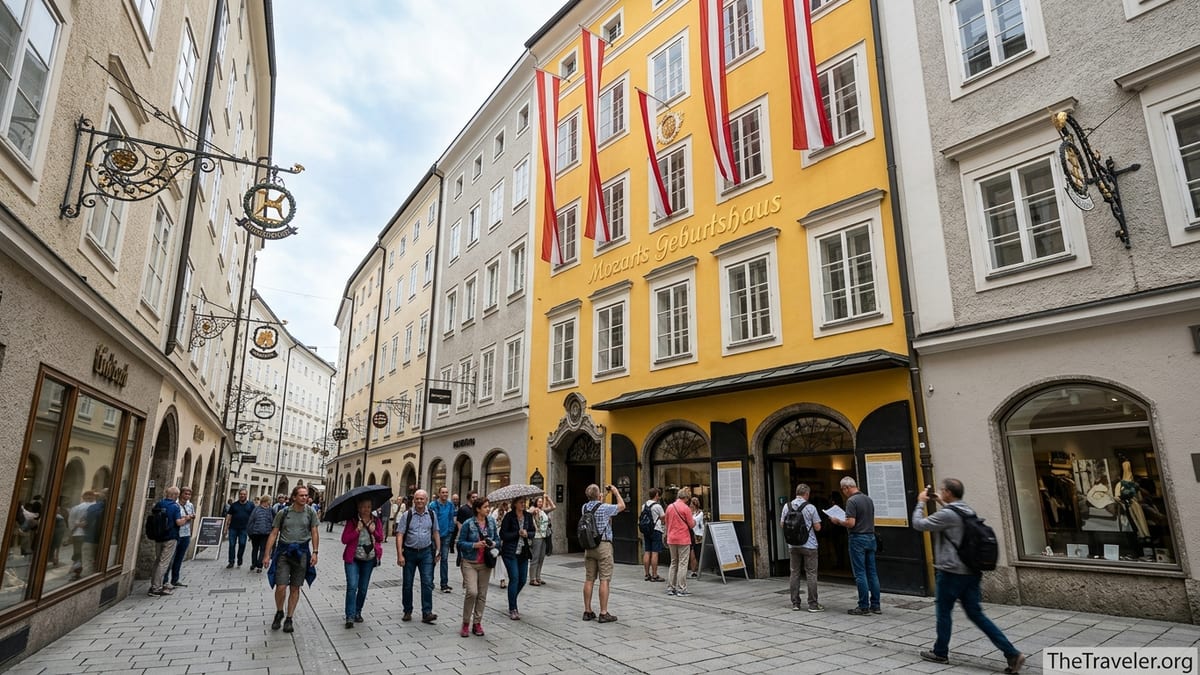
Mozart’s Birthplace, known locally as Mozarts Geburtshaus, is set on the busy shopping street of Getreidegasse in Salzburg’s UNESCO‑listed Old Town. The Mozart family rented an apartment on the third floor of this house, and it was here that Wolfgang Amadeus Mozart was born on 27 January 1756 and spent much of his childhood before the family moved across the river to their later residence. Today the building is a museum managed by the International Mozarteum Foundation and is considered one of the city’s essential stops for first‑time visitors.
Inside, the museum walks you through Mozart’s early years and family life using a mix of original rooms, historical documents and carefully chosen objects. Highlights typically include the small bedroom believed to be the room of his birth, portraits of family members, and historic instruments associated with him, including a child‑sized violin. Exhibit texts are printed on the walls and supported by a mobile text guide, so you move at your own pace rather than following a rigid route.
For many travelers, Mozart’s Birthplace also serves as a historical anchor for exploring Salzburg’s wider Old Town. You step directly from the modern shopfronts and wrought‑iron guild signs of Getreidegasse into 18th‑century Salzburg. Pairing a one‑hour visit here with a walk to nearby sights like the cathedral square or Hohensalzburg Fortress gives you a compact but vivid picture of the city that shaped Mozart’s early life.
Because it is such a core attraction, the house can be busy at peak times. That makes understanding ticket options and timing particularly valuable. With a little advance planning, you can avoid bottlenecks on the narrow staircases, see the exhibits comfortably and combine the visit with other Mozart‑related locations without overspending.
Location, Opening Hours and Best Time to Visit
Mozart’s Birthplace stands at Getreidegasse 9 in central Salzburg. Getreidegasse itself is one of the city’s main pedestrian shopping streets and is easy to reach on foot from almost anywhere in the historic center. From the cathedral square it is roughly a five‑minute walk through the Old Town lanes, and from the main shopping axis around Universitätsplatz it is just a block or two away. If you arrive by bus from Salzburg Hauptbahnhof, stops such as “Hanuschplatz” put you within a short walk of the museum.
The museum’s regular opening hours are daily from 9 am to 5:30 pm, with last admission 30 minutes before closing. On 24 December the museum closes early at 1 pm, and on 1 January it opens at midday. Opening hours can occasionally shift for special events or maintenance, so if you are visiting on a public holiday or in the off‑season, it is worth checking the latest details shortly before you travel.
In terms of crowd levels, timing makes a clear difference. Large tour groups commonly arrive in mid‑morning and early afternoon, especially in July, August and around Easter. If you visit shortly after opening, between about 9 and 10 am, you are more likely to climb the staircases with room to breathe and linger over exhibits without jostling. A second relatively calm window often appears late in the afternoon after 4 pm, when many tour groups have moved on and day‑trippers start heading back to coaches or trains.
Weather can also influence the experience. On rainy days in Salzburg, visitors naturally gravitate to indoor attractions, and Mozart’s Birthplace is near the top of that list. If your dates are fixed and the weekend forecast looks wet, consider reserving your Mozart museums for a weekday morning and using rainy weekend hours for larger spaces like the fortress, where crowds disperse more easily.
Ticket Types, Current Prices and How to Buy
Tickets for Mozart’s Birthplace are straightforward, but there are a few options that can save money if you plan to visit multiple Mozart sites. As of late 2025, standard individual admission to Mozart’s Birthplace costs around 15 euros for adults. Children from 6 to 14 years pay about 4.50 euros, and youths from 15 to 18 years around 5 euros. Children under 6 enter free. There are discounted rates of roughly 12 euros per person for groups of ten or more adults, students up to around 27 years and senior visitors, and a family ticket for two adults and their children under 18 is approximately 30 euros.
The museum also offers a combined ticket that covers both Mozart’s Birthplace in Getreidegasse and Mozart’s Residence on Makartplatz, across the river. As of the latest published prices, this combined ticket is around 23 euros for adults, 6 euros for children aged 6 to 14, and 7 euros for youths aged 15 to 18. Families can expect to pay roughly 46 euros for two adults and their children. The combined ticket is valid for 48 hours from the time of first use, which gives you flexibility to visit one site on your arrival afternoon and the other the next morning.
You can buy tickets in two main ways: in person at the museum ticket desk or online in advance. Walk‑up purchases are easy in low and shoulder seasons. In July, August and during major events such as the Salzburg Festival, buying online in advance can shorten your waiting time at the entrance and help you lock in a specific day. The official Mozarteum ticket shop sells timed entries for single and combined tickets, and you present either a printed confirmation or a digital code on your phone at the door.
One important detail for budget‑conscious travelers is that the Salzburg Card, the city’s official tourist pass, includes one free admission to Mozart’s Birthplace. If you already plan to visit other included sights such as Hohensalzburg Fortress, the Hellbrunn trick fountains or a Salzach river cruise, it is often more economical to purchase a 24‑, 48‑ or 72‑hour Salzburg Card and use it as your ticket at the Birthplace rather than buying a separate museum ticket.
Using the Salzburg Card and Other Ways to Save
The Salzburg Card can be a smart way to see Mozart’s Birthplace as part of a larger sightseeing plan. The card gives free entry to most major city museums and attractions, including Mozart’s Birthplace, and covers city public transport for the chosen validity period. You buy the card for a fixed time span, usually 24, 48 or 72 hours, and then simply present it at each included site. A typical one‑day card is priced so that if you visit three or four of the major sights in a single day, the pass quickly pays for itself.
For example, a traveler with a 24‑hour Salzburg Card might ride the funicular up to Hohensalzburg Fortress in the morning, visit the fortress museum, then walk down into the Old Town for lunch. In the afternoon they could visit Mozart’s Birthplace and the Salzburg Museum, then take an evening river cruise if it is in season. Buying these tickets separately would quickly add up; using the card effectively transforms Mozart’s Birthplace from a standalone expense into part of a bundled experience.
When using the card, remember that entry to Mozart’s Birthplace is included once per card. The staff scan or visually check your card at the entrance and treat it as a regular ticket. The card does not generally allow you to bypass necessary security or capacity limits, so at very busy times you might still need to wait briefly before stepping inside, but you will not have to stand in a separate ticket‑purchase line.
There are a few additional ways to keep costs reasonable. Families should compare the price of two adult Salzburg Cards plus free child admissions at certain sights with the dedicated family tickets for the Mozart museums. Older teens and students should carry valid ID, since some discounts apply up to age 27. Visitors with disabilities benefit from especially generous conditions at Mozart’s Birthplace: entry is typically free for a person holding a disability pass, and an accompanying person may also enter without charge if indicated on the pass, or at a reduced rate if not.
What to Expect Inside: Exhibits, Duration and Practicalities
A standard visit to Mozart’s Birthplace takes around one hour, although dedicated music enthusiasts may easily spend longer. After you enter from Getreidegasse, you move through a sequence of rooms on the upper floors that reconstruct elements of Mozart’s childhood home and explain the family’s life in Salzburg. The layout reflects the original apartments more than a modern museum floor plan, so expect a series of relatively small rooms connected by narrow corridors and staircases rather than a single large exhibition hall.
Exhibits focus on concrete aspects of Mozart’s early years. You will see family portraits, letters, everyday objects from the household and instruments such as a small violin often associated with his childhood performances. Wall texts, usually available in multiple languages, provide context about his father Leopold’s role as a court musician and teacher, the family’s extended travels through Europe and the cultural environment of 18th‑century Salzburg. The museum often dedicates part of the first floor to a changing special exhibition, which means repeat visitors can find fresh material on topics ranging from Mozart’s operas to his reception in later centuries.
Photography rules and quiet expectations can change over time, but in general visitors are asked to respect the historic interior and other guests. Bags may be restricted to smaller daypacks, and larger backpacks might need to be kept in lockers or avoided altogether. Because space in the stairwells is limited, staff sometimes regulate the flow of visitors during peak times. If you are sensitive to crowds in confined spaces, planning for early morning or later afternoon will help you experience the exhibits more comfortably.
One notable limitation is accessibility. The building is a historic townhouse with no lift to the museum floors, and the official visitor information clearly states that Mozart’s Birthplace is not wheelchair accessible. There are mobile text guides and wall texts to support visitors with hearing impairments, and guide dogs are permitted, but travelers who rely on step‑free access will generally find Mozart’s Residence across the river a more practical Mozart museum to explore.
Combining Mozart’s Birthplace with Mozart’s Residence and the Old Town
Mozart’s Birthplace is just one of two main Mozart museums in Salzburg. The other is Mozart’s Residence on Makartplatz, where the family lived for many years after leaving Getreidegasse. While the Birthplace emphasizes the composer’s early childhood in a cramped merchant house, the Residence presents his later Salzburg years in a more spacious setting with larger exhibition rooms and a stronger focus on music, compositions and the broader historical context.
If you buy the combined ticket, a common strategy is to visit the Birthplace first to understand the modest circumstances of Mozart’s birth and early family life, then cross the river to the Residence for a broader overview. The two sites are within a comfortable walking distance of each other. From Getreidegasse you typically exit onto one of the side alleys, walk toward the river, cross via one of the pedestrian‑friendly bridges, and reach Makartplatz in about 10 to 15 minutes. This walk naturally leads you past other landmarks such as the church of the Kollegienkirche or the Mirabell Gardens, depending on your chosen route.
Travelers with limited time can still stitch together an efficient Mozart‑themed circuit. For example, if you only have one afternoon in Salzburg, you might start at Mozart’s Birthplace around 2 pm, then stroll to the Residence for a later visit, and finish the day with a concert in one of the city’s churches or historic halls, many of which program Mozart works. Some tour operators also package the Birthplace with guided Old Town walks or evening concerts, but most independent travelers find it easy to explore these sights on their own with a good map or city app.
Because both museums are popular, it pays to consider the order in which you visit them. The Birthplace is located on a narrow, busy street and has the more constricted interior, so it usually makes sense to visit it first when you have the most energy and patience. The Residence, with its more open layout, tends to feel less crowded even when visitor numbers are similar, so it can be a more relaxed second stop later in the day.
Visitor Tips: When to Go, What to Bring and How to Avoid Stress
Planning your visit around likely crowd patterns and your own travel style will make Mozart’s Birthplace feel far more rewarding. If you are staying overnight in Salzburg, aim for a weekday morning outside of Austrian school holidays. Arriving close to 9 am often means you share the museum mainly with individual travelers rather than compact tour groups. If you are coming as a day‑tripper from Munich or Vienna, consider taking an early train so you can reach the Birthplace before the main wave of tour buses.
Dress with the building’s interior in mind as much as the weather outside. The museum rooms are climate controlled to protect the exhibits, so you may find them slightly cooler or warmer than the street. Wearing layers that you can easily carry in your hands or a small bag works better than heavy outerwear that becomes awkward in tight spaces. Comfortable shoes are important, since you will be climbing stairs and standing on hard floors for close to an hour.
As for what to bring, a compact bag, phone with a good camera and headphones for any audio content are usually sufficient. Large umbrellas, bulky backpacks and shopping bags can be inconvenient in the stairwells and may be restricted. If you are visiting with children, consider preparing them in advance with a simple story about Mozart’s life and perhaps a short playlist of his music; this turns the museum from an abstract collection of objects into a narrative they can follow.
After your visit, take a few minutes to enjoy the atmosphere outside. Hagenauerplatz, the small square beside the house, often offers a clearer view of the yellow facade than the crowded stretch of Getreidegasse directly in front of the door. Many travelers use this spot to take a quick photo of the building’s tall windows and the “Mozarts Geburtshaus” script before wandering on to explore the rest of the Old Town.
The Takeaway
Mozart’s Birthplace is more than a box to tick on a Salzburg itinerary. It is a rare chance to stand in the modest rooms where one of history’s most influential composers took his first steps and began to play music. Because of its central location and popularity, it rewards a small amount of planning around tickets and timing, especially if you are visiting in the height of summer or during the Salzburg Festival.
The key decisions are simple. First, decide whether you only want to see the Birthplace or whether you will also visit Mozart’s Residence; if the latter, the combined ticket is usually the best value. Second, consider whether a Salzburg Card makes sense for your broader sightseeing plans. Finally, pick a visiting time that keeps you away from the densest crowds, ideally early or late in the day.
With those basics sorted, the experience itself is straightforward. Expect about an hour inside, a sequence of compact rooms filled with personal objects and instruments, and clear explanations that bring Mozart’s early life in Salzburg into focus. Paired with a walk through the Old Town and, if time allows, a visit to the Residence or an evening concert, it forms one of the most coherent and memorable chapters of any trip to Salzburg.
FAQ
Q1. Do I need to buy tickets for Mozart’s Birthplace in advance?
It is not strictly necessary to buy tickets in advance, since you can purchase them at the museum desk, but advance online tickets help during peak seasons such as summer and festival periods, when lines at the entrance can be longer.
Q2. How much time should I plan for a visit to Mozart’s Birthplace?
Most visitors spend about one hour inside the museum. Enthusiasts who read every exhibit panel and study the special exhibition may prefer to allow up to 90 minutes.
Q3. Is Mozart’s Birthplace included in the Salzburg Card?
Yes. The Salzburg Card includes one free admission to Mozart’s Birthplace, along with entry to many other major Salzburg attractions and free use of city public transport for the card’s validity period.
Q4. What are the current ticket prices for Mozart’s Birthplace?
As of the latest published information, adult tickets cost around 15 euros, children 6 to 14 years about 4.50 euros, youths 15 to 18 years about 5 euros, and there are discounted and family rates, plus a combined ticket with Mozart’s Residence at a higher but still good‑value price.
Q5. Is Mozart’s Birthplace accessible for wheelchair users?
No. The building is a historic townhouse without a lift, and the museum clearly notes that it is not wheelchair accessible. Travelers who require step‑free access may find Mozart’s Residence a more suitable alternative.
Q6. When is the best time of day to visit to avoid crowds?
Early morning shortly after the 9 am opening and late afternoon after about 4 pm are typically quieter. Mid‑morning and early afternoon, especially in summer, tend to be busier with tour groups.
Q7. Can I visit both Mozart’s Birthplace and Mozart’s Residence with one ticket?
Yes. A combined ticket is available that covers both Mozart’s Birthplace and Mozart’s Residence and is usually valid for 48 hours, letting you visit each museum on the same or consecutive days.
Q8. Are guided tours or audio guides offered inside the museum?
Guided tours can often be arranged in advance for groups, but most individual visitors explore independently using the wall texts and optional mobile text guides provided by the museum.
Q9. Can I take photos inside Mozart’s Birthplace?
Photography policies can change, but flash and tripods are generally restricted to protect fragile exhibits and avoid disturbing other visitors. Always follow the current instructions given by staff and posted signs at the entrance.
Q10. Is Mozart’s Birthplace suitable for children?
Yes, as long as expectations are set. The museum is primarily textual and object‑based, but children who have heard Mozart’s music or know a simple version of his story often enjoy seeing the small violin, family portraits and the room associated with his birth.