


Salzburg Cathedral is one of Europe’s great Baroque churches and the spiritual heart of Mozart’s hometown. For many travelers, though, its rich musical life can feel confusing at first glance. Organ recitals, special "Domkonzert" evenings, festival services, and citywide events all overlap on the same calendar. This guide explains how Salzburg Cathedral concerts and music events actually work today, what you can realistically hear on a short visit, roughly what it costs, and how to make sense of the sacred-meets-touristic concert scene around Domplatz.
Get the latest updates straight to your inbox!
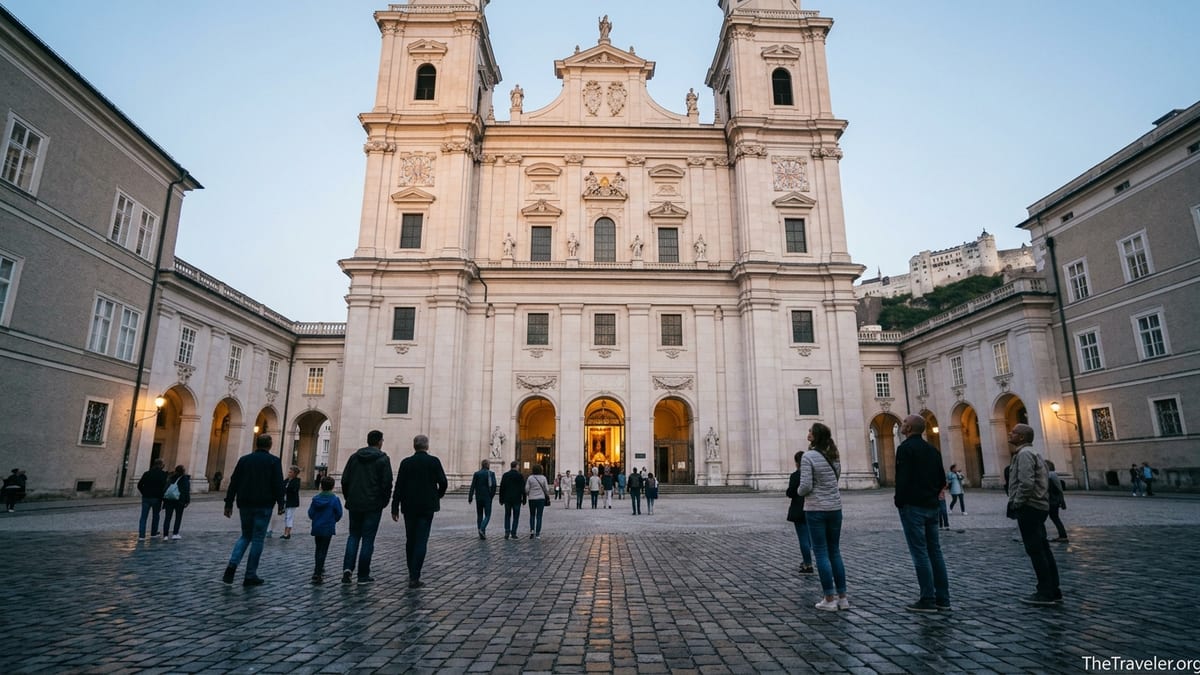
Understanding Music at Salzburg Cathedral Today
Salzburg Cathedral, often called the Dom zu Salzburg, is first and foremost a working Catholic church. That means many of the most impressive musical moments are part of liturgy rather than stand-alone concerts. Sunday and feast-day masses can feature full orchestra, choir, and soloists performing sacred works by Mozart and other composers, while weekday services are usually more modest musically. Alongside this liturgical life, there is now a structured program of public organ recitals at midday and a handful of larger evening concerts across the year.
As of 2026, visitors will most commonly encounter two types of musical experience in the cathedral: the regular midday organ concerts and occasional major Domkonzert or festival performances. The midday events are short, affordable, and easy to fit into sightseeing. By contrast, the larger concerts often tie into Salzburg’s wider classical calendar, such as the Salzburg Festival season in summer or special choral-orchestral evenings curated by Salzburger Dommusik and the Salzburger Kulturvereinigung. Understanding this split helps you plan: the organ concerts are almost always available, while full orchestral events are fewer and require advance checking of dates.
The cathedral’s musical life is anchored by its own music institutions. Dommusik Salzburg, with its cathedral choir, youth choir, soloists, and resident organists, provides the backbone for services and special concerts. Guest ensembles sometimes appear for festivals or one-off projects, but the sound most travelers hear comes from these in-house forces, together with the cathedral’s impressive set of seven organs. When you read about "Dommusik" or "Domorganistin" on posters in the vestibule, you are seeing the names of the musicians who keep this tradition going week after week.
Practically speaking, travelers should think of the cathedral as offering a spectrum of experiences rather than a single "Salzburg Cathedral concert." At one end is a quick midday organ recital with ticketed entry; in the middle are free or donation-based masses with elevated music on Sundays or feast days; and at the top are full-length evening concerts that feel closer to a festival event. Each option suits a different type of traveler, budget, and time commitment.
Midday Organ Concerts: What They Are and How They Work
The most accessible music event for visitors is the midday organ concert, often branded locally as "Musik zu Mittag" or "Music at Noon." These take place on most days except Sundays and public holidays, typically starting shortly after the cathedral bells ring at 12:00. The recital lasts around 30 minutes, so you can comfortably attend even on a tight city itinerary or before an afternoon Sound of Music tour.
Current listings show tickets for the midday organ concerts at about 9 euros for adults, with some operators and resellers quoting similar prices and occasional child discounts. You usually enter via the main vestibule, where a small ticket desk opens from around 11:40. On busier summer days tours may arrive in groups, so it pays to show up closer to opening time if you want a central seat under the dome. The seating is on standard wooden pews rather than concert chairs, but sightlines to the altar and the organ case are good from much of the nave.
Musically, these lunchtime programs are short but varied. A typical half-hour might include a Baroque prelude or toccata, a contrasting meditative piece by a Romantic or modern composer, and sometimes an improvisation that shows off the cathedral’s acoustics. The cathedral has an unusually rich "organ landscape" of seven instruments, including the main west organ and several smaller gallery organs. Many recitals feature two organists alternating between instruments or combining them to create an antiphonal effect that fills the space from multiple directions. Even if you are not a dedicated organ fan, the sheer physical impact of the sound in the cavernous stone interior can be memorable.
For most travelers, the midday organ concert is the simplest way to say "I heard music in Salzburg Cathedral" without restructuring an entire day. You can buy a ticket at the door, sit down with minimal ceremony, and emerge 30 minutes later having experienced the building as a resonant musical space rather than just as architecture. If you are uncertain about sacred services or you are visiting with children who might not last through a full mass, this bite-sized format works especially well.
Domkonzert and Special Evening Performances
Separate from the regular lunchtime series, Salzburg Cathedral occasionally hosts larger-scale evening concerts that are marketed as "Domkonzert" or presented in partnership with the Salzburger Kulturvereinigung and Dommusik. These events are less frequent but musically more expansive, drawing on the cathedral choir, youth choir, soloists, orchestra, and often a prominent organist or guest conductor. Recent programs have featured classic sacred repertoire such as Mozart masses, oratorios, and works by composers connected to Salzburg’s church music tradition.
Because these concerts are scheduled individually rather than as a daily series, you need to check specific dates if you hope to catch one. The annual program of the Salzburger Kulturvereinigung and Dommusik usually lists at least a few major cathedral evening concerts within the 2026/27 season, often clustered around liturgical highlights like Advent, Christmas, or significant feast days. Tickets are sold through local cultural organizations and can range widely in price depending on the program, seating category, and whether the concert is part of a larger festival framework.
In practice, an evening Domkonzert feels quite different from a tourist-oriented organ recital. The lighting is dimmer, the nave is often more densely filled with locals and regular concertgoers, and the performance runs closer to standard symphonic length. For example, an Advent Domkonzert might pair a large choral work such as a Mozart mass with shorter motets and organ pieces, resulting in a program of 70 to 90 minutes plus an interval. The atmosphere can be solemn yet festive, with a clear sense of attending a major cultural event rather than a sightseeing activity.
If your travel dates are flexible and you want a deeper musical experience, it is worth aligning your visit with one of these larger concerts. Travelers who have previously attended Salzburg Festival events in the summer sometimes add a Domkonzert during a winter or shoulder-season visit, commenting that it offers a more intimate but still grand expression of Salzburg’s sacred music tradition in the cathedral itself.
Liturgical Music: Experiencing Masses and Feast Days
Many of the cathedral’s most remarkable musical moments are not ticketed concerts at all but part of regular worship. On Sundays and major feast days, the principal mass may feature the cathedral choir and orchestra performing a full setting of the mass ordinary, often by Mozart or his contemporaries. Since Mozart composed numerous sacred works for Salzburg, including settings intended specifically for this building, there is a strong sense of continuity when his music is performed in situ.
Attending mass with music has a different etiquette and rhythm from going to a concert. There is no ticket, though a donation to support the music is usually welcomed, often via collection baskets or boxes near the exit. Visitors are expected to treat the event primarily as a religious service: arrive a bit early, dress respectfully, and follow the congregation’s cues for standing or sitting. Photography and applause during the liturgy are generally inappropriate, even if the music is spectacular. Some services list the musical program on a printed leaflet, so you may see the names of the choir, soloists, and the Domkapellmeister or Domorganistin.
Feast days associated with Salzburg’s patron saint Rupert or with the cathedral’s own dedication can bring especially rich music. During the annual Rupertikirtag fair, for instance, the squares around the cathedral fill with stalls and rides, while inside the church high masses with choir and orchestra mark the religious side of the celebrations. Travelers who stumble upon these dates sometimes describe the experience as stumbling into a living history tableau, with brass fanfares from the towers and festive processions complementing the sounds of choir and organ from within.
For visitors, participating in a musically rich mass can be one of the most authentic ways to encounter Salzburg Cathedral’s sound world. It requires no advance booking or extra budget, yet it offers a direct connection to centuries of Catholic and musical tradition. The trade-off is that you cannot treat it purely as entertainment or come and go at will; the expectation is that you join the community, at least in respectful silence, for the duration of the service.
How Cathedral Music Fits Into Salzburg’s Wider Concert Scene
While this article focuses on Salzburg Cathedral itself, it helps to understand how its concerts fit into the city’s broader musical ecosystem. Salzburg is saturated with classical music: Mirabell Palace concerts in the Marble Hall run on many evenings of the year, the DomQuartier’s "Date with Mozart" afternoon chamber series takes place in the Residenz state rooms, and fortress concerts on Hohensalzburg attract visitors for dinner-and-concert packages. In this crowded field, the cathedral’s offerings are more focused on sacred and organ repertoire than on overtly touristic Mozart highlights.
For example, a typical evening at Mirabell Palace might feature a string quartet or small chamber ensemble playing famous Mozart and Vivaldi works in a gilded hall, with tickets around the 40 to 60 euro mark depending on category and season. By contrast, a midday organ concert in the cathedral for roughly 9 euros focuses entirely on organ literature and sacred atmosphere, lasting only half an hour. Similarly, the DomQuartier’s "Date with Mozart" concerts in the Residenz, with tickets in the mid to high twenties, offer chamber music in intimate historical rooms rather than large-scale sacred works under a high dome.
For many travelers, the best approach is to pair at least one specifically sacred-music experience in the cathedral with another concert elsewhere in town. You might attend a lunchtime organ recital in the Dom, then book a palace or fortress concert for the evening to hear orchestral or chamber repertoire in a contrasting setting. This way, their different strengths complement each other: the cathedral offers liturgical atmosphere and organ grandeur, while the palaces offer close-up chamber playing and curated Mozart programs aimed at international audiences.
It is also worth remembering that Salzburg’s major festivals, such as the summer Salzburg Festival and the Salzburg Easter Festival, sometimes use sacred spaces across the city for special concerts, even when the bulk of performances take place in theaters and halls. While the cathedral is not the central festival venue, festival weeks heighten the overall musical intensity in town. Hotels book up early, ticket demand rises, and there is a greater chance of encountering visiting choirs, orchestras, or organists contributing to the city’s sacred music life.
Tickets, Prices, and Practical Tips for Visitors
From a practical standpoint, attending music in Salzburg Cathedral is surprisingly straightforward once you understand the basic categories. Midday organ concerts are usually the easiest: you simply arrive at the cathedral, look for signage or a small ticket desk in the vestibule, and purchase a ticket for the short recital starting at noon. Prices in recent seasons have hovered around 9 euros for adults for these half-hour programs, often with reduced or free entry for younger children. A few online resellers also bundle cathedral entry and organ concert tickets, though buying directly on site is generally just as convenient.
For larger Domkonzert evenings, advance planning matters more. These concerts are announced on seasonal programs and cultural calendars, and tickets are sold through local concert organizations. Depending on seat category and the scale of the event, pricing can range from modest to comparable with other major classical concerts in the city. If your trip coincides with Advent, Christmas, or a major feast, it is wise to check concert listings a month or two in advance, especially if you prefer central seating or if you are traveling in a group.
If you plan to attend mass with special music, there is typically no ticket at all, though some major feast-day services may advise arrival well ahead of time due to crowds. Donations to support the music ministry are common; think of dropping a few euros into a box or collection plate as an informal concert contribution. Dress is usually smart casual for visitors, with many locals opting for slightly more formal attire on big church holidays. Shoulders covered and hats removed are courteous norms.
Photographs and recordings are generally discouraged during both concerts and liturgy, particularly when the church is full and the music is in progress. Some visitors take a quick photo of the interior before or after the performance, but staff may ask you to refrain once the event has started. Treat the space as both a place of worship and a world-class concert setting, and you will avoid the most common visitor missteps.
Planning Your Ideal Salzburg Cathedral Music Experience
Because most travelers spend only one or two days in Salzburg, it is helpful to sketch a realistic plan that weaves cathedral music into a broader itinerary. One common approach is to visit the DomQuartier museum complex in the morning, which takes you through the archiepiscopal residence and offers elevated views into the cathedral nave, then attend the midday organ concert downstairs at 12:00. After a lunch break around Domplatz or in the nearby historic lanes, you can continue sightseeing or head up to Hohensalzburg Fortress for afternoon views and perhaps an evening fortress concert.
Another scenario is built around Sunday mass. If you are in Salzburg over a weekend and feel comfortable attending a Catholic service, you could visit the cathedral for the main Sunday mass with choir and orchestra, then spend the afternoon exploring the old town, including Mozart’s birthplace and the riverfront. This option replaces a ticketed concert with a rich liturgical music experience. If you want a more overtly concert-like evening later in the trip, you could then book a Mirabell Palace or DomQuartier chamber concert on a different day.
If your stay falls during a major festival period or special event such as Rupertikirtag, your plan might shift toward larger-scale performances. In those weeks the city is busy and hotel rates rise, but the payoff is the chance to attend an evening Domkonzert or a festival-related sacred concert that draws international artists. Here, booking tickets and accommodations early is key, and you may want to build your Salzburg dates around a specific concert that matters to you.
Regardless of the exact combination, most travelers who invest even one structured musical experience in the cathedral report that it deepens their sense of Salzburg’s identity. Seeing the building as a living musical space, not just an architectural stop on a walking tour, links the city’s faith history, its connection to Mozart, and its modern cultural life into one vivid memory.
The Takeaway
Salzburg Cathedral’s concert life can seem complex from the outside, but it becomes clear once you separate three strands: compact midday organ recitals, occasional full-scale Domkonzert evenings, and ongoing liturgical services with music. Each strand offers a different balance of cost, time commitment, and atmosphere. The organ recitals are budget friendly and easy to drop into; the evening concerts are rarer and more immersive; and the masses offer an authentic, donation-based way to encounter sacred music in its original context.
In a city saturated with Mozart-branded performances, the cathedral remains a place where music is not merely a tourist product but part of a living tradition. Planning ahead by checking current schedules, arriving a little early, and approaching the space with the respect due to an active church will reward you with experiences that feel grounded and genuine. Whether you spend half an hour under the dome listening to an organist unleash the full power of seven instruments, or sit through a festal mass where a Mozart mass unfolds as it was meant to be heard, Salzburg Cathedral can easily become the musical highlight of your visit.
FAQ
Q1. Do I need to book tickets in advance for the midday organ concerts at Salzburg Cathedral?
For most dates you can simply buy a ticket at the small desk in the cathedral vestibule from around 20 minutes before the concert, and seats are unassigned. On very busy summer days or during peak holiday periods, arriving earlier improves your chances of getting a central seat, but advance booking is not usually essential for individual travelers.
Q2. How much do Salzburg Cathedral organ concerts and music events typically cost?
Midday organ recitals are among the most affordable musical experiences in Salzburg, with adult tickets around 9 euros and discounts sometimes available for children. Larger evening Domkonzert performances have a broader price range similar to other classical concerts in the city, depending on program and seating, while masses with special music are ordinarily free to attend, with voluntary donations encouraged.
Q3. What should I wear to a concert or mass at Salzburg Cathedral?
Smart casual clothing works well for both concerts and services. Many visitors wear the same outfit they use for city sightseeing but add a layer such as a cardigan or scarf to keep shoulders covered. For major feast days or evening Domkonzert events, locals often dress a little more formally, and respectful attire is appreciated.
Q4. Can I take photos or videos during concerts and services?
Photography is generally allowed before or after events, but once a concert or mass begins, taking photos or videos is discouraged and may be prohibited. Staff or signage may remind visitors of this rule. It is best to assume that phones should be silenced and cameras put away during the music itself, especially during liturgy.
Q5. Is it appropriate to attend mass just for the music if I am not Catholic?
Yes, visitors of all backgrounds are welcome to attend mass, provided they treat it as a religious service rather than a show. That means arriving on time, staying for the duration, behaving respectfully, and following the congregation’s basic cues. Participation in communion is reserved for Catholics, but you can simply remain seated or kneel quietly at that moment.
Q6. How long do the different types of events at the cathedral last?
Midday organ concerts usually run about 30 minutes. Sunday or feast-day masses with choir and orchestra often last around one hour, sometimes a little longer on major holidays. Special evening Domkonzert performances typically run closer to standard concert length, often between 70 and 90 minutes, occasionally with a short intermission.
Q7. Are Salzburg Cathedral concerts suitable for children?
The short midday organ recitals can work well for school-age children, especially those interested in music or architecture, since they last only about half an hour. Evening Domkonzert events and longer masses may be more challenging for younger children who find it difficult to sit quietly, but mature older children and teenagers with an interest in music often enjoy them.
Q8. How do Salzburg Cathedral concerts compare with Mirabell Palace or fortress concerts?
Cathedral events focus on sacred and organ repertoire in a large Baroque church setting, with strong emphasis on spiritual atmosphere and acoustics. Mirabell Palace concerts tend to feature chamber ensembles playing well-known Mozart and classic works in an ornate hall, while fortress concerts combine views with dinner-and-music packages. Many travelers choose at least one cathedral event plus one palace or fortress concert to experience different sides of Salzburg’s musical life.
Q9. Will I definitely hear Mozart’s music if I attend a cathedral concert?
Not necessarily. While Mozart composed many sacred works for Salzburg and his music appears regularly in cathedral programs, the organ recitals draw from a broad range of organ literature, and liturgical services may feature a mix of composers. If hearing a specific Mozart piece is important to you, look for program details on posters or official schedules, or consider a dedicated Mozart-focused concert elsewhere in the city.
Q10. Where can I find up-to-date information on Salzburg Cathedral music events?
Because programs and schedules change from season to season, the most reliable information is published on current local event calendars and by Salzburg’s own cultural and tourism organizations. Once in the city, check the notice boards and printed leaflets in the cathedral vestibule, ask at the local tourist information office, or inquire directly at the cathedral ticket desk for the latest details during your travel dates.