


Mumbai’s Chhatrapati Shivaji Maharaj International Airport can be surprisingly confusing, especially if you are trying to figure out whether you need Terminal 1 or Terminal 2. Domestic flights depart from both terminals, international flights are concentrated in one, and some airlines even use different terminals for different routes. This guide breaks it all down in practical terms so you know exactly where to go, how to transfer, and how to avoid costly wrong-terminal mistakes.
Get the latest updates straight to your inbox!
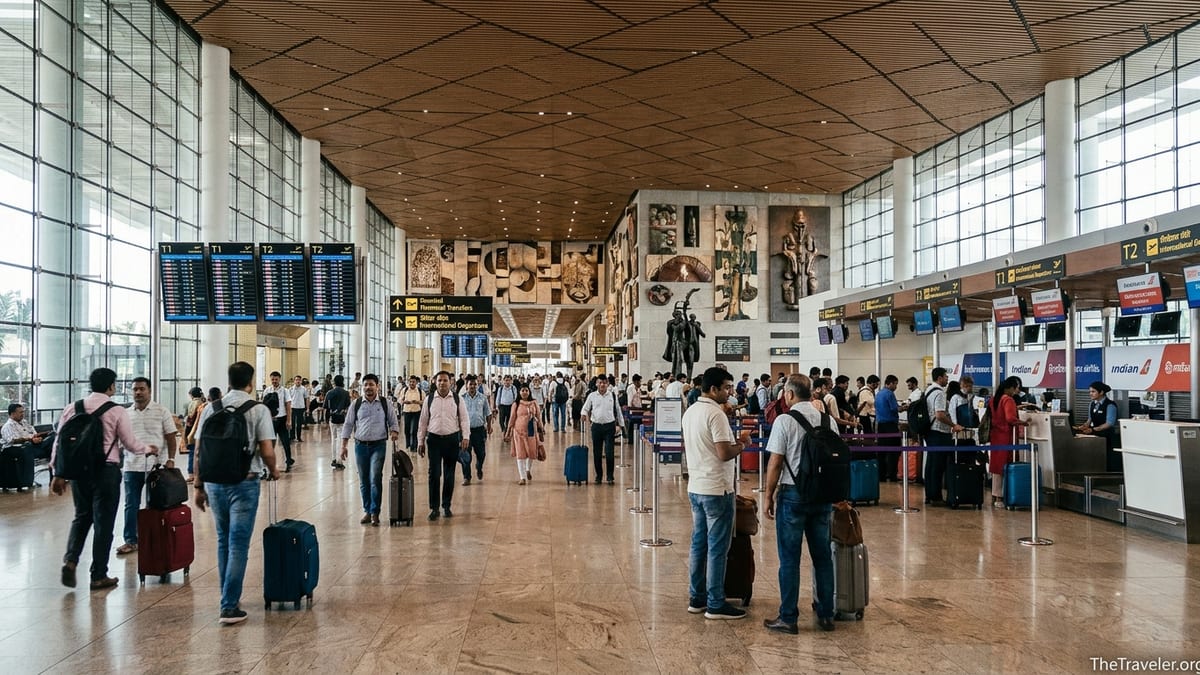
Overview: Two Terminals, Two Different Campuses
Mumbai Airport operates with two main passenger terminals: Terminal 1 in Santacruz and Terminal 2 in Sahar. They are not connected inside the secure area and they are not within easy walking distance. For a first-time visitor arriving late at night, this can be a real shock, especially when a driver or taxi drops you at the wrong campus and you discover your flight is actually leaving from the other terminal.
Terminal 1 is the older domestic terminal and today handles only selected domestic flights within India. Terminal 2 is the newer integrated terminal that handles all international flights and a large share of domestic flights, including the main national carriers and several newer airlines. In practice, most international passengers will only ever see T2, but many domestic routes still use T1, which is where confusion often begins.
Because the terminals are a road transfer apart, your first priority when flying from or via Mumbai should be to confirm which terminal your airline and specific flight uses on the day of travel. Airline apps, booking confirmations and departure boards at hotels in Mumbai usually show “T1” or “T2” next to the flight number. When in doubt, checking directly with the airline or airport information before you set out can save you 30 to 60 minutes of stressful last minute transferring.
To visualize the layout, think of Terminal 1 as being closer to the suburban areas near Vile Parle and Santa Cruz, and Terminal 2 closer to the Andheri East and Powai side. Many Mumbai residents will even ask, “Santacruz or Sahar?” rather than “T1 or T2,” because that is how the airport was known locally for years.
Domestic vs International: Which Terminal Handles What
The broad rule is simple: all scheduled international passenger flights in Mumbai currently operate from Terminal 2. That includes big-name carriers such as Emirates, Qatar Airways, Singapore Airlines, Lufthansa, British Airways, as well as Indian long haul operations by Air India. If your ticket includes passport control and a destination outside India, assume you are using T2 unless your airline or itinerary states something unusual.
Domestic flights are split between the two terminals. Terminal 1 is used by selected domestic services, while Terminal 2 handles domestic flights for full service and some low cost brands. As of mid 2026, common patterns travelers report include airlines such as IndiGo, SpiceJet and Air India Express operating many of their purely domestic routes from Terminal 1, while Air India and Akasa Air base their domestic operations in Terminal 2 alongside their international flights. However, allocations can change and certain airlines may run some domestic services from T2 even if most are at T1, so you should always check your booking rather than relying only on the airline name.
For example, a Bengaluru to Mumbai Indigo flight may arrive at T1, while an Indigo Mumbai to Dubai flight will depart from T2. A traveler booked on separate tickets could easily land at T1 and then need to reach T2 for check in for their onward international leg. Another common scenario is a business traveler flying Delhi to Mumbai on Air India domestic and then connecting to London on Air India. Both legs are likely to use Terminal 2, making the connection relatively straightforward within the same building, even though one flight is domestic and the other international.
Because Mumbai is a major domestic and international hub, mixed itineraries are very common. Tourists flying from Europe to Goa, Kochi or Jaipur via Mumbai might arrive internationally into T2, pass immigration, and then connect to a domestic low cost flight out of T1. Understanding in advance that this requires a landside transfer between two separate terminal complexes is crucial for planning realistic connection times.
Airline and Route Examples: Who Uses T1 and Who Uses T2
Although exact allocations evolve over time, real world patterns give travelers a useful starting point. Terminal 2 is home to all foreign international airlines serving Mumbai, from Gulf carriers such as Emirates and Etihad to Asian hubs like Singapore Airlines and Cathay Pacific and European airlines such as Lufthansa and Air France. It also serves international routes for Indian carriers, especially Air India. If you are flying Mumbai to New York, London, Singapore, Dubai or Doha, you will depart from T2.
On the domestic side, Terminal 2 typically handles flights operated by Air India and Akasa Air within India, along with some domestic services by other carriers. A Mumbai to Chennai business trip on Air India, for instance, will likely start and end at T2. For many frequent flyers who prefer lounges, this is a major advantage because T2 has a wider range of premium lounges and facilities even for domestic departures.
Terminal 1, by contrast, concentrates domestic low cost traffic. Travelers on budget trips from Mumbai to cities such as Goa, Ahmedabad, Jaipur or Hyderabad may find their IndiGo or SpiceJet flight listed from T1. For example, a long weekend traveler flying Mumbai to Goa on a low cost airline often departs from T1 in the morning and returns to T1 in the evening. Some routes on the same airline might operate from T2, which can be confusing if you are used to flying that carrier from one terminal and suddenly your gate information shows the other.
Because airline terminal assignments can depend on operational decisions, fleet types or regulatory changes, do not rely solely on older blog posts or what happened on your last trip. A simple check on your airline’s mobile app the day before departure will usually show “Mumbai BOM T1” or “Mumbai BOM T2” next to your flight and can prevent a very expensive taxi ride at the last minute.
Baggage Claim, Check In and Connections Between Flights
For point to point travelers starting or ending their journey in Mumbai, baggage handling is straightforward. If you arrive on a domestic flight into Terminal 1, you will collect your bags at the T1 domestic baggage hall, exit to the arrivals area and proceed to ground transport. If you land on a domestic or international flight at Terminal 2, you collect from the appropriate carousel at T2 and exit into that terminal’s arrivals hall. Bags are never transferred automatically between Terminal 1 and Terminal 2 unless you are on a through ticket and the airline explicitly confirms this in writing.
Where confusion arises is for connecting passengers. If you are booked on a single through ticket, such as Sydney to Mumbai to Delhi on one airline and both flights use Terminal 2, your bags will typically be tagged to your final destination and you can follow the domestic transfer signs inside T2 after immigration and customs. In contrast, if you are arriving on an international airline at T2 and then catching a separate low cost domestic flight from T1 that you booked yourself, you must collect your checked luggage at T2, clear customs, exit the terminal, and then physically transfer yourself and your bags to Terminal 1 to check in again.
A concrete example helps. Imagine a traveler flying London to Mumbai on a European carrier landing at T2 at 02:30, with a separately purchased Mumbai to Goa ticket on a low cost airline departing from T1 at 05:45. After landing, they must go through immigration at T2, collect their checked bag, pass customs, find the inter terminal shuttle or a taxi, travel by road to T1, then queue for domestic check in and security. Any delay at immigration or baggage claim could quickly eat into that buffer. In such cases, leaving at least 3 to 4 hours between scheduled arrival and departure is safer than cutting it close.
The reverse journey can be just as tight. A backpacker arriving from Kochi at T1 at 10:00 with a separate international ticket from T2 at 12:10 risks missing their long haul flight if there is a baggage delay, traffic between terminals or long queues at immigration in T2. Even with hand luggage only, it still takes time to exit T1, find transportation to T2, and clear full international formalities. For self connecting travelers, generous layovers and travel insurance are strongly recommended.
Inter Terminal Shuttle, Taxis and the “Can We Walk It?” Myth
A free inter terminal shuttle bus connects Terminal 1 and Terminal 2 for ticketed passengers. Reports from recent travelers suggest the shuttle typically runs every 20 to 30 minutes around the clock, though wait times can occasionally be shorter or longer depending on traffic and demand. The actual drive between terminals can take roughly 15 to 30 minutes in normal conditions but may be slower in peak Mumbai traffic or during monsoon downpours.
To use the shuttle, passengers usually need to show a same day boarding pass or onward ticket and in many cases may be asked for identification. Signs for the shuttle are posted in the arrivals areas, but they can be easy to miss in a crowded terminal. The shuttle is a standard airport coach rather than a luxury bus, and seats can fill during busy morning and late night banks of flights. Travelers with large families, heavy luggage or limited mobility may find the experience stressful and sometimes opt to pay for a taxi for more control over timing.
Prepaid taxis and app based ride services also operate between the terminals. Fares can vary depending on time of day and surge pricing, but a one way ride between T1 and T2 generally costs the equivalent of a few US dollars, often within the range of a few hundred Indian rupees. For example, a typical app based sedan transfer in normal traffic might cost around the price of a simple airport meal. The drive is usually 15 to 25 minutes outside rush hour, but morning and evening peaks can easily double that.
A persistent myth among some first time visitors is that you can simply walk between T1 and T2. On a map the distance might not look huge, but in reality the route involves busy multi lane roads, flyovers, security restricted zones and construction areas. There is no safe signposted pedestrian path for passengers. Attempting to walk with luggage in Mumbai’s heat, humidity and traffic is both impractical and potentially dangerous. For all practical purposes, treat the terminals as two separate airports and plan for a road vehicle between them.
Check In, Security and Facilities: What To Expect in Each Terminal
Terminal 2 is the flagship building and offers a more modern, spacious experience. It features tall ceilings, extensive artwork, multiple security lanes and a range of lounges, duty free shops and food outlets. Domestic and international departures are separated by security and immigration, but the overall design feels like a large, integrated complex. Regular travelers often comment that queues at T2’s security and immigration can swell during peak hours, but the processing capacity is higher and facilities such as seating, charging points and restrooms are more extensive than in T1.
Terminal 1, in comparison, feels more compact and functional. It has fewer dining and shopping options and a simpler layout focused on getting large volumes of domestic passengers in and out. For a morning commuter flight to cities like Pune or Ahmedabad, many business travelers appreciate the quick in and out nature of T1, but those used to the more polished ambiance of T2 might find it basic. Seating can be limited at very busy times, so arriving early does not always guarantee a comfortable place to sit near your gate.
Security procedures at both terminals follow standard Indian aviation rules. Expect to remove laptops and large electronics, place cabin bags through the X ray scanner, and go through separate screening lines for men and women. At T2, international departures add passport control and immigration checks, which can introduce extra waiting time. Travelers with lounge access may prefer T2 for its selection of airline operated and independent lounges, while T1 has fewer but still useful options for travelers wanting a quiet place to sit, shower or grab a more substantial meal.
Both terminals offer essentials such as ATMs, currency exchange counters, pharmacies, and snack kiosks, but availability can vary. For example, a traveler arriving late at night at T1 on a delayed domestic flight may find that only a couple of snack counters and convenience shops remain open, whereas T2’s international side often maintains more 24 hour outlets due to overnight long haul schedules.
Common Wrong Terminal Mistakes and How To Avoid Them
One of the most stressful experiences at Mumbai Airport is realizing you are at the wrong terminal with a departure time approaching. A classic example involves domestic travelers who assume all domestic flights depart from T1, only to discover at check in that their Air India or Akasa flight actually operates from T2. Another frequent case is international passengers on separate tickets who exit at T2 after a long haul arrival, then follow drivers or friends to T1, mistakenly thinking all domestic flights use that terminal, only to find their connecting airline listed from T2 as well.
Wrong terminal mistakes often stem from outdated information, assumptions based on airline reputation, or confusion between the old Santacruz and Sahar naming. Ride share drivers sometimes ask simply “Domestic or International” and may take “Domestic” to mean T1, even when the domestic leg departs from T2. Travelers arriving by suburban train at Vile Parle station may also naturally head to T1 because it is closer, without double checking their booking.
To avoid these pitfalls, use multiple sources to verify your terminal: the airline website or app, the e ticket confirmation, and the airport’s own flight information. Look specifically for “T1” or “T2” next to the city name. If you are being picked up or dropped off, send your driver a message with the exact terminal and, ideally, the airline and flight number. For example, “Drop at Mumbai Terminal 2, Air India AI 601 to Delhi” is far clearer than saying “Domestic Air India.”
If you do realize you are at the wrong terminal, act immediately. Skip non essential stops like coffee or smoking areas and head directly to the shuttle pick up or taxi stand. Inform your airline’s customer service as soon as possible if it appears you may miss check in cut off times. At busy Indian airports, airlines may strictly enforce closure times for baggage drop, especially on international flights. Being only a few minutes late because of a terminal mix up can mean no boarding, even if the aircraft is still at the gate.
The Takeaway
The key to navigating Mumbai’s Terminal 1 versus Terminal 2 is to treat them as two distinct airports serving different mixes of flights. Terminal 2 handles all international operations and a large share of domestic routes, especially on full service and newer carriers, while Terminal 1 concentrates selected domestic low cost flights. They are connected by road only and not realistically walkable, which makes accurate terminal information essential whenever you fly into or out of Mumbai.
For smooth journeys, confirm your exact terminal before you set out, allow generous time for any inter terminal transfer, and plan your baggage strategy carefully if you book separate tickets. Real world examples from countless travelers show that most Mumbai airport stress comes not from the flight itself, but from confusion over T1 versus T2, underestimated transfer times, and last minute scrambles between terminals.
With realistic expectations about shuttle frequency, traffic conditions, security queues and baggage collection, you can build a safe time buffer into your itinerary and enjoy the airport for what it is: a major South Asian hub with a striking modern terminal, strong domestic connectivity and plenty of onward options. A few minutes of planning before you travel can mean the difference between sipping chai calmly in a lounge at T2 and racing in a taxi between campuses hoping your gate has not closed.
FAQ
Q1. Is Terminal 1 only for domestic flights and Terminal 2 only for international flights at Mumbai?
Not exactly. All international flights use Terminal 2, but many domestic flights also use Terminal 2. Terminal 1 is used for selected domestic flights only, mainly on certain low cost carriers.
Q2. How long does it take to transfer between Terminal 1 and Terminal 2?
The free shuttle or a taxi ride usually takes around 15 to 30 minutes in normal traffic, but you should allow at least 60 to 90 minutes total once you include waiting for the shuttle, walking inside the terminals and possible traffic delays.
Q3. Can I walk between Terminal 1 and Terminal 2 at Mumbai Airport?
No. There is no safe, signposted pedestrian route between the terminals. They are separated by busy roads and security zones, so you should always use the shuttle or a vehicle.
Q4. If I arrive on an international flight at Terminal 2 and have a separate domestic ticket from Terminal 1, will my bags be checked through?
Usually not. With separate tickets you almost always need to collect your checked baggage at Terminal 2, clear customs, then transfer by road to Terminal 1 and check in again for your domestic flight.
Q5. How much connection time do I need between an international arrival at T2 and a domestic departure at T1?
It is safer to allow at least 3 to 4 hours between the scheduled landing of your international flight and the domestic departure from T1, especially if tickets are separate and you must clear immigration, collect bags and recheck in.
Q6. Which terminal does IndiGo use in Mumbai?
IndiGo operates many of its domestic flights from Terminal 1, while its international flights depart from Terminal 2. However, terminal assignments can vary by route and schedule, so always confirm on your booking or app.
Q7. Are facilities like lounges and restaurants better in Terminal 1 or Terminal 2?
Terminal 2 generally offers more lounges, dining options and shopping, both on the domestic and international sides. Terminal 1 has essential services but is more basic and focused on quick domestic turnarounds.
Q8. Do I need to go through security again when transferring between terminals?
Yes. Because the transfer between Terminal 1 and Terminal 2 takes you landside, you must clear security again at your departure terminal, and for international flights you also pass through immigration and passport control.
Q9. What should I do if my taxi drops me at the wrong terminal before departure?
Go straight to the inter terminal shuttle pick up point or taxi stand and transfer immediately. Inform your airline as soon as possible if you might miss check in, but understand that cut off times are often strictly enforced.
Q10. How can I be absolutely sure which terminal my flight uses in Mumbai?
Check multiple sources close to your travel date: your e ticket, your airline’s app or website, and the airport’s flight information. Look specifically for “T1” or “T2” next to your Mumbai departure or arrival.