


Landing in Mumbai and heading straight to a hotel in Colaba or South Mumbai sounds simple on a map, but the reality on the ground can be confusing, especially for first-time visitors. Between prepaid taxis, Uber and Ola pickups, evolving metro lines, and the unpredictable Western Express Highway, choosing the right route from Chhatrapati Shivaji Maharaj International Airport to Colaba can easily add or save an hour to your journey. This guide breaks down the most reliable options in 2026, with concrete examples and practical advice for different arrival times, group sizes, and luggage loads.
Get the latest updates straight to your inbox!
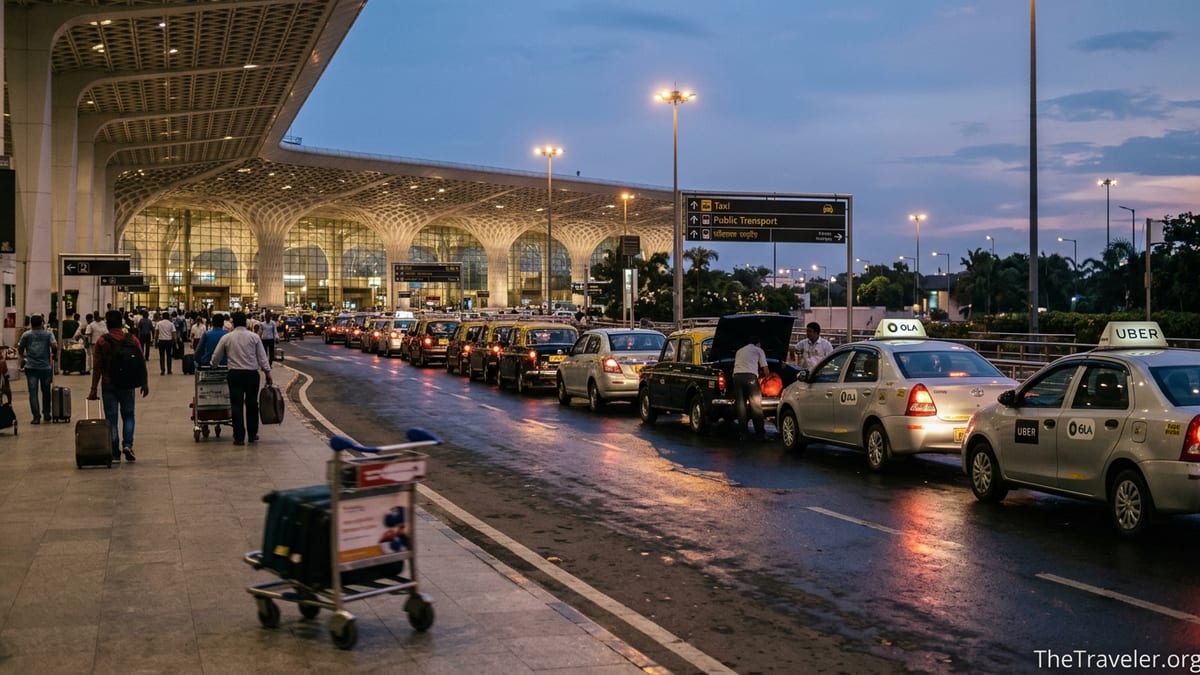
Understanding the Route: From Andheri to South Mumbai
Mumbai’s main airport, Chhatrapati Shivaji Maharaj International Airport, sits in Andheri East, about 25 to 30 kilometers north of Colaba. In normal traffic, that distance can take 45 to 60 minutes by road. In peak traffic, especially when the Western Express Highway is saturated, it can stretch to 90 minutes or more. For most travelers bound for Colaba, Fort, Cuffe Parade, or Marine Drive, the journey is essentially a straight road trip south: out of the airport via the Sahar Elevated Access Road, onto the Western Express Highway, cutting across to the eastern side via a link road, then continuing through central Mumbai into the old downtown.
The Western Express Highway is the critical first leg. It is a major north-south artery carrying heavy commuter and freight traffic, and local commuters often describe it as one of the city’s most congested corridors during rush hour. Southbound traffic is usually most intense on weekday mornings and early evenings, with long tailbacks around bottlenecks such as Andheri, Santacruz and Bandra. At the same time, travelers report that traffic often eases significantly late at night, early in the morning, and on some weekend afternoons, when trips from the airport to Colaba can be surprisingly quick.
Because of this variability, two people landing at different times can have very different experiences. A solo traveler arriving at 2 am on a Tuesday might reach a hotel near the Gateway of India in 35 to 40 minutes by Uber, while a family arriving at 6 pm on a Monday could easily spend 75 to 90 minutes in a prepaid taxi covering roughly the same distance. Understanding when you are landing and how congested the Western Express Highway is likely to be should shape your choice of transport.
Another important element is that, as of mid-2026, there is still no metro line that takes you directly from the airport into South Mumbai. The new underground Metro Line 3 now connects Cuffe Parade, Fort and the CSMT area with the northern suburbs, but the section directly serving the airport is not yet open. That means any metro or train-based option currently involves at least one taxi or rickshaw connection plus a transfer at a busy station, which is rarely ideal with luggage after a long flight.
Prepaid Airport Taxis: Simple and Predictable
For many visitors, the airport’s prepaid taxi counters remain the most straightforward way to reach Colaba. At both international Terminal 2 and the domestic terminals, you will find clearly marked prepaid taxi booths just before the arrivals exit. Here you tell the clerk your destination, pay a fixed fare in advance, and receive a slip that you hand to the driver outside. The fare is calculated by zone and distance, is regulated by the transport authorities, and is displayed on boards at the counter so you can see a rough price before you commit.
Recent examples from travelers in 2025 and early 2026 suggest that a standard prepaid black-and-yellow taxi or air-conditioned cool cab from the airport to Colaba or Nariman Point typically falls roughly in the 700 to 900 rupee range, depending on the exact location and vehicle category. A family arriving at Terminal 2 and heading to a mid-range hotel near Colaba Causeway might, for instance, pay around 800 rupees for a cool cab, plus a standard night surcharge if traveling between midnight and 5 am. Tariff cards for cool cabs show that late-night travel can add about 25 percent to the base fare, so a 700-rupee daytime trip might cost closer to 875 rupees after midnight.
The main advantages of prepaid taxis are clarity and convenience. You do not have to haggle on the curb, worry about a driver refusing your destination, or navigate a parking structure while jet-lagged and carrying bags. The prepaid slip lists your destination, and if there is any dispute you can refer back to the counter or airport police. This is particularly valuable for older travelers, families with children, or anyone arriving with several large suitcases. For example, a couple arriving from Europe at 3 am with two large and two cabin bags often prefer simply walking to the counter, paying a known amount, and heading straight to their hotel without opening an app.
The trade-off is that prepaid taxis are sometimes slightly more expensive than what Uber or Ola might charge at non-peak times, and the fleet quality can be mixed. Some visitors report very clean, air-conditioned sedans, while others are allocated older vehicles with tired interiors. If car quality matters and you are comfortable with ride-hailing apps, you may want to compare the prepaid fare with live app prices before deciding at the counter.
Uber and Ola from the Airport: When They Make Sense
Ride-hailing services like Uber and Ola operate at Mumbai Airport, but the pickup process is more involved than simply walking out to the curb. At Terminal 2, for example, app-based taxis typically pick up from designated zones in the multi-level parking structure rather than right outside arrivals. That can mean a short but sometimes confusing walk, especially if you are unfamiliar with the airport layout or dealing with heavy luggage and humidity. In practice, this means Uber and Ola are best for travelers who already use these apps at home and are comfortable checking driver details, car numbers and pickup zones in a crowded environment.
On price, app-based rides are often competitive. Local reports from 2025 and 2026 show that an Uber or Ola from the airport to Colaba during light traffic can cost noticeably less than a prepaid taxi, especially outside peak hours. For instance, someone arriving at 10 pm on a Sunday might see app quotes in the 600 to 800 rupee range for a standard sedan, similar to or slightly lower than prepaid. However, during busy evening periods, large events, or monsoon downpours, surge pricing can push these fares significantly higher. There are frequent anecdotes of passengers seeing quotes above 1,000 rupees even for shorter trips to nearby suburbs at peak time.
Another factor is that the airport charges a parking or pickup fee for app-based cabs, which is usually passed on to the rider and added automatically to the final bill. This can make short-distance rides from the airport feel disproportionately expensive compared with similar-distance trips elsewhere in the city. On a 30-kilometer journey to Colaba, this extra fee is less noticeable, but it is still worth being aware that the price on your phone already reflects tolls and airport surcharges.
Most experienced Mumbai residents say they personally default to Uber or Ola when leaving the airport, mainly because they like seeing the fare estimate in advance and tracking the route in the app. One common strategy is to check the app price as soon as you connect to airport Wi-Fi, then compare it with what you might expect to pay at the prepaid counter. If the app shows an unusually high price thanks to surge conditions, you can walk to the prepaid desk instead. Solo travelers with light luggage and a working local SIM often find this flexibility worthwhile.
Public Transport Combinations: Metro, Train and Bus
Mumbai’s public transport network is extensive and busy, and many locals would never consider paying for a taxi from the airport all the way to South Mumbai. As a visitor, however, the picture is more complicated. Using buses, metro lines and suburban trains to get from the airport to Colaba can be very cheap in rupee terms, but it almost always involves at least two or three changes and crowded conditions that can be overwhelming after a long flight.
As of July 2026, the key limitation is that there is no direct metro or suburban train station connected inside the airport terminals. The nearest suburban rail stop to Terminal 2 is Andheri station on the Western Line, and the nearest completed metro lines require either a short taxi or rickshaw ride from the terminals. A common low-cost route that some budget travelers use is to take a local bus or auto-rickshaw from the airport area to a station like Andheri or Ghatkopar, then board a suburban train towards Churchgate or CSMT, and finally switch to a bus or taxi to reach Colaba. While this can reduce the fare to a fraction of a taxi, it means hauling luggage through at least one busy station and often climbing footbridges.
The situation is changing gradually. The new underground Metro Line 3 now links Cuffe Parade, Fort and CSMT with northern neighborhoods like SEEPZ and Aarey, offering a clean, air-conditioned alternative between South Mumbai and the suburbs. However, the segment that will eventually connect directly to the airport is not yet open, and current feeder bus services are primarily designed for local commuters rather than travelers with suitcases. City authorities and metro planners have discussed dedicated feeder bus routes for airport passengers, but these are still a work in progress.
Airport express bus services have also evolved. In previous years, a private operator called Chalo ran an air-conditioned bus route directly from Terminal 2 to Cuffe Parade and Colaba for a flat fare of around 200 rupees, which was popular with budget-conscious travelers. That specific route has since been discontinued, and recent services have focused more on connecting the airport to Navi Mumbai and Thane. For now, this means there is no straightforward, single-seat bus ride from the airport doors to Colaba that you can reliably count on every day.
Realistically, public transport combinations make the most sense if you are a repeat visitor, traveling with a backpack rather than suitcases, and arriving in daylight hours. A solo traveler familiar with Mumbai might, for example, take a local bus to Andheri station, ride a fast local train to Churchgate, then hop on a short taxi or BEST bus down to Colaba for a total of under 150 rupees. But for a jet-lagged first-timer with a rolling suitcase and a laptop bag, the savings are often not worth the complexity and crowds, especially in the evening rush or the middle of the monsoon.
Traffic Timing: Western Express Highway and Peak Hours
The Western Express Highway is both your main gateway into the city and your biggest wild card. It is a multi-lane arterial route that carries cars, buses and heavy vehicles and is prone to congestion at key junctions. Local commuters often describe a consistent pattern: heavy southbound traffic in the morning as people head towards business districts, and heavy northbound traffic in the evening as they return home, with additional delays around major flyovers and construction zones. For airport-bound and airport-origin traffic, this means that late afternoon to early evening on weekdays can be particularly slow.
Traveler reports suggest that driving from the airport area to Bandra or Dadar along the Western Express Highway can sometimes take an hour by itself during bad congestion, leaving another 30 to 40 minutes for the final stretch into South Mumbai. In contrast, the same segment can shrink to 20 to 30 minutes after 9 or 10 pm, when many office commuters are already home. This variability is one reason that travel time estimates in taxi apps can oscillate widely; it is not unusual for an Uber quote at 5:30 pm to show a travel time of 80 to 90 minutes, then drop to 45 minutes when checked again at 9 pm.
Monsoon season adds another layer of uncertainty. Heavy rain between June and September can slow traffic to a crawl, especially when waterlogging closes individual lanes or smaller connector roads. On such days, even a mid-afternoon arrival can face delays that feel like peak rush hour, and many locals automatically add 20 to 30 minutes to any road journey across the city. If your incoming flight during the monsoon is scheduled around the evening peak, it is wise to assume the longer end of possible travel times and to inform your hotel in Colaba that you may arrive later than planned.
The gradual expansion of metro lines along the Western Express Highway corridor has reportedly reduced some commuter load, particularly on northern segments, but the highway remains busy near the airport thanks to a constant flow of taxis, private cars and airport service vehicles. Practically, for a visitor, the best strategy is simple: if you are landing between about 7 am and 11 am or 4 pm and 9 pm on a weekday, plan for at least an hour from the airport to Colaba and consider that any road-based mode, whether prepaid taxi or Uber, will be affected similarly by the same jams.
Outside these peaks, the choice of vehicle matters more than the route. A traveler landing at 1 pm on a Saturday often finds that traffic is relatively tolerable, and the main question becomes price, comfort and how quickly they can get out of the terminal rather than how to avoid the highway. In those cases, both prepaid taxis and app-based rides can perform similarly in travel time, and the main differences lie in fare, car quality and personal comfort with apps.
Night Arrivals, Safety and Luggage Considerations
Many long-haul international flights arrive in Mumbai late at night or in the early morning hours. If your plane touches down at 1 or 2 am, you will likely enjoy lighter traffic into South Mumbai, but you may also feel more exposed as you navigate an unfamiliar city after dark. Fortunately, the airport operates 24 hours, and both prepaid taxis and app-based cabs continue to run through the night. The main differences at these hours are price structures and your own comfort level.
For families, older travelers or anyone anxious about dealing with apps at 3 am, prepaid taxis are usually the safest-feeling option. The counters are inside the terminal in well-lit, staffed areas, with security and police nearby. You pay upfront, keep a receipt, and go directly to a marked taxi zone. Even if you are carrying two large suitcases and a stroller, porters are available to help you reach the car. The late-night surcharge for taxis is clearly defined by the local tariff card, which helps avoid surprises. Many local residents advising visitors online specifically recommend using the prepaid counter for elderly parents or relatives arriving alone at night.
For app-savvy travelers, Uber and Ola remain practical overnight, and fares can sometimes be lower than in the early evening because demand is less spiky. At 2 am on a weekday, for example, a standard app-based cab to Colaba may quote a moderate fare with a travel time of under 45 minutes, thanks to clear roads through Andheri and Bandra. If you have multiple suitcases, choosing a sedan or SUV category within the app gives you more trunk space, though at a slightly higher rate. As always, check the driver’s rating, car model and number plate before getting in, and avoid accepting unsolicited ride offers from drivers outside the official pickup area.
Luggage volume is a crucial factor that often gets underestimated. Mumbai’s taxis, especially the traditional black-and-yellow cabs, are compact by international standards. Two people with three or four large suitcases may find the trunk and interior space tight. If you are carrying sports equipment, musical instruments or bulky souvenirs, it is worth explicitly asking for a larger vehicle where possible. App-based platforms allow you to choose larger categories, while at the prepaid counter you can request a cool cab or specific category better suited to multiple bags, though availability is not always guaranteed.
For safety, common-sense precautions go a long way. Keep passports, wallets and electronics in a small bag that stays with you in the back seat rather than in the trunk. Share your route or live location with a friend or family member if possible. If a driver suggests a detour, it is reasonable to ask why; during the day, small diversions to avoid jams are normal, but at night you should expect a fairly direct route on major, well-lit roads between the airport and South Mumbai.
Choosing the Best Option for Your Trip
There is no single “best” route from Mumbai Airport to Colaba that fits every traveler. Instead, the right choice depends on your arrival time, budget, number of people and luggage, and your comfort with local apps and public transport. A solo backpacker landing at 11 am, familiar with Indian cities and eager to save money, might happily take a city bus or rickshaw to the nearest train station, ride a packed suburban train into Churchgate, and finish the journey with a short taxi, all for a fraction of a taxi fare. At the same time, a family of four arriving with grandparents and three suitcases around 6 pm on a weekday rush hour is likely better off booking a prepaid taxi or a large Uber and budgeting generously for traffic.
As a rule of thumb, if you are a first-time visitor, staying in a hotel in Colaba and arriving between late afternoon and midnight, a prepaid taxi from the airport counter offers the best balance of simplicity, safety and predictability. You will pay a clearly displayed fare, walk out under the guidance of airport staff, and avoid figuring out the pickup zones while jet-lagged. You may sit in traffic on the Western Express Highway, but you will do so without worrying about meters, detours or haggling at the end of the journey.
If you are a repeat visitor or a confident traveler with a local SIM, then checking Uber or Ola prices as soon as you land can yield savings. In quiet periods or late-night windows, these apps often undercut prepaid rates, and the ability to track the route on your phone can be reassuring. Keep in mind that airport pickup fees and night surcharges are factored into the quote, so what you see in the app is very close to what you will pay, barring major route changes or toll variations.
Public transport only really enters the picture if you are on a strict budget, comfortable with crowds and changes, and traveling relatively light. The lack of a direct airport metro or train station at present means that any money saved comes at the cost of time, physical effort and some uncertainty. In particular, it is not advisable to attempt a complex bus and train combination late at night or in the middle of a monsoon downpour if you are unfamiliar with Mumbai. In those scenarios, spending more on a taxi is a reasonable investment in safety and peace of mind.
Whatever option you choose, communicating with your hotel helps. Many Colaba hotels are used to guests arriving from the airport and can advise whether traffic is usually heavy at your arrival time or even arrange a private transfer at a pre-agreed rate. While such transfers are often more expensive than taxis or apps, they offer the ultimate in hand-holding: a driver waiting with your name on a sign, walking you to the car, loading your bags and knowing exactly where to go.
The Takeaway
The journey from Mumbai Airport to Colaba is straightforward on a map but nuanced in practice. You are dealing with a large, 24-hour airport in a dense megacity, a major highway prone to traffic swings, and a transport network that is modernizing quickly but still leaves a gap between the terminals and South Mumbai’s heritage districts. Understanding these moving parts helps you avoid surprises, especially after a long international flight.
In 2026, prepaid taxis remain the default, no-fuss choice for most first-time visitors and anyone arriving with family or multiple bags, particularly in the evening and at night. Uber and Ola are excellent alternatives when you are comfortable with the apps and the pickup process, and they can be noticeably cheaper at non-peak times. Public transport combinations via bus, metro and train are possible and very economical but best reserved for experienced travelers with light luggage and daytime arrivals.
There is no guaranteed way to avoid every traffic jam on the Western Express Highway, but planning around peak hours, allowing extra time in the monsoon, and choosing the mode that fits your comfort level and luggage situation will keep stress to a minimum. With a bit of forethought, your first hour in Mumbai can be less about battling logistics and more about watching the city’s neighborhoods change as you head south towards the sea and the historic streets of Colaba.
FAQ
Q1. How long does it usually take to get from Mumbai Airport to Colaba by taxi?
On a typical day, expect 45 to 60 minutes in light to moderate traffic and up to 75 to 90 minutes in weekday peak hours or heavy rain.
Q2. What is the approximate taxi fare from the airport to Colaba?
As of 2026, prepaid and metered taxis commonly cost in the broad range of 700 to 900 rupees for a standard air-conditioned cab, with night surcharges on top.
Q3. Is Uber or Ola cheaper than a prepaid taxi for this route?
Often, yes in off-peak periods or late at night, but during rush-hour or surge conditions app prices can match or exceed prepaid fares, so it is worth checking both.
Q4. Are taxis and ride-hailing services safe at night from Mumbai Airport to Colaba?
Generally they are considered safe, especially from the official airport prepaid counter or vetted app-based rides, but it is wise to follow normal precautions and share your route.
Q5. Can I use public transport like metro or train directly from the airport to Colaba?
Not directly. You currently need at least one taxi, rickshaw or bus connection from the airport to a station, then a metro or train plus a final taxi or bus to Colaba.
Q6. Is it realistic to use buses and trains if I have a lot of luggage?
It is technically possible but not comfortable. Crowded buses, station footbridges and packed trains make multi-bag journeys difficult, especially after a long flight.
Q7. What is the best option for older travelers or families with children?
A prepaid taxi from the airport counter or a pre-arranged hotel transfer is usually best, as both minimize walking, steps and the need to manage apps or transfers.
Q8. How bad is traffic on the Western Express Highway, and can I avoid it?
Traffic can be heavy during weekday peaks and in the monsoon. You cannot fully avoid the corridor when leaving the airport, but late-night or mid-day arrivals usually face fewer delays.
Q9. Do I need to tip taxi or Uber drivers for this journey?
Tipping is not mandatory, but rounding up the fare or adding a small extra amount for helpful service is appreciated; app-based platforms may also allow in-app tips.
Q10. Should I book a transfer in advance or decide on arrival?
If you arrive at odd hours, with a large group or elderly relatives, pre-booking a hotel or private transfer can reduce stress; otherwise, deciding between prepaid taxi and apps on arrival is fine.