


Munich Airport is one of Europe’s busiest hubs, and its parking system is just as extensive as its route network. Between multi-level terminal garages, budget-friendly long-stay lots and highly regulated drop-off lanes, choosing the right option can make the difference between a smooth start to your trip and an unexpected bill. This guide walks you through how parking works at Munich Airport today, with real examples of prices, locations and strategies that help regular travelers keep costs under control.
Get the latest updates straight to your inbox!
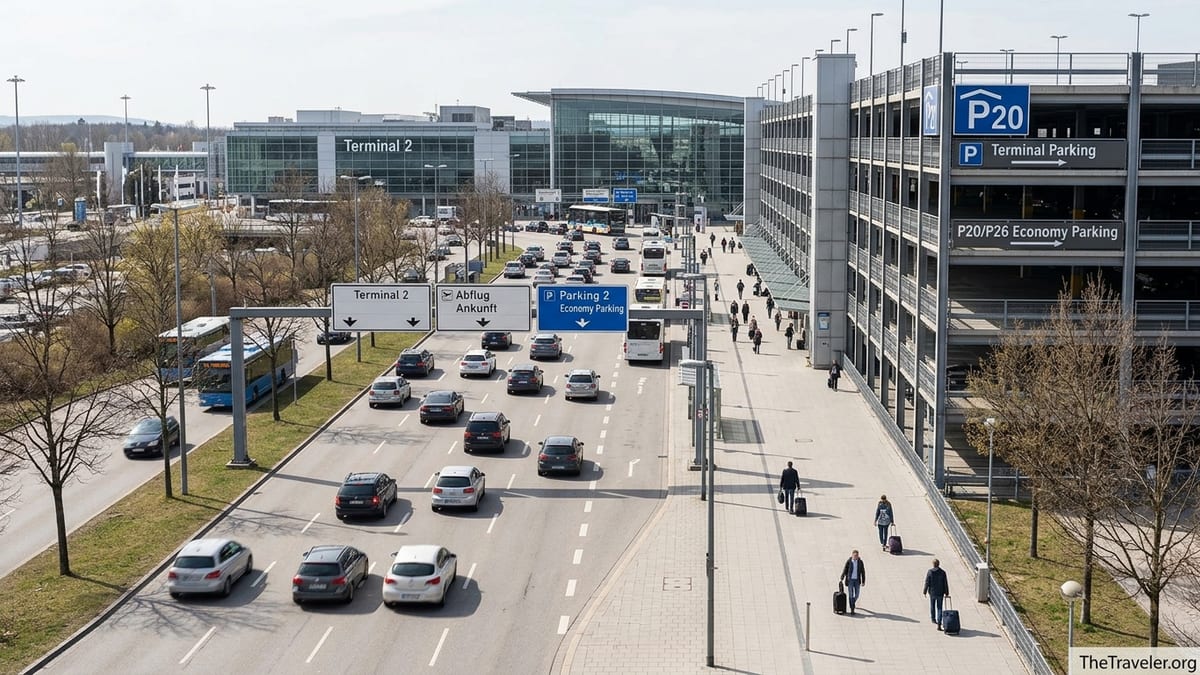
How Munich Airport’s Parking Is Organized
Munich Airport lies about 40 kilometers northeast of central Munich and is arranged around two main terminals plus a central area. Parking follows the same logic: premium options sit directly beside Terminal 1 and Terminal 2, while cheaper long-stay and “vacationer” parking spreads out a little further on the airport grounds. In total, there are tens of thousands of spaces split between multi-story garages, underground garages and open-air lots, including areas for oversized vehicles and special security products.
The key names to know are the terminal garages such as P1, P3 and P4 at Terminal 1 and P20 at Terminal 2, and the larger P41, P43, P44, P50, P51 and P90 economy or “vacationer” areas that typically offer lower daily rates. The airport also operates a clearly signposted Kiss & Fly zone in the terminal forecourts, where very short stops are free within strict time limits. Most of these facilities are run under a unified pricing system that is regularly updated, so you can plan with reasonable confidence if you check the current tables before you travel.
Almost all car parks feed into a well-marked internal road system. If you follow signs for Terminal 1, Terminal 2 or “M” for the central Munich Airport Center, you will quickly see electronic signboards listing P1, P20 or other garages together with the number of remaining spaces. This live guidance means that even at peak times, such as Saturday mornings in ski season, you are rarely driving around aimlessly looking for a space.
Importantly, parking fees at Munich Airport are calculated in 24-hour blocks from the time you take a ticket or scan your reservation at the barrier. That means arriving late in the evening and leaving early two days later can count as two full days. For example, entering P41 at 21:00 on a Monday and leaving at 20:30 on Wednesday will be charged as two days, not three, as long as you remain under 48 hours.
Terminal Parking: P1, P3, P4, P5, P7, P20 and P26
If you prioritize proximity to the check-in desks, the terminal garages are the straightforward choice. At Terminal 1, multi-story garages P1, P3, P4 and P5 sit directly beside the various departure modules, usually connected by covered walkways or short indoor routes through the Munich Airport Center. At Terminal 2, the largest facility is P20, an eleven-level combination of above- and underground parking that can hold several thousand vehicles. There is also P7, another terminal-side option that many regular flyers use when P20 gets busy.
These garages are classed as “Terminal Parking” in the official tariffs. In early 2026, a 24-hour stay in most terminal garages typically costs in the range of a few dozen euros when booked on the standard rate, with prices rising in roughly 24-hour steps. Internal tables show that by day seven, a stay in a terminal garage can climb into the low to mid hundreds of euros for a week, which is convenient for a three-day business trip but quickly becomes expensive for a two-week holiday. Online advance rates can be noticeably cheaper than simply taking a paper ticket at the barrier.
In practice, this is how many travelers use terminal parking. A consultant flying to London on Monday and back Wednesday might book 3 days in P20, paying a premium compared with the economy lots but saving time by walking straight from the car to check-in in around five minutes. A family dropping a car at P1 for an early-morning departure to Mallorca may accept the higher cost in exchange for not juggling luggage and children on a shuttle bus at 05:30.
Within the terminal garages, Munich Airport also offers special options, such as extra-wide “XXL” parking bays suitable for large SUVs or vans and a “security parking” area on a separate level in P20, where access is more tightly controlled. These carry their own supplements and are mainly aimed at high-value vehicles or business travelers who want added peace of mind.
Long-Stay & Economy Parking: P41, P43, P44, P50, P51, P73, P74, P80, P84, P90 and More
For stays of a week or more, the airport itself recommends the more distant “vacationer” or economy parking areas such as P41, P43, P44, P50 and P51. These are mostly open-air or low-rise facilities located a few minutes’ drive from the terminals, linked by shuttle bus or, in some cases, by the local bus network. They trade walking distance for significant savings on weekly and fortnightly stays.
Recent guidance from the airport indicates that economy parking products can undercut terminal rates by a noticeable margin over several days. For example, while a week in a terminal garage can easily cost more than two hundred euros at standard rates, a comparable stay in one of the vacationer lots like P43, P44 or P51 often comes in substantially lower. Exact figures depend on travel dates and whether you book online, but it is common for travelers to report week-long stays in these lots for what amounts to a modest per-day rate when divided across 7 to 14 days.
The trade-off is time. From P41 or P44, you normally continue to the terminal by shuttle bus. Transfer times are usually around 5 to 10 minutes, plus a short wait for the next bus. This makes economy lots a logical choice for long holidays, but less ideal if you are arriving tight on time for a short flight. For example, a couple flying to Thailand for three weeks may happily leave their car in P44, allowing extra time for the transfer, while a business traveler on a 24-hour Frankfurt turnaround is more likely to use P20 or another terminal garage.
Some of these economy and long-stay areas are particularly useful for special vehicle types. Outdoor lots like P41 and P50 can accommodate cars with roof boxes or higher vehicles that exceed the 2.0-meter height limits in most multi-story garages. This has made them popular with skiers driving up with fully loaded cars in winter or with travelers in camper-style vans who still want to park on airport property while they are away.
Drop-Off, Pick-Up and Kiss & Fly Zones
Munich Airport’s terminal forecourts serve as both the Kiss & Fly drop-off area and the short-term pick-up zone. The rules are strict but clearly defined. In front of both Terminal 1 and Terminal 2, drivers may enter the forecourt and stop for up to 10 minutes free of charge, twice per calendar day. Automatic license plate recognition or ticketing systems track the time, and overstaying leads to standard short-stay charges.
This means that if you are dropping someone off, you can usually pull up at the relevant departure area, unload bags, say goodbye and drive away within the complimentary 10 minute window. A typical scenario is a family arriving in a private car at Terminal 2: the driver stops, all passengers unload, they walk straight into the departure hall, and the driver leaves again before the free period expires. Used efficiently, this allows true curbside access without any parking fee.
For pick-ups, the same 10-minute rule applies. However, arriving passengers often take time to clear passport control and baggage claim, so it is risky to wait in the forecourt itself. The airport explicitly recommends that those who need longer should use alternative short-term parking, such as P20 at Terminal 2 or P1, P3 and P4 at Terminal 1. In practice, many locals coordinate by phone: the driver waits in a nearby car park or at a service area, and only enters the Kiss & Fly area once the arriving traveler confirms they are at the exit doors.
Drivers should be aware that lingering beyond the permitted time or repeatedly circling the forecourts is discouraged and can lead to charges. If you expect any delays, it is usually cheaper and far less stressful to park in a garage like P20, walk to the arrivals hall and meet your passenger inside. For example, paying for an hour in P20 to greet an elderly relative and assist with luggage can cost less than a forecourt overstay fee and removes the pressure of watching the clock.
How Online Booking Works and Why It Matters
Munich Airport strongly encourages travelers to reserve parking online in advance through its official booking system. This platform allows you to enter your travel dates, choose between terminal and economy options and see indicative prices for each product. In many cases, booking ahead secures a guaranteed space in a specific facility and can be noticeably cheaper than driving up without a reservation, particularly during school holidays and major trade fairs.
The online tool often highlights promotional products such as “Vacationer Parking” in specific lots, or limited-time deals that start at an attractive base price when you commit to a minimum stay. For example, you might see a special rate for 8 to 15 days in P51 that undercuts the flexible terminal-garage pricing by a wide margin, making it attractive for a two-week summer holiday. These offers tend to be capacity-controlled and may sell out long before departure during peak periods.
Technically, online reservations are linked to your license plate or a QR code. On arrival, you drive directly to the selected car park, where the system either recognizes your plate at the barrier or allows you to scan your booking confirmation. At the end of your trip, you usually drive out without needing to visit a payment machine, as charges were already calculated at the time of booking.
For travelers comparing off-airport parking providers in the wider Munich area, the official online prices are a useful benchmark. Third-party car parks around the airport sometimes advertise lower weekly rates that include a shuttle bus, but the difference narrows once you factor in extra transfer time, especially for early flights. By checking the airport’s economy offers first, you may find that official long-stay lots represent better value than expected, especially outside absolute peak holiday weeks.
Strategies to Save Money on Parking at Munich Airport
Because parking costs mount quickly on longer trips, frequent flyers in Munich tend to use a few proven strategies to keep bills down. The first is to match the parking product to the length and purpose of the trip. A three-day city break usually justifies terminal parking: the total bill, while not cheap, remains within a manageable range and the time savings are significant. By contrast, anyone heading off for a twelve-day holiday typically looks first at P41, P44 or P51, where the cost per day is lower over a full two weeks.
Booking early is another key tactic. On dates with heavy traffic, such as the start of Bavarian school holidays or big events at the Munich trade fair, on-the-day prices in terminal garages can be steep. Reserving several weeks ahead often unlocks capped packages. For instance, a traveler planning an Easter trip might log in two months before and secure a fixed-price 10-day stay in an economy lot, instead of risking last-minute day-by-day terminal rates.
Some locals also combine parking with other airport services. The central area around the Munich Airport Center includes a large supermarket and various restaurants. Certain promotions have, in the past, offered partial parking refunds if you spend a specific amount in these outlets. While such deals change over time, it can still be economical to allow a small paid stay in P20, do your grocery shopping on the way back from a flight and exit before crossing into a higher tariff band.
Finally, consider whether you really need to bring a car at all. For solo travelers or couples flying at civilised hours, the S-Bahn lines S1 and S8 from central Munich often work out far cheaper than even the most economical parking option, especially for long trips. Some residents who live near regional rail lines also drive to a suburban station, park at a local car park for a modest daily fee and continue to the airport by train, using airport parking only when traveling with bulky luggage or several family members.
Real-World Pickup Scenarios and Smart Workarounds
Pickups are where many drivers accidentally incur high charges, especially if a flight is delayed or queues at passport control are longer than expected. One practical approach used by many Munich locals is to wait away from the terminal until the passenger has actually reached the arrivals hall. For example, a driver might remain at a nearby service area on the A92 or in one of the industrial zones south of the airport, staying in phone contact. When the arriving traveler sends a message that they have their luggage, the driver heads in and uses the Kiss & Fly zone, staying well inside the free 10-minute window.
Another useful tactic, especially when picking up elderly relatives or large groups, is to park in a short-term area such as P20 at Terminal 2. The driver can walk into the arrivals hall, help with luggage, use airport restrooms and take a break at a café while keeping an eye on the time. Even if you end up paying for an hour or two of parking, the total often remains reasonable compared with the convenience and the reduced stress of having the car safely parked rather than circulating outside.
Drivers with taller vehicles, such as campervans or cars fitted with roof boxes, need to be mindful of height limits in the multi-story garages, which are typically around 2.0 meters. In these cases, the open-air approach lanes and outdoor lots around Terminal 1 are often the safer bet. Travelers in online forums frequently report using the uncovered forecourt or outdoor bays for very short pickups, while choosing economy lots such as P41 or P50 for any stay beyond a quick loading stop.
One realistic scenario might involve a family returning from a ski trip. They left their car with a roof box in P41 for ten days because the garage height restrictions at P20 ruled that out. On the day of return, they call a friend in Munich once they are standing at the baggage carousel. The friend then drives from the city, parks in P1 or P3, meets them inside the terminal and helps wheel skis and luggage back to the car. The bill for one or two hours in a terminal garage is minor compared with the convenience, and everyone avoids rushing in the Kiss & Fly lane with armfuls of gear.
The Takeaway
Munich Airport offers a wide spectrum of parking options, from high-convenience terminal garages to budget-friendly long-stay lots and strictly timed Kiss & Fly lanes. Understanding how these fit together, and how prices scale with duration, is the key to avoiding unwelcome surprises. Terminal garages like P1, P3, P4 and P20 are ideal for short business trips or situations where every minute counts, while economy areas such as P41, P44 or P51 better suit longer holidays and oversized vehicles.
Wherever you plan to park, booking online in advance, matching the product to your trip length and respecting the strict time limits in the forecourts will go a long way toward keeping your travel day calm. For pickups and drop-offs, a combination of smart timing, short-term parking and good communication with passengers can reduce costs and stress considerably. With a little planning, Munich Airport’s complex parking map becomes a set of flexible tools you can use to tailor each journey to your budget and priorities.
FAQ
Q1. How much does it cost to park at Munich Airport for one week?
For a week in a terminal garage, you should expect a bill in the low to mid hundreds of euros at standard flexible rates, depending on the exact car park and season. Economy or vacationer lots such as P41, P44 or P51 usually come in noticeably cheaper for the same period, especially when booked online in advance, though exact figures vary with demand.
Q2. Which parking area is best for long-stay holiday trips?
For trips of eight days or more, the airport itself directs travelers toward the economy or vacationer areas, notably P41, P43, P44, P50, P51 and P90. These lots are slightly further from the terminals and often use shuttle buses, but they generally offer better value over a full week or longer compared with terminal garages like P1 or P20.
Q3. How does the Kiss & Fly system at Munich Airport work?
In the forecourt areas in front of both Terminal 1 and Terminal 2, drivers may stop briefly to drop off or pick up passengers. You can usually stay up to around 10 minutes free of charge, and this free stop is allowed twice per calendar day. Overstaying leads to standard short-stay charges, so it is important to be ready to load or unload promptly.
Q4. Where should I park to pick someone up if their flight might be delayed?
If there is a risk of delays, it is safer to use a nearby car park such as P20 at Terminal 2 or P1, P3 and P4 at Terminal 1 instead of waiting in the forecourt. Parking for an hour or two in one of these garages costs less than many people expect and allows you to meet your passenger calmly inside the arrivals hall without watching the clock in the Kiss & Fly lane.
Q5. Do I need to book parking online or can I just drive up?
You can still arrive without a booking and take a ticket at most car parks, but online reservations often secure lower rates and guarantee a space in a specific facility. This is especially useful during school holidays and trade fairs, when drive-up prices at terminal garages can be high and some lots may reach capacity.
Q6. Are there height restrictions in Munich Airport’s parking garages?
Yes. Most multi-story and underground garages at Munich Airport have a height limit of around 2.0 meters, which is fine for standard cars but restrictive for taller vans, campervans or vehicles with roof boxes. In those cases, outdoor lots such as P41 or P50, or the uncovered approach areas at Terminal 1, are more suitable choices.
Q7. How early should I arrive if I am using an economy or vacationer car park?
Because economy and vacationer lots are often connected to the terminals by shuttle bus, you should add at least 30 minutes to your usual airport arrival time. This allows for the drive into the lot, parking, waiting for the next shuttle and the transfer itself, which typically takes 5 to 10 minutes. In peak seasons or early mornings, giving yourself even more margin is wise.
Q8. Is there special parking for electric cars at Munich Airport?
Munich Airport has been expanding charging infrastructure for electric vehicles, including spaces in some terminal garages and selected long-stay areas. Availability and exact locations change over time, so before you travel you should check the latest information on which car parks currently provide charging points and whether they require a separate reservation.
Q9. What is the best option for a short business trip of two to three days?
For a two or three day business trip, most travelers choose a terminal garage such as P1, P3, P4 or P20. The per-day cost is higher than in economy lots, but the total bill stays within a reasonable range and walking directly from your car to the check-in area in a few minutes is a major advantage, especially for early flights or tight return schedules.
Q10. Are there any discounts or ways to reduce parking costs at Munich Airport?
The most reliable ways to save are booking online in advance, choosing economy or vacationer parking for longer trips and matching your car park to your trip length. Occasionally, the airport or on-site shops run promotions that partially refund parking when you spend a certain amount on-site, but these offers change, so it is worth checking current conditions before your journey.