


I did not book my first Intrepid Travel tour expecting it to feel particularly local. I wanted someone to handle the logistics, a small group for company and a safety net in a part of the world I did not yet understand. What I did not anticipate was stepping into a style of travel that, at its best, feels closer to visiting a place with local friends than joining a conventional group tour. The biggest surprise about Intrepid was just how local the entire experience felt, from who led us to where we slept and who benefited from the money we spent.
Get the latest updates straight to your inbox!
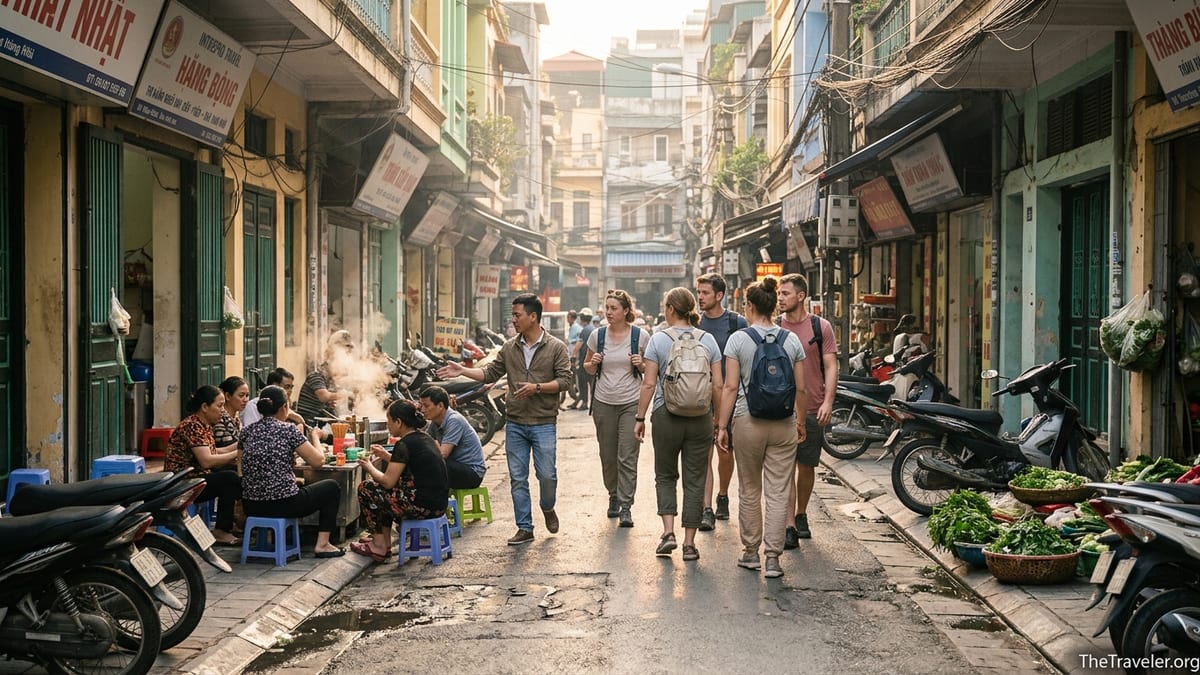
Realizing This Was Not a Typical Bus Tour
The first hint that this Intrepid trip would be different came at the welcome meeting. Our leader in Hanoi, Linh, introduced herself not as a tour guide parachuted in from abroad, but as someone who grew up in the Old Quarter, still lives a 15-minute walk from our hotel and has been leading Intrepid groups for years. Intrepid’s own materials emphasize that their leaders are locally based and live where they guide, a deliberate choice rather than a marketing flourish. You feel that difference quickly when your guide points out the alley where she buys breakfast for her kids rather than just the landmark everyone is photographing.
Over the next few days, the trip looked very little like the big-bus touring I had known. Instead of a branded coach waiting outside our hotel, we were handed small tickets for the Reunification Express night train, local bus stubs and, once, a crumpled paper receipt for a short taxi ride to a family-run homestay. Intrepid’s model, described both in its responsible travel policy and by partners who work with the company, is built on using public transport and locally owned accommodation wherever possible. That shows up in the rhythm of your days: you are sitting beside Vietnamese families on the train, squeezing into minivans used by locals instead of coaches, and staying in guesthouses that are clearly someone’s pride and livelihood.
I expected to feel looked after; I did not expect to feel so immersed in local routines. There were still structured visits to major sites, of course, but they were threaded through with everyday errands: stopping at markets to pick up fruit for the group, ducking into a hardware stall so our leader could replace a broken phone cable, waiting in line behind local students for iced coffee. These unscripted pauses, more than any formal activity, were what made the experience feel rooted in the real place rather than designed solely for visitors.
Local Leaders Who Open Doors You Would Walk Past
Intrepid’s decision to hire local leaders rather than flying in foreign tour managers is central to why the trips feel so embedded. The company’s recruitment materials stress that leaders are residents who know the culture and language, with “high levels of on-ground support” behind them. In practice, that meant that in Mexico City, our leader Jesús greeted café owners by name, switched seamlessly between Spanish and English and navigated situations that would have flummoxed most visitors, from last-minute rail strikes to sudden street closures for festivals.
On a community-based tourism project in rural Nepal, where Intrepid had partnered with conservation organizations to help develop homestays around Shivadwar, the presence of a Nepali leader made an obvious difference. He could talk candidly with homestay owners about how tourism money was shared within the village and could translate not only language but nuance: what it meant for local women to be managing the guesthouses, why certain religious sites were off-limits to visitors and how the community had debated the number of groups they were comfortable hosting. Those are the sorts of conversations that almost never happen when a tour is filtered entirely through outside staff.
Local leaders also tend to steer groups toward businesses that align with their own sense of pride. In Buenos Aires on another Intrepid itinerary, instead of directing us to a souvenir shop beside the main square, our leader took us to a cooperative run by artisans from across Argentina, many from Indigenous communities. Earlier that day, he had walked us through a backstreet bakery where his aunt buys medialunas, casually turning what could have been a generic “city tour” into a series of personal introductions. You can see the same pattern repeated in destinations from Cambodia to South Africa, where leaders regularly bring groups into small restaurants, workshops and markets that sit well outside the typical tourist grid.
Homestays and Community-Based Tourism That Actually Benefit Locals
Plenty of companies now promise “authentic homestays.” What surprised me with Intrepid was how consistently those experiences were tied into longer-term community partnerships rather than feeling like quick add-ons. The company has spent years working with local NGOs in places like Myanmar and Thailand to shape community-based tourism projects that are owned and run by villages themselves, and more recently has helped support homestay development around Shivadwar in Nepal’s buffer zones with conservation groups and international funders. The goal is not just to offer a night on the floor of someone’s house, but to help create income streams that stay in the community.
On a village stay in Cambodia, for example, we arrived to find a cluster of stilted wooden houses with simple but freshly painted guest rooms. Our hosts explained that the rooms had been upgraded using funds from a tourism partnership that included Intrepid; the money paid for our stay was pooled and used for both maintenance and community projects. Dinner was cooked collectively by several families, using vegetables from shared gardens and fish from a nearby stream. Rather than a single family profiting, there was a system in place so that hosting duties and earnings rotated. It felt less like intruding into a private home and more like being welcomed into a village initiative.
In Vietnam’s Pu Luong, where some Intrepid itineraries include rural homestays, travellers typically sleep on mattresses under mosquito nets in large, open rooms, often with a view of rice terraces and the sound of roosters at dawn. The shower may be a concrete stall and the electricity intermittent, but the impact of our presence was tangible. The owner of one homestay, who had previously relied solely on farming, now employed his cousin as a cook and his teenage niece as an English-speaking assistant, opportunities that would have been unlikely without organized small-group tourism.
Crucially, these stays are not presented as charity or staged performances. You pay a clear, up-front amount folded into the trip price, which in turn is part of a broader strategy Intrepid documents in its community-based tourism guidance. That framework covers everything from how many nights groups should stay to what kind of infrastructure investment is appropriate. The result, when done well, is an experience that genuinely feels like living, briefly, at the pace of a village rather than watching it from a distance.
Eating, Shopping and Moving Around Like a Local
Nothing reveals whether a trip is truly local like the choices around food and transport. Intrepid’s approach is to mix a few included group meals with a lot of free time, but the recommendations lean heavily toward family-run spots and street food. On a Hanoi street food tour run by Intrepid’s day-tour arm, Urban Adventures, our small group sat elbow to elbow with office workers at tiny plastic stools, slurping bowls of bun cha from a vendor who had been grilling pork in the same alley for decades. There were no laminated “tour menus,” just the dishes the stall was already serving to locals. When someone in the group asked for vegetarian options, the guide did not march us to a Western café; he ordered tofu-based versions from vendors he knew personally.
Daily costs on these trips can be surprisingly low if you follow the local lead. Travellers on Intrepid’s Nepal itineraries routinely report that meals in simple local restaurants, one step up from street food, can cost only a few US dollars, with coffee adding another dollar or two. In Vietnam, a bowl of pho or plate of com ga from a neighborhood spot is often in the range of what you might pay for a bottled drink in a hotel bar back home. You could, of course, choose the international pizzeria on the corner, but the presence of a local leader and group full of curious eaters pushes you gently toward the noodle stall or taco stand instead.
Transport decisions reinforce that ethos. On a Central America route, we took chicken buses, small local ferries and shared taxis rather than private coaches. In Mexico’s Yucatán, that meant squeezing into a colectivo with commuters headed to work, then hopping off on the side of the highway to walk a short distance to a cenote run by an ejido community. In Morocco, it meant a mix of trains, public buses and a locally owned minibus only where absolutely necessary. These choices may be less convenient than having a private bus on standby, but they embed you in the same flows of movement that locals rely on.
Shopping, too, is reframed. Instead of spending an hour in a large souvenir warehouse that pays high commissions, leaders will often steer groups into collectives: a women’s weaving cooperative in Peru’s Sacred Valley, for instance, or a textile workshop in a Mayan village where the weavers set their own prices. You still buy souvenirs, but the money reaches artisans more directly and you meet the people who made what you are taking home.
Indigenous and Community Voices at the Center
In recent years, Intrepid has taken deliberate steps to expand Indigenous and community-led experiences across its portfolio. A program announced for 2023 outlined around 100 Indigenous tourism experiences globally, and in 2026 the company signed a multi-year partnership with the Indigenous Tourism Association of Canada, committing funding to help grow Indigenous-owned tourism businesses. This sits alongside similar partnerships in Australia, Central America and other regions, where local communities shape what visitors see and do on their land.
What this looks like on the ground varies from place to place. In Queensland’s Scenic Rim in Australia, one multi-day walk is led entirely by an Indigenous guide known as Gurruhmun, or “Old Man Kangaroo,” who interprets landscape and culture from his perspective. In Guatemala, some itineraries include visiting a Mayan shaman or spending time in a village where traditional textile weaving is both a cultural practice and a primary source of income. In Canada, new partnerships are beginning to bring travellers into Indigenous-owned lodges and cultural centers on terms that communities define.
From a traveller’s point of view, the difference is subtle but significant. Rather than hearing about Indigenous history solely through a national guidebook lens, you are hearing it from people whose families have lived that history. Activities are introduced not as exotic spectacles but as normal expressions of culture: a smoking ceremony before a bush walk in Australia, for instance, or a communal meal prepared using pre-colonial ingredients in Mexico. These experiences can be confronting in honest ways, particularly when they address land rights or historical trauma, but that honesty is precisely what gives them depth.
There are, of course, trade-offs. Community-led tourism is not always as slick as large commercial attractions. Facilities may be basic, scheduling can be flexible to the point of unpredictable and language barriers may require patience. Yet those rough edges are part of what makes the experiences feel local rather than choreographed. You are adapting to the community’s rhythm instead of demanding that it adapt entirely to yours.
Where the “Local” Promise Meets Its Limits
None of this is to suggest that an Intrepid tour is the same as traveling entirely independently or that every moment feels deeply local. There are inherent compromises in group travel. In high-traffic destinations such as Machu Picchu or Petra, everyone passes through the same ticket gates and viewpoints. Group size can mean choosing a mid-range hotel over the tiniest guesthouse, simply because there are not enough rooms. And even with local leaders, time pressure occasionally pushes groups toward easier, more tourist-friendly options for meals or activities.
Travellers’ accounts of Intrepid trips bear this out. Many praise the local feel and responsible approach, but others note that some leaders lean on a small circle of familiar restaurants or shops, particularly in big cities, and that these can start to feel repetitive. A few travellers have reported feeling nudged toward particular businesses that may have informal arrangements with guides, a dynamic that exists across the tour industry. In any operation that runs thousands of departures a year, quality and authenticity will vary somewhat from trip to trip.
There is also the question of scale. Intrepid has grown into one of the world’s largest adventure travel companies. Its strategy documents talk about expanding community-based tourism offerings while remaining a purpose-driven B Corp, but balancing growth with depth is not simple. As more groups visit the same villages, the risk of over-tourism or cultural fatigue increases, and communities and tour operators alike must continually reassess what level of visitation still feels healthy and welcome.
Yet, even with those caveats, the baseline is strikingly different from conventional coach tours. When your days are shaped around local transport, smaller accommodations and community-led experiences, the occasional night in a chain hotel or dinner at a more tourist-friendly restaurant stands out as the exception rather than the rule. The structure of the trips nudges you toward a kind of travel that many independent travellers seek out deliberately: slower, more interactive and more mindful of where the money goes.
The Takeaway
Looking back on my Intrepid experiences, what lingers is not the checklist of sights but the accumulation of small, local moments: being taught to stir a curry correctly in a family kitchen in Kerala, sharing rice wine with hosts in a stilt house in northern Vietnam, listening to an Indigenous guide in Queensland describe the constellations as his grandparents did. These are encounters that could, in theory, happen on your own, but in practice often require connections and trust that outsiders rarely build in a short visit.
The biggest surprise, then, was discovering that a group tour could act less like a barrier and more like a bridge into local life. That is not guaranteed on every departure, and it is not a substitute for the intimacy of long-term independent travel. But if you choose your itinerary with care, accept a degree of shared structure and come with curiosity, an Intrepid trip can offer a version of travel that feels grounded in the places you visit and beneficial to the people who live there.
For travelers who are short on time, nervous about logistics or simply curious about a destination that feels intimidating to tackle alone, that combination can be powerful. You hand over some control of your schedule, but you gain access to a network of local leaders, communities and partners who have spent years figuring out how to welcome visitors on their own terms. In an industry still dominated by surface-level sightseeing, that, to me, is the most welcome surprise of all.
FAQ
Q1. Are Intrepid Travel tours really led by local guides?
Yes, Intrepid’s core model is to hire resident local leaders in each destination rather than bringing in foreign tour managers. They live where they guide, speak the local language and often have long-standing relationships with the restaurants, homestays and community projects that groups visit.
Q2. How small are Intrepid’s groups, and does that affect how local the experience feels?
Most Intrepid trips run with roughly 10 to 12 travellers, with a published maximum that is typically under 16. That scale makes it easier to use local guesthouses, homestays and public transport instead of large hotels and private coaches, which in turn helps the experience feel more embedded in local life.
Q3. What kinds of local accommodation can I expect on an Intrepid trip?
Depending on the trip style you choose, you might stay in family-run guesthouses, simple village homestays, small hotels or locally owned eco-lodges. In rural areas, facilities can be basic, with shared bathrooms and simple bedding, while “Comfort” and premium itineraries lean toward mid-range hotels but still prioritize local ownership where possible.
Q4. Does traveling with Intrepid really benefit local communities economically?
Intrepid’s responsible travel policies state that they favor locally owned accommodation, restaurants and transport providers, and they partner with community-based tourism projects in places like Nepal, Cambodia and Guatemala. While not every dollar you spend stays in the village you visit, a significant share is directed toward local businesses and community-run initiatives.
Q5. Will I still see major tourist sights, or is it all off-the-beaten-path?
You will still visit famous highlights such as Angkor Wat, Machu Picchu or the Taj Mahal on relevant itineraries. The difference is that these big-ticket sights are usually balanced with time in neighborhoods, villages and community projects that receive far fewer visitors, so your overall experience is not limited to the standard circuit.
Q6. How much free time do I get to explore on my own?
Most itineraries build in a mix of structured activities and free time. You might have guided visits in the morning and several hours free in the afternoon to wander, eat or shop independently, with your leader on hand to suggest local places to try and help with logistics if you need it.
Q7. Are the homestays comfortable, and what should I expect?
Homestays on Intrepid trips are intentionally simple. Expect basic but clean rooms, mosquito nets where needed, and shared facilities. Food is usually home-cooked and eaten communally. It is less about hotel-style comfort and more about experiencing local routines, so arriving with flexibility and an open mind is important.
Q8. How does Intrepid handle cultural sensitivity during local and Indigenous experiences?
Leaders receive training in responsible travel and are expected to brief groups on appropriate behavior, dress and photography. Many community and Indigenous experiences are developed in partnership with local organizations, with communities setting boundaries around what is shared and how visitors participate.
Q9. Is an Intrepid trip suitable for solo travelers who still want a local experience?
Yes. A large proportion of Intrepid’s customers travel solo and join groups specifically to have company and support while still experiencing destinations in a grounded way. Shared meals, local transport and homestays make it easy to connect both with fellow travellers and with hosts.
Q10. How can I choose an Intrepid itinerary that feels especially local?
Look for trips that mention homestays, community-based tourism projects or Indigenous-led activities, and consider itineraries that spend more time in rural or secondary destinations rather than only in capital cities. Reading recent reviews can also help you gauge how much time previous groups spent in local settings versus large, conventional hotels.