


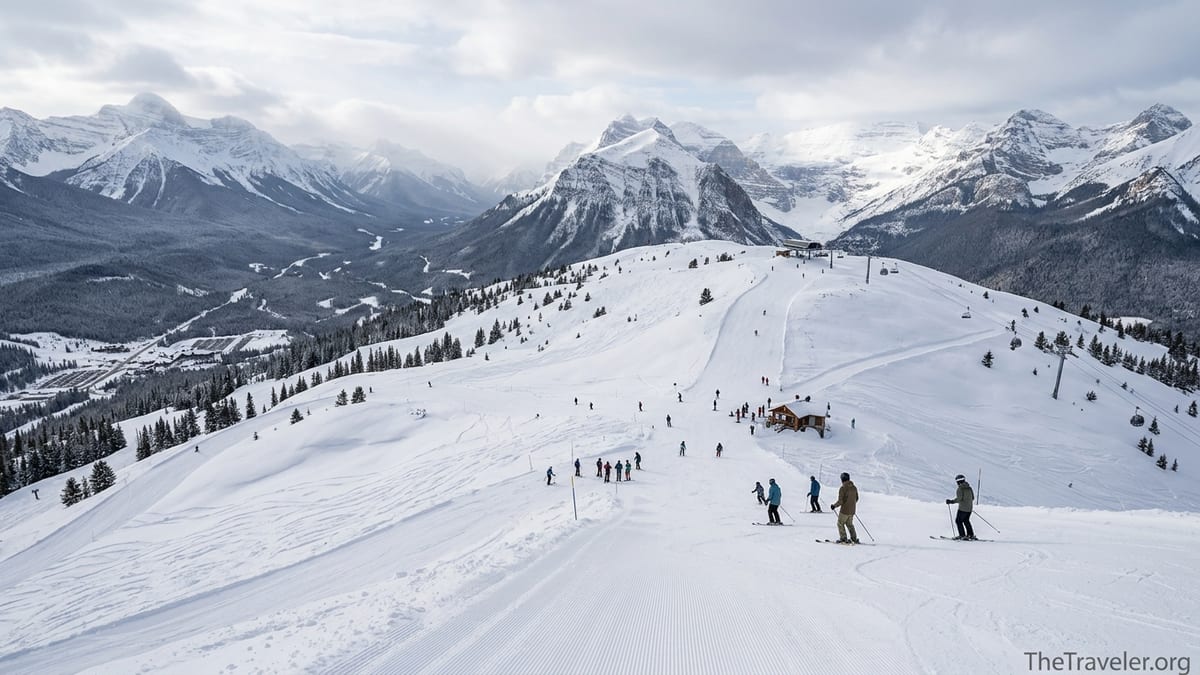
For most travelers, Lake Louise Ski Resort first appears on their radar as a photograph. It is usually a sweeping shot of white peaks above a frozen valley, the kind of image that pulls people to the Canadian Rockies every winter. But when you actually ski here, it becomes clear that Lake Louise is not just a pretty backdrop. The resort has been investing in modern lifts, expanding terrain, and quietly building a guest experience that feels more like a remote mountain adventure than a tightly packaged mega-resort. The famous views are only the beginning.
Get the latest updates straight to your inbox!
A Big-Mountain Feel That Still Feels Wild
Lake Louise sits inside Banff National Park, which immediately sets it apart from many North American ski areas built around dense slopeside real estate. There is no village sprawling up the hill. Instead, you pull into a large base-area parking lot, shoulder your skis, and look up at a wide amphitheater of peaks on Whitehorn and Lipalian mountains that holds thousands of acres of terrain. The setting feels more like a high-alpine backcountry basin than a commercial resort, yet you are still riding high-speed chairlifts and a gondola to reach it.
The resort markets roughly 4,200 acres of skiable terrain, divided across four main mountain faces that radiate from the base area and upper ridgelines. Skiers can lap the frontside groomers, disappear into the powder-filled Back Bowls, or traverse to the Larch and West Bowl zones that feel noticeably quieter. On storm cycles, local skiers will often head straight for Summit Chair to drop into Upper ER, Whitehorn 2, or the gullies of Ptarmigan and Paradise, while visitors are still taking in the view from the gondola unload. That balance between easy access and a sense of wilderness is one of Lake Louise’s defining qualities.
Recent seasons have also seen measured but meaningful growth. The resort completed its Summit Chair lift to serve West Bowl terrain, turning what used to require long traverses and hike-outs into repeatable laps. According to the resort’s own media material, that expansion and lift network now offer direct lift access to more than 4,200 acres, with additional terrain coming online in stages. This steady expansion is positioning Lake Louise among the largest ski areas in Canada without overwhelming the landscape with development.
Serious Terrain for All Levels, Not Just Experts
Lake Louise has a reputation as a big-mountain skier’s hill, and it is easy to see why. The Back Bowls offer steep fall-line pitches, cornices, and natural features that challenge strong skiers for days. Routes like Elevator Shaft, Whitehorn 1, and the chutes off Summit Chair are the kind of runs advanced visitors talk about long after they fly home. Freeski publications often highlight Lake Louise as a destination for skiers who want real alpine terrain inside resort ropes, which helps explain its popularity with film crews and big-mountain athletes.
What tends to surprise many first-timers is how much of the mountain remains genuinely friendly to intermediates and progressing beginners. Wide frontside runs such as Wiwaxy, Juniper, and Easy Street roll down toward the base area with gentle, confidence-building pitches. On the Larch side, tree-lined blues like Wolverine and Lynx offer protected, scenic cruising that feels far removed from the main traffic corridors. A recent terrain expansion on Richardson’s Ridge has been designed specifically to add more beginner and intermediate options on the backside, giving less aggressive skiers a taste of that big-mountain environment without dropping them onto expert slopes.
Beginners are not confined to a single congested slope at the bottom. The resort maintains dedicated learning areas near the base with magic carpets and short chairlift-accessed greens, and then progressively longer green runs that connect higher on the mountain, so new skiers can start to explore without suddenly finding themselves on something too steep. Feedback from families and new skiers often points to this gradual progression as a key reason their first real mountain experience at Lake Louise feels manageable instead of intimidating.
Modern Lift Network and Smart Upgrades
For a resort inside a protected national park, every new lift or major piece of infrastructure faces careful scrutiny and lengthy approval. That means Lake Louise cannot simply blanket its slopes with high-speed chairs the way some destination resorts have done. Instead, upgrades tend to be targeted, with an emphasis on unlocking terrain and reducing bottlenecks without dramatically altering the character of the mountain.
One of the most significant recent changes has been the Summit Chair, a quad chairlift that rises from the upper mountain and provides direct access into West Bowl as well as classic Back Bowl runs. Industry reports and the resort’s media kit describe this lift as a key piece in expanding the accessible footprint past the 4,200-acre mark. For visiting skiers, the impact is tangible. What used to be a longer traverse or a one-and-done adventure into West Bowl can now become a staple of a powder day, with fast laps and varied lines through open faces and glades.
Closer to the base, the addition and re-alignment of chairlifts such as Juniper and other lower-mountain quads have been designed to thin out early-morning queues and make it easier to move from beginner zones to upper-mountain terrain. Skiers coming for a single long weekend may not track each lift by name, but they do tend to notice that it is possible to cover a lot of ground without spending half the day in line. Local skiers comment that even on busy Saturdays, they can avoid crowds by moving quickly toward Summit, Larch, or West Bowl routes where lift capacity has improved in recent seasons.
Compared with some larger corporations’ more aggressive expansion strategies, the pace of change at Lake Louise remains relatively measured. That incremental approach helps the resort preserve the sense of scale and quiet that make it feel different from more intensely developed mountains, while still offering enough modern infrastructure to satisfy destination travelers used to smooth, efficient lift systems.
Family Friendly Without Feeling Over-Commercial
Despite its big-mountain profile, Lake Louise has steadily built a reputation as a strong choice for families. Ski industry review sites give the resort high marks for family friendliness, noting the combination of accessible terrain, on-site child care, and organized kids’ ski instruction. Parents arriving with strollers, rental gear, and nervous first-timers will find that the base area is compact, with the day lodge, ski school, rental shop, and beginner slopes all within a short walk of one another.
The Lake Louise Snow School runs group lessons, private coaching, and multi-day programs that cover everything from first turns on the magic carpet to advanced off-piste exploration. Group sizes for children’s lessons are typically capped at a modest number, which is crucial for younger learners who need frequent feedback and encouragement. Many families opt to enroll children in consecutive-day programs that allow instructors to progress the group from the beginner zone to easy greens off Glacier Express or Grizzly Express, giving kids the thrill of taking a real chairlift on day two or three.
For families with toddlers too young to ski, the resort operates a daycare program in the base area, often referred to in local conversation as the on-mountain daycare or kids’ center. Job listings for daycare staff emphasize early childhood education credentials and safety standards, which gives some reassurance to parents leaving children for a half or full day. This setup allows adults to ski the Back Bowls or Larch without taking turns sitting in the lodge, and it means multi-generational groups can travel together without compromising everyone’s time on snow.
Off the slopes, Lake Louise offers tubing at its Sunny Tube Park, located near the base area. Regional tourism boards promote this as a family activity suitable for children as young as about four years old or roughly 42 inches tall, making it one of the few thrill-focused options that even small kids can enjoy. Many families will schedule ski school in the morning and tubing in the afternoon, or use tubing as a shared activity for non-skiing grandparents, parents, and children who all want time outside without committing to lessons.
Beyond Skiing: Snowshoeing, Sightseeing and Winter Experiences
Lake Louise may be a ski resort first, but it functions as a broader winter adventure hub inside Banff National Park. One of the most accessible experiences is the sightseeing gondola, which runs in winter for non-skiers and in summer for hikers and wildlife watchers. In winter, pedestrians can purchase gondola tickets to ride above the valley and step out at an upper-mountain viewpoint, where interpretive displays and viewing decks look onto glaciers and peaks deep within the park. This makes the resort a viable destination even for travelers who will never clip into skis.
Tourism organizations for Banff and Lake Louise highlight guided snowshoe tours that depart from the ski area. These outings range from gentle walks through forested trails near the base to more involved hikes toward alpine viewpoints, depending on snow stability and weather. For many visitors, tromping through silent spruce forests with a guide explaining local wildlife and avalanche terrain is as memorable as any run down a groomed slope. It also gives mixed-ability groups something they can do together on lay days or when legs are too tired for more skiing.
Within the broader Lake Louise and Banff region, winter travelers can easily pair resort days with classic national park experiences. It is common for visitors to ski Lake Louise for a day or two, then spend an afternoon skating on the natural rink cleared on Lake Louise in front of the Fairmont Chateau, or join an ice walk through Johnson Canyon near Banff. Local dog-sled operators, often based in the Lake Louise area, offer small-group tours through forested valleys, and evening sleigh rides around the lake add a more traditional winter-holiday feeling to a ski-focused itinerary.
Because accommodation in the Lake Louise village area is a five-minute drive from the ski hill, many travelers appreciate that they can spend mornings on snow and afternoons exploring the wider park without complex logistics. Shuttle services from hotels such as the Fairmont Chateau Lake Louise and other village properties run regularly to the resort, which reduces the stress of winter driving for visitors unfamiliar with snow-covered mountain highways.
Access, Tickets and Passes in a Changing Ski Economy
Getting to Lake Louise typically involves flying into Calgary and then driving just under two hours along the Trans-Canada Highway through Banff and into the national park. Once in the region, skiers can base themselves either in the small Lake Louise village or in the larger town of Banff about 45 minutes away. The SkiBig3 shuttle network connects Banff with Lake Louise and the two other major local ski areas, providing an option for car-free travel to the hill. Travelers who prefer to stay steps from iconic sights like Lake Louise itself often rely on hotel-operated shuttles that run between the lakeshore and the ski resort throughout the day.
Lift ticket prices, like at most destination resorts, vary by date, demand, and how far in advance you purchase. Industry aggregators that track Lake Louise list single-day adult window rates that can reach into the high double-digits or low triple-digits in Canadian dollars on peak dates, with reduced prices on midweek and shoulder-season days. Flexible travelers who can visit in early season or late spring often find promotions or discounted multi-day products through the SkiBig3 office or lodging packages, though availability changes from year to year.
Lake Louise is also included on multi-resort passes such as the Ikon Pass and Mountain Collective. For many North American visitors, this can be the deciding factor that tips a trip toward the Canadian Rockies. Passholders on those products gain a set number of days at Lake Louise, often combined with access to other Rockies destinations. In practice, this means experienced skiers might plan a week in Banff, splitting their time between Lake Louise and its sister resorts while relying on the same pass and shuttle system.
Parking and morning access are ongoing considerations, particularly on busy weekends and holiday periods. Travelers posting recent trip reports note that the highway can back up at times as vehicles queue to turn into the resort access road. Those staying in Banff often avoid this by taking the first SkiBig3 shuttle of the morning, while guests in the Lake Louise village will frequently prefer hotel shuttles that drop them near the day lodge. The upside of this heavier visitation is that the resort continues to reinvest in lift and terrain upgrades, and the quiet, midweek days still retain much of that uncrowded national-park feel.
Food, Lodging and Life Between Runs
Unlike purpose-built resort villages where slopeside condos and after-ski nightlife dominate the landscape, Lake Louise’s base area remains compact and functional. The day lodge offers cafeteria-style dining, quick-service counters for coffee and snacks, and an upstairs bar environment where locals trade notes on snow conditions. On cold days, it is common to see families camp out at a corner table, rotating between the slopes and warm-up breaks without needing to navigate escalators or multi-level food courts.
On-mountain dining is scattered across lodges such as Whitehorn Bistro, which sits at mid-mountain with views back toward the glacier-topped peaks of Banff National Park. Visitors often remark on the experience of eating a hot bowl of soup on the deck while watching clouds shift across distant summits. While prices reflect remote mountain logistics and destination-resort norms, many skiers choose to bring their own snacks or lunch and use the base lodge facilities to keep overall costs manageable, a strategy that staff in local ski shops are quick to recommend.
Accommodation spreads between the small Lake Louise village, the lakeshore area anchored by the historic Fairmont Chateau Lake Louise, and the larger town of Banff down the highway. Travelers seeking a classic winter postcard setting gravitate to the Chateau, where winterized facilities support skating, sleigh rides, and easy access to snowshoe trails in addition to the shuttle link to the ski hill. Budget-conscious visitors more often stay in Banff, where a wider range of motels, hotels, and hostels line the main streets, along with restaurants and bars that stay open late into the evening.
Nightlife at Lake Louise itself is subdued. After a day on snow, most people settle into lodge lounges, hotel bars, or quiet dinners rather than late-night clubs. For some travelers, particularly families and those coming for the scenery and outdoor activities, that low-key atmosphere is a major part of the appeal. Those who want a bigger social scene can always base in Banff and treat Lake Louise as their primary ski destination during the day.
The Takeaway
Lake Louise Ski Resort has earned its fame for scenery, but what keeps skiers returning is a deeper mix of terrain, atmosphere, and steady investment. It offers true big-mountain skiing inside the protected landscape of Banff National Park, with four faces of lift-served slopes that range from mellow groomers to serious alpine lines. Recent lift expansions such as the Summit Chair and developing beginner and intermediate zones like Richardson’s Ridge show that the resort is not standing still, even under tight environmental oversight.
At the same time, Lake Louise has not tried to imitate the hyper-developed resort villages found elsewhere in North America. Families find a compact, practical base area with daycare, well-regarded ski school programs, and beginner zones that do not feel like an afterthought. Non-skiers and mixed-ability groups can fill their days with tubing, snowshoeing, sightseeing gondola rides, skating on the lake, and classic winter excursions throughout Banff National Park. For travelers willing to navigate mountain-weather logistics and national-park driving conditions, the reward is a ski holiday that feels both adventurous and surprisingly accessible.
In the end, what makes Lake Louise stand out is not only what you see when you step off the gondola, but how the entire experience unfolds once you start skiing. It is the way long, quiet runs spill into a simple base lodge instead of a mall, the way families can drop off toddlers at daycare and still disappear into the Back Bowls, and the way the resort continues to evolve without losing the sense that you are skiing in the heart of a wild, protected landscape. The view is just the first hint of what is waiting beyond.
FAQ
Q1. When is the best time of winter to ski Lake Louise for good snow and fewer crowds?
The heart of the season from mid-January through early March typically offers the most reliable snow coverage, with colder temperatures preserving conditions. If you want to avoid the heaviest crowds, aim for midweek visits outside of major Canadian and U.S. holiday periods, and consider late November or early April shoulder weeks when the resort often still has substantial terrain open but fewer destination visitors.
Q2. Is Lake Louise suitable for complete beginners, or is it mainly for advanced skiers?
Lake Louise caters to both. The resort has dedicated beginner zones near the base with magic carpets and gentle slopes, plus long green runs that connect to higher lifts so new skiers can gradually explore more of the mountain. At the same time, the Back Bowls and West Bowl provide challenging terrain for advanced skiers. Many families with mixed abilities choose Lake Louise precisely because it delivers genuine big-mountain skiing alongside well-structured beginner areas.
Q3. Do I need a car, or can I rely on shuttles to reach the resort?
You can ski Lake Louise comfortably without renting a car. SkiBig3 shuttles connect hotels in Banff with the resort on a daily schedule, and many properties in the Lake Louise village and at the lakeshore, including larger hotels, operate their own shuttle buses to the ski hill. A car does provide more flexibility for side trips to viewpoints and ice walks, but winter driving conditions and limited parking on busy days lead many visitors to prefer the shuttle options.
Q4. How expensive are lift tickets, and are there ways to save money?
Single-day adult lift tickets at Lake Louise can be relatively expensive at the window, especially on peak dates, but prices vary by day and how far in advance you purchase. You can often save by buying multi-day tickets through SkiBig3, checking for early-season or spring promotions, or visiting midweek. Travelers who already hold multi-resort products such as the Ikon Pass or Mountain Collective can use included days at Lake Louise, which can significantly reduce the per-day cost of skiing.
Q5. What on-mountain activities are available for non-skiers in my group?
Non-skiers have several options at Lake Louise. They can take the sightseeing gondola for panoramic views, join guided snowshoe tours that explore forest trails and viewpoints near the resort, or enjoy the Sunny Tube Park at the base area. In the wider Lake Louise area, popular off-slope activities include skating on the natural ice of Lake Louise, horse-drawn sleigh rides, and guided ice walks in nearby canyons.
Q6. How does Lake Louise compare to other major Canadian resorts for terrain variety?
Lake Louise ranks among the largest ski areas in Canada in terms of skiable acreage, with four distinct mountain faces and thousands of vertical feet to explore. Compared with some British Columbia resorts known for tree skiing and deep coastal snowpacks, Lake Louise offers more of a classic alpine feel, with open bowls and long vistas inside a national park setting. For travelers planning a Canadian Rockies circuit, many pair Lake Louise with neighboring resorts to experience an even broader mix of terrain and snow conditions.
Q7. Is Lake Louise a good choice for families with young children?
Yes, Lake Louise is widely regarded as family friendly. The compact base area keeps essentials like rentals, ski school check-in, and beginner slopes close together, which reduces the daily logistics for parents. Children’s ski programs, a daycare facility for toddlers, and tubing all provide options for different ages and comfort levels. Many families appreciate that evenings are quieter than at some party-focused resorts, allowing for earlier bedtimes and more relaxed mornings.
Q8. What kind of lodging options are closest to the ski hill?
The closest lodging cluster is the Lake Louise village, a short five-minute drive from the resort, where you will find hotels, inns, and hostels at a range of price points. Slightly farther away, the lakeshore area around the Fairmont Chateau Lake Louise offers a more upscale, iconic setting on the edge of the frozen lake, with shuttles running to the hill. Travelers seeking more nightlife and restaurant variety often stay in Banff and commute about 45 minutes by car or shuttle each day.
Q9. Are there terrain parks and freestyle options at Lake Louise?
Lake Louise generally maintains terrain park features that vary in size and difficulty through the season, with jumps and rails designed for both progressing riders and more advanced freestyle skiers and snowboarders. The offerings change depending on snow conditions and event schedules, so park-focused visitors often check snow reports or social media updates just before their trip to see what is currently built. While the resort is better known for its natural terrain, there are usually enough features to keep freestyle enthusiasts engaged.
Q10. What should I know about weather and visibility at Lake Louise in winter?
Weather at Lake Louise in winter can be very cold, especially in January and February, with temperatures often well below freezing. Clear days deliver stunning views and crisp, dry snow, but storms can bring low visibility and wind on exposed upper-mountain lifts. Visitors should pack proper layers, face protection, and goggles with lenses suited for both bright sun and flat light. On stormy days, many skiers choose to spend more time on tree-lined runs in areas like Larch or lower frontside slopes, where contrast and shelter are better.