


Nadi International Airport is the main gateway to Fiji and, for most visitors, the first place to sort out phone coverage, Fiji dollars and transport. The arrivals area is compact and easy to navigate, but knowing exactly where to buy a SIM card, withdraw cash, change money and pay for taxis or transfers will save you time and stress after a long flight. This guide walks you step-by-step through the process from the moment you clear immigration to the moment you roll your bags out of the terminal.
Get the latest updates straight to your inbox!
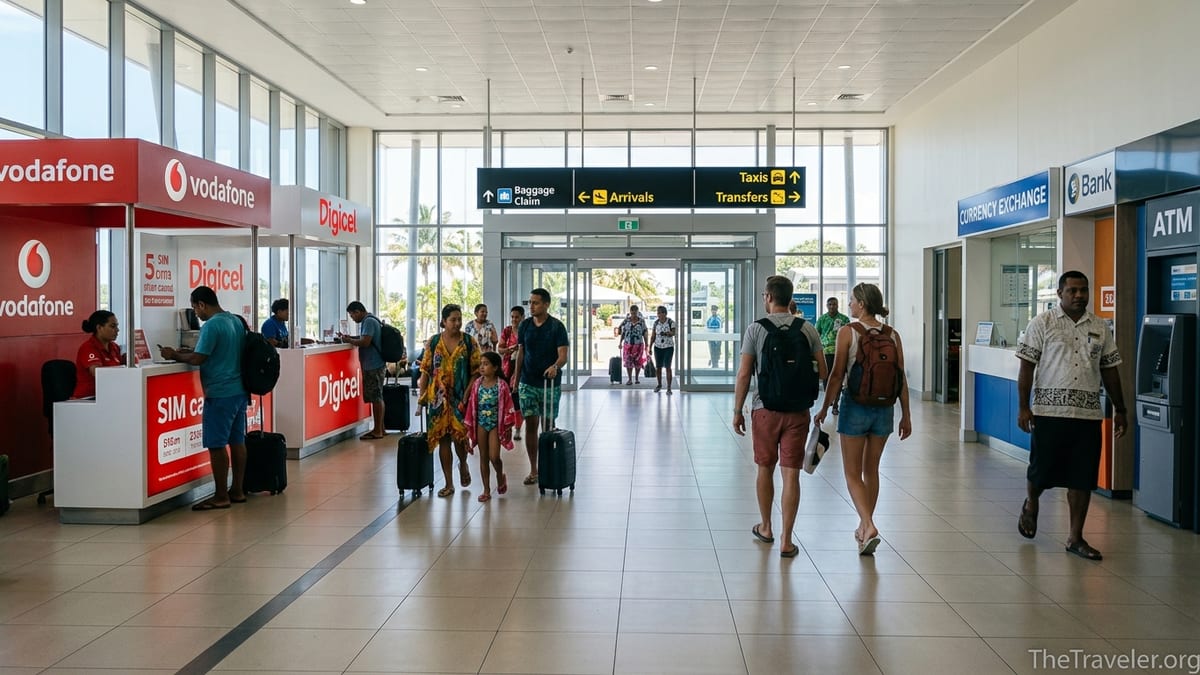
Understanding the Arrivals Layout at Nadi International Airport
After your aircraft parks at Nadi International Airport, you will follow the standard sequence of immigration, baggage claim, customs and biosecurity before reaching the public arrivals hall. The immigration and customs formalities are usually straightforward, but queues can build when several wide-body flights from Australia, New Zealand and North America arrive close together. Plan on anywhere from 20 minutes to over an hour from touchdown to reaching the public arrivals space, depending on time of day and how many flights are being processed.
Once you clear the final biosecurity screening, a set of sliding doors opens into the main arrivals hall. This is where you will find the key services most new arrivals need: mobile phone counters, currency exchange, ATMs, tour and transfer desks, car hire counters and an information desk. The space is a single, open concourse, so you do not need to worry about choosing the “right” exit. If you walk too far in one direction, you can simply turn around and you will still be inside the same hall.
Mobile operators and money services are located in clearly branded kiosks and shopfronts around the perimeter of the arrivals hall. Taxi ranks, hotel shuttles and private transfer vehicles are outside, beyond the main exit doors. It is worth pausing just inside the hall before stepping out to the curb so that you can get your SIM card and Fiji dollars sorted while you are in air conditioning, with staff who are used to answering visitors’ questions.
Buying a Local SIM Card in the Arrivals Hall
The two main mobile operators in Fiji, Vodafone Fiji and Digicel Fiji, both run dedicated outlets in the international arrivals hall at Nadi. These counters are positioned just after you exit biosecurity, so you will see their red (Vodafone) and red-and-white (Digicel) branding almost immediately. Staff at both outlets are used to setting up phones for visitors who have just come off long-haul flights and can usually handle everything in a few minutes, including SIM registration, plan activation and basic setup.
Tourist SIM packages are designed for short stays and typically bundle local data, domestic calls and some international call or messaging allowance. For example, Vodafone Fiji has offered tourist SIM packs around the FJ$30 to FJ$50 range with several gigabytes of data and validity of one or two weeks, while Digicel has marketed tourist options that sometimes include a free SIM and a starter data bundle for arriving passengers who top up. Exact inclusions and prices change regularly, so it is best to read the printed rate boards at the counter and ask which package is best for your length of stay and data needs.
To buy a SIM, you will need your passport and an unlocked phone. Staff typically insert the SIM, change the APN settings if required and perform a test call or data check before handing your phone back. If you are arriving in the evening or late at night, both operators generally align their hours with international flight schedules, so counters are commonly open for major arrivals from Sydney, Auckland and Los Angeles, but if your flight is heavily delayed you may find only one operator open or, in rare cases, both closed. In that situation, you can use the airport’s free Wi-Fi to connect temporarily and then buy a SIM in Nadi town or at larger supermarkets the next day.
Travelers who prefer not to change physical SIMs can consider using an eSIM from an international provider before departure and then switching to a local physical SIM once settled at their hotel. However, for most visitors, buying a SIM directly in the arrivals hall is the simplest and usually the cheapest way to secure reliable coverage across Nadi, Denarau, the Coral Coast and the popular island chains.
Getting Fiji Dollars: Currency Exchange and ATMs
The official currency in Fiji is the Fiji dollar, commonly written as FJ$. You will need at least a small amount of cash on arrival for taxis that do not yet accept cards, small snacks, tipping and purchases in more local shops and markets. Within the international arrivals area at Nadi Airport you will find both currency exchange counters and bank-branded ATMs, so you can choose whichever option suits your situation and home banking arrangements.
Currency exchange desks operated by banks or financial services companies are usually located in or near the baggage claim area and again in the public arrivals hall. These counters accept major currencies such as US dollars, Australian dollars, New Zealand dollars, euros and British pounds. Rates at the airport are generally convenient rather than the absolute best available, so many frequent travelers use them to change a modest amount, for example FJ$100 to FJ$200, to cover immediate expenses, then do any larger exchanges later at banks or money changers in Nadi town.
ATMs from regional banks such as ANZ, BSP and Westpac are positioned in the arrivals hall and sometimes near the exits. These machines accept most Visa, Mastercard and Cirrus-branded cards. A typical strategy for many visitors is to withdraw cash directly in Fiji dollars from an ATM using a debit or travel card, since this often gives a more competitive exchange rate than cash exchange, even after foreign ATM and card fees. Daily withdrawal limits set by local banks can apply, often around FJ$2,000, although your home bank may impose a lower limit. Before traveling, inform your bank that you will be in Fiji and check what they charge for foreign transactions and ATM withdrawals.
If an ATM in the terminal is temporarily out of service or your card is declined, do not panic. You can exchange a smaller amount of foreign cash at a counter as a backup, then use a taxi to reach Nadi town, where additional ATMs are spread along the main street near the market and supermarket complexes. As always, use normal security precautions when withdrawing cash: shield your PIN, take your receipt and count your notes discreetly.
Cards, Contactless Payments and When You Really Need Cash
Card acceptance in Fiji has steadily improved, especially in the tourism corridor between Nadi Airport, Denarau Island and major resorts along the Coral Coast. Hotels, larger restaurants, supermarkets and tour desks around Nadi almost always accept Visa and Mastercard, and many now support contactless tap payments. For example, a midrange restaurant at Port Denarau or a large grocery store in Namaka, a suburb near the airport, will typically process card payments just as smoothly as a merchant in Australia or New Zealand, though you may occasionally be asked to sign rather than enter a PIN if the connection is slow.
Despite this progress, cash is still important. Smaller eateries, local produce markets, roadside snack stands, taxis that have not adopted card terminals and village-based experiences often operate on a cash-only basis. A taxi from the airport to Nadi town or to a local guesthouse can cost roughly FJ$15 to FJ$20, and having exact or near-exact cash makes the transaction easier. Likewise, buying coconuts or roti parcels from stalls along Queens Road or paying a village contribution at a waterfall or snorkel site will almost always require Fiji dollars.
In the last couple of years, banks and card networks have begun rolling out card payment solutions for taxis in Fiji, including some vehicles operating from Nadi Airport. You may notice decals on vehicle windows advertising card acceptance. Even so, it is wise to assume you will need cash for taxis unless the driver confirms otherwise before you depart. Mobile wallet services tied to local banks exist but are not yet a primary payment method for short-term visitors, so travelers from North America or Europe generally rely on physical cards combined with enough cash to cover transport, tips and small purchases.
Because many visitors now arrive with multiple cards and digital wallets, a practical approach is to keep one primary credit or debit card for hotel and restaurant bills, a backup card stored separately in case of loss, and around FJ$100 to FJ$200 in smaller notes and coins on hand. That mix usually handles everything from an espresso at the airport café to an unplanned minibus ride into Nadi.
Airport Taxis, Transfers and How to Pay for Your Ride
After you have arranged your SIM and cash in the arrivals hall, the next step is getting from Nadi Airport to your accommodation. Just outside the terminal you will find an official taxi rank with metered vehicles, often painted in bright yellow or similarly distinctive colors. These airport taxis are licensed to operate from the terminal and have regulated starting fares and per‑kilometer charges set by Fiji’s transport authorities. As a very approximate guide, a metered ride from the airport to Nadi town might fall in the FJ$15 to FJ$20 range in normal traffic, while a trip to Denarau Island, about 10 kilometers away, can run roughly FJ$25 to FJ$35, depending on time of day and any waiting time.
Most taxis are still geared toward cash payments, so it is sensible to withdraw or exchange at least FJ$50 before leaving the terminal if you plan to take a taxi. Some vehicles, particularly those aligned with newer card programs, now carry portable card terminals that accept tap or chip payments. Before setting off, ask the driver directly whether card is possible and whether the meter will be used. If a driver proposes a fixed price, compare it to the rough ranges above and only agree if it seems reasonable to you. You can ask to use the meter instead if you prefer.
Many resorts and hotels around Nadi and Denarau offer private transfers that must usually be booked before arrival. In the arrivals hall you will see branded counters for companies such as Tourist Transport Fiji, Rosie Holidays, Tour Managers, Tewaka and other operators. If you have pre‑booked, your confirmation email will typically direct you either to a specific counter in the hall or to a representative holding a sign with your name just outside the exit doors. Payment for these services may already be included in your hotel package or taken via credit card in advance, so you might only need to present your voucher or booking reference on arrival.
For travelers heading straight to the Mamanuca or Yasawa islands, ground transfers from Nadi Airport to Port Denarau are often bundled with boat or high‑speed catamaran tickets. Operators or resort representatives in the arrivals area can confirm your pickup time and advise how long you will wait before departure. In busy periods there can be a short delay while vehicles consolidate guests from several flights, so keeping a small amount of local cash and a bottle of water handy is useful.
Using Transfer and Tour Desks Before Leaving the Terminal
One advantage of Nadi Airport’s compact arrivals hall is the concentration of travel services in a relatively small space. Along one side you will see counters for major tour and transfer operators, airlines operating seaplanes or helicopters, and occasionally resort brands. If you have not pre‑arranged your onward travel, this is the best place to make those bookings before stepping out into the heat.
At these desks, you can arrange shared shuttles or private transfers to Denarau, the Coral Coast, Pacific Harbour and other resort areas. For example, a shared shuttle to Denarau might cost somewhat less than a taxi if you are comfortable waiting until a small group assembles, while a private car booked at the desk can be priced in a similar range to a taxi but with the reassurance of clear, printed terms. Payment is typically accepted by card at the counter, which is helpful if you prefer to preserve your cash for later.
Some desks also sell ferry tickets or bundle transfers to island resorts, saving you from having to manage multiple bookings yourself. For instance, if you are staying on an island in the Mamanucas, staff can coordinate your vehicle from the airport to Port Denarau and your boat connection onward. In these cases, it is common to pay the full amount by card, in Fiji dollars, and receive a printed voucher and instructions on where to meet the driver or vessel.
If you are arriving late in the evening and staying near the airport in a guesthouse or small hotel, staff at the transfer desks can advise on safe and practical options, such as pre‑arranged taxis or short shuttles. They are also a useful source of last‑minute information on road conditions, approximate travel times and any changes affecting popular routes like Queens Road to Sigatoka or Pacific Harbour.
Practical Steps Before You Walk Out of the Terminal
Because the arrivals hall at Nadi Airport brings together communications, money, transport and information services, it pays to pause and run through a short mental checklist before you walk out to the curb. Start with connectivity: confirm that your new SIM is working by loading a web page or messaging a contact at home, and make sure your phone displays the correct local time. If you are relying on airport Wi‑Fi only, test it before you move on in case you need to download ride‑hailing or messaging apps.
Next, handle your cash and cards. Decide how much Fiji dollar cash you want to carry immediately and how much you will access later. If you have foreign currency, change just enough at a counter to cover your first day if you are concerned about ATM fees, or use the ATM to withdraw a rounded amount such as FJ$200 so that you have a mix of 10s, 20s and 50s. Put most of your cash in a secure, zipped location in your bag and keep only what you need for taxis and snacks in an easily reachable pocket or wallet.
Third, confirm your onward transport. If you have a pre‑booked shuttle or boat transfer, check your printed voucher or confirmation email for the pickup point and any instructions. If in doubt, visit the relevant tour desk in the arrivals hall and ask them to confirm your details. If you are taking a taxi, glance at the official fare information boards usually posted near the exit, note the expected rough fare to your destination and clarify with the driver whether the meter will be used before loading your luggage.
Finally, take a moment at the airport information desk if you have unanswered questions. Staff there can clarify where the taxi rank is located, whether your domestic connection leaves from the adjacent terminal, or how long it should take to reach Denarau or your resort in current traffic conditions. Spending five extra minutes confirming these points inside the terminal is far easier than improvising once you are already on the road.
The Takeaway
Arriving at Nadi International Airport does not need to be stressful, even if it is your first time in Fiji. The arrivals hall is compact, well signposted and packed with the essential services you need in the first 30 minutes on the ground. Vodafone and Digicel counters sit just beyond biosecurity, ready to sell and activate tourist SIMs, while currency exchange booths and ATMs make it simple to pick up Fiji dollars for your first taxi ride or market purchase.
Understanding how and where you can pay is key to a smooth start. Cards and contactless payments are common in hotels, larger restaurants and supermarkets, yet cash still rules in local taxis, village visits and small family‑run businesses. The official airport taxi rank outside the terminal, along with a row of transfer and tour desks in the arrivals hall, offers a range of options for reaching Nadi town, Denarau and beyond, with examples of fares and clear points of payment.
If you take a moment before leaving the terminal to activate your SIM, secure some local cash, confirm your transport and ask any lingering questions, you will step into the Fijian humidity prepared rather than rushed. That preparation means your first real glimpse of palm trees and sugarcane fields on the road from Nadi Airport can feel like the beginning of a holiday, rather than just another travel chore.
FAQ
Q1. Can I buy a SIM card on arrival at Nadi International Airport?
Yes. Both Vodafone Fiji and Digicel Fiji operate outlets in the international arrivals hall, just after you clear customs and biosecurity, and they sell and activate tourist SIM packages on the spot.
Q2. What documents do I need to purchase a SIM card at Nadi Airport?
You usually need your passport and an unlocked mobile phone. Staff will register the SIM, insert it for you, adjust any settings and test that calls and data are working before you leave.
Q3. Are the SIM card counters at Nadi Airport open for late-night arrivals?
The operators generally align their opening hours with major international flights, including many evening arrivals. However, if a flight is heavily delayed, you may find only one counter open or, rarely, both closed, in which case you can rely on airport Wi‑Fi and buy a SIM later in town.
Q4. Is it better to exchange cash or use an ATM at Nadi Airport?
For many travelers, withdrawing Fiji dollars from a bank ATM at the airport using a debit or travel card provides a competitive rate, even after fees. Currency exchange counters are convenient for those carrying major currencies in cash or whose cards may not work in foreign ATMs.
Q5. How much Fiji dollar cash should I carry when I leave the terminal?
A practical starting amount is around FJ$100 to FJ$200 in mixed notes. This usually covers a taxi into town or to Denarau, a meal, some drinks and small incidental purchases until you find more ATMs or exchange options.
Q6. Do taxis from Nadi Airport accept credit or debit cards?
Some airport taxis have begun accepting card payments through portable terminals, but many still operate on a cash-only basis. Always ask the driver if cards are accepted before you set off and be prepared to pay in cash if needed.
Q7. What are typical taxi fares from Nadi Airport to nearby destinations?
As an approximate guide, a metered taxi from Nadi Airport to Nadi town often costs around FJ$15 to FJ$20, while a ride to Denarau Island may fall in the FJ$25 to FJ$35 range, depending on traffic and waiting time.
Q8. Can I book shuttles or island transfers inside the airport after I land?
Yes. The arrivals hall has desks for major transfer and tour companies that can arrange shuttles or private cars to Denarau, the Coral Coast and other resort areas, and coordinate ground transfers to Port Denarau for onward boat connections.
Q9. Is card payment widely accepted in Nadi and popular resort areas?
Hotels, large restaurants, supermarkets and many tourist-oriented businesses around Nadi, Denarau and the main resort zones widely accept Visa and Mastercard, often with contactless tap. Small shops, markets, village visits and some taxis still rely more on cash.
Q10. What should I do before walking out of the arrivals hall at Nadi Airport?
Before leaving, check that your SIM or Wi‑Fi connection works, withdraw or exchange enough Fiji dollars for at least your first day, confirm your transfer or taxi plan, and visit the airport information or transfer desks if you have questions about routes, fares or pickup points.