


More news on this day
An emergency landing by a Philippine Airlines jet at Manila’s Ninoy Aquino International Airport on Sunday, November 29, 2026, forced the closure of the airport’s main runway for several hours, triggering diversions, delays and rolling schedule changes across the Philippine air network, including at Mactan-Cebu International Airport where travelers faced disruption through the day.
Get the latest news straight to your inbox!
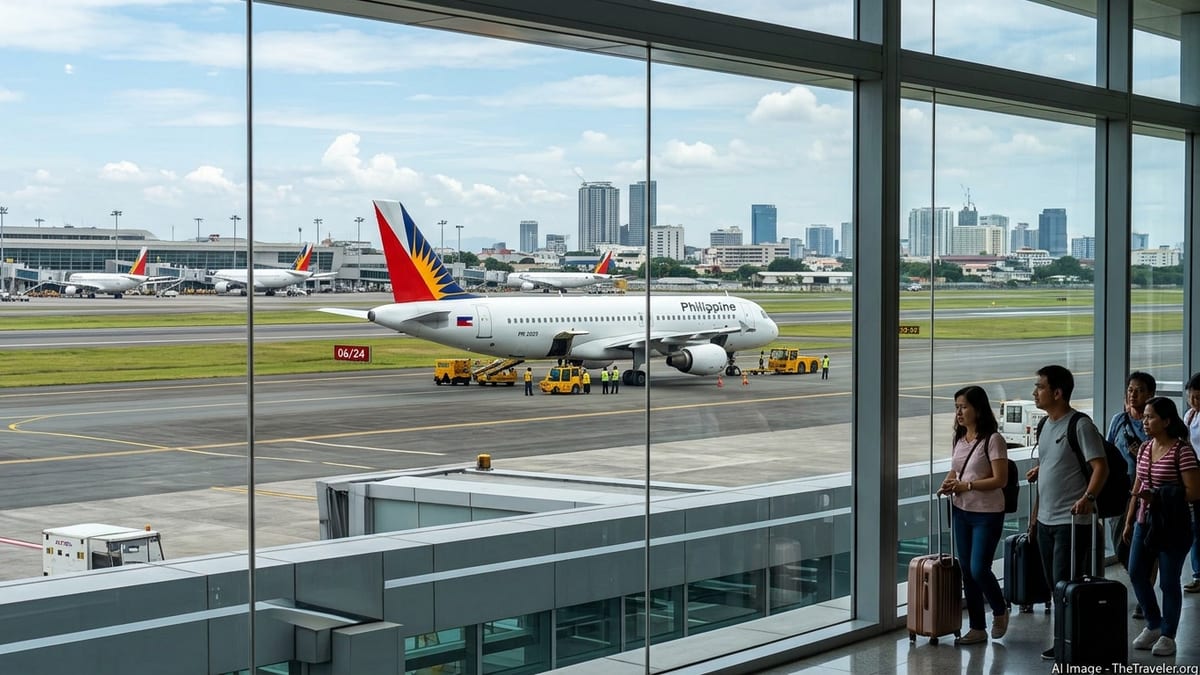
What happened to Philippine Airlines flight PR 2923 at NAIA
Philippine Airlines flight PR 2923, an Airbus A320 operating the regular Manila to Daraga service in Albay province, departed Ninoy Aquino International Airport (NAIA) on the morning of November 29 but did not complete its journey. According to the Civil Aviation Authority of the Philippines (CAAP) and statements from the airline, the crew reported a hydraulic system problem while en route and decided to return to Manila as a precaution instead of continuing to Bicol.
The aircraft landed back at NAIA at around 11:45 a.m. local time. CAAP and several local media outlets reported that the jet came to a stop on the main runway, designated 06/24, with burst main landing gear tires, leaving it disabled on the pavement. Because the aircraft could not immediately exit the runway under its own power, airport authorities suspended traffic on 06/24 while emergency and engineering teams secured the aircraft and began recovery preparations.
Philippine Airlines confirmed that all passengers and crew disembarked safely and that there were no injuries linked to the incident. In public statements, the carrier said it was coordinating with New NAIA Infrastructure Corp, the private operator of the Manila airport, along with relevant government agencies, to remove the disabled jet and restore normal operations. By midafternoon on November 29, CAAP advisories indicated that the main runway closure remained in effect while inspections of the surface and debris removal continued.
How the runway closure reshaped operations in Manila
NAIA normally relies heavily on runway 06/24 to handle a high proportion of its daily movements, especially larger international and widebody flights. With PR 2923 stopped on that runway, CAAP reported that traffic was consolidated on runway 13 wherever operationally possible. That shorter runway can accommodate certain types of narrowbody aircraft in suitable conditions but is more restrictive for long-haul or heavily loaded jets, which have stricter performance requirements and typically use the longer 06/24 strip.
As air traffic controllers reconfigured arrival and departure flows, the reduced runway capacity forced airlines to slow the pace of operations. Aircraft already inbound to Manila were initially placed in holding patterns while controllers assessed whether they could safely land on runway 13 or needed to divert. As the closure persisted, authorities prioritized flights that could operate within the available performance margins on the open runway, while others were routed to alternative airports.
CAAP confirmed that at least four Manila-bound services diverted to Clark International Airport in Pampanga during the middle of the day. These included Philippine Airlines flight 891 from Taipei operated by a Boeing 777-300ER, Cebu Pacific flight 5J 313 from Taipei using an Airbus A330-900, Philippine Airlines flight 659 from Dubai using an Airbus A330-300, and Philippine Airlines flight 1454 from General Santos aboard an Airbus A350-900. Other aircraft remained airborne in holding stacks around Manila until they either secured a landing slot on runway 13 or reached decision points where diversion became necessary.
Knock-on effects for Cebu and the wider domestic network
While the operational bottleneck was in Manila, the impact quickly spread throughout the country’s domestic network because many flights and aircraft are tightly interconnected. NAIA is the primary hub for Philippine Airlines and a crucial base for Cebu Pacific and Philippines AirAsia, meaning delays and diversions at Manila can leave aircraft and crews out of position for their next rotation to secondary cities such as Cebu.
By around 3 p.m. on November 29, advisories from Mactan-Cebu International Airport and airline status pages showed irregular operations on multiple routes tied to Manila. Arrivals into Cebu from the capital were running late or subject to rolling delays, while some departures from Cebu back to Manila were held at the gate waiting for incoming aircraft that had been delayed in or around NAIA. In a few cases, same-day flights were cancelled when required aircraft did not make it back into position in time to operate later legs.
Mactan-Cebu itself did not report any local technical issues on November 29. Publicly available notices pointed instead to routine infrastructure advisories unrelated to the NAIA incident, such as navigation aid and runway equipment status. The disruption for Cebu passengers stemmed almost entirely from reduced throughput and altered traffic patterns in Manila, which constrained capacity on the country’s busiest domestic trunk route between the two cities and affected connecting services onward to other islands.
Airlines serving Cebu, including Philippine Airlines, Cebu Pacific and Philippines AirAsia, used their digital channels throughout the afternoon to signal delays and advise customers to monitor flight status closely. As aircraft that had diverted to Clark or entered extended holds near Manila gradually repositioned, carriers adjusted their timetables and rotations for the remainder of the day. This meant that some Cebu-bound flights operated significantly behind schedule, while others were consolidated or, in the case of low-demand off-peak services, cancelled to free up capacity for busier peak departures.
How airports and airlines managed passenger disruption
The Mactan-Cebu International Airport Authority stated that airport facilities in Cebu were operating normally and that the primary issues for passengers related to schedule uncertainty on services that either originated in Manila or relied on aircraft coming from flights affected by the NAIA closure. Travelers were advised to arrive early, prepare for possible waiting times at check-in and boarding, and remain in close contact with their airlines for the most accurate, route-specific updates.
Philippine Airlines said it was working with both NAIA and other affected airports, including Clark and Cebu, to realign aircraft and crew resources as swiftly as possible. For passengers connecting through Manila to international destinations, the airline advised customers departing from Cebu and other domestic points to double-check departure times and onward connections, given the heightened risk of missed links when the hub’s main runway is not fully available. Where connections were no longer viable, passengers were directed to contact the airline to discuss rebooking and, where applicable, hotel or other re-accommodation options in line with ticket conditions and regulatory requirements.
Low-cost carriers also issued guidance to passengers, largely through mobile apps and social media feeds, which they emphasized as the fastest way to obtain real-time status information. These airlines typically encourage travelers to self-manage changes within apps or online portals where rebooking options are shown as they become available. Some carriers indicated that they would relax change fees or fare difference rules for affected passengers, although such waivers varied by airline, fare type and route and were generally published in individual advisory notices rather than in a single industry-wide policy.
On the ground at NAIA, passengers on diverted or delayed flights faced a range of potential outcomes depending on their itinerary and airline. Those whose flights were rerouted to Clark often needed onward surface transport to Manila or revised onward air connections. For Cebu-bound travelers whose flights were stuck in holding patterns or awaiting a landing slot in Manila before continuing, airlines weighed safety and crew duty-time limits when deciding whether to continue operations later in the day or cancel services once delays extended into the evening.
Why a single runway incident causes such widespread disruption
The November 29 closure took place at an airport that already runs close to its declared capacity for much of the day. NAIA’s configuration, with runway 06/24 handling a large share of heavier and longer-haul aircraft, leaves limited resilience if that strip becomes unavailable. When an aircraft is disabled on the main runway, safety regulations require that it remain closed until specialized recovery teams move the jet and engineers verify that the surface is safe, free of debris and structurally sound.
Previous incidents in the Philippines have shown how quickly such closures can ripple through the network. In 2018, a Xiamen Airlines aircraft that veered off a NAIA runway led to a prolonged shutdown and widespread cancellations, while in October 2022 a Korean Air Airbus A330 overran the runway at Mactan-Cebu International Airport, forcing that airport to suspend operations for several days until the jet was removed and repairs were completed. While the current PAL incident at NAIA is more limited in scale and, based on available information, involves no runway excursion, it underscores the same structural vulnerability in a system with few surplus slots and limited runway redundancy at its main hub.
The operational environment in late 2026 also includes seasonal factors. The busy year-end travel period and the approach of peak holiday demand mean that load factors on many domestic and international routes are already high. This leaves airlines with fewer spare seats on alternative flights when disruptions occur, reducing their ability to quickly re-accommodate affected travelers. In addition, aircraft utilization remains intense, particularly for narrowbody fleets used on Manila to Cebu and other trunk routes, which narrows the window to recover schedules once several rotations have been delayed.
For Cebu specifically, the events at NAIA highlight the continuing importance of Manila as a hub even as Mactan-Cebu has expanded its own facilities and international route network. Although Cebu has gained more direct overseas flights in recent years, a large proportion of international itineraries for travelers based in Central Visayas still pass through Manila, so constraints there can cascade into longer waits and rebookings for passengers starting or ending their journeys in Cebu.
What travelers should check next
As of late afternoon on Sunday, November 29, airport and airline statements had not yet provided a definitive public timeline for fully reopening NAIA’s runway 06/24. The duration of the closure depends on the condition of the disabled Airbus A320, the complexity of tire and hydraulic system issues, and the time required for surface inspections and any necessary cleaning or minor repairs once the jet is towed clear. Until those steps are completed and regulators are satisfied with the findings, NAIA will continue relying on the remaining runway capacity, which is insufficient to absorb the full day’s scheduled traffic without continuing delays, particularly for widebody aircraft.
Travelers scheduled to fly on November 29 on routes involving either Manila or Cebu should treat timetables as provisional until their airline confirms otherwise. Before setting out for the airport, passengers are advised to check their flight status directly through official channels such as airline websites, mobile applications, customer service hotlines or verified social media accounts. This is especially important for those holding tight same-day connections via Manila, including travelers originating in Cebu with onward long-haul flights to the Middle East, North America or Europe.
Some disruption is also likely to linger into the late evening of November 29 and potentially into November 30, even after runway 06/24 reopens. Aircraft that diverted to Clark will need to be repositioned to Manila, and crew duty-time limitations may prompt further last-minute schedule adjustments as airlines work through the backlog created during the closure. Passengers with early morning departures or arrivals on November 30 should therefore continue monitoring advisories from both NAIA and Mactan-Cebu, allow extra time at the airport in case of congestion at check-in and security, and be prepared for the possibility that gate assignments or departure times may change at short notice as operations normalize.