


Nairobi’s Jomo Kenyatta International Airport (JKIA) is the main gateway to Kenya and East Africa, and for many travelers it is also a connection point to domestic destinations like Mombasa, Diani, Kisumu, Eldoret or Malindi. Whether you are landing on a long-haul overnight flight or arriving from a regional hub, understanding how to connect from an international arrival to a domestic departure at JKIA can save you stress, time and sometimes money. This guide explains, step by step, how immigration, baggage reclaim, recheck and terminal changes work in practice today, with realistic examples and conservative timing advice.
Get the latest updates straight to your inbox!
How JKIA Is Laid Out: Terminals and Domestic Airlines
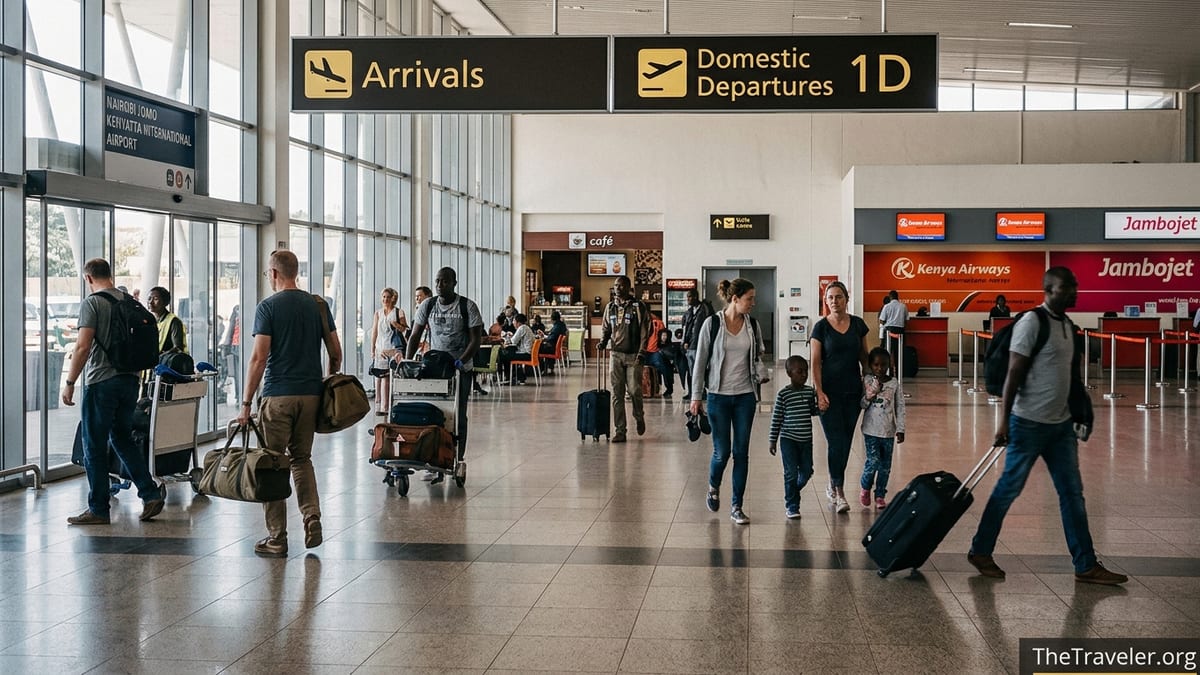
Jomo Kenyatta International Airport has two main terminal buildings: Terminal 1, which is a single connected complex with concourses 1A to 1E plus 1D, and a separate Terminal 2 in another building accessed by road. International flights mainly use concourses 1A, 1B, 1C and 1E, while domestic flights within Kenya usually operate from concourse 1D inside Terminal 1. This means that many international to domestic transfers happen within the same overall building, but not always within the same concourse.
Most scheduled domestic flights from JKIA currently depart from Terminal 1D. These include Kenya Airways and its low-cost subsidiary Jambojet, as well as other domestic carriers such as Fly540 and Skyward Express on many routes. Airport and airline websites list 1D as the standard domestic concourse for flights to places like Mombasa, Kisumu and Eldoret, although occasional operational changes do occur. In contrast, Terminal 2 is used more variably, often by some regional or low-cost operations and charter flights but has no airside walkway to Terminal 1, so any move between the two requires going landside and using the road outside the terminals.
For a typical visitor flying from Europe with Kenya Airways into Nairobi, arrival is often at concourse 1A or 1E, followed by a domestic Kenya Airways or Jambojet connection from 1D. A traveler arriving on a Gulf carrier or European airline may land at 1A, 1B or 1E and then walk to 1D for a domestic sector. Someone connecting from an African regional airline operating from Terminal 2 might need a short vehicle ride between Terminal 2 and Terminal 1 before checking in for a domestic flight in 1D. Knowing your arriving and departing concourses in advance helps you judge how far you will need to walk or whether you must plan for a landside terminal transfer.
Because terminal use can be adjusted for operational reasons, especially during busy periods or construction works, always check your terminal on your booking, boarding pass or the airport’s live departures screens on the day of travel. Airline apps for Kenya Airways and Jambojet also show the planned terminal and check-in area for each flight, which is particularly helpful if you are landing in the early hours and have to navigate with jet lag.
Immigration on Arrival: What to Expect When You Land
Almost every international to domestic connection at JKIA begins with immigration. Unless your inbound ticket is issued as a true airside transit connection and you never technically “enter” Kenya, you should expect to pass through passport control, collect your checked baggage and clear customs before heading to your domestic check-in. For many travelers this also means needing a Kenya electronic travel authorization or other permission in advance, since Kenya now generally uses an eTA system instead of visas on arrival for most visitors.
On arrival, passengers disembark into the international concourse and follow the standard “Arrivals” and “Immigration” signage. Queue times at JKIA vary with the time of day and the number of international flights landing together. In quieter mid-morning or mid-afternoon banks, many passengers report clearing immigration in around 20 to 40 minutes. During overnight arrival waves between roughly 04:30 and 07:30, or late evening peaks, queues can stretch to 45 minutes or longer. Electronic e-gates are available for some nationalities and residency categories, which can shorten the process, but you should not assume you will qualify.
A realistic example: if you land from London on a Kenya Airways widebody at 06:00, you may disembark by 06:20 and join immigration queues that could take 30 minutes or so to clear, putting you into baggage reclaim around 06:50. A traveler arriving from Dubai on a late-evening flight around 22:30 might find shorter lines if they land in a quieter wave, or much longer ones if several regional flights arrive together. Because staffing and passenger volumes change day by day, build in a generous buffer and do not assume that a previous smooth experience at JKIA will always repeat.
Passengers on separate tickets should also factor in unexpected delays at passport control. If you have paid for a domestic ticket separately on Jambojet, Fly540 or another carrier and miss the check-in cut-off because immigration queues were long, they are not obliged to rebook you free of charge. Giving yourself an extra hour on paper can save you the cost of buying a last-minute walk-up fare to Mombasa or Kisumu if something slows down at passport control.
Baggage Reclaim, Customs and Domestic Recheck
After immigration you enter the baggage reclaim hall, which is shared for most international arrivals. Screens show which carousel corresponds to each arriving flight. In typical conditions, bags for a widebody international arrival start appearing on the belt about 15 to 30 minutes after the first passengers reach the reclaim area. In busy periods, or when there are ground handling delays, waits can be longer. It is not uncommon for travelers landing in the early morning bank to collect checked luggage 45 minutes or more after landing.
How your baggage is handled for the onward domestic sector depends almost entirely on whether your flights are on a single ticket or separate tickets. On a single through-ticket with Kenya Airways, for example Amsterdam to Nairobi to Mombasa bought in one booking, your bags are usually tagged through from your origin to your final destination. In that case you still collect them at JKIA only if the airline or local regulations require it. Many Kenya Airways passengers report that on purely domestic connections following an international arrival on one ticket, bags are indeed tagged to the final city, but practices can change by route or booking, so it is essential to check the tag at your origin check-in counter to confirm it lists the domestic airport code like MBA for Mombasa or KIS for Kisumu.
On separate tickets, your bags will not be transferred automatically. Consider a traveler flying from Paris to Nairobi on Air France, then separately on Jambojet from Nairobi to Diani. At Charles de Gaulle, the Air France agent will normally tag the checked baggage only to NBO. On arrival in Nairobi the passenger must pass immigration, collect the bag from the carousel, clear customs through the green or red channel, exit into the public arrivals area and then walk to the domestic departures zone at Terminal 1D to check the bag in again for the Jambojet flight. This self-transfer process at JKIA is straightforward but can be time consuming, and the domestic airline’s baggage allowance may be lower than the long-haul carrier, leading to possible excess baggage fees based on local Kenyan shilling rates at the 1D ticket desk.
Customs at JKIA for arriving travelers connecting domestically is usually a formality, but you must still walk through the declared or non-declared channels with your belongings. Random inspections do occur. If you are carrying expensive camera equipment for a safari, it is wise to have purchase receipts or documentation easily available. Once clear of customs you enter the public arrivals area outside Terminal 1E or another concourse exit, where you will find currency exchange booths, ATMs, mobile SIM vendors and official taxi desks. From here your domestic recheck process starts, either by walking within Terminal 1 to concourse 1D or by transferring by road to Terminal 2 if your domestic airline operates there.
Moving Between International Arrivals, Terminal 1D and Terminal 2
For most international to domestic connections at JKIA involving Kenya Airways or Jambojet, movement is entirely within Terminal 1. If you arrive at concourse 1A or 1E and are heading to a domestic departure from 1D, follow the overhead signs for “Domestic departures 1D” after you exit customs into the public area. The walk from the international arrivals exit in 1E to the 1D check-in counters is typically around 5 to 10 minutes at normal walking speed, along a straightforward corridor with shops, small cafés and airline offices. You do not need any transport or shuttle for this movement; it is an indoor walk within the same overall building.
Terminal 2 is physically separate. If you arrive into Terminal 2 on a regional or low-cost carrier and have a domestic departure from Terminal 1D, you must first exit into the public area of Terminal 2, then use the road outside to travel to Terminal 1. This can be by airport taxi, ride-hailing service like Uber or Bolt, or an airport shuttle if one is operating. The drive between the two terminals is short in distance, often 5 to 10 minutes without traffic, but at busy times, especially during shift changes or early evening rush hours on the road network around the airport, it can take longer. You must also allow time to pass the security checkpoint at the entrance to Terminal 1, where vehicles queue and passengers go through a baggage screening and access control before even reaching the check-in hall.
A concrete example illustrates how timing can play out. Imagine you land from Entebbe into Terminal 2 on a regional airline at 11:00 and have a separately ticketed domestic departure on Fly540 from Terminal 1D at 13:30. After disembarking, immigration and baggage reclaim at Terminal 2 might take you to 12:00. Clearing customs and walking out to the curb could put you at 12:10. If you immediately hire an airport taxi and the short drive plus security at Terminal 1 entrance takes 20 to 25 minutes, you might enter the Terminal 1 check-in hall around 12:35. With domestic check-in for many airlines closing around 45 to 60 minutes before departure, this would leave a narrow but workable margin, provided nothing runs late. Any delay on the inbound flight, baggage delivery or at the entrance security could make such a plan risky, which is why many travelers prefer three or more hours when changing between Terminal 2 and 1D on separate tickets.
When connections are on a through-ticket and both flights are handled by Kenya Airways or its partners, airside transfer buses or controlled walkways may be used for certain patterns of movement, but procedures can vary seasonally and by airline agreement. If your boarding passes show both segments and your baggage tag lists the final domestic destination, follow the “Transit / Connections” signage after landing. Airline or airport staff will direct you, and in some cases you may not fully exit to landside between international and domestic sectors. Even in this smoother scenario, you should still allow enough time because security screening, gate changes and occasional bus transfers across the apron can add minutes to the journey.
Kenya Airways and Jambojet: How Through-Connections Work
Kenya Airways is JKIA’s main hub carrier and operates many domestic routes, some directly and some via its low-cost subsidiary Jambojet. When all segments are sold on a single Kenya Airways ticket, international to domestic connections are generally treated as protected transfers. This means that if your inbound Kenya Airways flight is late and you miss the onward domestic leg, the airline is usually responsible for rebooking you on the next available service without extra fare, subject to their conditions of carriage. Checked baggage should be tagged through to your final city so that you do not need to collect and recheck it in Nairobi, although there are exceptions where regulations or systems require re-clearance at JKIA.
Consider a traveler flying from New York to Nairobi to Mombasa on one Kenya Airways ticket. In New York the agent issues both boarding passes and prints a baggage tag that reads from JFK to MBA. On landing in Nairobi, the passenger follows the dedicated connections or transit signage instead of going directly to the general immigration hall. Airport staff check boarding passes, direct them through a transfer security checkpoint and guide them to the domestic departures concourse 1D. If the inbound flight was slightly late and they have only 75 minutes before the Mombasa departure, the protected nature of the connection and airside transfer procedures typically make that feasible in normal conditions, especially outside peak waves.
Jambojet also sells many itineraries that connect with international flights, either via interline arrangements or separate bookings. If you book Jambojet separately, for instance as a low-cost ticket from Nairobi to Ukunda or Eldoret to add onto a long-haul ticket that ends in Nairobi, then your connection is not protected. In that case you must clear immigration, collect baggage, pass customs and then present yourself at the Jambojet check-in counters in Terminal 1D as a regular departing passenger. If your long-haul flight on another carrier is delayed, Jambojet may allow same-day changes subject to space and a fee, but this is discretionary and not guaranteed. Here a cushion of at least three hours and ideally four between scheduled arrival and domestic departure is prudent, especially in high season when Mombasa and Diani flights run full.
Kenya Airways domestic check-in times can change, but as a rule of thumb the airline and the airport advise passengers to be at the airport roughly two hours before domestic departure and three hours before international flights. Jambojet and other domestic carriers commonly close check-in around 45 to 60 minutes before departure. As a practical test, if your international flight is scheduled to land at 14:00 and your separate Jambojet ticket to Kisumu departs at 16:00, that leaves two hours on paper. Any 30-minute delay on the inbound flight, plus 40 minutes through immigration and baggage reclaim, would put you dangerously close to the check-in cut-off. For peace of mind, many experienced travelers avoid these tight self-made connections.
Realistic Minimum Connection Times and Worked Examples
Airlines and timetable compilers publish minimum connection times for JKIA, which for protected international to domestic connections within the same terminal are often set around 60 to 90 minutes. These are the theoretical minimums under normal staffing and punctual operations, assuming you are ticketed on one booking and your baggage is through-checked. In practice, travelers should use more conservative personal minimums, particularly for separate tickets or when a terminal change is involved.
A comfortable worked example for a same-terminal self-transfer: imagine you land from Doha at 08:00 at concourse 1E, with a separate Jambojet ticket to Mombasa at 12:00 from 1D. If the inbound flight is on time, you might be off the aircraft by 08:20, clear immigration by 08:50, collect bags around 09:15 and exit customs around 09:25. The indoor walk to 1D check-in could see you there by 09:35. Even if domestic check-in closes at 11:15 for the 12:00 flight, you would have a healthy buffer of more than 90 minutes for unexpected delays or a coffee. This layout shows why a four-hour gap in the same terminal is generally comfortable even on separate tickets.
A more marginal example highlights the risks: a traveler books a low-cost Jambojet ticket from Nairobi to Kisumu departing at 11:00, pairing it with an overnight European arrival scheduled into JKIA at 08:00. On paper the three-hour window seems fine. But if the European flight is delayed by 45 minutes, and immigration plus baggage reclaim takes another 60 minutes in a busy early morning bank, the traveler may not reach the 1D check-in desks until around 10:45. With many domestic check-ins closing 45 to 60 minutes before departure, they could be refused and forced to buy a same-day one-way ticket at the counter, often significantly more expensive than their original fare.
When a change between Terminal 2 and Terminal 1D is involved, prudent travelers treat it as a half-day exercise rather than a tight connection. Allow an absolute minimum of three hours from scheduled arrival to domestic departure, and four or more if your inbound flight is prone to delays, arrives during Nairobi road rush hours or if you are traveling with children or heavy luggage. If you cannot find flight times that give you that kind of margin, consider overnighting at an airport hotel near JKIA or using a domestic departure from Nairobi the following morning, which also helps if your final destination has limited evening flights.
For fully protected connections sold by Kenya Airways or partner airlines, following the airline’s minimum connection times is reasonable, but it is still unwise to accept the tightest possible option if you have a choice. If a booking engine offers you a 65-minute international to domestic connection in Nairobi or a 2-hour 30-minute alternative, the longer connection provides a buffer against routine issues like a slow disembarkation, a congested security queue at the domestic concourse or a last-minute gate change requiring a bus ride across the apron.
Practical Tips: Money, SIMs, Food and Lounges in Transit
Because international to domestic connections at JKIA usually involve entering Kenya, many travelers use the gap between flights to sort out practicalities. After customs in Terminal 1 you enter a public arrivals area with bank counters, exchange booths and ATMs. While airport exchange rates can be less favorable than in town, withdrawing a modest amount of Kenyan shillings from an ATM often gives a better rate than cash exchange, assuming your bank fees are reasonable. For example, a traveler might withdraw the equivalent of 10,000 to 15,000 shillings to cover taxis, meals and tips for the first couple of days, then get a larger sum later in Nairobi city if needed. Card acceptance within the airport’s cafés and shops is generally good, but small domestic airports and roadside stops still rely heavily on cash.
Local mobile operators like Safaricom, Airtel and Telkom Kenya usually maintain kiosks near the arrivals exits where you can purchase a SIM card or eSIM activation and data package. Buying a local SIM during your connection can make the onward journey smoother, especially if you plan to use ride-hailing apps from your final domestic airport or need data in remote safari areas. A typical traveler might pick up a 10–20 GB data bundle valid for a month at a cost that is usually modest by international standards, then activate mobile money services like M-Pesa if they plan to use them widely in Kenya.
Food options within Terminal 1 include small cafés, coffee bars and fast-food outlets both landside and airside. During a long layover before a domestic flight, passengers often grab a coffee and snack in the public hall before going through domestic security, then perhaps a more substantial meal in the 1D departures area. Prices are higher than in central Nairobi but reasonable by international airport standards, with a typical coffee costing the equivalent of a few US dollars and simple hot meals a little more. Domestic lounges in Terminal 1D exist, some affiliated with Kenya Airways and others accessible via certain bank cards or paid entries, although offerings change and refurbishment works occur periodically, so check current access rules with your airline or card provider ahead of time.
Passengers with very long gaps, such as eight hours or more between an early-morning international arrival and an evening domestic departure, sometimes consider leaving the airport entirely for a nearby hotel room or a short excursion. While Nairobi National Park lies relatively close to JKIA and operators advertise quick game drives, most seasoned travelers suggest that if your total time between flights is under about six to seven hours, you are better off staying within the airport system. Immigration queues, baggage handling, city traffic and the need to return two hours before your domestic flight can consume more time than expected, and the risk of missing a connection is not worth a rushed side trip.
The Takeaway
Transferring from an international arrival to a domestic departure at Nairobi’s Jomo Kenyatta International Airport is entirely manageable when you understand how the terminals fit together and how your ticketing affects baggage and protection. Most domestic flights use Terminal 1D inside the main Terminal 1 complex, and many international flights arrive into nearby concourses, which keeps walking distances modest. Terminal 2, however, sits in a separate building, and any connection between it and Terminal 1D involves a short but non-trivial landside road transfer and a repeat of entrance security.
The two key questions that shape your experience are whether your flights are on a single protected ticket and whether your baggage is tagged through to your final domestic destination. On a Kenya Airways through-ticket to places like Mombasa or Kisumu, international to domestic transfers can be as smooth as any connecting hub in the region, with typical airside minimums around 60 to 90 minutes. On separate tickets, plan conservatively: three hours is a sensible floor for same-terminal self-transfers and four or more for movements between Terminal 2 and 1D.
By building in margin for immigration queues, baggage delays and entrance security, and by using your layover to handle cash, SIM cards and a quick meal rather than worrying over the clock, you can turn a Nairobi connection into the start of your Kenyan journey instead of a source of anxiety. The airport is busy, evolving and at times imperfect, but with realistic expectations and a clear mental map of the process, an international to domestic connection at JKIA can be a straightforward step on the way to Kenya’s beaches, lakes and savannahs.
FAQ
Q1. Do I have to clear immigration at JKIA before catching a domestic flight?
In almost all cases yes. Unless you are on a rare true airside transit arrangement where you never technically enter Kenya, you will pass through passport control, collect your bags, clear customs and then check in again for your domestic sector.
Q2. Will my bags be checked through to my final domestic destination?
If you are on a single through-ticket, such as Kenya Airways from Europe to Nairobi and onward to Mombasa, bags are often tagged through, but you must confirm at your origin check-in that the baggage tag shows the final airport code. On separate tickets you should assume you must collect and recheck your bags in Nairobi.
Q3. How long do I need to connect from international to domestic at JKIA on one ticket?
For protected connections sold on a single ticket, many itineraries are built around minimums of roughly 60 to 90 minutes for international to domestic. These work when everything runs smoothly, but if you have a choice, selecting a connection of 2 hours or more provides a safer buffer.
Q4. How much time should I allow for a self-transfer on separate tickets?
For separate bookings where you must clear immigration, collect bags and recheck, a conservative minimum is about 3 hours when both flights use Terminal 1. If any part of your journey involves Terminal 2 or a road transfer between terminals, aim for at least 4 hours to absorb delays.
Q5. How do I get from Terminal 2 to Terminal 1D for a domestic flight?
After arriving and clearing immigration and customs in Terminal 2, exit to the public area and take an airport taxi, ride-hail or shuttle to Terminal 1. The drive is short but you must also pass security at the Terminal 1 entrance, so budget 20 to 30 minutes for the transfer in normal traffic, more at peak times.
Q6. Do Kenya Airways and Jambojet protect my connection if I book everything together?
When international and domestic segments are sold on a single Kenya Airways ticket, the connection is usually protected, meaning the airline is responsible for rebooking you in case of a missed connection. If you buy a separate Jambojet ticket to add onto an unrelated long-haul booking, that onward leg is not protected.
Q7. What are the check-in cut-off times for domestic flights at JKIA?
Times vary by airline, but many domestic carriers at JKIA stop accepting checked baggage around 45 to 60 minutes before departure. The airport and major airlines generally recommend arriving about 2 hours before a domestic flight to allow for entrance security, check-in and security screening.
Q8. Can I buy a local SIM card or change money during my connection?
Yes. After customs you enter a public arrivals area with bank counters, exchange booths, ATMs and mobile network kiosks. Many travelers use this time to withdraw a modest amount of Kenyan shillings and buy a Safaricom or Airtel SIM before heading to Terminal 1D.
Q9. Is it realistic to leave JKIA for a quick safari or city visit on a layover?
With a layover of less than about 6 to 7 hours between flights, leaving the airport is usually not worth the risk once you factor in immigration, baggage, traffic and the need to be back 2 hours before your domestic departure. For short connections, it is safer to stay within the airport system.
Q10. What happens if I miss my domestic flight because my international flight was late?
If both flights are on one protected ticket, contact the airline transfer desk or check-in staff as soon as you land; they will normally rebook you on the next available flight according to their rules. On separate tickets, you are treated as a no-show and may need to buy a new domestic ticket, so wider time buffers are essential.